珀莱雅

Search documents
珀莱雅化妆品股份有限公司关于“珀莱转债”2025年付息公告
Shang Hai Zheng Quan Bao· 2025-12-01 19:58
Core Points - The company will begin paying interest on its convertible bonds, "Pola Convertible Bonds," starting December 8, 2025, for the period from December 8, 2024, to December 7, 2025 [2][14] - The bond has a total issuance amount of RMB 751.713 million, with a maturity period of six years from December 8, 2021, to December 7, 2027 [4][12] Summary by Sections Bond Issuance Overview - The bond was issued on December 8, 2021, with a total issuance amount of RMB 751.713 million and a face value of RMB 100 per bond [4][12] - The bond has a fixed interest rate that increases over the years, starting from 0.30% in the first year to 2.00% in the sixth year [2][4] Interest Payment Details - The interest payment date is set for December 8, 2025, with a record date of December 5, 2025 [3][20] - The interest for the fourth year will be 1.50% (RMB 1.50 per bond) before tax, resulting in a net payment of RMB 1.20 after tax for individual investors [14][18] Conversion Terms - The conversion period for the bonds is from June 14, 2022, to December 7, 2027, with an initial conversion price of RMB 195.98 per share, adjusted to RMB 95.46 as of the latest update [6][12] - The conversion price has been adjusted multiple times due to various corporate actions, including equity distributions and stock incentive plans [6][7][10] Credit Rating - The company and the convertible bonds have been rated "AA" with a stable outlook by a credit rating agency [12][13] Tax Implications - Individual investors are subject to a 20% tax on interest income, while foreign institutional investors are exempt from corporate income tax on bond interest until December 31, 2025 [18][19]

青眼情报:2025东方美谷中国化妆品行业趋势洞察蓝皮书
Sou Hu Cai Jing· 2025-12-01 10:36
Group 1 - The global beauty market is expected to exceed $600 billion by 2025, driven by emerging markets, middle-class expansion, and digital e-commerce [1][12][14] - China's cosmetics market shows a moderate recovery, with retail sales reaching 328.82 billion yuan in the first three quarters of 2025, a year-on-year increase of 3.9%, and is projected to surpass 450 billion yuan for the year [1][20][21] - The market structure is shifting from a unipolar to a multipolar competition, with the Asia-Pacific region becoming a core growth area and Latin America leading global growth [1][17][18] Group 2 - Consumer demand is evolving, with a significant increase in male consumers (over 20% year-on-year) and a rise in the elderly demographic (84% increase) [2][9] - The trend towards rational consumption is emerging, with nearly 80% of consumers focusing on product ingredients, and personalized skincare needs are becoming more prominent [2][37] - Domestic brands are gaining market share, with local brands' sales increasing by 8.33% year-on-year, significantly outpacing foreign brands [2][35][36] Group 3 - The cosmetics industry is transitioning from scale expansion to quality enhancement, with a focus on efficacy, scene segmentation, and cultural empowerment [3][20] - The integration of biotechnology, digital technology, and material science is expected to reshape the industry landscape [3][17] - Regulatory frameworks are becoming more refined, with a comprehensive approach to innovation and safety in cosmetics [42][43][44]


珀莱雅(603605) - 珀莱雅化妆品股份有限公司关于“珀莱转债”2025年付息公告
2025-12-01 09:46
| | | 珀莱雅化妆品股份有限公司 关于"珀莱转债"2025 年付息公告 本公司董事会及全体董事保证本公告内容不存在任何虚假记载、误导性陈述 或者重大遗漏,并对其内容的真实性、准确性和完整性承担法律责任。 重要内容提示: 珀莱雅化妆品股份有限公司(以下简称"公司")于 2021 年 12 月 8 日发行的 可转换公司债券(以下简称"珀莱转债")将于 2025 年 12 月 8 日开始支付自 2024 年 12 月 8 日至 2025 年 12 月 7 日期间的利息。根据《珀莱雅化妆品股份有限公 司公开发行 A 股可转换公司债券募集说明书》(以下简称"《募集说明书》")有关 条款的规定,现将有关事项公告如下: 一、可转债发行上市概况 可转债付息债权登记日:2025 年 12 月 5 日 可转债除息日:2025 年 12 月 8 日 可转债兑息日:2025 年 12 月 8 日 1、债券名称:珀莱雅化妆品股份有限公司公开发行 A 股可转换公司债券 2、债券简称:珀莱转债 3、债券代码:113634 4、发行日期:2021 年 12 月 8 日 5、上市日期:2022 年 1 月 4 日 6、证券类型:可转换为公 ...
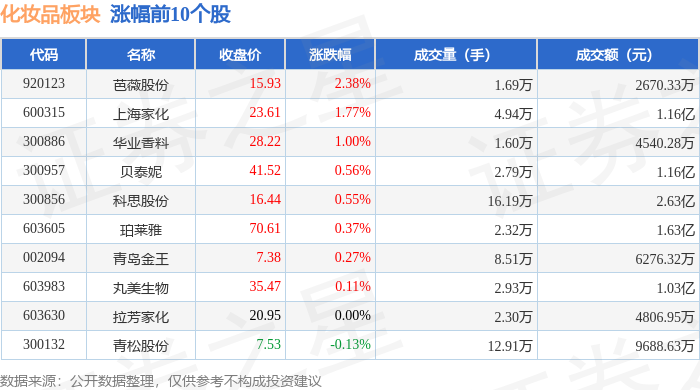
化妆品板块12月1日涨0.26%,芭薇股份领涨,主力资金净流出4951.61万元
Zheng Xing Xing Ye Ri Bao· 2025-12-01 09:16
Market Overview - On December 1, the cosmetics sector rose by 0.26% compared to the previous trading day, with BAWI leading the gains [1] - The Shanghai Composite Index closed at 3914.01, up 0.65%, while the Shenzhen Component Index closed at 13146.72, up 1.25% [1] Individual Stock Performance - BAWI shares closed at 15.93, up 2.38% with a trading volume of 16,900 lots and a transaction value of 26.70 million yuan [1] - Shanghai Jahwa closed at 23.61, up 1.77% with a trading volume of 49,400 lots and a transaction value of 116 million yuan [1] - Huachun Color closed at 28.22, up 1.00% with a trading volume of 16,000 lots and a transaction value of 45.40 million yuan [1] - Betaini closed at 41.52, up 0.56% with a trading volume of 27,900 lots and a transaction value of 116 million yuan [1] - Kohn shares closed at 16.44, up 0.55% with a trading volume of 161,900 lots and a transaction value of 263 million yuan [1] - Proya closed at 70.61, up 0.37% with a trading volume of 23,200 lots and a transaction value of 163 million yuan [1] - Qingdao King closed at 7.38, up 0.27% with a trading volume of 85,100 lots and a transaction value of 6.28 million yuan [1] - Marubi closed at 35.47, up 0.11% with a trading volume of 29,300 lots and a transaction value of 103 million yuan [1] - Lafang closed at 20.95, unchanged with a trading volume of 23,000 lots and a transaction value of 4.81 million yuan [1] - Qingsong shares closed at 7.53, down 0.13% with a trading volume of 129,100 lots and a transaction value of 96.89 million yuan [1] Fund Flow Analysis - The cosmetics sector experienced a net outflow of 49.52 million yuan from institutional funds, while retail investors saw a net inflow of 51.08 million yuan [2] - The overall fund flow indicates a mixed sentiment, with institutional investors pulling back while retail investors are increasing their positions [2] Detailed Fund Flow by Stock - Jiahen Home's main funds saw a net inflow of 7.25 million yuan, while retail funds had a net outflow of 19.70 million yuan [3] - Shanghai Jahwa experienced a net inflow of 3.64 million yuan from main funds, with retail investors contributing a net inflow of 348.90 million yuan [3] - Kohn shares had a net inflow of 3.35 million yuan from main funds, but retail investors saw a net outflow [3] - BAWI experienced a net outflow of 0.50 million yuan from main funds, while retail investors had a net inflow of 164.42 million yuan [3] - Qingdao King saw a net outflow of 0.83 million yuan from main funds, but retail investors contributed a net inflow of 238.25 million yuan [3]


舆情监测与新媒体营销如何重塑美妆快消行业
Sou Hu Cai Jing· 2025-12-01 05:31
Core Insights - The success of beauty brands increasingly relies on effective public opinion monitoring and new media marketing in the digital age [1] - The cosmetics industry in China is experiencing significant growth, with retail sales projected to rise from 251.4 billion yuan in 2017 to 435.7 billion yuan in 2024, reflecting a compound annual growth rate of 8.17% [1] Industry Transformation: New Ecosystem in Beauty Marketing - By 2025, the beauty and personal care industry is undergoing a dual wave of channel transformation and consumer upgrading, characterized by "omni-channel resonance, refined demand, and technology-driven innovation" [3] Trends in Consumer Preferences - Trends such as health, personalization, and sustainability are gaining traction, with consumers seeking more than just functional products [4] - Sales of hand creams with soothing scents have increased by nearly 40%, while searches for fatigue-relief shower gels surged by 200% [4] Risks: Public Opinion Crisis - The cosmetics industry faces escalating public opinion risks, with the China Consumers Association reporting a total of 1.7619 million complaints in 2024, a year-on-year increase of 32.62% [5] - Complaints related to cosmetics reached 251,800, with 97,600 concerning product quality and 22,300 related to advertising [5] - Negative information can rapidly escalate online, with brand crises typically unfolding within 48 hours if not managed effectively [5] Crisis Management: Golden Rules of Public Opinion Monitoring - Advanced public opinion monitoring systems are essential for beauty companies to act as a "firewall" against potential crises [7] - Successful crisis management follows the "48-hour golden rule," which includes crisis detection and assessment within the first 6 hours, team formation within 6-12 hours, official response within 12-24 hours, and ongoing monitoring within 24-48 hours [8] Marketing Innovation: Rise of New Media Channels - The online cosmetics market in China is projected to reach 405.527 billion yuan in 2024, with Tmall holding a market share of 41.1% and Douyin at 37.8% [8] - Live commerce has surpassed 5 trillion yuan in transaction volume, creating a vast commercial ecosystem and reshaping the business model of the cosmetics industry [8] Future Trends: Technology-Driven and Channel Integration - AI technology is expected to further transform marketing strategies in the beauty industry, with systems like VOC+ providing structured reputation monitoring and market insights [9] - Beauty brands should leverage centralized media advantages to build brand consensus and enhance brand momentum [10] - Continuous exploration in technology application and strategic innovation is crucial for the beauty industry to effectively manage crises and maintain consumer trust [10]
化妆品医美行业周报:多品牌全球化+AI赋能,化妆品年会指明未来发展-20251130
Shenwan Hongyuan Securities· 2025-11-30 13:43
Investment Rating - The report gives a "Buy" rating for the cosmetics and medical beauty industry, highlighting potential growth opportunities in the sector [4][13]. Core Insights - The cosmetics and medical beauty sector is currently underperforming compared to the market, with the Shenwan Beauty Care Index rising by only 0.5% from November 21 to November 28, 2025, which is lower than the overall market performance [5][4]. - The sixth China Cosmetics Annual Conference emphasized the importance of multi-brand globalization and AI empowerment for future development, with industry leaders discussing strategies for growth and market adaptation [10][4]. - The report anticipates that domestic brands will thrive during the industry's consolidation phase, leveraging innovation and consumer demand to drive growth [11][4]. Summary by Sections Industry Performance - The cosmetics and medical beauty sector has shown weak performance, with the Shenwan Cosmetics Index increasing by 1.4%, which is 1.6 percentage points lower than the Shenwan A Index [5][4]. - Key stocks in the sector include Yanjiang Co. (+22.0%), Mingchen Health (+17.9%), and Lihe Technology (+9.9%) [6][4]. Market Trends - The report identifies trends such as the need for brands to localize when expanding internationally, the role of AI in upgrading the industry, and the focus on men's skincare and body care segments [10][4]. - The medical beauty market is expected to see growth driven by new products and consumer demand, despite some economic pressures [12][4]. Company Analysis - Qingmu Technology is highlighted as a leading player in the full-service e-commerce operation sector, with a strong focus on data and technology to drive growth [16][4]. - The report notes that the company has shown significant revenue growth, with projected revenues of 15.1 billion, 19.0 billion, and 23.4 billion yuan for 2025-2027, respectively [19][4]. Investment Recommendations - Recommended stocks include brands with strong channel and brand matrices such as Maogeping, Shuangmei, and Proya, as well as companies in the medical beauty sector like Aimeike [13][4]. - The report suggests focusing on companies with strong R&D capabilities and a broad product pipeline, particularly in the medical beauty segment [13][4].
耐用消费产业行业研究:消费品供需适配性方案提供消费板块切换与成长方向
SINOLINK SECURITIES· 2025-11-30 11:32
Consumer Macro Strategy - The overall performance of the discretionary consumption sector is flat as the year-end approaches, but high-end consumption, including duty-free shopping in islands, is expected to gradually stabilize overall consumption [2][10] - The implementation plan released on November 26 aims to enhance the adaptability of supply and demand for consumer goods, with a goal to optimize the supply structure by 2027, creating three trillion-yuan consumption fields and ten hundred-billion-yuan consumption hotspots [2][10] - By 2030, a high-quality development pattern of mutual promotion between supply and consumption is expected to be established, with consumption steadily contributing to economic growth [2][10] New Consumption Manufacturing - The pet economy continues to thrive, with companies like Guobao Pet investing in high-end pet food factories in New Zealand, enhancing competitiveness in international markets [23][24] - The AI and 3D printing sector is rapidly evolving, with significant advancements expected in consumer-grade 3D printing by 2026, driven by companies like Huina Technology and Snapmaker [25][26] - The integration of AI with 3D printing is being promoted in educational settings, expanding the supply space for the industry [25] Light Industry Manufacturing - The home appliance sector is facing weak domestic demand, but there are opportunities for companies with overseas production capabilities and brand advantages as demand recovers [26][27] - The new tobacco sector is experiencing growth, particularly in e-cigarette exports to the U.S., which saw a significant increase in October [27][28] - The packaging industry is showing signs of profitability improvement despite a slight decline in revenue, driven by leading companies capturing market share from smaller firms [28] Textile and Apparel - The apparel sector is experiencing fluctuations in consumer demand, with a focus on companies that can demonstrate unique advantages in the market [30][31] - The export market remains under pressure due to trade tensions, but leading textile manufacturers are expected to present investment opportunities as they maintain strong positions in the industry [31] Beauty and Personal Care - The beauty sector shows positive fundamentals, with a 9.6% year-on-year increase in retail sales for cosmetics in October, although valuations have been affected by the new consumption sector [32][33] - The medical beauty segment is expanding, with new products gaining regulatory approval, indicating growth potential in the market [33] Home Appliances - Focus on two directions: resilient white goods leaders with strong cash flow and black goods leaders benefiting from optimized domestic sales and stable costs [34][35] - The white goods sector is facing pressure in domestic sales, while black goods are seeing improvements in average prices and export recovery [36][37]
商贸零售行业周报:品牌建设+科技美学,谱写国货美妆增长答案-20251130
KAIYUAN SECURITIES· 2025-11-30 07:11
Investment Rating - The investment rating for the retail industry is "Positive" (maintained) [1] Core Views - The retail industry is experiencing a shift towards quality growth and long-term strategies, moving away from reliance on traffic bonuses [25][26] - The industry is focusing on emotional consumption themes, with high-quality companies in sectors like gold jewelry, offline retail, cosmetics, and medical aesthetics being highlighted as investment opportunities [5][29][30] Summary by Sections Retail Market Review - The retail industry index rose by 3.45% during the week of November 24-28, 2025, outperforming the Shanghai Composite Index by 2.05 percentage points [4][13] - The multi-format retail sector showed the highest growth this week, with a 6.18% increase, while the jewelry sector led the year-to-date performance with a 22.11% increase [18][19] Retail Insights: Brand Building and Technological Aesthetics - The 2025 Cosmetics Annual Conference highlighted the importance of brand building and technological aesthetics for domestic beauty brands to achieve growth [25][26] - Companies like Shiseido and Shanghai Jahwa are focusing on quality and profitability, while Elysian Group is transitioning from operational to technological drivers [26][27] Investment Recommendations - **Gold Jewelry**: Focus on brands with differentiated product offerings and consumer insights, recommending companies like Chow Tai Fook and Lao Pu Gold [5][29] - **Offline Retail**: Highlighting companies adapting to trends and exploring AI-enabled cross-border e-commerce, with recommendations for Yonghui Supermarket and Aiyingshi [5][30] - **Cosmetics**: Emphasizing brands that meet emotional value and safety innovation, recommending companies like Maogeping and Proya [5][30] - **Medical Aesthetics**: Targeting differentiated product manufacturers and expanding medical chains, recommending companies like Aimeike and Kedi-B [5][30] Company-Specific Insights - **Chow Tai Fook**: Achieved revenue of HKD 38.986 billion in FY2026H1, with a slight decline in revenue but a stable profit margin [36][37] - **潮宏基 (Chao Hong Ji)**: Reported a revenue increase of 28.4% in Q1-Q3 2025, with a strong performance in Q3 [39][40] - **永辉超市 (Yonghui Supermarket)**: Experienced a revenue decline of 22.2% in Q1-Q3 2025, but is undergoing a transformation towards quality retail [43][44]



2025生成式营销产业研究报告:从营销供给到营销决策(从AIGC到AIGD)
Sou Hu Cai Jing· 2025-11-29 18:51
Core Insights - The report titled "2025 Generative Marketing Industry Research: From AIGC to AIGD" highlights the evolution of generative AI in marketing, transitioning from AIGC (AI-Generated Content) focused on content creation to AIGD (AI-Generated Decision) centered on decision support, indicating a shift from AI as an "efficiency tool" to a "strategic partner" in marketing [2][4]. AIGC: Marketing Supply Explosion - By 2025, generative AI has matured in creating marketing content, including copy, images, videos, and digital personas, significantly enhancing content supply [3]. - The emergence of new models and products like DeepSeek and Manus has lowered technical barriers, evolving AI from a "creative assistant" to an "execution agent" [3]. - However, the explosion of content supply raises challenges for businesses in selecting optimal solutions and ensuring the authenticity and reliability of AI-generated content, as AIGC addresses production issues but not effectiveness [3]. AIGD: Systematic Upgrade in Marketing Decisions - AIGD aims to resolve decision-making challenges from the AIGC era by integrating classic marketing theories with AI tools, creating a complete loop from "insight—generation—validation—decision" [4]. - On the consumer side, over 68% of consumers are influenced by AI recommendations in their purchasing decisions, indicating a shift in decision-making power towards AI [4]. - On the enterprise side, AI is utilized for core marketing tasks such as environmental analysis, brand positioning, and demand exploration, enhancing the scientific and efficient nature of marketing decisions [4]. AI Practices: Deepening Industry Applications - Generative AI has been implemented across various industries: - **Food and Beverage**: Companies like Mengniu and Yili use AI for health models and ad testing [5]. - **Beauty and Personal Care**: L'Oréal optimizes formula development with AI, while Proya builds ROI-driven decision systems [5]. - **Automotive**: AI enhances lead management and user profiling [5]. - **Alcohol Industry**: AI integrates into brewing processes and enhances cultural experiences through digital personas and the metaverse [5]. - **Dining and Retail**: Smart ordering and AI-driven site selection are core to digital transformation [5]. - **Apparel, Home Appliances, and Digital Products**: AI assists in design, sales forecasting, virtual fitting, and customer service [5]. Future Outlook: Human-AI Collaboration with Decision Priority - The future of generative marketing emphasizes human-AI collaboration rather than AI replacing humans, necessitating organizations to build "AI-ready" structures that deeply integrate AI into strategy, operations, and innovation processes [6]. - The transition from AIGC to AIGD represents a shift from "content-driven" to "decision-driven" approaches, where effective use of AI for decision-making will determine market success [6].
2025年第47周:美妆行业周度市场观察
艾瑞咨询· 2025-11-29 00:03
Group 1: Market Trends - The beauty retail industry is experiencing a dichotomy between price increases and decreases, with brands adopting different pricing strategies to cope with cost pressures from tariffs and market changes [3] - Some brands, like Elf Beauty, are opting for transparent price increases while others, such as BeautyStat, are lowering prices to boost sales, particularly in high-end channels where consumers are more price-sensitive [3] - The market for anti-aging skincare is projected to reach 85 billion yuan by 2025, growing at 11%, with a shift towards systematic scientific management and consumer preference for long-term efficacy [4] Group 2: Consumer Behavior - Color cosmetics are becoming a key driver for attracting younger consumers in shopping malls, with a focus on emotional expression and social attributes, particularly among women aged 18-35 [5] - The trend of "experiential marketing" is evident, as consumers engage in try-on experiences that create a loop of offline experience leading to online sharing [5] - The demand for high-efficacy products is rising, with live-streaming platforms like Douyin playing a significant role in driving sales, particularly for domestic brands [9] Group 3: Brand Performance - Domestic brands are showing strong performance during promotional events, with Pechoin entering the top 4 on Douyin and domestic brands dominating the top 10 in the beauty category [6][8] - The beauty industry is facing challenges, with many brands experiencing revenue declines, while Marubi Biotech reported a 25.51% increase in revenue, attributed to its focus on R&D and a strong product strategy [14] - Natural Hall, a veteran domestic brand, is struggling with growth, facing challenges such as over-reliance on its main brand and high marketing costs, which are squeezing profits [15] Group 4: Innovation and Technology - La Roche-Posay has introduced a new supermolecular technology in its skincare products, emphasizing scientific innovation and skin health [10][11] - The emergence of new skincare brands focusing on light medical beauty and anti-aging solutions reflects a broader trend towards personalized and scientifically-backed skincare [12] - The industry is witnessing a shift towards age-appropriate skincare, with brands advocating for simpler, more effective routines for children, amidst concerns over the commercialization of children's skincare products [13]