
华安基金

Search documents
安集科技股价跌1.16%,华安基金旗下1只基金重仓,持有1180股浮亏损失2950元
Xin Lang Cai Jing· 2025-12-31 01:55
Group 1 - The core point of the news is that Anji Technology's stock price decreased by 1.16% to 213.70 CNY per share, with a trading volume of 1.23 billion CNY and a turnover rate of 0.33%, resulting in a total market capitalization of 36.02 billion CNY [1] - Anji Microelectronics Technology (Shanghai) Co., Ltd. is located in the Pudong New Area of Shanghai and was established on February 7, 2006, with its listing date on July 22, 2019. The company focuses on the research and industrialization of key semiconductor materials [1] - The main business revenue composition includes 81.48% from the sales of chemical mechanical polishing liquids, 18.14% from functional wet electronic chemicals, and 0.38% from other sources [1] Group 2 - From the perspective of the top ten holdings of funds, Huashan Fund has one fund heavily invested in Anji Technology. The Huashan CSI 1000 Index Enhanced A (015148) held 1,180 shares in the third quarter, accounting for 0.47% of the fund's net value, making it the second-largest holding [2] - The Huashan CSI 1000 Index Enhanced A (015148) was established on July 12, 2022, with a latest scale of 45.938 million CNY. Year-to-date returns are 28.89%, ranking 1,908 out of 4,189 in its category; the one-year return is 25.71%, ranking 1,975 out of 4,188; and since inception, the return is 10.65% [2] - The fund manager of Huashan CSI 1000 Index Enhanced A (015148) is Zhang Xu, who has a cumulative tenure of 5 years and 229 days, with total fund assets of 7.661 billion CNY. The best fund return during his tenure is 144.3%, while the worst is -7.07% [2]

资金涌入突破6万亿,ETF年末掀起“更名潮”
Di Yi Cai Jing· 2025-12-30 12:07
Core Viewpoint - The ETF industry is undergoing a "renaming wave" that promotes product transparency, making it easier for investors to select ETFs as they would choose products in a supermarket [1][6]. Group 1: ETF Market Growth - As of December 29, the total number of ETFs reached 1,393, a one-third increase from the previous year, with total assets exceeding 6 trillion yuan, marking a year-on-year growth of over 60% [2]. - The rapid growth in ETF scale is significantly driven by the competition surrounding the CSI A500 ETF, which saw its total scale surpass 296 billion yuan, with a net inflow of 93.16 billion yuan in December alone [2]. - The growth is not limited to a single category; various types of ETFs, including equity, bond, commodity, and cross-border assets, are expanding, catering to different investor risk preferences [2]. Group 2: Bond and Commodity ETFs - Bond ETFs have continued to be a major driver of market expansion, with 53 existing bond ETFs reaching a total scale of 813.26 billion yuan, a 3.67-fold increase from last year [3]. - Commodity ETFs, particularly those related to gold, have attracted over 100 billion yuan in inflows this year, with 17 commodity ETFs reaching a total scale of 255.90 billion yuan, marking a year-on-year increase of over 238% [3]. Group 3: Cross-Border ETFs - Cross-border ETFs have also gained popularity, attracting nearly 400 billion yuan in net inflows this year, leading to a doubling of their scale [4]. - Specific segments like Hang Seng Technology and Hong Kong Stock Connect Internet ETFs have seen significant interest, with over 235 billion yuan in net inflows [4]. Group 4: Standardization of ETF Naming - The industry is moving towards standardized naming conventions for ETFs, with companies like E Fund leading the way by renaming 45 ETFs to a clearer format that includes core investment elements and the fund manager's name [6][7]. - This standardization aims to enhance investor efficiency in selecting products and reduce confusion caused by similar product names [7]. Group 5: Future Outlook - Analysts predict that China's equity ETFs will enter a rapid growth phase in the next five years, driven by the development of equity funds, continued support from state-owned entities, low fees, and product innovation [8]. - A unified and clear naming standard is expected to facilitate deeper development and optimization of the ETF market, leading to higher quality growth in the fund industry [8].
“黄金 +” 产品正式崛起,资管行业开启多元配置新时代
2 1 Shi Ji Jing Ji Bao Dao· 2025-12-30 10:48
Core Viewpoint - Despite recent price corrections, gold remains one of the best-performing assets in recent years, with a 27% increase in 2024 and over 70% since 2025. This has led banks and institutions to launch "gold+" multi-asset strategy products [1] Group 1: Market Trends and Product Development - The acceptance of gold as a strategic asset has increased, with 45% of domestic FOF products holding gold by mid-2025, up from 20% at the end of 2020 [1] - The number of bank wealth management products containing "gold" reached 52 by December 30, 2025, compared to only a few two years prior [1] - In 2025, 40 out of 89 newly established FOF funds included gold indices in their performance benchmarks, indicating a significant rise in gold's popularity in multi-asset allocations [5] Group 2: Performance of "Gold+" Products - Several "gold+" wealth management products have shown impressive returns this year, with notable examples including a 21.7% return for 招银理财 and 23.0% for 兴证全球基金 [2] - The average annualized return for wealth management products with "gold" in their names was 4.56%, outperforming other types of products [2] Group 3: Strategic Positioning of Gold - Asset managers emphasize that gold's role in "gold+" products is not solely for yield growth but also for its hedging capabilities to reduce portfolio volatility [2] - The long-term value of gold in asset allocation is supported by its anti-inflation properties and negative correlation with other assets [3] Group 4: Innovations in Product Offerings - Banks are innovating "gold+" products, with two main types: "fixed income + gold" and structured products linked to gold derivatives [5][6] - The introduction of structured wealth management products has gained traction, allowing for capturing gold price increases while mitigating volatility [6] Group 5: Regulatory and Market Context - The regulatory environment is encouraging long-term capital to enter the market, with banks increasing their equity asset allocation [7] - The insurance sector is also exploring gold investments, recognizing its liquidity and long-term return potential compared to traditional assets [9]

基金市场与ESG产品周报20251230:国防军工主题基金净值显著上涨,大盘宽基ETF资金大幅净流入-20251230
EBSCN· 2025-12-30 08:43
- The provided content does not include any specific quantitative models or factors, nor their construction methodologies, processes, evaluations, or test results. The documents primarily focus on market performance, fund issuance, fund performance tracking, ETF market trends, and ESG financial products, without delving into quantitative models or factors. [1][2][3]
年内15只养老FOF集中清盘:国联养老FOF三年跌0.01%“白忙一场”,国投瑞银积极养老五年持有跌9.96%垫底
Xin Lang Cai Jing· 2025-12-30 07:24
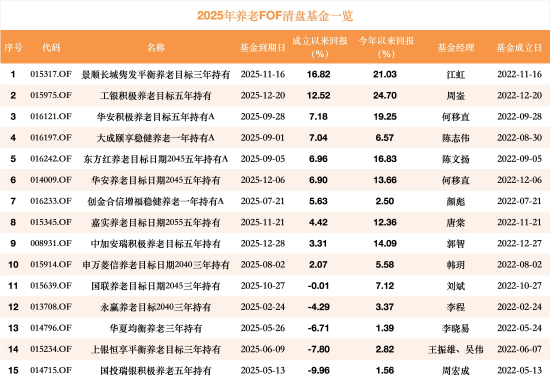
Core Insights - The fund industry is entering a period of intensive liquidation, with 284 funds being liquidated in 2025, maintaining a similar level to 2024. Mixed, equity, and bond funds are the primary types being liquidated, while FOF products have also seen a notable number of liquidations, totaling 37 [1][11]. Group 1: Fund Liquidation Details - Among the liquidated funds, 15 are retirement-themed funds established in 2022, which triggered automatic liquidation due to not meeting the minimum size of 200 million yuan or having fewer than 200 investors after three years [3][12]. - The distribution of liquidated funds includes two from Huaan Fund and one each from other companies like Invesco Great Wall, ICBC Credit Suisse, and others [3][12]. - Performance-wise, 10 out of the 15 retirement funds had positive returns since inception, with notable performers including Invesco Great Wall's balanced retirement fund and ICBC's active retirement fund, yielding returns of 16.82%, 12.52%, and 7.18% respectively [3][13]. Group 2: Specific Fund Performance - The "Guolian Retirement Target Date 2045" fund is particularly noteworthy for its near-zero return of -0.01% since inception, leading to its liquidation after failing to meet the contractual threshold due to low asset value [3][13]. - This fund had a starting size of only 10.36 million yuan, with 96.52% of the initial investment coming from the company itself, indicating a lack of external investor interest [4][13]. - The fund's performance was significantly below its benchmark, with a -4.52% return in 2023 and a -0.61% return for the entire year of 2024, resulting in substantial losses for investors [4][15]. Group 3: New Fund Issuance Trends - In 2025, 11 new retirement funds were launched, with a total issuance of 3.99 billion units, including products from companies like Qianhai Kaiyuan and E Fund [9][19]. - The largest new fund, "Qianhai Kaiyuan Kangyue Stable Retirement Fund," reached an issuance of 2.709 billion units, while other funds struggled to exceed 1 billion units, indicating potential vulnerability to liquidation [10][19]. - Analysts suggest that the small scale of many retirement FOFs is due to a combination of high issuance numbers and varying product quality, with a need for fund managers to enhance competitiveness and performance [10][19].
华安基金:央企负责人会议召开,央国企改革成效彰显
Xin Lang Cai Jing· 2025-12-30 06:26
Market Overview - The Hang Seng China Central Enterprises Dividend Index increased by 0.52%, the Hang Seng Index rose by 0.50%, and the Hang Seng Technology Index grew by 0.37% last week [1][7] - In the A-share market, the CSI State-Owned Enterprises Dividend Index rose by 0.31%, while the CSI 300 increased by 1.97% [1][7] Central Enterprises Meeting Insights - A meeting of central enterprise leaders was held on December 22-23, emphasizing the need for enhancing core functions, improving competitiveness, and deepening reforms [1][8] - The meeting aimed to prevent and mitigate major risks, promote the growth and optimization of state-owned capital and enterprises, and ensure the successful completion of the "14th Five-Year Plan" [1][8] Operational Indicators of Central Enterprises - The operational indicators of central enterprises are showing overall stability with some optimization, focusing on profit growth and maintaining stable asset-liability ratios [8] - The "one profit and five rates" operational indicator system aims for stable profit growth, stable asset-liability ratios, and improvements in net asset return rate, R&D expenditure intensity, labor productivity, and cash collection rate [8] Profitability and Valuation of State-Owned Enterprises - State-owned enterprises (SOEs) show robust profitability, with a projected annualized ROE for the first three quarters of 2025 significantly higher than the overall A-share market [2][8] - Despite facing long-term valuation challenges, SOEs are expected to have strong dividend willingness and capacity due to improved profit quality and market management [2][8] Dividend Yield and Valuation Metrics - The Hang Seng China Central Enterprises Dividend Index has a dividend yield of 6.97% and a PB ratio of 0.61, with a PE ratio of 6.96, showing a cumulative return of 151% over the past five years [2][8] - The CSI State-Owned Enterprises Dividend Index has a dividend yield of 5.20%, a PB ratio of 0.87, and a PE ratio of 8.71, with a cumulative return of 64% over the same period [2][8] Future Market Outlook - The low interest rate environment and weak economic recovery are favorable for dividend strategies, enhancing the dividend willingness and capacity of central enterprises [2][8] - The Hang Seng China Central Enterprises Dividend ETF (513920) and the State-Owned Enterprises Dividend ETF (561060) are considered to have high allocation value [2][8] ETF Product Overview - The Hang Seng China Central Enterprises Dividend ETF (513920) is the first ETF combining Hong Kong stocks, central enterprises, and dividends, tracking the Hang Seng China Central Enterprises Dividend Index [3][9] - The State-Owned Enterprises Dividend ETF (561060) tracks the CSI State-Owned Enterprises Dividend Index, selecting 100 stocks with high dividend yields and stable dividends from state-owned enterprises [4][11]

奥特维股价跌1.1%,华安基金旗下1只基金重仓,持有4.33万股浮亏损失2.25万元
Xin Lang Cai Jing· 2025-12-30 01:57
Group 1 - The core point of the article highlights the performance and financial metrics of Aotwei Technology Co., Ltd., including its stock price, trading volume, and market capitalization as of December 30 [1] - Aotwei's main business involves the research, design, production, and sales of high-end intelligent equipment, with revenue composition as follows: photovoltaic equipment 78.86%, transformation and other main businesses 13.61%, lithium battery equipment 5.20%, semiconductor 2.13%, and others 0.19% [1] Group 2 - From the perspective of fund holdings, Aotwei is a top ten holding in the Huazhang New Materials Theme Stock Fund A, with 43,300 shares held, accounting for 3.44% of the fund's net value [2] - The Huazhang New Materials Theme Stock Fund A has a total scale of 28.4041 million, with a year-to-date return of 66.37% and a one-year return of 62.47% [2] - The fund manager, Chen Quanhong, has a tenure of 2 years and 48 days, with the best fund return during this period being 76.3% and the worst being 46.34% [2]

中国卫星股价跌2.93%,华安基金旗下1只基金重仓,持有17.53万股浮亏损失45.23万元
Xin Lang Cai Jing· 2025-12-30 01:45
Group 1 - The core point of the news is that China Satellite experienced a decline of 2.93%, with its stock price at 85.42 yuan per share, a trading volume of 550 million yuan, and a turnover rate of 0.54%, resulting in a total market capitalization of 1010.08 billion yuan [1] - China Satellite, officially known as China Dongfanghong Satellite Co., Ltd., is located in Haidian District, Beijing, and was established on August 21, 1997, with its listing date on September 8, 1997. The company's main business involves aerospace manufacturing and satellite applications, with revenue composition being 97.01% from aerospace manufacturing and satellite applications, 1.71% from other sources, and 1.28% from leasing income [1] Group 2 - From the perspective of major fund holdings, Huashan Fund has one fund heavily invested in China Satellite. The Huashan Guozheng Aerospace Industry ETF (159267) held 175,300 shares in the third quarter, accounting for 3.07% of the fund's net value, making it the eighth largest holding. The estimated floating loss today is approximately 452,300 yuan [2] - The Huashan Guozheng Aerospace Industry ETF (159267) was established on July 21, 2025, with a current scale of 211 million yuan and a cumulative return of 13.84% since inception [2]

美元流动性维持宽松,商品短期或偏稳运行
Guo Tou Qi Huo· 2025-12-29 13:36
1. Report Industry Investment Rating No relevant content provided. 2. Core Viewpoints of the Report - The commodity market as a whole rose 4% last week, with precious metals leading the way with a 9.69% increase. The short - term commodity market may run stably due to the loose dollar liquidity [2]. - The Fed's loose outlook and geopolitical risks support the strength of precious metals. The short - term market fluctuates greatly as various varieties hit new highs [2]. - The non - ferrous sector may oscillate strongly in the short term due to the weak dollar and the support from the expected contraction of mine supply [3]. - The black sector may oscillate as the demand and supply situation is complex, with factors such as changes in steel mill production and raw material supply [3]. - Oil prices continue to be under pressure due to the long - term loose supply - demand background, despite the geopolitical tension in Venezuela [3]. - The polyester chemical varieties may be affected by supply and demand changes, and attention should be paid to the downstream polyester load [4]. - The short - term trend of agricultural products and oils and fats is expected to be oscillatory, influenced by factors such as weather and export expectations [4]. 3. Summary According to Related Catalogs 3.1 Market Review - The overall commodity market rose 4% last week, with precious metals up 9.69%, non - ferrous metals up 4.97%, energy and chemicals up 2.98%, agricultural products up 2.53%, and black metals up 0.08%. Silver, PTA, and nickel were the top gainers, while tin, coke, and rebar were the top losers [2][6]. - The 20 - day average volatility of the commodity market increased, with only the black and coal - chemical related varieties showing a decline in volatility. The overall market scale increased, but only the precious metal and non - ferrous sectors had net inflows, with most funds concentrated in silver [2][6]. 3.2 Outlook for Different Sectors - **Precious Metals**: Supported by the Fed's loose policy and geopolitical risks, the shortage of spot makes silver, platinum, and palladium more favored by funds. The gold - silver ratio has fallen below the average. Exchange restrictions and risk warnings have led to large short - term market fluctuations [2]. - **Non - ferrous Metals**: The weak dollar and better - than - expected GDP growth in the US provide a neutral - warm macro environment. Although the inventory is increasing and the spot premium is weakening, the expected contraction of mine supply supports the price, and the sector may oscillate strongly in the short term [3]. - **Black Metals**: The demand for rebar decreased, production increased slightly, and inventory continued to decline. The slowdown of blast furnace production cuts and the stable molten iron output need attention to the sustainability of environmental protection restrictions. The supply of raw materials is relatively sufficient, and the sector may oscillate in the short term [3]. - **Energy**: The geopolitical tension in Venezuela increases the risk premium of crude oil, but the impact on global supply is limited. The US shale oil production remains high, and oil prices are under pressure due to the long - term loose supply - demand situation [3]. - **Chemical Industry**: Polyester varieties may face supply pressure from device restarts, but the strong expectation remains, and attention should be paid to the downstream polyester load [4]. - **Agricultural Products**: The improving weather in South America and the expected transition of La Nina to ENSO neutral increase the expectation of a bumper harvest in South America. The fundamentals of palm oil are less negative, and the short - term trend of oils and fats may be oscillatory [4]. 3.3 Commodity Fund Overview - Gold ETFs generally had positive returns last week, with the total scale of gold ETFs increasing by 0.77% and the total trading volume increasing by 29.04%. The total scale of commodity ETFs increased by 0.86% and the trading volume increased by 23.22% [36]. - Among them, the returns of different gold ETFs ranged from 3.21% to 3.60%, and the return of the silver fund was 17.43%, while the returns of energy - chemical, bean - meal, and non - ferrous metal ETFs were 4.25%, 1.69%, and 4.34% respectively [36][38].
因“劳动争议”,华宝前基金经理怒告老东家?
Shen Zhen Shang Bao· 2025-12-29 12:50
Core Viewpoint - Huabao Fund is facing a labor dispute lawsuit filed by Chen Long, with the case accepted by the Shanghai Pudong New District People's Court, scheduled for a hearing on January 19, 2026 [1][2]. Group 1: Legal Proceedings - The lawsuit against Huabao Fund is categorized as a labor dispute, with the case number being (2025) Hu 0115 Min [2]. - The hearing is set for January 19, 2026, at 14:30 [2]. Group 2: Chen Long's Tenure and Performance - Chen Long worked at Huabao Fund from September 2018 and managed products from September 2, 2021, until his resignation on April 9, 2024, with a total tenure of 3 years and 62 days [3]. - During his management, the net asset values of the funds he managed decreased significantly, with Huabao Green Theme Mixed Fund dropping by 54.8% and Huabao Competitive Advantage Mixed Fund by 46.75% [3]. - The Huabao Green Theme Mixed Fund was liquidated due to its net asset value falling below 50 million RMB for 60 consecutive working days, shrinking from approximately 56 million RMB to 13 million RMB during Chen Long's management [4]. Group 3: Fund Performance and Management Changes - In 2024, Huabao Fund had a total of 9 products liquidated, with most of them showing negative returns since inception; in the current year, 9 products have also been liquidated, with 3 having negative returns [4]. - Huabao Fund currently employs 43 fund managers, significantly exceeding the industry average of about 24, with an average tenure of 3 years and 84 days [4]. - The recent two years saw only 4 fund managers leaving Huabao Fund, while 3 new hires were made [4]. Group 4: Current Fund Performance - As of the third quarter, Huabao Fund manages a total of 161 products with a combined scale of 401.25 billion RMB, ranking 28th in the industry [5]. - The fund's performance has improved in 2024, with several products achieving returns exceeding 100%, while some equity funds have reported negative returns [5]. - Over a three-year period, several actively managed equity funds from Huabao Fund have underperformed against their benchmarks, with declines exceeding 20% in net value for some products [6].
