拓普集团

Search documents
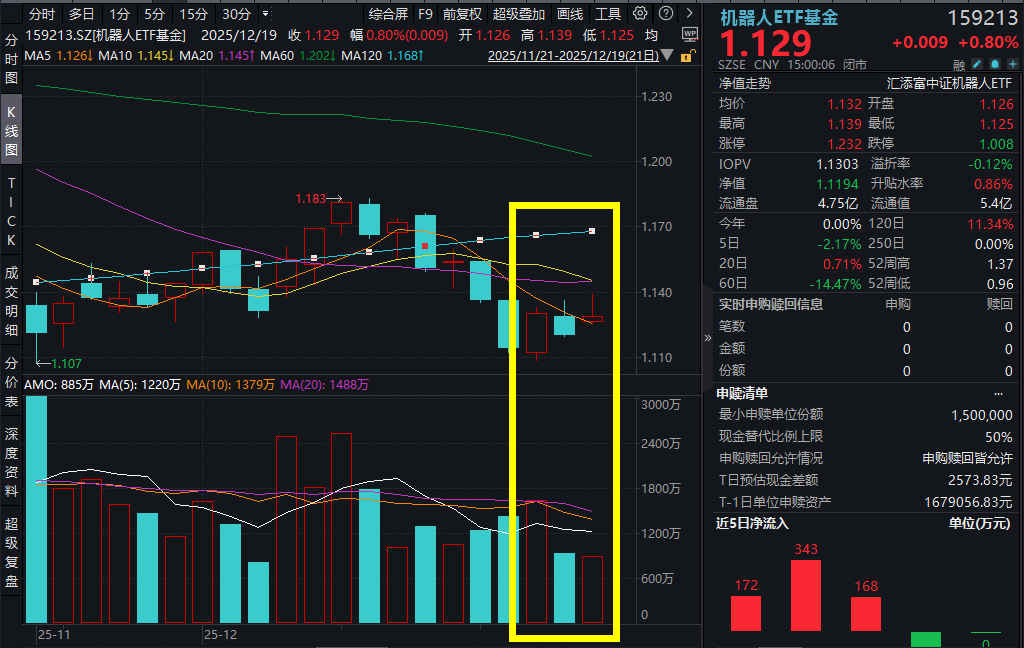
推动人形机器人走向全自主阶段,北京开源XR-1模型!拓普集团涨超1%,机器人ETF基金(159213)反弹涨近1%!人形机器人迈向新阶段?
Xin Lang Cai Jing· 2025-12-19 10:17
Group 1 - The core viewpoint of the news highlights the significant growth and investment potential in the humanoid robotics sector, with predictions of a compound annual growth rate (CAGR) of 50% or more over the next decade, leading to a market size approaching 3 trillion yuan by 2040 [5][8]. - The Robot ETF fund (159213) has seen most of its constituent stocks rise, with notable increases such as Double Ring Transmission up over 4% and several others like Zhongkong Technology and Green Harmony rising over 1% [2][3]. - The humanoid robot industry is recognized as a strategic sector, addressing labor shortages and adapting to human environments, with various cities in China implementing supportive policies and development plans [5][8]. Group 2 - In the first nine months of 2025, global investment in humanoid robotics reached approximately $7 billion (about 50 billion yuan), marking a 250% increase compared to the same period last year [9]. - The demand for B-end applications in robotics continues to grow, with several companies reporting annual orders exceeding 1 billion yuan, indicating a robust market for commercial robotics [12]. - Major companies are accelerating their production timelines, with Tesla and other firms planning to launch mass production of humanoid robots by 2026, signaling a shift from technological competition to manufacturing and commercial competition [13].


动辄计划出货成千上万台 人形机器人“竞速”量产 但交付迟滞仍然普遍
Mei Ri Jing Ji Xin Wen· 2025-12-19 09:33
Group 1 - The core focus of the articles is on the advancements and competitive landscape of humanoid robots in China and the U.S., highlighting the rapid development and deployment of technology in the Chinese market [1][2] - The Chinese humanoid robot industry is experiencing significant growth, with a reported financing total of approximately 500 billion yuan in the first three quarters of 2025, which is 2.5 times that of the same period last year [1][7] - Major companies in the humanoid robot supply chain, such as Sanhua Intelligent Controls and Joyson Electronics, are planning IPOs in Hong Kong, indicating strong investor interest in the sector [1][7] Group 2 - The acceleration of domestic core component localization is evident, with companies like Top Group and Sanhua Intelligent Controls expanding their production capabilities both domestically and internationally [2][3] - The domestic production rate of key components, such as harmonic reducers, has reached over 90%, significantly reducing reliance on imports and improving cost competitiveness [3][4] - The market for six-dimensional force sensors is also seeing a shift towards domestic products, with local companies offering competitive pricing and faster delivery times compared to international counterparts [4] Group 3 - The humanoid robot market is projected to see a significant increase in installations, with China expected to install nearly 300,000 robots in 2024, surpassing the total installations in other regions [6][9] - The IPO performance of leading companies like Sanhua Intelligent Controls has been remarkable, with oversubscription rates reaching 747 times, raising 10.7 billion HKD [7] - The industry is facing challenges with delivery capabilities, as many companies are struggling to meet the demand for large orders, with some companies only able to deliver a fraction of their expected output [10][11] Group 4 - The cost pressures in the domestic humanoid robot sector are significant, with companies facing competitive pricing pressures from their peers, leading to a decline in product prices [12] - Research and development expenditures are substantial, with companies like UAI Intelligent and UBTECH investing over 30% of their revenues into R&D, indicating a strong focus on innovation [12] - The rental market for robots has seen a dramatic price drop, with daily rental rates decreasing from over 10,000 yuan to below 3,000 yuan, reflecting the overall trend of declining prices in the industry [12]

东吴证券2026年汽车行业策略:坚定“破旧立新”
Zhi Tong Cai Jing· 2025-12-19 09:04
Core Viewpoint - The automotive industry is at a new crossroads, with the end of the electric vehicle (EV) boom and the rise of smart technology. Commercial vehicles and two-wheelers are seen as promising investment areas. The company suggests two strategies: finding cyclical alpha varieties and embracing the next industrial trends of smart technology and robotics/AIDC [1] Automotive Sector Forecast for 2026 - Passenger vehicle sector: The industry will be impacted by a 5% new energy vehicle purchase tax, with an overall domestic demand expectation of 3.5%. Total domestic sales are projected at 22 million units (down 3.5% year-on-year), with new energy domestic sales at 13.2 million units (up 6.4% year-on-year). Total external sales are expected to be 6.41 million units (up 12.0% year-on-year), with new energy external sales at 3.52 million units (up 43.9% year-on-year) [1] - Heavy truck sector: Under neutral predictions, wholesale sales are expected to reach 1.16 million units (up 1.5% year-on-year), with domestic sales at 770,000 units (down 5.5% year-on-year) and external sales at 390,000 to 400,000 units (up 18.8% year-on-year) [1] - Bus sector: Continued resonance in domestic and external demand is expected, with export growth likely to maintain over 30%, and new energy export growth anticipated to be even faster. Domestic sales are projected at 81,000 units (up 3% year-on-year), with exports at 76,400 units (up 30% year-on-year) [1] - Motorcycle sector: Total industry sales are expected to reach 19.38 million units (up 14% year-on-year), with large-displacement motorcycles at 1.26 million units (up 31% year-on-year). Domestic sales are projected at 3.99 million units (down 9% year-on-year), while external sales are expected to be 15.39 million units (up 21% year-on-year) [1] Investment Opportunities - Passenger vehicle sector: Preferred stocks include Yutong Bus (600066) and attention to King Long Motor (600686) [2] - Motorcycle sector: Top picks are Chunfeng Power (603129) and Longxin General (603766) [2] - Heavy truck sector: Preferred stocks include China National Heavy Duty Truck Group (000951) H and Weichai Power (000338) [2] - Passenger car sector: Top choice is BYD (002594), with Jianghuai Automobile (600418) as a preferred option [2] - Parts sector: Preferred stocks include Fuyao Glass (600660), Xingyu Co., Ltd. (601799), and Minth Group (002743) [2] Growth Opportunities - L4RoboX investment opportunities: Focus on the L4RoboX industry chain, with B-end software targets preferred over C-end hardware. Top picks include XPeng Motors and Horizon Robotics in H-shares, and Qianli Technology and Desay SV in A-shares [3] - Robotics/AIDC investment opportunities: The overseas Optimus V3 is expected to be finalized in 2026, with rapid capital progress in domestic robotics. Preferred stocks in the robotics and liquid cooling sectors include Top Group (601689) and Junsheng Electronics (600699) [3]

2026年汽车行业总投资策略:坚定“破旧立新”
Soochow Securities· 2025-12-19 08:14
Core Conclusions - The 2026 automotive industry investment strategy emphasizes "breaking old and establishing new," suggesting that the industry is at a crossroads similar to 2011 and 2018, with the end of the electric vehicle (EV) boom and the rise of smart technology [2][3] - The report predicts a total domestic demand of 22 million vehicles in 2026, a decrease of 3.5% year-on-year, with new energy vehicle (NEV) sales expected to reach 13.2 million, an increase of 6.4% [2][10] - The commercial vehicle sector is expected to see a wholesale volume of 1.16 million units in 2026, with a slight increase of 1.5% year-on-year, while the bus sector is projected to maintain strong export growth [2][19] Passenger Vehicle Sector - The passenger vehicle sector is projected to experience a total sales volume of 22 million units in 2026, with NEV sales expected to reach 13.2 million units, reflecting a year-on-year growth of 6.4% [2][10] - The report highlights the impact of a 5% purchase tax on NEVs starting January 1, 2026, which is expected to support domestic demand [10] - Key investment opportunities include BYD and Jianghuai Automobile in the passenger vehicle sector [2][3] Commercial Vehicle Sector - The heavy truck segment is forecasted to have a wholesale volume of 1.16 million units in 2026, with domestic sales expected to decline by 5.5% to 770,000 units, while exports are projected to grow by 18.8% [2][15] - The bus sector is expected to see a total domestic sales volume of 81,000 units, with exports anticipated to grow by over 30% [2][19] Motorcycle Sector - The motorcycle industry is expected to achieve total sales of 19.38 million units in 2026, representing a year-on-year increase of 14%, with large-displacement motorcycles projected to grow by 31% [2][22] - Domestic sales of large-displacement motorcycles are expected to reach 430,000 units, while exports are projected to grow significantly [22] Investment Opportunities - The report identifies key investment opportunities across various segments, including Yutong Bus and King Long in the bus sector, and Spring Power and Longxin General in the motorcycle sector [2][3] - The focus on L4 RoboX investment opportunities highlights the importance of software over hardware in the autonomous driving sector, with recommended stocks including XPeng Motors and Horizon Robotics [2][3] Growth Trends - The report anticipates a continued focus on smart technology and robotics, with significant growth expected in the L4 RoboX industry and AIDC (Automated Identification and Data Capture) sectors [2][3] - The penetration rate of smart driving technology in new energy vehicles is expected to reach 40% by 2026, with a notable shift in chip supplier market shares [13][14]



人形机器人企业集体扩产背后是机遇还是“不扩产就丢单”的焦虑?
Tai Mei Ti A P P· 2025-12-19 04:33
文 | GPLP看科技,作者 | 马赫环 2025年对于人形机器人行业来说,确实可以被称为"量产元年",其中的重要标志就是已经有企业初步构 建了一定的量产能力。如智元机器人已经于12月8日宣布,其通用具身机器人已经累计下线5000台,其 中远征系列(A1/A2)下线1742台,精灵系列(G1/G2)为1412台,灵犀系列(X1/X2)达到了1846 台。 在目前的政策态度、市场氛围以及技术发展方向来看,2026年的国内人形机器人企业将具备更大规模的 量产能力。然而,现在的问题是当前阶段的市场能承载下快速增长的产能吗? 海内外同频,人形机器人产能扩张势不可挡 日前,人形机器人赛道正上演着预期与现实的激烈碰撞,这种碰撞不止是源于核心零部件对现有产品的 制约,也有产能快速扩张与现有市场的不匹配。 11月就有报道称,高盛发布了《中国人形机器人供应链实地调研报告》,高盛调研9家中国机器人产业 链企业,认为这些机器人零部件公司正规划中国及海外产能,规划年产能10万台至100万台机器人。但9 家公司中,尚无任何一家获得确定性大额订单,也没有明确的量产计划。 这9家企业中包括了三花智控(002050.SZ/2050.HK)、 ...


全球首个机器人舞台秀上演,机器人ETF鹏华(159278)连续3天净流入
Xin Lang Cai Jing· 2025-12-19 02:52
Group 1 - The National Robot Industry Index (980022) has seen a strong increase of 1.61%, with notable gains from constituent stocks such as Aerospace Intelligent Equipment (300455) up 6.84%, and Double Ring Transmission (002472) up 3.79% [1] - The Robot ETF Penghua (159278) has risen by 1.30%, with the latest price reported at 1.01 yuan, and has experienced a significant scale growth of 16.18 million yuan over the past week [1] - The Robot ETF Penghua has achieved a new high in shares, reaching 1.104 billion shares, and has seen a total net inflow of 57.84 million yuan over the last three days [1] Group 2 - Yushu Technology has launched the first humanoid robot application store, aiming to modularize and standardize humanoid robot functionalities, indicating a positive outlook for the humanoid robot industry chain [2] - The humanoid robot products are expected to begin mass production and sales in 2026, with anticipated shipment volumes showing exponential growth compared to 2025 [2] - The top ten weighted stocks in the National Robot Industry Index account for 40.47% of the index, including companies like Double Ring Transmission (002472) and Ecovacs (603486) [2]


11月新能源汽车表现亮眼 | 投研报告
Zhong Guo Neng Yuan Wang· 2025-12-19 02:04
Core Insights - November automotive sales reached 3.429 million units, a year-on-year increase of 3.4%. Cumulative sales from January to November totaled 31.127 million units, reflecting an 11.4% year-on-year growth [1][2] - The comprehensive inventory coefficient for automotive dealers in November was 1.6, up 41.4% year-on-year and 34.2% month-on-month. The inventory warning index stood at 55.6%, an increase of 3.8 percentage points year-on-year and 3 percentage points month-on-month [2] Sales Performance - In November, the sales of new energy vehicles (NEVs) reached 1.823 million units, marking a 20.6% year-on-year increase, with a penetration rate of 53.2%. From January to November, NEV sales totaled 14.78 million units, up 31.2% year-on-year, with a penetration rate of 47.5% [2] Investment Strategy - The automotive sector should focus on undervalued leading companies in vehicle manufacturing and parts due to performance improvements. Key areas of interest include: - Domestic car manufacturers with first-mover advantages in the NEV sector, such as BYD, Changan Automobile, Geely, and Li Auto [3] - Stable performance low-valuation leading parts manufacturers like Huayu Automotive and Fuyao Glass [3] - Core players in the electrification and intelligentization sectors, including Desay SV, Ruikeda, Kobot, and Bertley [3] - Opportunities arising from domestic circulation and local replacements, such as Lingdian Electric Control, Sanhua Intelligent Control, Xingyu Co., and Shangsheng Electronics [3] - Strong vehicle manufacturers driving demand for core components, including Top Group, Wencan Co., and Xusheng Group [3] Market Overview - The automotive sector experienced a weekly change of 0.16%, ranking 9th among 31 sectors. The automotive industry outperformed the CSI 300 index during the week [5] - The weekly performance of major indices was as follows: Shanghai Composite Index -0.34%, CSI 300 -0.08%, Shenzhen Component Index 0.84%, and ChiNext Index 2.74% [5] - In sub-sectors, the weekly performance was: automotive services -5.23%, automotive parts 0.11%, passenger vehicles 0.23%, commercial vehicles 0.25%, and motorcycles and others 1.70% [5] Top Performing Stocks - The top five performing stocks in the automotive sector for the week were: Chaojie Co., Huamao Technology, Yueling Co., Huapei Power, and Zhenghe Industrial [6] Underperforming Stocks - The bottom five performing stocks in the automotive sector for the week were: Xiamen Xinda, Rongtai Co., Longji Machinery, Kailong High-Tech, and Disengli [7]




L3商用在即,智能底盘有望批量应用 | 投研报告
Zhong Guo Neng Yuan Wang· 2025-12-19 02:02
Core Viewpoint - The automotive industry is expected to benefit from the acceleration of automotive intelligence and the development of the robotics industry, with the auto parts sector outperforming the vehicle manufacturing sector in 2025 [1][2]. Group 1: Market Performance - From January 1 to December 12, 2025, the CITIC passenger car index decreased by 0.40%, while the CITIC auto parts index increased by 34.76%, indicating a significant outperformance of the auto parts sector compared to the vehicle manufacturing sector [1]. - The vehicle manufacturing sector has shown weakening performance due to intensified price wars and fierce market competition, while the auto parts sector has benefited from opportunities arising from the rapid development of AI and related industries [1]. Group 2: Revenue and Profitability - The passenger car sector experienced revenue growth in the first three quarters of 2025, driven by the "old-for-new" policy, but faced a decline in short-term profitability due to increased competition [1]. - The auto parts sector, on the other hand, has seen continuous performance improvement driven by economies of scale and demand from emerging industries [1]. Group 3: 2026 Outlook - The automotive market in 2026 is expected to see a decline in policies such as the "old-for-new" program, which may affect car purchase demand, while the export of new energy vehicles is projected to grow rapidly, showcasing strong competitiveness in China's new energy vehicle industry [2]. - The penetration rate of new energy vehicles continues to rise, with intelligent and high-end features becoming new growth drivers [2]. Group 4: Technological Advancements - The intelligentization of chassis systems is a key area of focus to ensure the reliability of high-level autonomous driving, with domestic companies actively promoting the implementation of intelligent technologies in suspension, steering, and braking systems [3][4]. - The development of intelligent suspension systems is advancing, with active suspension becoming a necessary choice for intelligent driving vehicles, and domestic parts manufacturers are becoming major players in this field [3]. Group 5: Investment Strategy - The automotive market in 2026 will be influenced by various factors, with the rise in new energy vehicle penetration, exports, and intelligent high-end features expected to be structural highlights [4]. - Companies that continue to focus on automotive intelligence and are positioned to benefit from the mass application of intelligent driving technologies, particularly those involved in active suspension and line control systems, are recommended for investment [5].
拓普集团(601689) - 拓普集团关于使用部分暂时闲置募集资金进行现金管理的进展公告
2025-12-18 10:00
证券代码:601689 证券简称:拓普集团 公告编号:2025-087 宁波拓普集团股份有限公司 关于使用部分暂时闲置募集资金进行现金管理的进展公告 本公司董事会及全体董事保证本公告内容不存在任何虚假记载、误导性陈述 或者重大遗漏,并对其内容的真实性、准确性和完整性承担法律责任。 重要内容提示: 已履行的审议程序:宁波拓普集团股份有限公司(以下简称"公司") 分别于 2025 年 4 月 22 日召开第五届董事会第二十一次会议和第五届监事会 第十七次会议、2025 年 5 月 14 日召开 2024 年年度股东大会,审议通过了《关 于使用部分暂时闲置募集资金委托理财的议案》,授权公司使用最高额度 24 亿元的暂时闲置募集资金委托理财,用于结构性存款或购买保本型理财产品, 授权期限为 2025 年 7 月 1 日至 2026 年 6 月 30 日。详情请见公司于 2025 年 4 月 18 日在上海证券交易所披露的《拓普集团关于使用部分暂时闲置募集资金 委托理财的公告》。 特别风险提示:公司投资的理财产品为保本型银行理财产品,安全性 高,流动性好,总体风险可控。但金融市场受宏观经济、财政及货币政策的 影响较大, ...
汽车行业2026年策略:L3商用在即,智能底盘有望批量应用
Dongxing Securities· 2025-12-18 08:54
Investment Summary - The automotive industry is benefiting from the acceleration of smart technology and the development of the robotics industry, with the parts sector outperforming the vehicle sector. From January 1 to December 12, 2025, the CITIC passenger car index fell by 0.40%, while the CITIC automotive parts index rose by 34.76%, indicating a significant difference in performance between the two sectors [4][18][25]. Group 1: 2025 Market Performance and Earnings Review - The automotive parts sector achieved a revenue of 7,541.60 billion yuan in the first three quarters of 2025, a year-on-year increase of 8.75%, and a net profit of 460.10 billion yuan, up 19.60% year-on-year [49]. - The passenger vehicle sector's revenue reached 15,203.16 billion yuan, growing by 8.68% year-on-year, while the net profit decreased by 15.72% to 391.90 billion yuan [31][49]. - The performance of passenger vehicle companies varied, with most showing revenue growth, but some, like BYD and Great Wall Motors, experienced profit declines [39][42]. Group 2: Outlook for 2026 - The automotive market in 2026 is expected to see a decline in policies, while exports and new energy vehicles (NEVs) will continue to rise. The "old-for-new" policy is anticipated to drive high growth in vehicle sales in 2025, but its absence in 2026 may lead to a demand shortfall [5][62][66]. - The penetration rate of NEVs is expected to continue increasing, with smart and high-end vehicles becoming new growth drivers. By 2025, the penetration rate of NEVs reached 46.7% [72][73]. - The L3 commercial application is expected to reach a critical point in 2026, with smart chassis technology anticipated to be applied in large quantities [5][6]. Group 3: Investment Strategy - The investment strategy focuses on the smart automotive sector, particularly as the industry transitions from L2 to L3 autonomous driving. Companies that continue to invest in this area are expected to benefit significantly [6][8]. - Recommended companies in the vehicle sector include SAIC Motor, Jianghuai Automobile, and Chery Automobile, which are positioned to leverage advancements in smart driving technology [6][8]. - In the parts sector, companies like Baolong Technology and Top Group are highlighted for their potential to benefit from the implementation of line control steering and braking systems, which are set to enter mass application in 2026 [8][49].