
晋控煤业

Search documents
煤炭与消费用燃料行业周报:动力煤涨势延续,重视焦煤高弹性-20251116
Changjiang Securities· 2025-11-16 07:12
Investment Rating - The industry investment rating is "Positive" and is maintained [8] Core Views - The report indicates that the upward trend in thermal coal prices is expected to continue due to supply constraints from the November central safety production assessments and improving demand as winter approaches, with prices likely to exceed expectations [5][6] - For coking coal, despite short-term demand pressure from the off-season, the current low inventory and tight supply suggest significant price recovery potential if pro-cyclical policies are reintroduced globally [5][6] - The report emphasizes the importance of recognizing the bottom reversal opportunities in the coal sector, supported by low price-to-book ratios and low holdings [6] Summary by Sections Thermal Coal - As of November 14, the market price for thermal coal at Qinhuangdao Port is 834 RMB/ton, a week-on-week increase of 17 RMB/ton. The report anticipates continued price increases due to tight supply and low port inventories, alongside seasonal demand improvements [5][13] - The report notes that the inventory at the northern three ports is 12.58 million tons, down 12% year-on-year, while power plant inventories are 130 million tons, down 1.5% year-on-year, with usable days at 25.9 days, up 1.2 days year-on-year [6][14] Coking Coal - The price for main coking coal at Jingtang Port remains stable at 1860 RMB/ton as of November 14. The report highlights that while steel mill demand is currently weak, the supply situation for coking coal is tight, indicating potential for price elasticity [5][6] - The report also mentions that the average daily pig iron production at sample steel mills is 2.3688 million tons, a year-on-year increase of 0.4% [15] Valuation and Market Dynamics - The report suggests that the current price-to-book ratios for coking coal and major thermal coal companies are at the lower third percentile since 2016, indicating undervaluation compared to other cyclical resource sectors [6] - The report recommends a mixed strategy for investment, highlighting companies like Yanzhou Coal Mining Company and China Shenhua Energy as stable leaders, while also suggesting more aggressive plays in companies like Lu'an Environmental Energy and Jinneng Holding Group [6][27]



利率修复信用债大致平稳,二永债收益率小幅回落
Xinda Securities· 2025-11-15 15:23
Report Industry Investment Rating No relevant content provided. Core Viewpoints of the Report - Interest rates are recovering, credit bond yields are generally stable, and credit spreads of high - grade bonds over 3Y are widening. The yields of credit bonds are generally stable, while the yields of government - developed bonds of 3Y, 5Y, 7Y, and 10Y are declining. Credit spreads of high - grade bonds over 3Y are mostly widening [2][5]. - Most urban investment bond spreads have slightly increased. The credit spreads of external rating AAA and AA+ platforms have generally increased by 2BP and 1BP respectively compared to last week, while the AA platform has generally remained flat [2][9]. - The spreads of industrial bonds have increased overall, and the increase in the spreads of mixed - ownership real - estate bonds is significant. The spreads of central and state - owned enterprise real - estate bonds, mixed - ownership real - estate bonds, and private real - estate bonds have all increased, with the mixed - ownership real - estate bonds having the largest increase [2][20]. - The yields of Tier 2 and perpetual bonds have slightly declined, and high - grade varieties are relatively advantageous. The yields of Tier 2 and perpetual bonds of all maturities have slightly decreased, with 3Y perpetual bonds performing strongly and high - grade varieties being more favorable [2][27]. - The excess spreads of 3Y industrial perpetual bonds have declined, and the excess spreads of urban investment perpetual bonds continue to diverge. The excess spreads of industrial AAA 3Y perpetual bonds have decreased, while the excess spreads of urban investment AAA 3Y and 5Y perpetual bonds show different trends [2][31]. Summary by Relevant Catalogs 1. Interest rates are recovering, credit bond yields are generally stable, and credit spreads of high - grade bonds over 3Y are widening - Yield changes: 1Y government - developed bond yields are flat compared to last week, while 3Y, 5Y, 7Y, and 10Y yields have decreased by 3BP, 2BP, 2BP, and 1BP respectively. For credit bonds, 1Y yields are flat, 3Y AAA - grade yields increase by 1BP, others decrease by 1BP; 5Y AAA - grade yields are flat, AA+ decreases by 1BP, AA decreases by 3BP, AA - decreases by 8BP; 7Y AAA - grade yields increase by 1BP, others decrease by 1BP; 10Y AAA - grade yields increase by 2BP, others are flat [2][5]. - Credit spread changes: 1Y credit spreads are flat; 3Y AAA - grade credit spreads increase by 4BP, others increase by 2BP; 5Y AA+ and above grade spreads increase by 1 - 2BP, AA grade decreases by 1BP, AA - grade decreases by 6BP; 7 - 10Y credit spreads increase by 1 - 3BP [2][5]. - Rating spread changes: 1Y spreads are flat; 3Y AAA/AA+ spreads decrease by 2BP, others are flat; 5Y AA/AA - grade spreads decrease by 5BP, others decrease by 1 - 2BP; 7Y and 10Y AAA/AA+ rating spreads decrease by 2BP, others are flat [5]. - Maturity spread changes: For AAA grade, 5Y/3Y decreases by 1BP, others increase by 1BP; for AA+ grade, 3Y/1Y decreases by 1BP, 10Y/7Y increases by 1BP, others are flat; for AA grade, 5Y/3Y and 3Y/1Y decrease by 1 - 2BP, others increase by 1 - 2BP [5]. 2. Most urban investment bond spreads have slightly increased - By external rating: The credit spreads of external rating AAA and AA+ platforms have generally increased by 2BP and 1BP respectively compared to last week, while the AA platform has generally remained flat. Among them, most AAA - grade platform spreads increase by 1 - 2BP, with Henan and Yunnan remaining flat; most AA+ - grade platforms are flat or increase by 1BP, with Guizhou, Yunnan, and Tianjin decreasing by 1 - 3BP, Gansu and Inner Mongolia increasing by 2BP; most AA - grade platforms are flat or increase by 1BP, with Shaanxi, Tianjin, Jilin, and Shandong decreasing by 1 - 3BP, Guizhou increasing by 4BP [2][9]. - By administrative level: The credit spreads of provincial and municipal platforms have generally increased by 2BP and 1BP respectively compared to last week, while the county - level platform spreads have remained flat. Most provincial platform spreads increase by 1 - 2BP, with Xinjiang, Anhui, and Zhejiang increasing by 3 - 4BP, Jiangsu increasing by 7BP, Yunnan and Shaanxi remaining flat; most municipal platforms increase by 1BP, with Yunnan decreasing by 1BP, Qinghai remaining flat, Zhejiang increasing by 2BP; most county - level platforms are flat or increase by 1BP, with Shaanxi, Jilin, and Jiangxi decreasing by 1 - 2BP, Guizhou increasing by 3BP [2][17]. 3. The spreads of industrial bonds have increased overall, and the increase in the spreads of mixed - ownership real - estate bonds is significant - Real - estate bonds: The spreads of central and state - owned enterprise real - estate bonds have increased by 1BP, the spreads of mixed - ownership real - estate bonds have increased by 123BP, and the spreads of private real - estate bonds have increased by 14BP. The spreads of Longfor have increased by 20BP, CIFI by 40BP, Midea Real Estate remained flat, and Vanke by 438BP [2][20]. - Other industrial bonds: The spreads of coal bonds of all grades have increased by 0 - 2BP; the spreads of AAA - grade steel bonds have increased by 1BP, AA+ by 5BP; the spreads of AAA - grade chemical bonds have increased by 2BP, AA+ remained flat. The spreads of Shaanxi Coal Industry have increased by 1BP, while the spreads of HBIS and Jinkong Coal Industry have decreased by 1BP [2][20]. 4. The yields of Tier 2 and perpetual bonds have slightly declined, and high - grade varieties are relatively advantageous - 1Y: The yields of all grades of Tier 2 and perpetual bonds have decreased by 0 - 1BP, and the spreads have compressed similarly [2][27]. - 3Y: The yields of all grades of Tier 2 capital bonds have decreased by 2 - 3BP, and the spreads have increased by 0 - 1BP; the yields of all grades of perpetual bonds have decreased by 3 - 4BP, and the spreads have compressed by 0 - 1BP [2][27]. - 5Y: The yield of AAA - grade Tier 2 capital bonds has decreased by 3BP, and the spread is flat; the yields of other grades of Tier 2 and perpetual bonds have decreased by 2BP, and the spreads have increased by 1BP [2][27]. 5. The excess spreads of 3Y industrial perpetual bonds have declined, and the excess spreads of urban investment perpetual bonds continue to diverge - Industrial perpetual bonds: The excess spreads of industrial AAA 3Y perpetual bonds have decreased by 1.38BP to 14.79BP compared to last week, at the 38.88% percentile since 2015; the excess spreads of industrial 5Y perpetual bonds are flat at 12.39BP compared to last week, at the 27.07% percentile since 2015 [2][31]. - Urban investment perpetual bonds: The excess spreads of urban investment AAA 3Y perpetual bonds have decreased by 2.04BP to 5.35BP, at the 5.14% percentile; the excess spreads of urban investment AAA 5Y perpetual bonds have increased by 1.83BP to 10.97BP, at the 17.02% percentile [2][31]. 6. Credit Spread Database Compilation Instructions - Calculation basis: The overall market credit spreads, commercial bank Tier 2 and perpetual bond spreads, and urban investment/industrial perpetual bond credit spreads are calculated based on ChinaBond Medium - and Short - Term Notes and ChinaBond Perpetual Bonds data, with historical percentiles since the beginning of 2015; the urban investment and industrial bond - related credit spreads are compiled and统计 by the R & D Center of Cinda Securities, with historical percentiles since the beginning of 2015 [36]. - Calculation methods: Industrial and urban investment individual bond credit spreads = individual bond ChinaBond valuation (exercise) - same - maturity government - developed bond yield to maturity (calculated by linear interpolation method), and then the credit spreads of industries or regional urban investments are obtained by arithmetic averaging; bank Tier 2 capital bond/perpetual bond excess spreads = bank Tier 2 capital bond/perpetual bond credit spreads - same - grade and same - maturity bank ordinary bond credit spreads; industrial/urban investment - type perpetual bond excess spreads = industrial/urban investment - type perpetual bond credit spreads - same - grade and same - maturity medium - term note credit spreads [38]. - Sample selection: Both industrial and urban investment bonds select medium - term notes and public corporate bonds as samples, and exclude guaranteed bonds and perpetual bonds. If the remaining maturity of an individual bond is less than 0.5 years or more than 5 years, it is excluded from the statistical sample. Industrial and urban investment bonds use external entity ratings, while commercial banks use ChinaBond implicit debt ratings [38].
煤炭公司2025年三季报业绩总结:动力煤较优,涨价或集中于Q4体现
Hua Yuan Zheng Quan· 2025-11-15 11:16
Investment Rating - The industry investment rating is "Positive" (maintained) [4] Core Viewpoints - The coal sector showed positive revenue growth in Q3 2025, with the net profit growth rate of thermal coal companies outperforming that of coking coal companies [4] - The price of Qinhuangdao 5500 kcal thermal coal increased from 621 RMB/ton on June 30, 2025, to 699 RMB/ton on September 30, 2025, reflecting a cumulative increase of 12.6% in Q3 [4] - The overall performance of coal companies in Q3 was supported by rising coal prices, inventory reduction, and increased electricity sales during peak summer demand [4] - The production of leading thermal coal companies remained stable, while coking coal production faced pressure, leading to more aggressive inventory reduction [4] - The improvement in long-term contracts for thermal coal helped boost coal prices, although some companies still recorded a decline in unit sales revenue due to delayed price transmission [4] - The cost control strategies adopted by thermal coal companies helped maintain profitability despite rising costs in some coking coal companies [4] - The winter season is expected to see strong coal prices due to supply constraints and increased demand for heating [5] Summary by Sections Section: Q3 Performance - The coal sector's Q3 revenue showed a positive trend, with thermal coal companies experiencing a net profit growth rate that was better than that of coking coal companies [4] - The overall revenue for coal companies in Q3 was positively impacted by rising coal prices and increased electricity sales [4] Section: Price Trends - The price of thermal coal saw a significant increase in Q3, with a 12.6% rise in Qinhuangdao 5500 kcal thermal coal prices [4] - Despite the increase in market prices, some companies experienced a lag in price transmission, affecting their unit sales revenue [4] Section: Production and Inventory - Leading thermal coal companies maintained stable production levels, while coking coal production faced challenges [4] - Most listed coal companies did not significantly reduce their sales volumes, with some companies achieving higher sales in Q3 [4] Section: Cost Management - Thermal coal companies continued to focus on cost control, resulting in a decrease in unit costs [4] - Some coking coal companies faced rising costs, which negatively impacted their performance [4] Section: Future Outlook - The report suggests a positive outlook for Q4 2025, with expectations of continued improvement in coal company performance due to favorable market conditions [5] - The winter season is anticipated to bring strong coal prices driven by supply constraints and increased heating demand [5]




寒潮来袭提振需求,煤价上涨动力仍强
ZHONGTAI SECURITIES· 2025-11-15 11:09
寒潮来袭提振需求,煤价上涨动力仍强 煤炭 证券研究报告/行业定期报告 2025 年 11 月 15 日 2025-11-13 2025-11-08 望震荡上行》2025-11-01 | 增持(维持) 评级: | | | 重点公司基本状况 | | | | | | | | | | | | | --- | --- | --- | --- | --- | --- | --- | --- | --- | --- | --- | --- | --- | --- | --- | | | | 简称 | 股价 | | | EPS | | | | | PE | | | 评级 | | 分析师:杜冲 | | | (元) | 2023A | 2024A | 2025E | 2026E | 2027E | 2023A | 2024A | 2025E | 2026E | 2027E | | | 执业证书编号:S0740522040001 | | 山西焦煤 | 7.21 | 1.19 | 0.55 | 0.35 | 0.40 | 0.45 | 6.1 | 13.1 | 20.6 | 18.0 | 16.0 | 买入 | | | | 潞安环能 ...
煤炭周报:预期扰动不改供弱需强格局,涨价动能持续-20251115
Minsheng Securities· 2025-11-15 09:13
Investment Rating - The report maintains a "Buy" recommendation for several companies in the coal sector, including Shanxi Coal International, Lu'an Environmental Energy, and Yanzhou Coal Mining [2][3][12]. Core Insights - The report highlights a strong demand-supply imbalance in the coal market, with prices expected to continue rising due to seasonal demand and regulatory constraints on supply [1][7][8]. - October saw a decrease in national raw coal production, with a daily average of 13.12 million tons, down 4.3% month-on-month [1][37]. - The report anticipates that coal prices may peak at around 1000 RMB/ton by the end of the year, driven by tight supply and increasing demand as winter approaches [1][8]. Summary by Sections 1. Weekly Insights - The report notes that seasonal demand is gradually being realized, with port coal prices continuing to rise and stabilizing in the latter half of the week [1][7]. - Regulatory inspections have led to a significant contraction in coal supply, particularly in regions like Ulanqab and Linfen [2][11]. 2. Market Performance - As of November 14, the coal sector's weekly decline was 0.8%, outperforming the broader market indices [14][17]. - The report identifies that the coking coal sub-sector experienced the highest weekly increase of 6.2% [17]. 3. Company Dynamics - The report recommends focusing on companies with high spot market exposure, such as Shanxi Coal International and Lu'an Environmental Energy, as well as stable growth companies like Jinko Coal and Huayang Co [12][21]. - Notable stock performance includes An Tai Group, which saw a significant increase of 57.29% in its stock price [21]. 4. Industry Developments - The report discusses the impact of international coal trade dynamics, including increased imports by India and Taiwan, which may influence domestic supply and pricing [25][35]. - It also highlights the ongoing safety inspections and regulatory measures that are expected to limit coal production capacity in the near term [1][26]. 5. Coal Data Tracking - The average price of Shanxi thermal coal remained stable at 682 RMB/ton, while coking coal prices increased slightly to 1484 RMB/ton [45].
日耗上行带动电厂去库,焦炭第四轮提涨落地
Huafu Securities· 2025-11-15 07:41
Investment Rating - The report maintains an "Outperform" rating for the coal industry [7]. Core Views - The report emphasizes that the fundamental goal is to reverse the Producer Price Index (PPI) decline, which has narrowed to a year-on-year decrease of 2.1% in October. The stability of coal prices is crucial for stabilizing the PPI, and the lowest coal prices in 2025 may represent a policy bottom. The report anticipates more supply-side policies to be introduced, given the ongoing "involution" competition [5][6]. - The coal industry is viewed as being in a golden era due to energy transformation demands and strict capacity controls under carbon neutrality goals. The supply of coal is expected to be rigid, with increasing extraction difficulties and regional supply disparities. Despite weak macroeconomic conditions affecting demand, the report suggests that coal prices will maintain a fluctuating upward trend [5][6]. Summary by Sections Coal Consumption and Supply - As of November 14, 2025, the average daily production of 462 sample coal mines is 5.495 million tons, a slight increase of 0.2 million tons week-on-week but a year-on-year decrease of 6.8% [3][37]. - The daily consumption of coal by six major power plants surged to 804,000 tons, up 6.7% week-on-week and 4.8% year-on-year, while their inventory decreased to 13.873 million tons, down 2.4% week-on-week [39][40]. Price Trends - The Qinhuangdao 5500K power coal price increased to 834 RMB/ton, a week-on-week rise of 2.1% [3][24]. - The long-term contract price for Qinhuangdao power coal (Q5500) is 684 RMB/ton, reflecting a month-on-month increase of 1.2% but a year-on-year decrease of 15.0% [24]. Focus on Investment Opportunities - The report suggests focusing on companies with strong resource endowments and stable operating performance, such as China Shenhua, China Coal Energy, and Shaanxi Coal and Chemical Industry [6]. - Companies with production growth potential benefiting from the coal price cycle, such as Yanzhou Coal Mining, Huayang Co., and Gansu Energy, are also highlighted [6]. Coking Coal Insights - The average daily production of 523 sample coking coal mines is 757,000 tons, with a week-on-week increase of 2.59% [66]. - The price of coking coal at the Jing Tang Port remains stable at 1860 RMB/ton, while the Shanxi production price increased to 1650 RMB/ton, reflecting a week-on-week rise of 3.13% [67].
煤炭开采板块11月14日跌1.1%,晋控煤业领跌,主力资金净流入7.39亿元
Zheng Xing Xing Ye Ri Bao· 2025-11-14 08:58
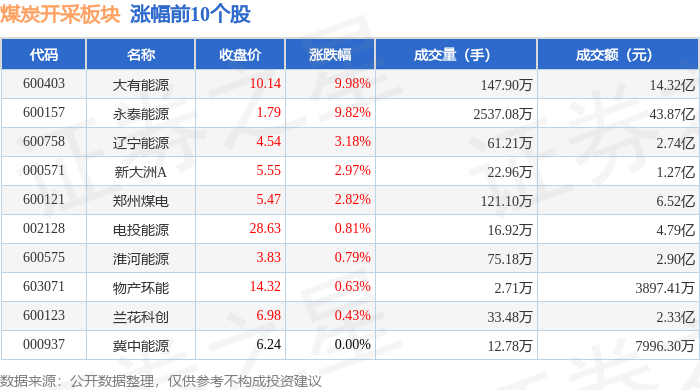
Market Overview - The coal mining sector experienced a decline of 1.1% on November 14, with Jin控煤业 leading the drop [1] - The Shanghai Composite Index closed at 3990.49, down 0.97%, while the Shenzhen Component Index closed at 13216.03, down 1.93% [1] Stock Performance - Major gainers in the coal mining sector included: - Dayou Energy (600403) with a closing price of 10.14, up 9.98% and a trading volume of 1.479 million shares, totaling 1.432 billion yuan [1] - Yongtai Energy (600157) closed at 1.79, up 9.82% with a trading volume of 25.3708 million shares, totaling 4.387 billion yuan [1] - Other notable performers included Liaoning Energy (600758) up 3.18%, and Zhengzhou Coal Electricity (600121) up 2.82% [1] Capital Flow - The coal mining sector saw a net inflow of 739 million yuan from institutional investors, while retail investors experienced a net outflow of 124 million yuan [2][3] - The main capital inflow was observed in Yongtai Energy, with a net inflow of 1.058 billion yuan, accounting for 24.12% of the total [3] Individual Stock Analysis - Yongtai Energy (600157) had significant institutional support with a net inflow of 1.058 billion yuan, while retail investors withdrew 470 million yuan [3] - Dayou Energy (600403) also saw a net inflow of 155 million yuan from institutional investors, but retail investors withdrew 1.05 billion yuan [3] - Other stocks like Xin Dazhou A (000571) and Huai Bei Mining (600985) showed mixed capital flows, with varying levels of institutional and retail investor activity [3]


今日看盘 | 11月14日:3只个股触涨停 山西板块逆势上涨0.21%
Xin Lang Cai Jing· 2025-11-14 07:51
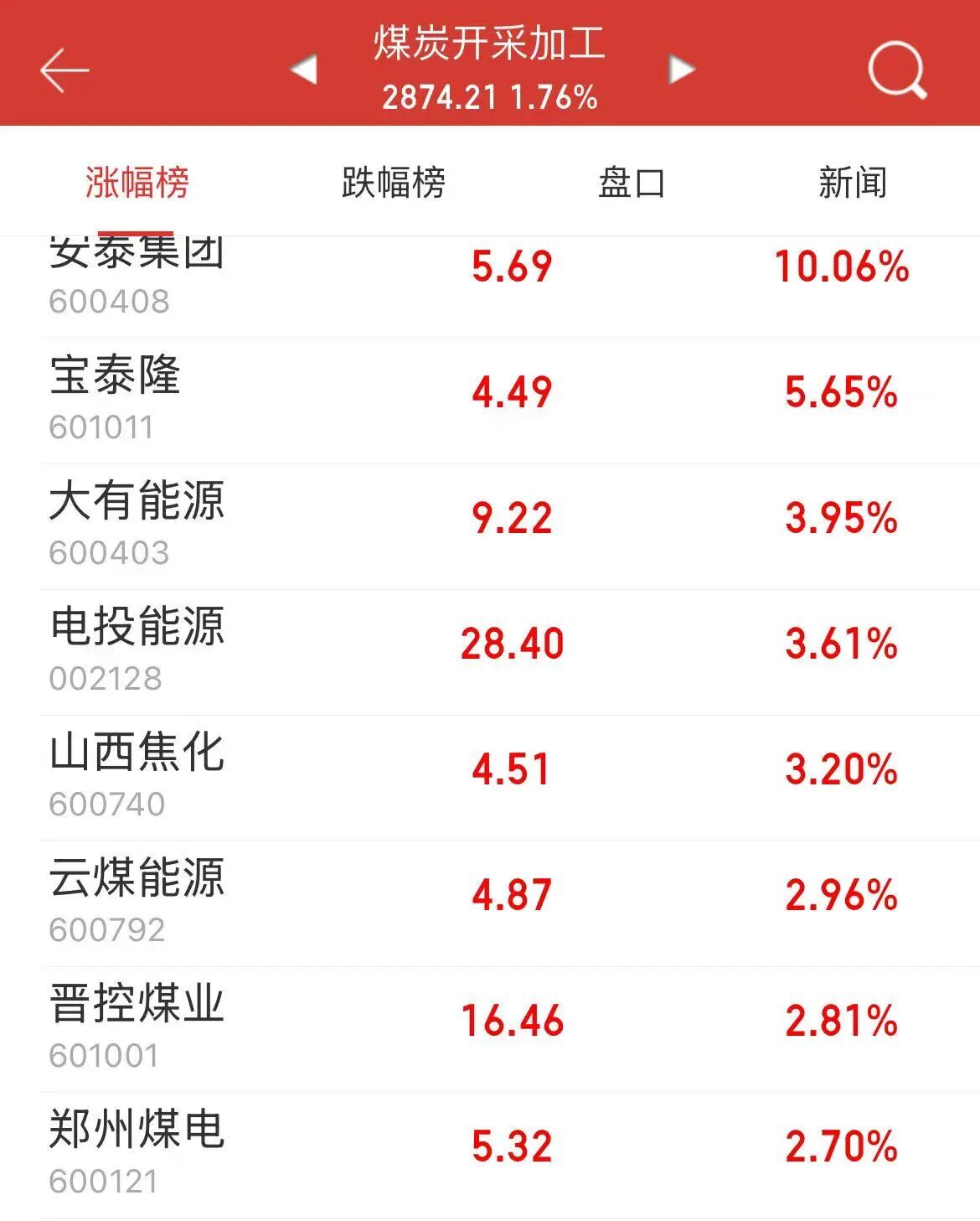
Core Viewpoint - On November 14, the A-share market experienced a collective decline across the three major indices, with the Shanghai Composite Index down by 0.97%, the Shenzhen Component Index down by 1.93%, and the ChiNext Index down by 2.82% [1] Market Performance - The total trading volume in the Shanghai and Shenzhen markets was approximately 1,958.08 billion yuan, a decrease of about 83.88 billion yuan compared to the previous trading day [1] - Out of the total stocks, 1,961 stocks rose while 3,323 stocks fell, with 89 stocks hitting the daily limit up and 9 stocks hitting the daily limit down [1] Sector Performance - The Hainan and Fujian sectors showed strength, with pharmaceutical stocks related to influenza leading in gains, while the gas and photovoltaic equipment sectors also performed well [1] - The storage chip sector underwent a correction, along with adjustments in the CPO and food and beverage sectors [1] Regional Performance - Despite the overall decline in the three major indices, the Shanxi sector demonstrated resilience, with a slight increase of 0.21% on November 14 [1] Individual Stock Performance - In the Shanxi sector, three stocks hit the daily limit up, with China New Energy and Antai Group reaching limit up around 10 AM, ultimately closing with gains of 10.11% and 10.02% respectively; Yongtai Energy also hit limit up in the afternoon, closing with a gain of 9.82% [1] - Additionally, two other stocks in the Shanxi sector rose by over 2%, with Zhendong Pharmaceutical up by 3.08% and Jinlihua Electric up by 2.80% [1] - Leading the decline was Lu Hua Technology, which fell by 4.16% compared to the previous trading day; other notable decliners included Keda Control, Jinkong Coal Industry, Huayang Co., and Northern Copper, with declines of 3.73%, 3.46%, 3.46%, and 3.31% respectively [1]


起飞!寒潮消息引爆,冰雪旅游又火了!
Mei Ri Shang Bao· 2025-11-13 10:26
Coal Industry - The price of thermal coal has risen significantly, surpassing 800 yuan per ton, marking a new high for the year as of November 13 [1][3] - The coal sector has shown strong performance, with key listed coal companies reporting a more than 20% increase in profits in Q3 compared to the previous quarter [3][4] - Factors contributing to the rise in coal prices include extreme weather conditions, with northern regions experiencing significant temperature drops, while southern regions faced higher than average temperatures [3][4] - The coal industry is expected to benefit from a dual attribute of dividends and cyclical characteristics, making it a favored asset for market funds [3] Ice and Snow Tourism Industry - The ice and snow tourism sector has seen a surge, with multiple stocks hitting the daily limit up, driven by events such as the "Qixing Mountain·Camel Cup" wilderness survival challenge [5][6] - The ice and snow industry in China is projected to exceed 1 trillion yuan by 2025, with continuous growth expected due to upcoming major winter sports events [7] - The tourism industry is currently benefiting from a combination of policy incentives and demand release, with recommendations to focus on leading companies in online travel agencies (OTA), comprehensive cultural tourism service providers, and ice and snow tourism leaders [7]


晋控煤业涨2.06%,成交额2.20亿元,主力资金净流出1269.52万元
Xin Lang Cai Jing· 2025-11-13 05:55
Core Viewpoint - Jin Energy Holdings Co., Ltd. has experienced fluctuations in stock performance, with a notable increase in share price and changes in shareholder structure, reflecting the company's operational challenges and market dynamics [1][2]. Group 1: Stock Performance - On November 13, Jin Energy's stock rose by 2.06%, reaching 16.34 CNY per share, with a trading volume of 220 million CNY and a turnover rate of 0.82%, resulting in a total market capitalization of 27.348 billion CNY [1]. - Year-to-date, Jin Energy's stock price has increased by 26.52%, with a 0.55% rise over the last five trading days, 4.68% over the last 20 days, and 15.23% over the last 60 days [1]. Group 2: Financial Performance - For the period from January to September 2025, Jin Energy reported operating revenue of 9.325 billion CNY, a year-on-year decrease of 16.99%, and a net profit attributable to shareholders of 1.277 billion CNY, down 40.65% year-on-year [2]. - Since its A-share listing, Jin Energy has distributed a total of 6.083 billion CNY in dividends, with 3.640 billion CNY distributed over the past three years [2]. Group 3: Shareholder Structure - As of October 20, 2025, the number of Jin Energy shareholders increased to 58,000, with an average of 28,856 circulating shares per shareholder, a decrease of 4.40% from the previous period [2]. - The second-largest circulating shareholder is the Guotai CSI Coal ETF, holding 33.2232 million shares, an increase of 20.2405 million shares from the previous period [2].