联影医疗

Search documents
北京上海发文促进医疗器械产业高质量发展
Zheng Quan Shi Bao· 2025-11-25 18:31
Group 1: Policy Initiatives - Beijing's Economic and Information Technology Bureau, along with five other departments, issued measures to promote high-quality development in the medical device industry, focusing on innovation, clinical research, registration, production, application, cluster development, digital empowerment, and international expansion [1] - Shanghai also released measures to deepen drug and medical device regulatory reforms, encouraging expedited registration for innovative Class II medical devices with significant clinical value [1] Group 2: Market Growth and Projections - The medical device market in China is experiencing steady growth, with the market size projected to increase from 729.8 billion RMB in 2020 to 941.7 billion RMB by 2024, reflecting a compound annual growth rate (CAGR) of 6.6% [2] - By 2035, the overall market size for medical devices in China is expected to reach 1.81 trillion RMB [2] Group 3: Investment Opportunities - Long-term investment opportunities in the medical device sector are identified in innovation, international expansion, and mergers and acquisitions, with a recognition of the sector's innovative and international capabilities leading to a revaluation of its stocks [2] - Following a surge in the innovative drug sector, the medical device sector is seeing recognition for its competitive products, with companies actively pursuing growth strategies to enhance overseas business [2] Group 4: Market Valuation and Performance - As of November 25, the market capitalization of the medical device industry in A-shares reached 1.38 trillion RMB, with major companies like Mindray Medical and United Imaging Healthcare having market caps exceeding 235 billion RMB and 110 billion RMB, respectively [3] - Among 45 medical device stocks with rolling price-to-earnings ratios below 40, 12 stocks have ratios below 20, indicating potential undervaluation [3] - Some stocks have experienced significant price corrections, with 20 stocks retreating over 20% from their yearly highs, and five stocks, including Aibo Medical and Jianfan Biological, seeing declines exceeding 30% [3]


2025年中国医疗大模型行业概览:大模型铸就新引擎,赋能驱动大健康
Tou Bao Yan Jiu Yuan· 2025-11-25 12:45
行业概览 2025/10 www.leadleo.com 2025年中国医疗大模型行业概览: 大模型铸就新引擎,赋能驱动大健康 China Medical Large Model Industry 中国医療用大規模モデル産業 报告标签:人工智能、AI医疗、大模型 主笔人:吕佳睿 报告提供的任何内容(包括但不限于数据、文字、图表、图像等)均系头豹研究院独有的高度机密性 文件(在报告中另行标明出处者除外)。 ,任何人不得以任何方式擅自 复制、再造、传播、出版、引用、改编、汇编本报告内容,若有违反上述约定的行为发生,头豹研究 院保留采取法律措施、追究相关人员责任的权利。头豹研究院开展的所有商业活动均使用"头豹研究院 "或"头豹"的商号、商标,头豹研究院无任何前述名称之外的其他分支机构,也未授权或聘用其他任何 第三方代表头豹研究院开展商业活动。 行业概览 | 2025/10 中国医疗大模型行业 ◼ 中国医疗大模型市场呈现"梯队分化、场景 深耕、生态协同"的竞争格局,行业正向临 床价值与商业化落地加速迈进 中国医疗大模型市场已形成以华为云、晶泰科 技、讯飞医疗、联影智能等为代表的第一梯队, 凭借技术壁垒与商业落地能力主 ...
员工分了18亿
投资界· 2025-11-25 08:38
Core Viewpoint - The article highlights the success story of United Imaging Healthcare, showcasing how employee stock ownership plans have enabled employees to realize significant financial gains, reflecting a broader trend of wealth creation in the A-share market [2][9]. Group 1: Company Overview - United Imaging Healthcare was founded in 2011 by alumni Xue Min and Zhang Qiang, aiming to break the foreign monopoly in high-end medical equipment, and has filled a gap in domestic high-end medical imaging equipment [2][6]. - The company went public on the STAR Market in 2022, achieving a market capitalization of approximately 1,100 billion [2][6]. Group 2: Employee Stock Ownership - Recently, five employee stock ownership platforms of United Imaging Healthcare collectively reduced their holdings by 1,337,000 shares, valued at 1.82 billion [3][5]. - The employee stock ownership plan has benefited over 800 individuals, with an average payout of at least 2 million per person after the recent share reduction [5]. Group 3: Investment and Returns - The article discusses the long-term investment returns for early investors, with notable returns from angel investments made in 2012, leading to significant financial gains for institutional investors [8]. - The trend of wealth creation is not limited to United Imaging Healthcare, as other companies like Century Huatong and Ailisi are also rewarding employees through stock options and share reductions, indicating a broader movement in the A-share market [9][10].

联影医疗公告:员工分了18亿
Sou Hu Cai Jing· 2025-11-25 07:35
Core Viewpoint - The announcement from United Imaging Healthcare regarding the reduction of shares by employee stockholding platforms highlights a significant wealth realization moment for employees, reflecting a narrative of patience and trust in the company's growth journey [1][2]. Group 1: Employee Stockholding and Wealth Realization - United Imaging Healthcare's five employee stockholding platforms collectively reduced their holdings by 13.37 million shares, valued at approximately 1.82 billion yuan [2]. - The employee stockholding plan has benefited over 800 individuals, with an average payout of at least 2 million yuan per person following the recent share reduction [3]. - This is not the first instance of wealth creation through employee stockholding, as a previous reduction in 2024 saw 7.47 million shares sold for about 894 million yuan [3]. Group 2: Company Background and Growth - Founded in 2011 by alumni Xue Min and Zhang Qiang, United Imaging Healthcare aimed to break the foreign monopoly in high-end medical equipment, achieving a market capitalization of approximately 110 billion yuan as of now [1][4]. - The company has developed a range of innovative high-end medical imaging devices, including the 3.0T MRI and 640-slice CT, filling gaps in both domestic and international markets [5]. - United Imaging Healthcare went public on the STAR Market in 2022, with its market value peaking at 170 billion yuan, benefiting both founders and early investors significantly [5]. Group 3: Broader Industry Trends - The trend of wealth creation through employee stock options is becoming more prevalent in the A-share market, with over 1,300 companies announcing stock incentive plans this year, compared to only 381 in 2024 [6]. - Other companies, such as Century Huatong and Ailisi, are also engaging in similar stock incentive programs, indicating a shift towards broader employee participation in company success [6]. - The narrative of wealth distribution is evolving, with employees increasingly sharing in the financial success of their companies, reflecting a shift in the traditional wealth creation model [8].

机构调研、股东增持与公司回购策略周报(20251117-20251121)-20251124
Yuan Da Xin Xi· 2025-11-24 14:07
Group 1: Institutional Research on Popular Companies - The top twenty companies with the highest number of institutional research visits in the last 30 days include United Imaging Healthcare, Lens Technology, Aibo Medical, Sanhua Intelligent Control, and Zhaoyi Innovation [2][13] - In the last 5 days, the most popular companies for institutional research include Ninebot Company-WD, Rongbai Technology, Lens Technology, Yintong Intelligent Control, and Yinglian Co., Ltd [2][15] - Among the top twenty companies in the last 30 days, 19 companies had 10 or more rating agencies involved, with significant profit growth expected for Jiao Cheng Ultrasound, Lanke Technology, and United Imaging Healthcare in Q1-Q3 of 2025 compared to the same period in 2024 [2][13][16] Group 2: Major Shareholder Increase in A-Share Listed Companies - From November 17 to November 21, 2025, five listed companies announced significant shareholder increases, with Changshu Bank increasing its shareholding by more than 1% of total equity, while Huangtai Liquor, Longlide, Fuguang Co., and Feiwo Technology planned to increase their holdings with an average of more than 1% of the market value on the announcement date [3][20] - From January 1 to November 21, 2025, a total of 295 companies announced significant shareholder increases, with 90 of them having 10 or more rating agencies involved. Among these, 23 companies had an average planned increase amount exceeding 1% of the market value on the announcement date, including Xianhe Co., Hubei Yihua, Xinji Energy, and Zhongju Gaoxin [5][22] Group 3: Share Buyback Situation in A-Share Listed Companies - From November 17 to November 21, 2025, 65 companies announced their buyback progress, with 16 companies having 10 or more rating agencies involved. Five companies had an average planned buyback amount exceeding 1% of the market value on the announcement date, with a focus on Jian Sheng Group, Trina Solar, and Prologis Pharmaceuticals [4][25] - From January 1 to November 21, 2025, a total of 1,805 companies announced their buyback progress, with 344 of them having 10 or more rating agencies involved. Among these, 88 companies had a significant buyback ratio, with two companies, Huaming Equipment and Prologis Pharmaceuticals, still in the board proposal stage [6][27]




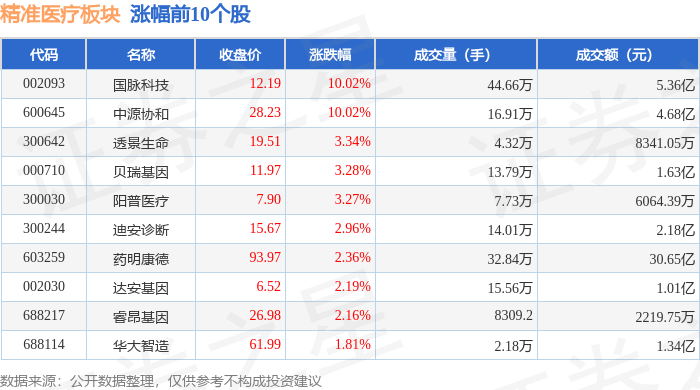
精准医疗板块11月24日涨1.92%,国脉科技领涨,主力资金净流入5.26亿元
Sou Hu Cai Jing· 2025-11-24 09:19
Core Insights - The precision medicine sector experienced a 1.92% increase on November 24, with Guomai Technology leading the gains [1] - The Shanghai Composite Index closed at 3836.77, up 0.05%, while the Shenzhen Component Index closed at 12585.08, up 0.37% [1] Stock Performance - Guomai Technology (002093) closed at 12.19, up 10.02% with a trading volume of 446,600 shares and a transaction value of 536 million [1] - Zhongyuan Xiehe (600645) also rose by 10.02% to 28.23, with a trading volume of 169,100 shares and a transaction value of 468 million [1] - Other notable performers include: - Toukeng Life (300642) at 19.51, up 3.34% [1] - Beirui Gene (000710) at 11.97, up 3.28% [1] - Yangjin Medical (300030) at 7.90, up 3.27% [1] Capital Flow - The precision medicine sector saw a net inflow of 526 million from institutional investors, while retail investors experienced a net outflow of 143 million [2] - The main capital inflow and outflow for key stocks include: - WuXi AppTec (603259) with a net inflow of 251 million [3] - Guomai Technology (002093) with a net inflow of 241 million [3] - Zhongyuan Xiehe (600645) with a net inflow of 102 million [3]




医药生物行业跨市场周报(20251124):小核酸药物风起云涌,下一代创新药浪潮呼之欲出-20251124
EBSCN· 2025-11-24 08:12
Investment Rating - The report maintains a "Buy" rating for several companies including Tian Shi Li, Xin Da Biology, and WuXi AppTec, with a focus on the innovative drug industry and high-end medical devices [3][25]. Core Insights - The small nucleic acid drug sector is experiencing significant advancements, marking the dawn of a new wave of innovative drugs. The industry is entering a golden development period driven by technological breakthroughs and commercial validation, with a recommendation to focus on leading innovative drug companies and those benefiting from the overall industry upturn [1][20][24]. Summary by Sections Market Review - The A-share pharmaceutical and biotechnology index fell by 4.32%, underperforming the CSI 300 index by 0.54 percentage points, while outperforming the ChiNext index by 1.92 percentage points, ranking 30th among 31 sub-industries. The H-share Hang Seng Healthcare Index dropped by 7.5%, underperforming the Hang Seng Index by 2.41 percentage points [1][15][9]. R&D Progress - Recent IND applications have been initiated for Heng Rui Medicine's HRS-1358 and HRS-3738, and clinical applications for SHR-9539 and JS207 have also been newly undertaken. Additionally, Zheng Da Tian Qing's TQB2934 is in Phase I clinical trials, while Gan Li Pharmaceutical's Bo Fan Gu Lu Tai is in Phase III [1][28]. Key Company Recommendations - The report highlights key companies to watch, including Heng Rui Medicine (A+H), Xin Da Biology (H), WuXi AppTec (A+H), Qian Yan Biology, Chengdu Xian Dao, and Jian Kai Technology, focusing on those with leading technology platforms and differentiated pipelines [1][25][24]. Investment Strategy - The report emphasizes the importance of clinical value in the pharmaceutical sector, suggesting that investments should focus on innovative drug chains and medical devices that meet clinical needs. The strategy is based on a three-stage clinical value framework [2][24]. Financial Forecasts - The report provides earnings per share (EPS) forecasts for key companies, with Tian Shi Li projected at 0.64 CNY for 2024, Xin Da Biology at -0.06 CNY, and WuXi AppTec at 3.27 CNY for 2024, indicating a positive outlook for several firms [3].


华为发布AI容器技术Flex:AI,国产算力再次突破
China Post Securities· 2025-11-24 05:50
Investment Rating - The industry investment rating is "Outperform the Market" and is maintained [1] Core Insights - The report highlights the launch of Huawei's AI container technology Flex:ai, which addresses the low utilization efficiency of computing power in the industry, currently averaging only 30% to 40%. Flex:ai enhances utilization by 30% through precise segmentation of GPU/NPU resources [4][5] - The report emphasizes the unique advantages of Flex:ai over Nvidia's Run:ai, particularly in virtualization and intelligent scheduling, which can optimize resource allocation for AI workloads [5][6] - The development of Flex:ai is seen as a significant step in strengthening domestic computing power capabilities, promoting a complete open-source ecosystem for AI tools [6][7] Summary by Sections Industry Overview - The closing index is at 5068.36, with a 52-week high of 5841.52 and a low of 3963.29 [1] Performance Analysis - The relative performance of the computer industry compared to the CSI 300 index shows fluctuations, with a notable decline of 13% from November 2024 to November 2025 [3] Key Developments - Huawei's Flex:ai is positioned to significantly improve AI cluster computing efficiency and reduce migration barriers for AI models, reinforcing the software capabilities in the domestic computing landscape [6][7] - The report suggests monitoring companies involved in AI containers and domestic computing power, including BoRui Data, Haohan Deep, and others [7]
万丰奥威目标价涨幅近90%;太阳能等7家公司评级被调低|券商评级观察
2 1 Shi Ji Jing Ji Bao Dao· 2025-11-24 01:05
Group 1 - The core viewpoint of the articles highlights significant changes in stock ratings and target prices for various companies, with notable increases for Wan Feng Ao Wei, Guang Xun Technology, and Tai Chen Guang [1] - Wan Feng Ao Wei's target price increased by 89.64%, Guang Xun Technology by 81.99%, and Tai Chen Guang by 71.51%, all within the automotive parts and communication equipment sectors [1] - A total of 408 companies received broker recommendations during the period, with Yili receiving 5 recommendations, and Top Group and United Imaging Medical receiving 4 each [1] Group 2 - Three companies had their ratings upgraded, including Huadong Heavy Machine from "Hold" to "Buy" by Caixin Securities, Sinopec from "Add" to "Buy" by Huatai Securities, and Hongyuan Electronics from "Add" to "Buy" by CITIC Securities [1] - Seven companies had their ratings downgraded, including Solar Energy from "Strong Buy" to "Recommended" by Huachuang Securities, Source Technology from "Buy" to "Add" by Western Securities, and Titan Technology from "Strong Buy" to "Recommended" by Huachuang Securities [1] - During the same period, 77 instances of first-time coverage were reported, with Delijia receiving an "Outperform" rating from Guosen Securities, and YTO Express, Yanjiang Co., and Far East Co. receiving "Add" or "Buy" ratings from various brokers [2]



2025出海标杆榜单揭晓:做好世界的合伙人
虎嗅APP· 2025-11-23 13:41
Core Insights - The article discusses the transformation of Chinese companies in their overseas expansion, marking the beginning of "Overseas 2.0" era, characterized by a shift from price competition to organizational strength, innovation, and localized operations [2][3]. Group 1: Strategic Upgrades - In the past year, there has been a significant upgrade in overseas strategies, with more companies establishing global operational systems, transitioning from product export to brand export [3]. - Many manufacturing and emerging consumer brands are setting up localized teams and data management units in specific regions, enhancing innovation, service, and marketing at community and user touchpoints [3][4]. Group 2: External Challenges - The external environment for overseas expansion is becoming increasingly complex, with geopolitical factors significantly impacting companies' strategies [4]. - Trade barriers in Europe and the U.S., data protection regulations in Southeast Asia, and market access issues in the Middle East require companies to possess higher strategic sensitivity and local adaptability [4][5]. Group 3: Local Adaptation and Risk Management - Compliance has become a critical threshold, necessitating that Chinese companies develop cross-border risk control and emergency response capabilities [5]. - Companies are moving from a "hit-and-run" approach to a more rooted strategy, focusing on local talent, data, ecosystems, and teams to withstand external risks and achieve resilient growth [5][6]. Group 4: Evolving Competitive Landscape - The competitive landscape and philosophies of Chinese companies are evolving, transitioning from product sales to creating value ecosystems [6]. - The most promising sectors for overseas expansion by 2025 include smart manufacturing, consumer electronics, renewable energy, and cross-border e-commerce brands [7][8]. Group 5: Benchmark Enterprises - The article emphasizes that true benchmark enterprises are not just defined by high revenue or size but by their continuous evolution of capabilities and ecological innovation [11][12]. - The evaluation criteria for benchmark enterprises include innovation capability, localization, organizational resilience, and sustainable growth [12]. Group 6: Award Winners - The article lists several companies recognized for their outstanding performance in overseas markets, including Haier, Lenovo, Midea, Didi, and Changan Automobile, highlighting their contributions to global brand building and market penetration [16][19][20][21][22][23][24][25][26][27][28]. - New emerging companies like United Imaging, Baseus, and Fantuan are also acknowledged for their rapid rise and innovative business models in overseas markets [30][31][32][33][34][35][36][37][38][39]. Group 7: Service Providers - The article identifies key service providers that support overseas enterprises, including logistics, marketing, and payment solutions, which help lower the barriers for Chinese brands to reach global users [41][42][43][44][45][46][47][48][49][50][51]. Group 8: Future Outlook - The future of Chinese companies' overseas expansion is expected to be defined by the integration of localization capabilities, data-driven strategies, and ecological collaboration [51]. - The evolution of Chinese brands in the global market is not a sprint but a long-term contest of organizational strength, innovation, and belief [51].