
云顶新耀

Search documents
交银国际每日晨报-20250704
BOCOM International· 2025-07-04 01:04
Core Insights - The report highlights a strong performance of Hong Kong stocks in the first half of 2025, with the Hang Seng Index and Hang Seng Tech Index recording returns of 20% and 18.7% respectively, placing them among the top global indices [3][4] - The report identifies a structural tilt in southbound capital allocation towards healthcare and financial sectors, while foreign capital remains focused on technology, indicating a preference for long-term competitiveness and valuation recovery in Hong Kong tech firms [3][4] Southbound Capital Trends - Southbound capital has increased holdings across various sectors, with notable rotations from information technology in Q1 to new consumption in early Q2, and a recent concentration in healthcare and financial sectors [3] - The report notes that foreign capital has marginally increased its position in the information technology sector, while other sectors have seen a decline in market value [3][4] Short Selling Dynamics - The report discusses the short selling landscape, indicating high levels of short selling in cyclical sectors such as telecommunications, real estate, energy, and materials, with minimal changes observed [4] - Consumer sectors show a clear divergence, with stable essential consumption contrasting with rising short selling in discretionary consumption [4] - The concentration of short selling in the information technology sector is decreasing, suggesting a convergence of long and short positions, which may indicate reduced volatility and the potential for upward trends [4] Investment Opportunities - The technology sector is highlighted as having significant investment value, supported by foreign capital's continued investment and the convergence of short selling positions, which may lead to lower volatility and emerging trends [4] - The report emphasizes that a transition from a structural market to a comprehensive upward trend in Hong Kong stocks requires stronger fundamental support and policy catalysts [4]
交银国际每日晨报-20250703
BOCOM International· 2025-07-03 02:24
Group 1: Northern Huachuang (北方华创) - The company is positioned as a leading domestic semiconductor equipment manufacturer, showcasing both growth potential and resilience [1] - The domestic semiconductor equipment market share in China has increased from 13% in 2015 to an estimated 42% in 2024, with Northern Huachuang expected to double its market share by 2025 compared to 2020 [2] - The company’s current valuation at 27 times NTM P/E is close to historical lows, suggesting an attractive investment opportunity with a target price of RMB 530, indicating a potential upside of 19.6% [2] Group 2: Genscript Biotech (云顶新耀) - The company is advancing its platform for reversible mRNA therapies, with promising data from multiple drug candidates [3] - The EVM16 candidate has shown efficacy in mouse models and demonstrated synergy with PD-1 antibodies, while EVM14 is progressing through preclinical studies with potential for inducing immune memory [4] - The EVER001 study for treating membranous nephropathy has reported significant immunological responses, with antibody levels dropping by over 60% after 8-12 weeks [4][7] Group 3: Photovoltaic Industry - Recent policy discussions indicate a shift towards addressing the challenges faced by the photovoltaic industry, with expectations for substantive policies to emerge [8] - The report highlights opportunities for leading photovoltaic manufacturers, particularly in glass and silicon production, as the industry seeks to overcome competitive pressures [8] Group 4: Automotive Industry - The report notes a slowdown in the month-on-month growth of new energy vehicle deliveries, with a 17.7% year-on-year increase across 11 manufacturers [9] - BYD's June sales reached 377,628 units, reflecting an 11% year-on-year growth, while Xiaomi's deliveries exceeded 25,000 units despite slight month-on-month declines [10][11] - The overall market is expected to continue its growth trajectory in July, driven by new model launches from various manufacturers [11]


云顶新耀(1952.HK):MRNA平台开发稳步推进 可逆BTK膜性肾病数据优异;上调目标价
Ge Long Hui· 2025-07-02 18:29
Core Insights - The company showcased its fully integrated and localized AI + mRNA platform during a recent R&D day, highlighting advancements in multiple mRNA cancer therapeutics [1] - The company has updated promising data on its reversible BTK inhibitor EVER001 for treating membranous nephropathy, indicating significant immunological and clinical responses [1][2] Group 1: AI + mRNA Platform Developments - The personalized cancer therapeutic vaccine EVM16 has shown efficacy in mouse melanoma models and demonstrated synergy with PD-1 antibodies, with initial IIT research results indicating a strong T cell response even at low starting doses [1] - The universal on-demand cancer therapeutic vaccine EVM14 targets five tumor-associated antigens and has shown potential in inducing immune memory and reducing tumor recurrence, with ongoing dual submissions in China and the U.S. [1] - The autologous CAR-T project has been validated in animal models, showcasing advantages such as on-demand availability, no lymphodepletion requirement, and controllable dosing, indicating potential for treating tumors and autoimmune diseases [1] Group 2: EVER001 Updates - The company reported Phase Ib/IIa data for the covalent reversible BTK inhibitor EVER001 in treating membranous nephropathy, with significant reductions in anti-PLA2R antibodies and urinary protein levels observed [1] - After 36 weeks of treatment, the high-dose group maintained a 100% rate of complete immunological and clinical response post-treatment [1] - The potential market for membranous nephropathy is substantial, with 2 million patients in China and 180,000 in Europe and the U.S., and no approved drugs globally [1] - The company plans to release 52-week follow-up data in September and is exploring potential registration pathways with regulatory agencies in China and the U.S. [1] - Discussions are ongoing with potential partners regarding business development opportunities and the possibility of using EVER001 for other B cell-mediated autoimmune diseases [1] Group 3: Financial Projections - The company has adjusted its 2025-2027 profit forecasts to reflect a more cautious outlook on product revenue growth but has included EVER001 in its long-term financial projections, expecting peak sales to exceed 1.5 billion RMB [2] - The target price has been raised to 72.5 HKD, corresponding to a target valuation of 23.7 billion HKD and a price-to-sales ratio of 1.8 times at peak revenue [2]
云顶新耀(01952):mRNA平台开发稳步推进,可逆BTK膜性肾病数据优异;上调目标价
BOCOM International· 2025-07-02 08:06
Investment Rating - The report assigns a "Buy" rating to the company, with a target price of HKD 72.50, indicating a potential upside of 16.6% from the current closing price of HKD 62.20 [1][27]. Core Insights - The mRNA platform development is progressing steadily, with excellent data on the reversible BTK inhibitor for membranous nephropathy. The target price has been raised to reflect these developments [2][6]. - The company has showcased its fully integrated and localized AI + mRNA platform, highlighting several mRNA tumor drug developments, including personalized and universal therapeutic vaccines [6]. - The reversible BTK inhibitor EVER001 has shown promising results in clinical trials for treating membranous nephropathy, with significant reductions in anti-PLA2R antibody levels and urinary protein levels [6]. Financial Overview - Revenue projections for the company are as follows: - 2023: RMB 126 million - 2024: RMB 707 million - 2025E: RMB 1,660 million - 2026E: RMB 2,552 million - 2027E: RMB 3,752 million - Year-on-year growth rates are projected at 884.5% for 2023, 461.2% for 2024, and 134.9% for 2025 [5][28]. - The net profit (loss) is expected to improve from a loss of RMB 844 million in 2023 to a profit of RMB 743 million by 2027 [5][28]. - The company’s market capitalization is approximately HKD 20.2 billion, with an average daily trading volume of 13.36 million shares [3]. Valuation Metrics - The report indicates a peak sales estimate for EVER001 exceeding RMB 1.5 billion, with a target valuation of HKD 72.50 corresponding to a market cap of HKD 237 billion and a price-to-sales ratio of 1.8 times at peak revenue [6][24]. - The company’s financial forecasts have been adjusted, reflecting a more cautious outlook on product revenue ramp-up, with slight downward revisions in revenue estimates for 2025-2027 [6][23].
云顶新耀宣布治疗原发性膜性肾病的新型BTK抑制剂EVER001在1b/2a期临床试验最新阶段性数据,持续展现优异的有效性与安全性
Ge Long Hui· 2025-07-01 12:22
Core Viewpoint - The latest phase data from the 1b/2a clinical trial of EVER001 shows promising efficacy and safety in treating primary membranous nephropathy (pMN), supporting its potential as a treatment for autoimmune glomerular diseases characterized by proteinuria [2][3][4]. Group 1: Clinical Trial Results - As of March 21, 2025, the ongoing 1b/2a clinical trial has collected long-term data, with 11 patients in the low-dose group followed for 52 weeks, and 16 and 12 patients in the high-dose group completing 24 and 36 weeks of treatment, respectively [1][3]. - The geometric mean levels of anti-PLA2R antibodies decreased by 62.2% and 87.3% in the low and high-dose groups at 12 weeks, with both groups showing over 93% reduction at 24 weeks [1][3]. - The 24-hour proteinuria geometric mean values decreased by 57.0% and 67.6% at 24 weeks for the low and high-dose groups, respectively, with further reductions to 76.7% and 80.6% at 36 weeks, maintained until the 52-week follow-up [4][5]. Group 2: Safety and Tolerability - EVER001 demonstrated good safety and tolerability, with most adverse events being mild to moderate and transient, consistent with previous observations [1][3][6]. - No clinically significant adverse events commonly associated with other BTK inhibitors, such as bleeding or severe infections, were observed [3][6]. Group 3: Market Potential and Future Development - The company aims to accelerate the global clinical development of EVER001, which has the potential to address the unmet medical needs of over 10 million patients with pMN and other autoimmune kidney diseases [5][15]. - Currently, there are no approved drugs for the treatment of pMN globally, highlighting the significant market opportunity for EVER001 [4][6]. - The company plans to initiate Phase 3 clinical trials and engage with regulatory authorities in the U.S. and China to expedite the development process [6][17]. Group 4: Mechanism and Advantages - EVER001 is a next-generation covalent reversible BTK inhibitor, offering advantages such as better selectivity and reduced off-target toxicity compared to traditional irreversible BTK inhibitors [5][13]. - The drug's mechanism allows for rapid and sustained immune and clinical responses, with significant reductions in antibody levels and proteinuria observed early in treatment [11][12][13]. Group 5: Broader Applications - The company believes that EVER001 may also be effective for other autoimmune diseases, including IgA nephropathy and lupus nephritis, due to its mechanism of action [15][18]. - There is a significant unmet need in these conditions, with millions of patients potentially benefiting from this treatment [15][18].


mRNA巨头亏损背后,中国药企能否接棒下一个增长极
2 1 Shi Ji Jing Ji Bao Dao· 2025-07-01 04:53
Core Insights - The mRNA industry is transitioning from a pandemic-driven boom to a critical transformation phase, with significant potential in cancer immunotherapy and personalized medicine [1][6][7] - Major players like BioNTech and Moderna are adjusting their strategies in response to declining revenues from COVID-19 vaccines, focusing on expanding their cancer treatment pipelines [6][7] Industry Developments - mRNA technology has shown promise in various applications beyond vaccines, including therapeutic vaccines, cancer immunotherapy, and regenerative medicine [4][5] - The market potential for mRNA cancer vaccines is projected to reach hundreds of billions of dollars, driven by their accessibility and personalization capabilities [1][4] Company Strategies - BioNTech has made strategic acquisitions to enhance its capabilities in mRNA cancer immunotherapy, including a $1.25 billion acquisition of CureVac [1] - Moderna is facing financial challenges, with a projected revenue drop of 33% in 2025, leading to workforce reductions [6][7] Market Dynamics - The Chinese mRNA sector is experiencing a bifurcation, with some companies like Simao Biotechnology facing financial difficulties, while others are making significant advancements [8][9] - Chinese companies are gaining international recognition, with successful FDA approvals for innovative mRNA cancer vaccines [9] Future Outlook - The mRNA industry is expected to evolve towards a model where drug development is based on "coding nucleic acid sequences," potentially revolutionizing treatment for various diseases [5][10] - The success of Chinese mRNA companies in the competitive landscape will depend on their ability to leverage business development opportunities for rapid monetization [10]
创新药全链条支持政策落地!恒生医疗ETF(513060)溢价交投火爆,估值修复双击启动
Sou Hu Cai Jing· 2025-07-01 03:44
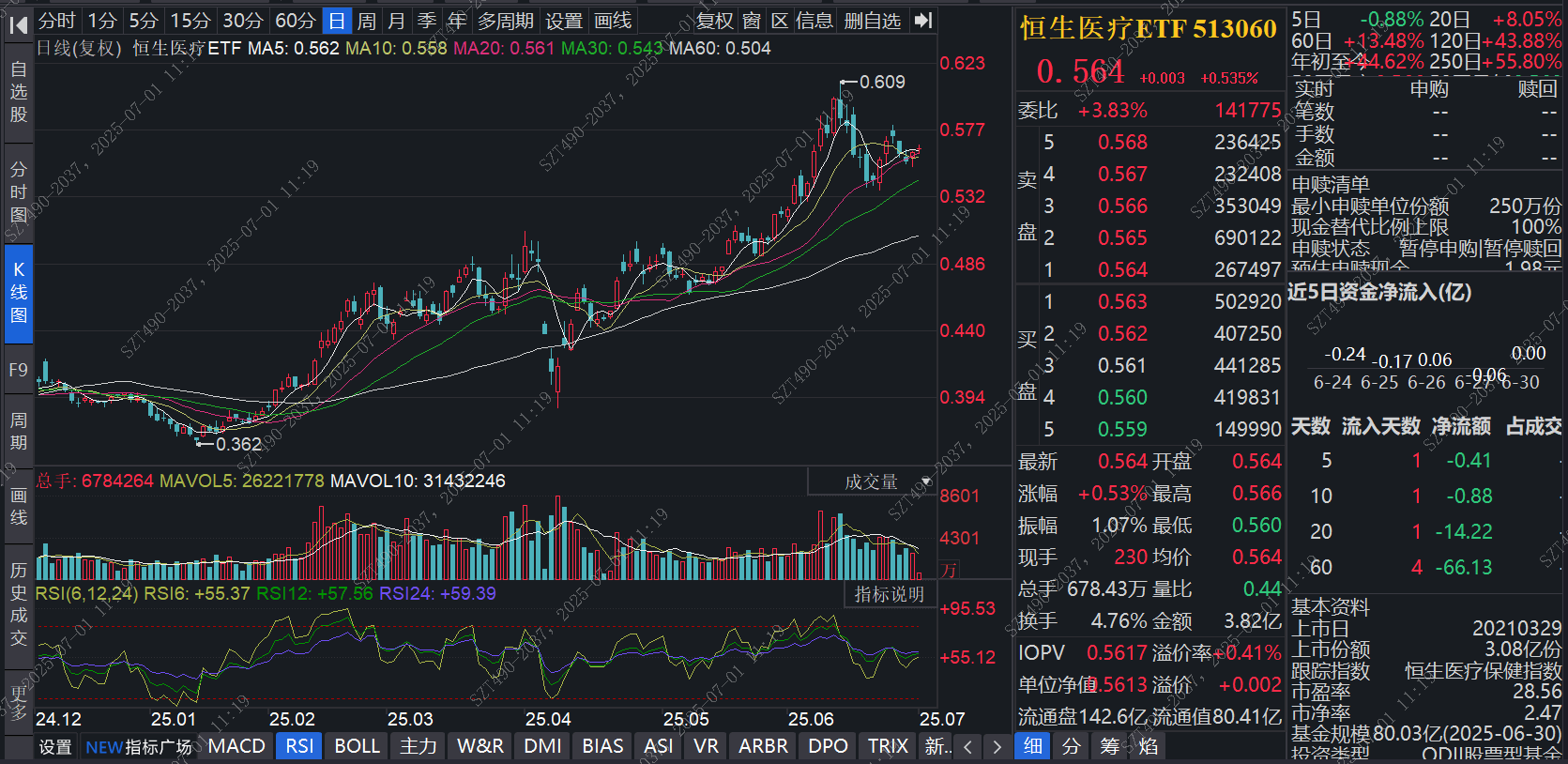
Core Insights - The article highlights the significant policy changes aimed at supporting the development of innovative drugs in China, marking a new phase of systematic support for the industry [2][3][6] Group 1: Policy Framework - The policy document establishes a comprehensive support framework covering the entire lifecycle of innovative drugs, focusing on breaking through key bottlenecks in research, approval, payment, and application [3][4] - A major breakthrough is the strategic use of medical insurance data, which will be centralized on a national platform to inform drug development decisions, representing a milestone in the utilization of medical insurance data in China [3][4] - The introduction of a "commercial health insurance innovative drug catalog" creates a tiered protection system, allowing high-value innovative drugs to operate in an independent market space [3][4] Group 2: R&D and Market Transformation - The policy drives innovation in drug development and market transformation through multi-level institutional design, encouraging insurance capital to form "patient capital" to address long-term funding challenges [4][6] - A dual-track mechanism for dynamic adjustment of the medical insurance catalog and targeted policy guidance for enterprises significantly enhances approval efficiency [4][6] - The establishment of a multi-faceted payment system supports innovative drug cases exempt from payment by disease type, optimizing cash flow through prepayment and immediate settlement [4][5] Group 3: Implementation Challenges - The effective execution of the policy faces systemic challenges, particularly in hospital management efficiency and the awareness of clinical physicians regarding new drugs [5][6] - Data security and compliance boundaries require careful attention, as the specifics of operational standards and privacy protection need to be clarified [5][6] - The sustainability of payment capabilities is a long-term issue, necessitating a delicate balance between fund capacity and innovation incentives [5][6] Group 4: Strategic Shift and Global Competitiveness - The policy signifies a strategic shift towards a "demand-driven" model for innovative drug development, enhancing patient access and international competitiveness [6] - It emphasizes the importance of collaboration among various departments to leverage medical insurance data for research decisions and to break down barriers to clinical accessibility [6] - The policy also supports the globalization of innovative drugs through platforms in Hong Kong and Macau, aiming to convert domestic market advantages into international influence [6] Group 5: Investment Opportunities - The Hengsheng Medical ETF (513060) is positioned as a core vehicle for investing in innovative drugs, benefiting from the scarcity of underlying assets and the anticipated commercial value reassessment [7] - The ETF's holdings include leading companies that are direct beneficiaries of the policy changes, with over 40% of its biotech companies having overseas rights [7] - The article suggests that the policy is not a short-term benefit but rather a long-term growth engine through data-enabled research and dual-track payment systems [7]
创新药迎投资元年!如何穿越周期迷雾?两大绩优基金经理最新研判
券商中国· 2025-06-30 09:58
Core Viewpoint - The article emphasizes the transformative opportunities in the innovative pharmaceutical sector, predicting that 2025 will mark a significant year for revenue growth, profit breakthroughs, and valuation increases in the industry [4][5]. Group 1: Innovative Drug Investment Outlook - The innovative drug sector is entering a "three-dimensional screening era" characterized by major disease categories, clinical data validation, and global competition [4]. - 2025 is anticipated to be the starting point for collective revenue growth among innovative drug companies, with 80% of A-share and Hong Kong-listed innovative drug firms expected to see revenue increases following 2024's medical insurance negotiations [5]. - The period from 2025 to 2028 is projected to be crucial for many Chinese innovative drug companies to enter profitability, contrasting with previous years where only a few companies achieved profits [5]. Group 2: Key Investment Areas in Innovative Drugs - Focus areas for investment include: 1. Bispecific antibodies, with the first approved product in China and several in late-stage clinical trials [8]. 2. Antibody-drug conjugates (ADCs), where domestic companies lead in the development of the next generation of ADCs [8]. 3. Targeted therapies, with the global oncology drug market exceeding $150 billion, and a significant share expected to come from domestic small molecules by 2030 [8]. 4. Autoimmune diseases, driven by environmental factors and improved insurance coverage, with a focus on kidney disease drugs showing substantial growth [8]. Group 3: Investment Strategy and Methodology - The investment strategy in the pharmaceutical sector is based on three selection criteria: 1. Focus on large market spaces, such as oncology and metabolic diseases, to mitigate R&D risks [10]. 2. Prefer clear competitive landscapes, such as orphan drugs, with minimal competition expected in the next three years [10]. 3. Target products with optimal clinical data, avoiding those that do not meet top-tier standards [10]. Group 4: Insights from Fund Managers - Fund manager Wu Qingyu emphasizes the importance of absolute return thinking, focusing on high-growth sectors while maintaining valuation discipline [11][12]. - Wu's investment approach combines top-down and bottom-up strategies, selecting high-growth industries and then identifying companies with superior growth rates and matching valuations [15]. - The focus on concentrated holdings is driven by strong research conclusions, aiming for higher alpha returns through precise stock selection [17]. Group 5: Future Investment Directions - Wu Qingyu identifies three key sectors for future investment: 1. AI computing power, driven by increased domestic demand for servers and capital investments from companies like ByteDance [19]. 2. Investment opportunities in "AI new hardware" arising from the integration of AI models with downstream hardware [19]. 3. The automotive sector's trend towards smart technology, with certain domestic manufacturers expected to gain market share [19].

从授权引进到创新引领:云顶新耀AI+mRNA平台成型,重塑国际竞争力
Ge Long Hui· 2025-06-30 00:54
Core Insights - The article highlights the advancements of CloudTop New Medicine (1952.HK) in the mRNA technology platform, showcasing its dual-driven strategy that combines cash flow from licensed products with long-term value creation through self-developed mRNA platforms [1][7]. AI Empowerment and Global Competitive Barriers - The latest research indicates that mRNA vaccines have the potential to induce immune memory, effectively preventing tumor recurrence and metastasis [2]. - CloudTop has developed an AI-driven system, EVER-NEO-1, which outperforms international peers in identifying tumor neoantigens, demonstrating superior predictive capabilities [3]. - The company has established a proprietary LNP (lipid nanoparticle) delivery technology platform, with over 500 proprietary lipids, ensuring effective and safe delivery of mRNA therapies [3]. Tumor Treatment Matrix - CloudTop has created a comprehensive tumor treatment matrix that includes personalized mRNA vaccines, off-the-shelf vaccines, and autologous CAR-T therapies [4]. - The EVM16 personalized mRNA vaccine has shown efficacy in preclinical models and is currently in clinical trials, with promising initial results [4]. - The EVM14 off-the-shelf vaccine targets five tumor-associated antigens and is set to begin a global multi-center Phase I clinical trial [5]. Strategic Transformation and Dual-Driven Strategy - The mRNA breakthroughs signify a strategic transformation for CloudTop, moving from a drug commercialization entity to a technology-driven innovative pharmaceutical company [7]. - The company has established a commercial matrix with three key licensed products, expected to generate peak sales of 1.5 billion, 5 billion, and 5 billion respectively, providing a stable cash flow for long-term investments in mRNA technology [7]. - CloudTop's mRNA platform has attracted interest from top global pharmaceutical companies, enhancing its international collaboration and commercialization prospects [8].
平安基金周思聪——创新药投资有望迎来收入放量盈利突破估值抬升元年
Zheng Quan Shi Bao· 2025-06-29 17:55
Core Viewpoint - The innovative drug sector is entering a golden investment window, with expectations for significant revenue growth, profitability breakthroughs, and valuation increases by 2025, marking a systemic investment opportunity in the industry [1][2]. Summary by Relevant Sections Investment Outlook - The innovative drug sector has recently experienced a slight pullback, but this does not alter the long-term growth logic of the industry. As the fundamentals trend upward, the sector is expected to attract more long-term capital once volatility stabilizes [2]. - 2025 is anticipated to be a pivotal year for the Chinese innovative drug industry, characterized as the "three milestone years" for revenue growth, profitability, and valuation uplift [2]. Market Dynamics - The market landscape has shifted significantly, moving away from fierce competition for funds among innovative drugs, AI, and robotics, to a more favorable environment for innovative drugs [2]. - From 2025 to 2028, a critical phase for profitability is expected, with many companies entering a profitability cycle simultaneously, which historically indicates a new phase of systemic strength for the sector [2]. Key Investment Areas - Investment focus should be on major disease categories, particularly in four key areas: 1. Bispecific antibodies, with several products in late-stage clinical trials [3]. 2. Antibody-drug conjugates (ADCs), where domestic companies lead in global research and development [3]. 3. Targeted therapies, with the global oncology market exceeding $150 billion [3]. 4. Autoimmune diseases, driven by environmental factors and improved insurance coverage [3]. Specific Company Insights - In the autoimmune disease sector, companies like Yunding Xinyao, which specializes in kidney disease treatments, have shown significant stock performance, with a more than 700% increase since Q4 2022 [4]. Competitive Landscape - The integration of AI in drug development is expected to enhance efficiency, particularly benefiting the contract research organization (CRO) sector. AI's application in areas like imaging and pathology is also anticipated to expand market opportunities [5]. - Investment selection criteria include focusing on large market spaces, clear competitive landscapes, and optimal clinical data, emphasizing the need for "top performers" in the industry [6].