浙商证券

Search documents
华虹公司股价涨5.16%,浙商证券资管旗下1只基金重仓,持有4000股浮盈赚取2.22万元
Xin Lang Cai Jing· 2025-12-29 02:11
资料显示,华虹半导体有限公司位于上海张江高科技园区哈雷路288号,香港中环夏悫道12号美国银行中 心2212室,成立日期2005年1月21日,上市日期2023年8月7日,公司主营业务涉及华虹半导体有限公司 是一家主要从事特色工艺晶圆代工的中国投资控股公司。该公司提供包括嵌入式/独立式非易失性存储 器、功率器件、模拟与电源管理、逻辑与射频等多元化特色工艺平台的晶圆代工及配套服务。该公司还 从事提供包括知识产权(IP)设计、测试等配套服务。该公司主要在国内市场从事其业务。主营业务收 入构成为:集成电路晶圆代工94.60%,其他4.78%,租赁收入0.62%。 12月29日,华虹公司涨5.16%,截至发稿,报112.94元/股,成交6.08亿元,换手率1.34%,总市值 1960.64亿元。 从基金十大重仓股角度 数据显示,浙商证券资管旗下1只基金重仓华虹公司。浙商鼎盈事件驱动混合(LOF)(169201)三季度 持有股数4000股,占基金净值比例为5%,位居第三大重仓股。根据测算,今日浮盈赚取约2.22万元。 浙商鼎盈事件驱动混合(LOF)(169201)基金经理为张雷。 截至发稿,张雷累计任职时间291天,现任 ...

十大券商看后市|A股中线看多,“跨年+春季”行情有望持续
Xin Lang Cai Jing· 2025-12-29 00:33
Group 1 - The core viewpoint is that the A-share market is expected to experience a "cross-year + spring" rally, supported by favorable conditions such as liquidity and risk appetite [1][7][13] - Spring market conditions remain favorable due to loose liquidity, with private equity actively purchasing on dips and the appreciation of the RMB benefiting market liquidity [1][6] - Historical trends indicate that the A-share market typically experiences a "spring rally," and policy support is expected to continue, bolstering market confidence and attracting various funds [1][14] Group 2 - The market is anticipated to see a "systematic slow bull" trend, with a high level of confidence in the medium-term outlook, although short-term movements may require cautious observation [2][11] - The A500 ETF has shown significant net inflows, indicating stable incremental funds entering the market, despite potential seasonal outflows in the following quarter [12][7] - The appreciation of the RMB is expected to resonate with the capital market, enhancing industry configurations and attracting foreign investment [10][9] Group 3 - The focus on structural opportunities in a volatile market suggests that sectors with low attention but high long-term ROE potential, such as chemicals and engineering machinery, should be prioritized [3][15] - The "transformation bull" market is characterized by economic structural changes and capital market reforms, indicating a shift in investment focus towards emerging technologies and large financial institutions [5][4] - The market is likely to experience fluctuations, especially as the year-end approaches and companies begin to disclose annual performance forecasts, which may lead to a preference for large-cap value stocks [8][11]
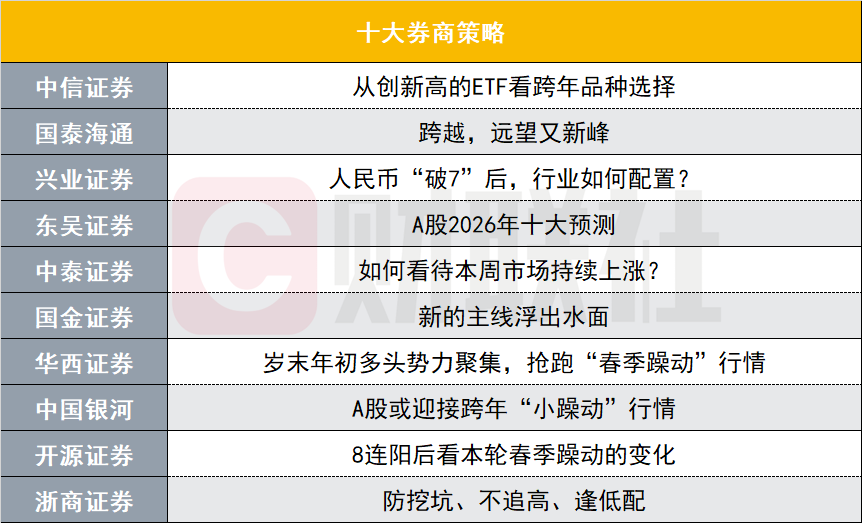
跨越2025 年终行情能否连涨收官?请看本周十大券商策略
智通财经网· 2025-12-28 23:37
Core Viewpoint - The Chinese stock market is experiencing a positive trend as it approaches the end of 2025, with significant movements in various sectors and a focus on potential investment opportunities for 2026 [1][30]. Group 1: Market Trends and Predictions - The Shanghai Composite Index has achieved an "eight consecutive days of gains" [1]. - The total scale of Chinese ETFs has surpassed 6 trillion, setting a new historical high [1]. - Major brokerages have provided insights on market trends, with predictions for 2026 focusing on sectors that may dominate [2][5][13]. Group 2: Sector Analysis - Citic Securities highlights that 39 out of 360 industry/theme ETFs reached new highs in December, with a focus on telecommunications, non-ferrous metals, and commercial aerospace as key sectors [3]. - Industry sectors such as chemicals, engineering machinery, and new energy are expected to see increased attention and potential growth due to their long-term return on equity (ROE) improvement [4]. - Guotai Junan emphasizes the importance of capital markets in driving social confidence and investment, marking a shift from traditional investment methods to more capital-intensive approaches [5]. Group 3: Currency and Economic Factors - The recent appreciation of the Renminbi is attributed to a weaker US dollar and seasonal capital inflows, which may support the Chinese stock market [9][30]. - The potential for a significant influx of capital back into China is anticipated, driven by the reversal of previous trends in currency valuation and investment sentiment [9][10]. - The structural transformation of the Chinese economy is expected to reduce uncertainty and enhance investment opportunities, particularly in technology and manufacturing sectors [7][24]. Group 4: Investment Strategies - Investment strategies are shifting towards sectors that benefit from the current economic environment, including AI hardware, renewable energy, and consumer services [19][31]. - Brokers suggest focusing on thematic trading opportunities in sectors like robotics, commercial aerospace, and healthcare, which are expected to gain traction in the upcoming year [19][31]. - The market is advised to adopt a cautious approach, emphasizing low-cost entry points and avoiding high-risk positions as the market stabilizes [35][36].



“一年少了300多人”
3 6 Ke· 2025-12-28 23:28
Core Insights - The investment banking industry in China is experiencing a structural adjustment, with a notable decrease in the number of registered representatives, indicating a "clearing out" phase despite a recovery in IPOs and listings [1][2] - There is a significant shift of investment banking professionals towards the real economy, particularly in mergers and acquisitions and overseas listings, reflecting a demand for talent with investment banking backgrounds [1][3] - The industry is facing a paradox of layoffs alongside aggressive recruitment, highlighting a mismatch in talent supply and demand, with a need for high-end professionals who can understand client needs more comprehensively [1][4] Group 1 - As of December 27, the total number of registered representatives in the industry has decreased to 8,493 from 8,800 at the beginning of the year, a reduction of 307 [1] - The trend of investment banking professionals moving to the real economy is expected to become more pronounced by 2025, driven by increased demand from industrial capital for talent in capital operations [1][2] - The industry is undergoing a "capacity reduction" process that is still in its early stages, with many professionals remaining in a state of observation [2][3] Group 2 - A significant number of investment bankers are transitioning to roles in large state-owned enterprises, with motivations including a reevaluation of career value and dissatisfaction with the current state of the investment banking sector [2][3] - The tightening of policies prior to the recent recovery has led to a perception that the previous boom was not sustainable, resulting in overcapacity in the industry [2][3] - The number of investment bankers moving to listed companies has accelerated, with nearly a hundred professionals making the switch since 2025 [3] Group 3 - Despite the overall reduction in workforce, there is a simultaneous "war for talent" as firms seek to adapt to changing market conditions and explore new business opportunities [5][6] - Some firms are focusing on specific sectors and regions to differentiate themselves, with notable recruitment efforts in areas like aerospace and robotics [5][6] - The Hong Kong market is becoming increasingly important for investment banks, with projections indicating that A+H share listings will contribute significantly to the IPO market [6][7] Group 4 - The net income of listed securities firms' investment banking divisions reached 25.2 billion yuan in the first three quarters of 2025, a year-on-year increase of 23.46%, with A-share and H-share IPO volumes growing by 61% and 237% respectively [7][8] - The market share of the top five investment banking firms has risen to 52%, an increase of 8 percentage points compared to the previous year [7] - The future landscape of investment banking is expected to be characterized by a concentration of top firms alongside regional specialization, as firms adapt to competitive pressures [7][8]
汽车人,变形出发!
Zhong Guo Zheng Quan Bao· 2025-12-28 22:23
Core Viewpoint - The transformation of Zhejiang's automotive parts companies into the humanoid robot industry represents a strategic shift towards a new growth opportunity, with the potential to create a "second growth curve" for these companies [1][3][10]. Group 1: Industry Trends - Since 2025, Zhejiang's automotive parts companies have collectively focused on humanoid robots, forming a unique "Zhejiang phenomenon" in the transition from traditional automotive components to advanced robotics [2][3]. - The global humanoid robot market is projected to reach 1.24 million units and 6.339 billion yuan by 2025, with expectations to exceed 5 million units and 400 billion yuan by 2035 [3]. - The commercialization of humanoid robots is accelerating, with significant milestones such as the delivery of the 5,000th general-purpose robot by ZhiYuan and over 800 million yuan in orders for the Walker series by UBTECH [3][4]. Group 2: Cost Reduction and Localization - The rise of humanoid robots is supported by the increased localization of core components, leading to cost reductions; for instance, the cost of UBTECH's Walker series robots has decreased by 25% compared to 2024 [5][6]. - The collaborative production capabilities of Zhejiang's automotive parts companies allow for cost-effective manufacturing, with dual-use facilities reducing investment costs and enhancing equipment utilization [6][7]. - Research indicates that there is still significant potential for increasing the localization rates of key components like harmonic reducers and planetary roller screws, which Zhejiang companies are targeting [6][7]. Group 3: Technological Synergy - The transition to humanoid robots is facilitated by the technological similarities between automotive components and robotics, allowing for seamless integration and reduced R&D costs [8][9]. - Companies like Junsheng Electronics have been planning their entry into the humanoid robot market for years, leveraging existing technologies in autonomous driving and intelligent networking [8][9]. - The overlap in customer bases between automotive and humanoid robot sectors, with a 70% overlap in clients, provides a strategic advantage for companies in accessing new markets [9]. Group 4: Strategic Implications - The collective move of Zhejiang's automotive parts companies into the humanoid robot sector is not merely a gamble but a strategic response to industry trends, creating a replicable model for future industrial development [8][10]. - The established supply chain and technological capabilities of Zhejiang's automotive industry position it as a leader in the emerging humanoid robot market, reflecting a proactive approach to industry evolution [10].

机构展望 | 机构资金踊跃布局 本轮“春季躁动”行情或已展开
Shang Hai Zheng Quan Bao· 2025-12-28 19:26
上周,A股市场延续强势表现,截至12月26日,沪指实现8连涨,追平年内连涨纪录,沪深两市成交额 重返2万亿元。2025年交易迎来最后三个交易日,券商策略展望报告一致认为,A股的强劲反弹在年末 关口有望延续。机构资金买入力量不断增强、人民币升值吸引外资流入,构成A股资金面边际改善的两 大主要因素。 机构资金买入力量有望增强 上周证券市场一个值得注意的现象是,中证A500ETF份额数快速上行,成为短期增量资金流入最快的方 向。 对此,华西证券分析称,中证A500ETF净申购成为年末A股重要的增量资金来源之一。根据统计,12月 至今,股票型ETF累计净申购908亿元,为今年4月以来净申购规模最高的月份。其中,增量资金主要来 源于规模居前的中证A500ETF产品的净申购,这反映出年末机构增量资金正在加速流入。 兴业证券分析称,短期来看,企业结汇需求释放的滞后效应,对岁末年初人民币汇率走强仍构成一定助 力,汇率市场与证券市场的"春季躁动"行情有望共振。展望2026年,弱美元为人民币升值提供良好外部 环境。 兴业证券回顾了2016年以来的四轮人民币升值周期,发现区间A股与港股大多实现上涨,即人民币升值 阶段中国资产往往表 ...
AI大时代催生投资新叙事 多方共话变革机遇与布局路径
Shang Hai Zheng Quan Bao· 2025-12-28 19:10
Core Insights - The roundtable discussion focused on how the AI era is creating new investment narratives and opportunities across various sectors [5] - AI is rapidly transforming industries, enhancing productivity, and changing organizational models, with significant implications for financial services [6] - The investment methodology in the consumer sector is being re-evaluated due to the rise of AI, leading to the emergence of "super consumers" and "super entrepreneurs" [7] Group 1: AI's Impact on Industries - AI is reshaping the development landscape across all industries, with its rapid evolution exceeding expectations [6] - In financial services, AI's impact is categorized into four areas: personalized services, proactive risk management, automated operations, and integrated ecosystems [6] - The distinction between financial technology and AI is highlighted, with AI making finance "smarter" rather than just more convenient [6] Group 2: Consumer Sector Transformation - The consumer investment approach is being transformed by AI, leading to a new era where consumer preferences drive product design [7] - AI applications are increasingly integrated into daily life, enhancing consumer power and enabling lightweight entrepreneurial models [7] - The macro perspective indicates that the AI technology revolution carries value, bubble, and cyclical attributes, with a predicted bubble turning point around 2028 [7] Group 3: Technological Foundations - The growth of the AI industry relies on foundational hard technologies, with domestic companies focusing on semiconductors and precision optics to build a self-sufficient ecosystem [8] - The development of AI chips is aligned with the trend of "full functionality and full ecology," addressing complex application demands [8] - Companies like 茂莱光学 are deeply involved in the optical sector, with over 50% of their business linked to AI, presenting long-term growth opportunities [8] Group 4: Future Investment Opportunities - Experts agree that the AI narrative is far from over, with multiple layers of investment opportunities emerging in computing power, applications, and traditional industry transformations [10] - The A-share market is expected to experience a stable upward trend, with investment opportunities shifting towards mid-cap blue-chip stocks in sectors like cyclical consumption and biomedicine [10] - AI is anticipated to remain a key investment focus in 2026, transitioning from upstream computing power to application algorithms, with a window for explosive applications [10] Group 5: Consumer Demand Evolution - Consumer demands will evolve alongside AI technology, with companies like 泡泡玛特 expected to emerge in various niches [11] - Long-term competitive companies still hold investment value, with a focus on "steady progress" in investment strategies for 2026 [11] - The allocation of financial assets is seen as a means to achieve stability, while technology assets are expected to perform more prominently [11]

“一年少了300多人” !
Zhong Guo Ji Jin Bao· 2025-12-28 09:02
Core Insights - The investment banking industry in China is undergoing a significant transformation, with a notable trend of seasoned professionals leaving the brokerage system to join industrial sectors, driven by a reevaluation of career value and the challenges faced in the current market environment [2][3][4] Group 1: Industry Trends - As of December 27, the total number of sponsoring representatives in the industry has decreased to 8,493 from 8,800 at the beginning of the year, indicating a reduction of 307 individuals [1] - The "capacity reduction" process is still in its early stages, with many professionals still observing the market, and structural adjustments may take several more years [3] - The demand for high-end talent capable of understanding client needs from a fundamental perspective is still scarce, despite the ongoing layoffs in the industry [1][3] Group 2: Talent Migration - A significant number of investment bankers are transitioning to real industries, with nearly 100 professionals from various securities firms moving to listed companies since 2025, reflecting a faster migration rate compared to 2024 [3] - The departure of talent is partly attributed to the stagnation of IPO projects, with some professionals citing a decline in project fees and overall compensation as key factors for their exit [2][3] Group 3: Recruitment and Structural Changes - Despite the overall reduction in workforce, a "war for talent" is simultaneously occurring, with firms like Guolian Minsheng Securities launching large-scale recruitment initiatives to attract elite teams [6] - Some firms are focusing on vertical integration within specific regions and industries, aiming to deepen their service capabilities for local enterprises [6][9] Group 4: Market Opportunities - The Hong Kong stock market is emerging as a "second battlefield" for investment banks, with projections indicating that A+H share listings will account for half of the new stock financing in Hong Kong in 2025 [7] - The net income of listed securities firms' investment banking divisions reached 25.2 billion yuan in the first three quarters of 2025, reflecting a year-on-year increase of 23.46%, with IPO volumes in A-shares and H-shares growing by 61% and 237%, respectively [9] Group 5: Future Outlook - The future landscape of investment banking is expected to be characterized by a concentration of leading firms alongside regionally specialized players, with firms needing to adapt quickly to market changes to seize new opportunities [10] - The ongoing policy support for emerging industries is anticipated to create opportunities for smaller firms to leverage their unique industry teams and regional resources for growth [10]
浙商证券:“未分胜负”变“利于多方” 防挖坑、不追高、逢低配
Xin Lang Cai Jing· 2025-12-28 08:51
Core Viewpoint - The market is experiencing a gradual upward trend driven by the strong performance of the A500 ETF, the booming commercial aerospace sector, and the continued strength of optical modules. The conclusion of a medium-term bullish outlook for A-shares, characterized as a "systematic slow bull," is deemed to have high confidence, although the sustainability of the driving factors needs to be verified in the short term [1][4][9]. Market Overview - Major indices collectively rose, with the CSI 500 leading in gains during the week of December 22 to December 26, 2025. The market showed broad-based gains, although the dividend consumption sector remained generally weak. Trading volume in Shanghai and Shenzhen saw a slight decline, and most stock index futures contracts were trading at a discount. The margin financing balance increased slightly, with a higher proportion of financing purchases and net inflows into stock ETFs. The valuation of the ChiNext index is relatively low, and the downward energy model is at a normal level [2][7]. Market Attribution - The IPO guidance status of Blue Arrow Aerospace has changed to "guidance work completed," and SpaceX has confirmed preparations for a potential IPO in 2026. The central bank has released a one-time personal credit repair policy to help individuals rebuild credit. Additionally, the central bank's monetary policy committee held its fourth-quarter meeting, emphasizing the need to "maintain the stability of the capital market" [3][8]. Future Market Outlook - The market has shifted from a state of indecision to one favorable for bulls, primarily due to three driving factors: the strong performance of the CSI A500 ETF, which saw total shares increase by 39.89 billion and 67.23 billion over the past week and two weeks, respectively; the ongoing boom in commercial aerospace, which has significantly boosted growth indices; and the continued strength of optical modules, which supports the innovation index. While these factors have shifted the market towards a bullish trend and laid the foundation for upward movement in the first half of the following year, their sustainability remains uncertain. The medium-term bullish outlook for A-shares is supported, but short-term developments require careful observation [4][9]. Investment Strategy - Based on the assessment of a medium-term bullish outlook and the need for short-term observation, it is advised to maintain current positions and avoid chasing after high-performing stocks, especially those with significant gains this year. If a situation similar to the "golden pit" seen earlier this year arises, it is recommended to actively increase allocations at lower prices. The focus should be on the brokerage sector, which has shown signs of lagging and potential for share expansion. Additionally, attention should be given to the Hang Seng Technology Index, which has undergone sufficient adjustments and formed a daily MACD divergence. A strategy of "light index, heavy stock" is suggested, with a focus on low-performing stocks above the annual line [5][10].
“一年少了300多人” !
中国基金报· 2025-12-28 08:15
Core Viewpoint - The investment banking industry in China is undergoing a significant transformation, characterized by a talent migration towards the real economy and a structural imbalance in talent supply and demand, despite a recovery in IPO activities and a hiring spree in certain sectors [2][3][4]. Group 1: Talent Migration and Industry Changes - A significant number of investment bankers are leaving the brokerage system to join industrial sectors, with a notable increase expected by 2025 [3][5]. - The departure of talent is driven by a reevaluation of career value, particularly due to a lack of IPO projects and declining project fees, leading to a perception of reduced value in the investment banking role [4][5]. - The industry is experiencing a paradox of simultaneous layoffs and recruitment, indicating a mismatch in the skills required and available talent [2][4]. Group 2: Industry Adjustments and Opportunities - Despite challenges in traditional IPO business, areas such as mergers and acquisitions, Hong Kong listings, and refinancing remain active, prompting firms to adapt their services [7][10]. - Some brokerages are focusing on niche markets and regional strengths to differentiate themselves, with a notable emphasis on sectors like aerospace and robotics [8][10]. - The application of digital tools and AI is reshaping the work processes in investment banking, necessitating a workforce that can leverage these technologies effectively [9][10]. Group 3: Market Performance and Future Outlook - The net income of listed brokerages' investment banking divisions reached 25.2 billion yuan in the first three quarters of 2025, reflecting a year-on-year growth of 23.46% [10]. - The market share of the top five investment banking firms increased to 52%, indicating a growing disparity between leading and smaller firms [10][11]. - The future landscape of investment banking is expected to be characterized by a concentration of top firms and a focus on regional specialties, with firms needing to explore differentiated and specialized development paths [11].