联发科

Search documents
台积电市占,再创新高
半导体行业观察· 2025-09-16 01:39
Core Insights - Taiwan's semiconductor manufacturing company, TSMC, is projected to increase its foundry market share to 38% by Q2 2025, up from 31% year-over-year, driven by a 19% increase in foundry revenue due to AI demand and Chinese subsidies [1] - Advanced packaging technology is becoming increasingly important, with TSMC expected to maintain its leadership in both advanced process nodes and advanced packaging in the foreseeable future [1][2] - The OSAT (Outsourced Semiconductor Assembly and Test) industry is experiencing a revenue growth rate acceleration from 5% to 11%, with companies like ASE and King Yuan benefiting significantly from AI GPU demand [2] Summary by Sections TSMC Market Share and Revenue Growth - TSMC's foundry market share is expected to rise to 38% by Q2 2025, compared to 31% in the same period last year [1] - The overall foundry revenue is anticipated to grow by 19% year-over-year, primarily due to the demand for advanced processes and packaging driven by AI and subsidies from China [1] - Counterpoint Research forecasts moderate single-digit growth in foundry revenue by Q3 2025 [1] Advanced Packaging and Technology Trends - Advanced packaging is becoming a crucial growth driver for chip manufacturers, with TSMC's strong technology and customer relationships positioning it well for future leadership [2] - The shift towards Foundry 2.0 indicates a transition from traditional foundry services to a more integrated technology platform, encompassing various semiconductor manufacturing processes [2] Application Processor (AP) Market Dynamics - TSMC is expected to dominate the application processor market with a projected 90% share in the 5nm or smaller process technology segment [3] - The demand for advanced semiconductor processes is increasing due to the growing need for performance and energy efficiency in high-end smartphones [4] - TSMC's market share in the sub-3nm AP manufacturing segment is projected to be around 87% this year, increasing to 89% by 2028 [4] Competitive Landscape - Samsung is working to improve its yield rates in the 3nm and below processes to catch up with TSMC, having recently stabilized its 3nm process [5] - Despite Samsung's efforts, TSMC continues to lead in advanced process technology, with significant market share in AP manufacturing for major clients like Apple and Qualcomm [4][5]


通信行业:博通ASIC预期再上调,深圳光博会预热
Shanxi Securities· 2025-09-12 07:27
Investment Rating - The report maintains an "Outperform" rating for the communication industry, indicating expected growth exceeding the benchmark index by over 10% [1][46]. Core Insights - Broadcom's latest financial report shows continued high growth in AI business, with new ASIC customer orders reaching 10 billion USD. The company reported Q3 2025 revenue of 15.95 billion USD, a 22% year-on-year increase, and a non-GAAP EPS of 1.69 USD, up 36.3% year-on-year, exceeding analyst expectations. The forecast for Q4 revenue is approximately 17.4 billion USD, indicating nearly double-digit sequential growth. AI revenue has seen a 63% year-on-year increase, reaching 5.2 billion USD, with expectations to rise to 6.2 billion USD next quarter. Broadcom anticipates ASIC demand to reach 60 to 90 billion USD by FY2027, suggesting potential for annual doubling of AI business growth if it captures a significant market share [3][15][41]. - The upcoming Shenzhen Optical Expo (CIOE2025) on September 10 is expected to boost the optical module sector. Key areas of focus include the introduction of 3.2T optical modules, TFLN thin-film lithium niobate chips, silicon photonic chips, CPO high-density optical connection products, and hollow-core fiber products. These innovations are anticipated to enhance the capabilities and offerings within the optical communication industry [4][16]. Summary by Sections Weekly Viewpoint and Investment Suggestions - Broadcom's strong AI financial results alleviate concerns regarding investment slowdowns among North American cloud providers, indicating a potential resonance between GPU and ASIC markets in 2026-2027 [15][17]. - The report suggests focusing on companies in various sectors, including domestic computing servers (ZTE, Unisoc, Huaqin Technology), optical modules (Zhongji Xuchuang, NewEase, Tianfu Communication), and satellite internet (Chengchang Technology, Zhenlei Technology) [18]. Market Overview - The overall market performance for the week of September 1-7, 2025, showed mixed results, with the ChiNext Index rising by 2.35%, while the Shanghai Composite Index fell by 1.18%. The communication index dropped by 2.68%, with the optical module sector leading gains at +8.4% [6][17]. Sector Performance - The optical module sector is highlighted as having a strong upward trend, with major companies showing a safety margin in performance post-adjustment. The report indicates that upstream related stocks have been undervalued and warrant investor attention [6][17].
AI芯片业+半导体,最受资金追捧的产业链受益公司
Sou Hu Cai Jing· 2025-09-11 16:42
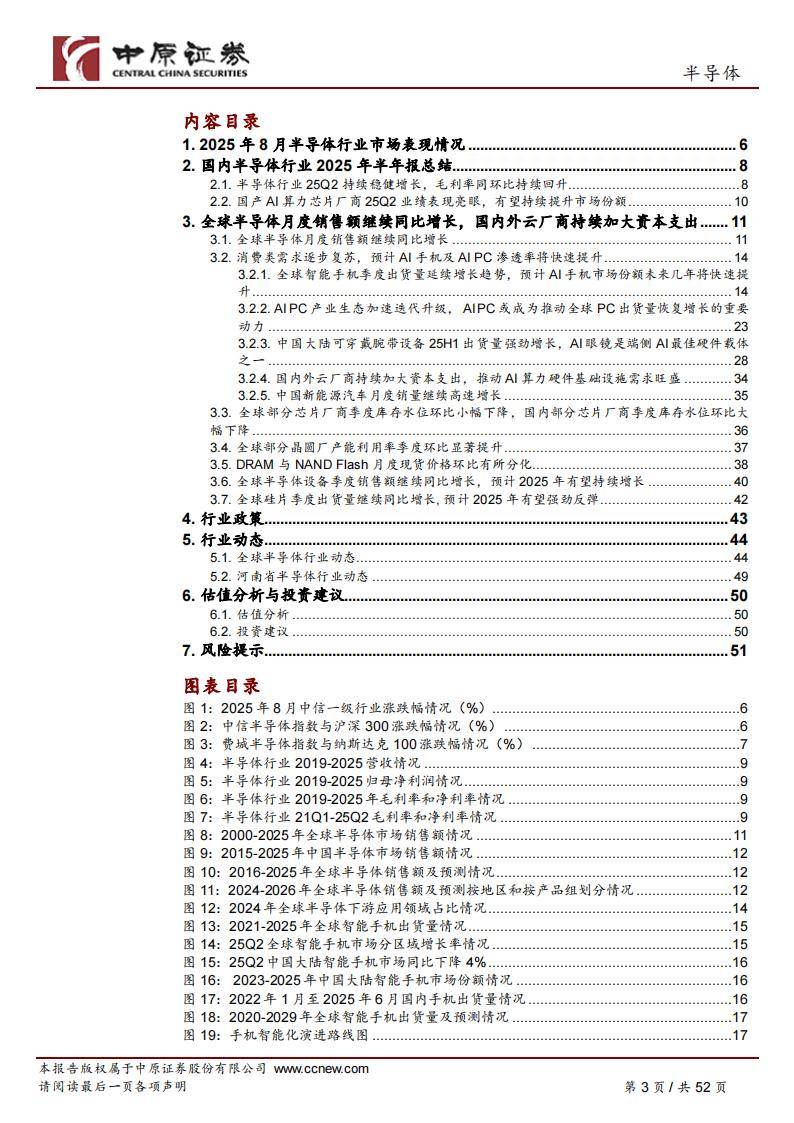
Group 1 - The semiconductor sector in A-shares has become one of the best-performing segments, with a significant increase of 23.84% in August, outperforming the Shanghai Composite Index's 10.33% rise [1][8] - The domestic semiconductor industry reported a year-on-year revenue growth of 13.87% and a net profit increase of 23.99% in the latest quarter, with integrated circuits and semiconductor equipment showing particularly strong performance [1][17] - Notable companies in the A-share market that saw significant gains in August include Cambricon (110%), Dongxin Technology (82%), and Shengke Communication (78%) [1][10] Group 2 - Globally, the semiconductor industry continues to see differentiated demand, with AI-related hardware investments remaining high. In July 2025, global semiconductor sales grew by 20.6% year-on-year, marking 21 consecutive months of growth [2][28] - Major cloud service providers in North America, including Google, Microsoft, Meta, and Amazon, increased their capital expenditures by 69% year-on-year in Q2, while Chinese internet giants like Alibaba, Tencent, and Baidu saw a combined capital expenditure increase of 168% [2][28] - The semiconductor equipment and materials sectors also showed strong performance, with equipment revenue growing by 42.87% year-on-year in Q2 2025 [2][20] Group 3 - The consumer electronics market is recovering, with increased shipments of smartphones and PCs, and a rise in the penetration rate of AI PCs and AI smartphones expected in the second half of the year [3][28] - Major smartphone manufacturers, including Samsung, Apple, and Xiaomi, continue to lead the global market, while domestic brands like Huawei and Vivo maintain stable performance [3][28] - The semiconductor industry is currently undergoing a new wave of technological innovation and accelerated domestic substitution, with companies like Cambricon and Haiguang Information positioned to benefit from increased funding inflows [3][26] Group 4 - In Q2 2025, the domestic AI computing chip manufacturers showed impressive performance, with Cambricon's revenue skyrocketing by 4425% year-on-year and a net profit increase of 325% [25][27] - The global GPU market is projected to grow from $43.6 billion in 2023 to $274.2 billion by 2029, with a compound annual growth rate of 33.2% [25][26] - The demand for AI computing chips is expected to continue rising, driven by major cloud service providers and internet companies investing heavily in self-developed chips [25][26]


Arm全新IP解析:功耗值得关注,小核前景堪忧
3 6 Ke· 2025-09-11 12:18
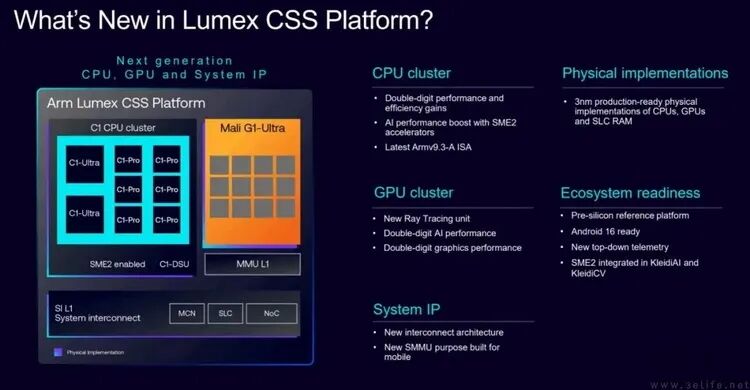
Group 1 - Arm recently held the Arm UNLOCKED summit in Shanghai, where it officially launched the Arm Lumex Compute Subsystem (CSS) aimed at mobile devices [1] - Lumex CSS is essentially a marketing concept that includes Arm's new C1 series CPU architecture, G1 series GPU architecture, C1-DSU inter-core bus design, and other peripheral system IP designs [1][3] - It is important to note that Lumex CSS does not equate to a complete SoC architecture license, as it lacks essential components like NPU, baseband, power management, and ISP [3] Group 2 - The new product naming logic has undergone significant changes, with Arm introducing four new CPU IPs: C1-Ultra, C1-Premium, C1-Pro, and C1-Nano [8][11] - C1-Ultra is positioned as the flagship "super core," replacing the current Cortex-X925, while C1-Premium serves as the "next flagship big core" with similar architecture but smaller cache [11] - The performance and efficiency improvements of the new CPUs are notable, with C1-Ultra achieving a 25% increase in single-thread performance and a double-digit IPC performance growth compared to its predecessor [12][16] Group 3 - Arm also introduced the Mali G1 GPU IP family, which allows customization of shader core counts from 1 to 24, categorized into G1-Ultra, G1-Premium, and G1-Pro [13] - The new IPs generally show performance improvements, but there are concerns regarding power consumption, particularly with the G1-Ultra GPU, which has a 20% performance increase but a 9.2% rise in overall power consumption [22] Group 4 - The new architectures suggest that upcoming flagship mobile platforms will likely not use the C1-Nano "small core," with potential configurations including two C1-Ultra cores paired with six C1-Pro cores [23][25] - There is a concern that the performance improvements for the C1-Nano are not as significant as those for larger cores, which may lead to a decline in motivation for further development of small cores in the industry [29]

半导体行业月报:半导体行业25Q2持续稳健增长,国产AI算力厂商业绩表现亮眼-20250911
Zhongyuan Securities· 2025-09-11 08:25
Investment Rating - The semiconductor industry is rated as "Outperform" [1] Core Viewpoints - The semiconductor industry continues to show steady growth in Q2 2025, with significant performance from domestic AI computing chip manufacturers [4][5] - The global semiconductor monthly sales continue to grow year-on-year, driven by increased capital expenditure from domestic and international cloud service providers [4][6] - The demand for AI computing hardware infrastructure remains strong, with major cloud companies increasing their capital expenditures significantly [6] Summary by Sections 1. Semiconductor Industry Performance - In August 2025, the domestic semiconductor industry (CITIC) rose by 23.84%, significantly outperforming the Shanghai and Shenzhen 300 index, which increased by 10.33% [4][12] - The semiconductor industry (CITIC) has seen a year-to-date increase of 36.16% [12] 2. Q2 2025 Financial Performance - The semiconductor industry reported a revenue of 188.43 billion yuan in Q2 2025, a year-on-year growth of 13.87%, with a net profit of 14.76 billion yuan, up 23.99% year-on-year [4][22] - The gross margin for the semiconductor industry has been on the rise, with Q2 2025 showing a gross margin of 26.29%, an increase of 1.72% year-on-year [22][25] 3. AI Computing Chip Manufacturers - Domestic AI computing chip manufacturers have shown remarkable performance in Q2 2025, with companies like Cambricon reporting a revenue increase of 4425.01% year-on-year [4][5][22] - The domestic AI computing chip sector is entering a period of accelerated growth, with expectations of increased market share [5][22] 4. Global Semiconductor Sales - Global semiconductor sales in July 2025 increased by 20.6% year-on-year, marking the 21st consecutive month of growth [4][6] - The demand for consumer electronics is gradually recovering, with expectations for rapid growth in AI smartphones and AI PCs [4][6] 5. Capital Expenditure Trends - Major North American cloud service providers have significantly increased their capital expenditures, with a combined increase of 69% year-on-year in Q2 2025 [6] - The total capital expenditure of the three major domestic internet companies (Alibaba, Baidu, Tencent) reached 61.6 billion yuan in Q2 2025, a year-on-year increase of 168% [5][6] 6. Market Dynamics - The inventory levels of some global chip manufacturers have slightly decreased, while domestic chip manufacturers have seen a significant reduction in inventory levels [4][22] - The utilization rate of global wafer fabs has significantly improved in Q2 2025, indicating a positive trend in production capacity [4][22]

康希通信(688653.SH):在手订单充裕,低空经济无人机、泛IoT领域市场拓展顺利
Ge Long Hui· 2025-09-11 08:11
Core Viewpoint - 康希通信 is positioned as a leading fabless RF front-end design company, focusing on Wi-Fi RF front-end chips and modules, and has established itself as a preferred supplier in the market through strategic collaborations with major SoC manufacturers like Qualcomm, Broadcom, and MediaTek [1] Group 1: Business Overview - 康希通信's main business revolves around Wi-Fi RF front-end chips and modules, transitioning from independent R&D to partnerships with international SoC manufacturers to explore Wi-Fi communication protocols [1] - The company has achieved a significant milestone, with Wi-Fi 7 sales revenue accounting for over 50% of total Wi-Fi sales revenue in the first half of 2025, surpassing the market penetration rate of Wi-Fi 7 [1] Group 2: Market Position and Orders - 康希通信 has a robust order backlog, with successful market expansion in low-altitude economy drones and the IoT sector, leading to a trend of increasing orders [1] - The company aims to diversify its product offerings and strengthen its upstream and downstream supply chain to enhance its overall competitiveness and achieve sustainable, high-quality growth [1]
联发科2025年8月营收同比增长7.27%
Huan Qiu Wang Zi Xun· 2025-09-11 06:32
Group 1 - The core viewpoint of the article highlights MediaTek's steady revenue growth, with a reported revenue of NT$44.547 billion in August 2025, marking a year-on-year increase of 7.27% and a month-on-month increase of 3.07% [1][2] - For the cumulative revenue from January to August 2025, MediaTek's total revenue reached NT$391.448 billion, reflecting a year-on-year growth rate of 12.53%, establishing a solid foundation for stable annual performance [2] - MediaTek is set to launch its flagship mobile platform, Dimensity 9500, on September 22, coinciding with Qualcomm's SM8850 launch event on September 23, indicating a competitive landscape in the flagship mobile platform sector [2]

港股概念追踪 | 甲骨文(ORCL.US)RPO大增引爆AI算力产业链 关注国内相关机会(附概念股)
智通财经网· 2025-09-10 23:30
Group 1 - Oracle reported a staggering remaining performance obligation (RPO) of $455 billion, a year-on-year increase of 359%, igniting market enthusiasm and leading to a nearly 36% surge in its stock price, marking the largest single-day gain since 1992 [1] - Oracle's cloud infrastructure revenue is projected to grow by 77% year-on-year, reaching $18 billion in fiscal year 2026, with further increases expected in subsequent years [1] - Nvidia announced the upcoming launch of a new product, Rubin CPX, designed for complex tasks such as video generation and software development, set to be released by the end of 2026 [2] Group 2 - Microsoft has entered a long-term AI cloud computing partnership with Nebius valued at $19.4 billion, which includes a $2 billion option, effective until 2031 [3] - Meta's founder, Mark Zuckerberg, announced plans to invest approximately $60 billion in AI infrastructure by 2028, indicating a significant increase in capital expenditure among leading firms [3] - The Chinese AI market is projected to reach $81.59 billion by 2028, with a five-year compound annual growth rate (CAGR) of about 33%, driven by technological breakthroughs and increased demand [4] Group 3 - Baidu's new Wenxin large model X1.1 has been officially launched, showing significant improvements in factual accuracy and instruction adherence compared to its predecessor [6] - SenseTime's revenue performance exceeded expectations with a year-on-year growth of 36%, driven by a strong increase in its generative AI business, which grew by 73% [7] - Kintor Group reported a 71% increase in net profit for the first half of 2025, reflecting strong demand in the PCB market and a positive outlook for AI-related options [8]

Oracle的4550亿订单,AI持续向好,TPU进展如何?
傅里叶的猫· 2025-09-10 12:29
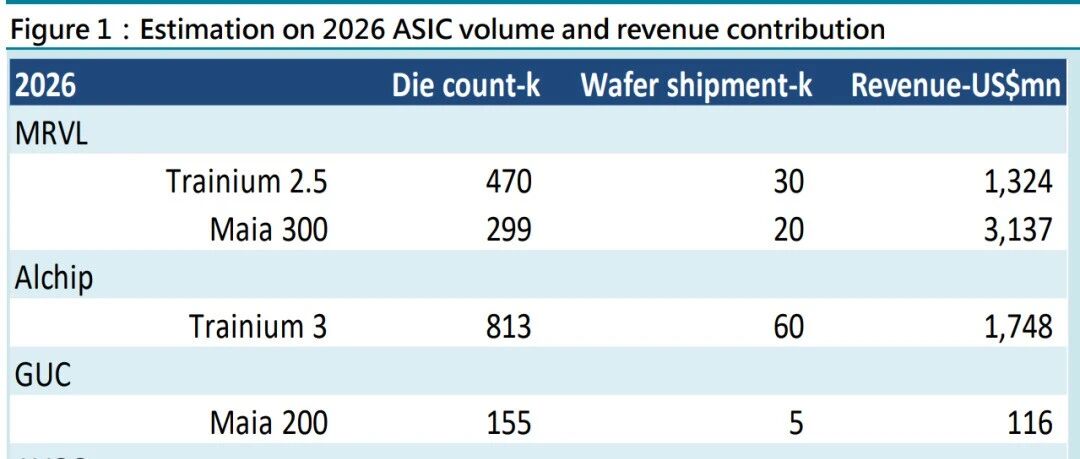
Core Viewpoint - Oracle has provided a strong revenue guidance for AI cloud services, projecting significant growth over the next five years, with expected revenues reaching $18 billion in 2026 and $1.14 trillion by 2029 [2][3]. Group 1: Oracle's Performance and Future Projections - Oracle's future AI cloud revenue guidance indicates a substantial increase, with projections of $18 billion in 2026, $32 billion in 2027, $73 billion in 2028, and $114 billion in 2029 [2]. - The report highlights a remarkable $455 billion in Remaining Performance Obligations (RPO), indicating a strong revenue assurance for the next 3-5 years [3]. Group 2: AI Infrastructure Contracts - The growth in RPO is primarily driven by AI-related cloud infrastructure contracts, with collaborations involving major companies such as OpenAI, xAI, and Meta [5]. Group 3: Capital Expenditure Trends - Recent earnings reports from major cloud service providers (CSPs) like Google, Meta, Microsoft, and Nvidia show significant revenue and net income growth, leading to increased capital expenditure guidance for AI infrastructure [7]. - Specific capital expenditure guidance includes $85 billion from Alphabet for 2025, $66-72 billion from Meta, and $80 billion from Microsoft, all aimed at enhancing AI capabilities [8]. Group 4: Google TPU Developments - Google is expected to ship 2.5 million TPU units in 2025, with a significant portion being the V5 series, which is popular due to its cost-effectiveness and compatibility [16]. - The average selling price (ASP) of Google TPU is projected to be around $4,500, with a slight increase expected in 2026 due to new product introductions [18][21]. - By 2026, Google anticipates shipping over 3 million TPUs, reflecting a 20% increase from 2025, driven by growing AI application demands [19]. Group 5: Supply Chain Innovations - Google is experimenting with supply chain strategies, involving MediaTek for backend production to reduce costs and mitigate risks, while Broadcom remains the primary partner for front-end design [22].

高通雪上加霜,联发科基带供货苹果
半导体行业观察· 2025-09-08 01:01
Core Viewpoint - Apple is set to unveil the iPhone 17 series and a new Apple Watch, with MediaTek entering the supply chain for the first time by providing 5G baseband chips, marking a significant milestone for the company [1][2]. Group 1: Apple Watch Updates - The new Apple Watch lineup will see comprehensive upgrades across all models, including the high-end Ultra and the budget SE, with the Ultra model introducing 5G and satellite communication features [1][2]. - Apple aims to increase the number of its proprietary baseband chips, reducing reliance on Qualcomm and Intel [1]. - The Apple Watch series is expected to have an annual shipment volume of at least 30 million units, capturing over 50% of the global smartwatch market [2]. Group 2: MediaTek's Role - MediaTek has been working on 5G separated chip technology for years and has successfully entered Apple's ecosystem after extensive testing and validation [2]. - The 5G functionality in the new Apple Watch will utilize low-power Redcap technology, combined with satellite communication capabilities [1][2]. - MediaTek has committed to supplying at least 5 million chipsets to meet customer demand, with potential for additional orders if Apple products are in high demand [2]. Group 3: Transition from Qualcomm - Apple is gradually moving away from Qualcomm's technology, with plans to integrate its own C1 modem into products, although the initial step involves using MediaTek's technology [3][4]. - The Apple Watch Ultra will be the first model to support 5G RedCap services, optimized for wearables and IoT devices [4]. - Apple's long-term goal includes developing its own wireless modems, with significant investments made over the past seven years [5].