
零跑汽车

Search documents
零跑汽车新设电子公司,含智能机器人业务
Qi Cha Cha· 2026-01-28 08:32
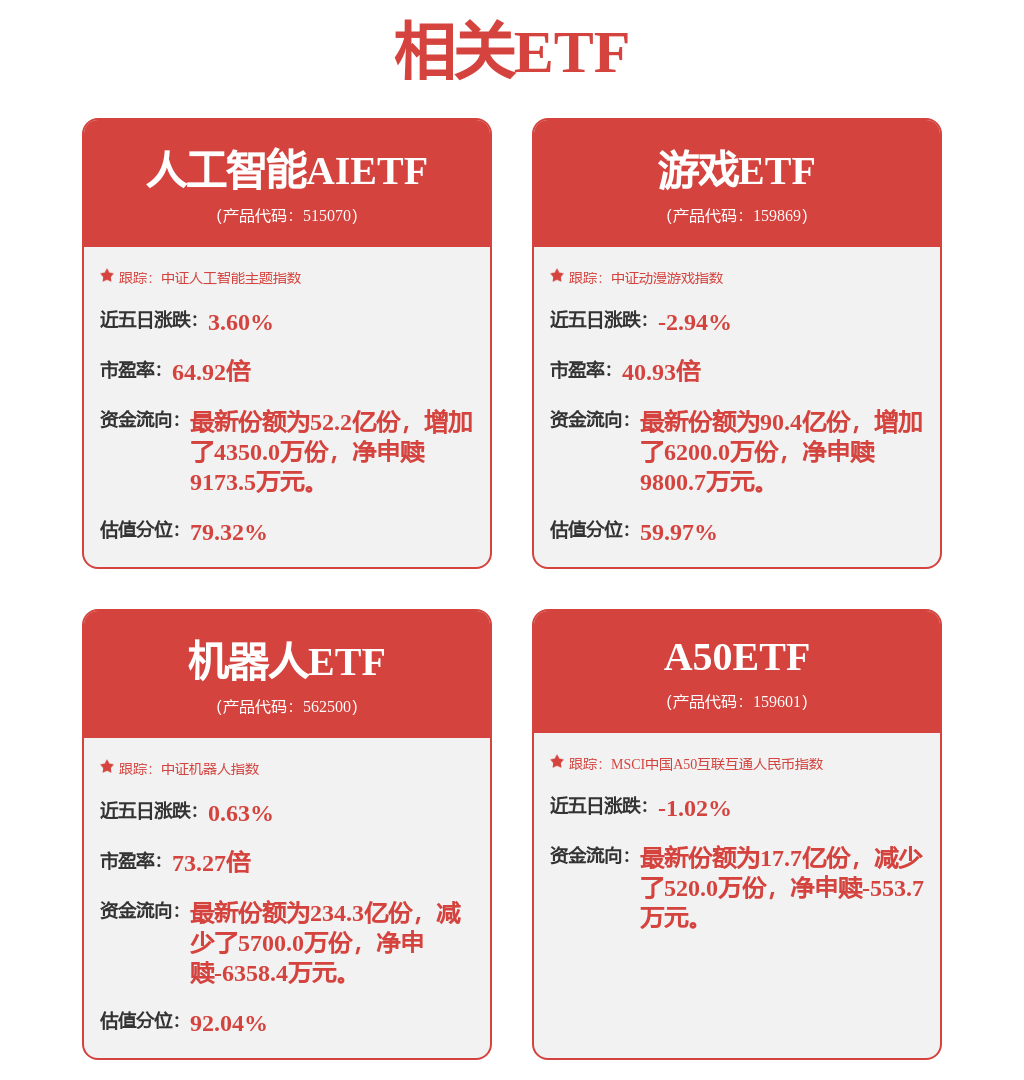
人工智能AIETF (产品代码: 515070) ★ 跟踪:中证人工智能主题指数 近五日涨跌: 3.60% 市盈率: 64.92倍 资金流向: 最新份额为52.2亿份,增加 了4350.0万份,净申赎 9173.5万元。 估值分位: 79.32% 游戏ETF (产品代码:159869) (原标题:零跑汽车新设电子公司,含智能机器人业务) 企查查APP显示,近日,金华凌艾电子有限公司成立,法定代表人为周洪涛,注册资本为1.2亿元,经营范围包含:电子元器件制造;智能车载设 备制造;汽车零部件及配件制造;云计算设备制造;智能机器人的研发等。企查查股权穿透显示,该公司由零跑汽车(09863.HK)间接全资持 股。 相关ETF 资金流向: 最新份额为234.3亿份,减 少了5700.0万份,净申 赎-6358.4万元。 ★ 跟踪:中证动漫游戏指数 近五日涨跌: - 2.94% 市盈率: 40.93倍 资金流向: 最新份额为90.4亿份,增加 了6200.0万份,净申赎 9800.7万元。 估值分位: 59.97% 机器人ETF (产品代码: 562500) ★ 跟踪:中证机器人指数 近五日涨跌:0.63% 市盈率: 7 ...


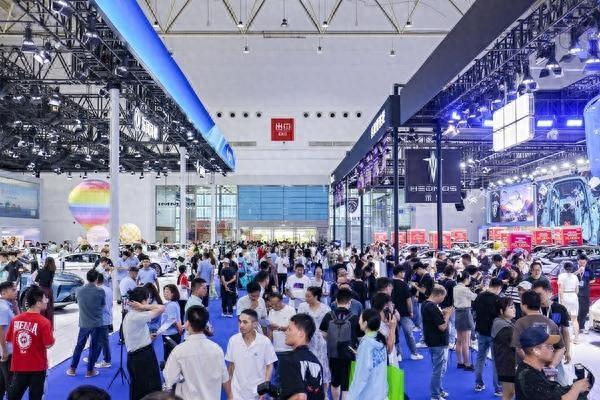
2026年汽车行业投资策略:智能化+全球化驱动,把握结构性机会
Shanghai Aijian Securities· 2026-01-28 07:13
行业: 评级: 汽车 强于大市(维持) 2026年1月28日 证券研究报告 智能化+全球化驱动,把握结构性机会 2026年汽车行业投资策略 分析师:吴迪(汽车首席) SAC:S0820525010001 wudi@ajzq.com 联系人:徐姝婧 SAC:S0820124090004 xushujing@ajzq.com 0. 核心摘要 1. 复盘展望:总量承压,结构突围 2. 行业趋势:智能化+全球化驱动增长 3. 投资建议 目 录 2 0. 核心摘要 1. 复盘展望:总量承压,结构突围 2. 行业趋势:智能化+全球化驱动增长 3. 投资建议 4. 风险提示 4. 风险提示 目 录 3 0. 核心摘要 请务必阅读正文之后的信息披露和免责申明 4 n 复盘:受益于设备更新及消费品以旧换新的"两新"政策助力,以及企业新品密集上市,终端需求持续释放,全年汽车销 量实现较快增长。2025年申万汽车板块整体涨幅+24.3%,同期沪深300指数涨幅+17.7%。2025年中国汽车总销量达 3440万辆,同比+9.4%,其中乘用车销量3010万辆,同比+9.2%,商用车销量430万辆,同比+10.9%。 n 展望:202 ...




2026年中国新能源汽车融资租赁行业政策、产业链、市场规模、重点企业及趋势研判:新能源汽车产销持续高速增长,带动融资租赁市场规模跃升至千亿元[图]
Chan Ye Xin Xi Wang· 2026-01-28 01:25
Core Insights - The rapid growth of the new energy vehicle (NEV) financing leasing market is driven by policy support and technological advancements, making it a crucial financial solution to lower ownership barriers and mitigate technology iteration risks [1][6][7]. Group 1: Market Overview - The NEV financing leasing market in China is projected to grow from 449 million yuan in 2015 to 112.72 billion yuan in 2024, with a compound annual growth rate (CAGR) of 84.78% [1][7]. - By 2025, the market size is expected to reach approximately 165.58 billion yuan, indicating robust growth potential [1][7]. Group 2: Policy Support - The Chinese government has extended the NEV purchase tax exemption policy until 2025 and is exploring innovative models like battery-vehicle separation [1][4][7]. - Local governments are also providing targeted financing leasing subsidies to stimulate procurement and consumption [1][4][7]. Group 3: Technological Advancements - Continuous improvements in NEV technology and performance are enhancing user experience and increasing market acceptance, particularly among the younger generation [1][7]. - The Z generation shows a strong preference for environmentally friendly, intelligent, and connected NEVs, promoting the "rent-to-buy" consumption model [1][7]. Group 4: Industry Structure - The NEV financing leasing industry comprises various players, including traditional automotive finance companies, specialized leasing firms, and financial institutions [6][8]. - Major companies in the sector include SAIC General Motors Automotive Finance Co., Ltd., Volkswagen Financial Services (China) Co., Ltd., and Mercedes-Benz Automotive Finance Co., Ltd. [2][8][10]. Group 5: Industry Trends - Digital transformation in the NEV financing leasing sector is expected to evolve towards intelligent risk control and asset management based on big data [11]. - The integration of NEV financing leasing with green finance will create unique competitive advantages, allowing for lower-cost funding through green bonds and innovative financial products linked to carbon reduction [12]. - International expansion will focus on local operations and global asset circulation, particularly in emerging markets with rising electric vehicle penetration [13].


盘点2025年汽车产业政策新风向:从追求“规模速度”到比拼“质量效益”
Zhong Guo Qing Nian Bao· 2026-01-27 22:48
Core Insights - The Chinese automotive industry achieved significant milestones in 2025, with total vehicle production and sales showing steady growth, and new energy vehicle sales surpassing 10 million units for the first time, achieving a market penetration rate of over 50% [2][10] - A comprehensive set of policies was implemented to guide and correct the industry, with over 30 key standards and regulatory policies released by relevant departments, averaging more than 2.5 per month [2] Group 1: Market Competition and Regulation - The year 2025 marked a shift from "price wars" to "value wars," with a strong emphasis on curbing "involution" in the automotive sector through regulatory measures [3][4] - Key regulations included a "60-day payment cycle" for suppliers and a "price behavior compliance guideline" aimed at restoring order in the market and protecting supplier rights [3][4] - Major automakers like SAIC, BYD, and Geely adopted the 60-day payment cycle, which is seen as a move towards healthier industry ecology and stable cash flow for suppliers [3][4] Group 2: Safety and Technological Standards - Policies focused on safety in both intelligent connected vehicles and new energy vehicles were intensified, establishing a robust safety regulatory framework [5][6] - In the intelligent connected vehicle sector, new mandatory standards were introduced to ensure safety and prevent exaggerated claims about advanced driving capabilities [5] - The new national standards for electric vehicle batteries introduced stringent safety requirements, including tests for fire resistance and crash safety, which are considered the strictest in history [6] Group 3: Future Policy Directions - The continuity and foresight of policies in 2026 are expected to reinforce the stability of the automotive industry, with high standards established in 2025 set to be fully implemented [7] - Future competition will focus on the resilience and collaboration of the entire supply chain, emphasizing technological research, high-end manufacturing, and global operations [7] - Policies will increasingly support the development of cutting-edge technologies like L3-level autonomous driving and solid-state batteries, while promoting collaboration across the supply chain [7][10] Group 4: Global Expansion and Innovation - The push for "going global" is shifting from product export to "industry chain export" and "standard export," with a focus on building a complete ecosystem for Chinese automakers in international markets [9][10] - Companies like Leap Motor and Chery are rapidly expanding globally, utilizing diverse strategies to enhance their market presence and competitiveness [9][10] - The policies are driving innovation across the supply chain, with companies like Xinwangda developing advanced battery technologies to meet stringent safety and performance standards [8][9]
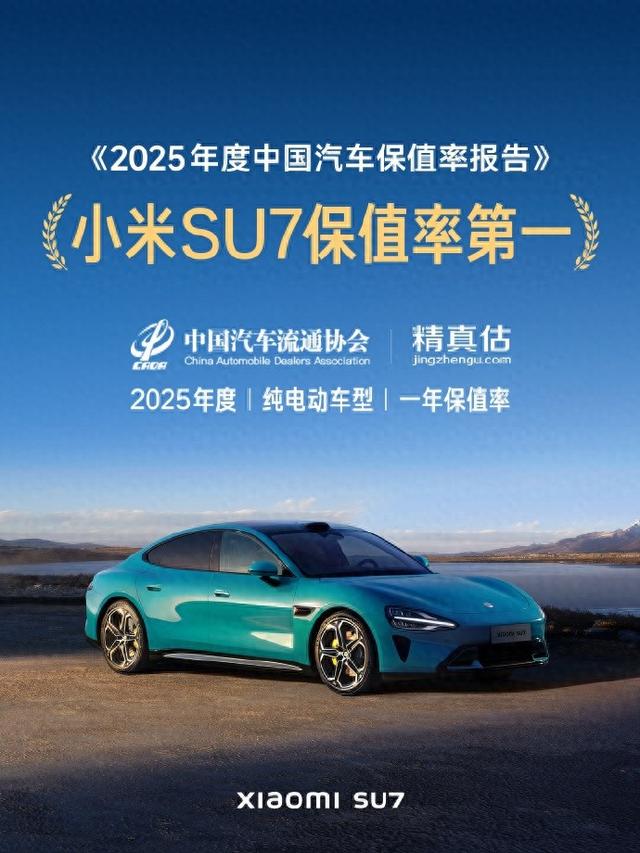
小米SU7纯电动车型中“一年保值率”2025年度第一
Bei Jing Ri Bao Ke Hu Duan· 2026-01-27 10:34
Core Insights - The report titled "2025 Annual China Car Retention Rate Report" indicates that the Xiaomi SU7 achieved the highest one-year retention rate among pure electric vehicles for 2025, marking its first participation in the annual retention rate rankings since its launch [1][5]. Group 1: Retention Rate Rankings - The Xiaomi SU7 has a one-year retention rate of 86.05%, placing it first in the rankings [4]. - The second position is held by the Jianjie M9 with a retention rate of 82.44% [4]. - The Li Auto MEGA ranks third with a retention rate of 78.56% [4]. - Other notable mentions include the Geely Galaxy Xingyuan at 78.01% and Tesla Model X at 76.38% [4]. - The Tesla Model 3 and XPeng MONA M03 have retention rates of 75.27% and 73.10%, respectively [4].

全球视野看电车之四:德国电车补贴重启,欧洲新能源进一步加速
Changjiang Securities· 2026-01-27 09:15
Investment Rating - The investment rating for the automotive and automotive parts industry is "Positive" and maintained [6]. Core Insights - The German government plans to restart the electric vehicle (EV) subsidy policy that was suspended in 2023, with a total budget of €3 billion (approximately ¥24 billion), aimed at boosting the domestic automotive industry and accelerating the green transition [2][4][18]. - The subsidy will provide between €1,500 and €6,000 for eligible low- to middle-income families purchasing new energy vehicles priced below €45,000, effective from January 1, 2026, until 2029 or until funds are exhausted [18]. - The expected impact of the subsidy is to significantly increase the penetration rate of new energy vehicles in Germany, with projections indicating that at least 500,000 vehicles will be subsidized, accounting for approximately 29.5% of the expected new energy vehicle sales in 2025 [18][21]. Summary by Sections Event Description - On January 19, the German government announced the restart of the EV subsidy policy, with a total budget of €3 billion, to enhance the penetration of new energy vehicles in the market [4][18]. Market Performance - The report indicates that the penetration rate of new energy vehicles in Germany is expected to rise significantly due to the subsidy, with a projected 84,700 new energy vehicles sold in 2025, representing a year-on-year growth of 48.3% [13][18]. - The overall new energy vehicle sales in Europe are projected to reach 3.9 million units in 2025, with a year-on-year increase of 32.7% [13][18]. Implications for Domestic Companies - The subsidy is expected to benefit domestic companies such as BYD, Leapmotor, and SAIC, as many of their models are priced below €45,000 [30]. - The increase in new energy vehicle penetration in Europe is anticipated to positively impact the performance of domestic component manufacturers and vehicle producers operating in the European market [30].


汽检机构捞金能力远超整车厂
第一财经· 2026-01-27 05:59
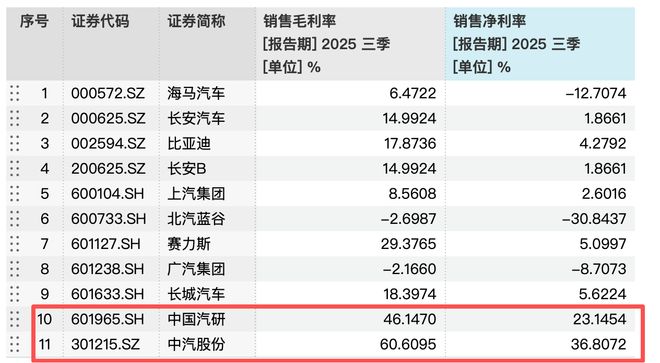
Core Viewpoint - The article highlights the contrasting financial performance between the automotive industry, which is experiencing historically low profit margins, and the high profitability of automotive testing institutions, revealing the challenges faced by the new energy vehicle sector [3]. Group 1: Company Performance - China Automotive Research (601965.SH) expects to achieve a net profit of 1.06 billion yuan in 2025, a year-on-year increase of 16.78%, with revenue of 4.968 billion yuan, up 4.98%, indicating that profit growth outpaces revenue growth [3]. - China Automotive Corporation (301215.SZ) reported a revenue of 435 million yuan for the first three quarters, a year-on-year increase of 20.91%, and a net profit of 160 million yuan, up 31.26%, with a non-recurring net profit growth of 38.71% [3]. - In the first three quarters of 2025, China Automotive Research and China Automotive Corporation had net profit margins of 23.1% and 36.8%, respectively, while the overall automotive industry had a profit margin of only 4.1% [3]. Group 2: High Profitability of Testing Services - The automotive testing business has shown high profitability, with China Automotive Research's intelligent connected vehicle testing segment achieving a revenue of 224 million yuan, a year-on-year increase of 95.92%, and a net profit margin of 33% [6]. - China Automotive Corporation's testing service revenue reached 204 million yuan with a gross margin of 70.21%, contrasting sharply with the low gross margins of major automotive manufacturers, which are mostly below 20% [7]. - The sales gross margins for China Automotive Research and China Automotive Corporation were 46.15% and 60.61%, respectively, compared to leading automakers like BYD (4.28%) and SAIC Motor (2.6%) [7]. Group 3: Industry Challenges and Regulatory Environment - The automotive safety regulation landscape is evolving, with the automotive testing sector playing an increasingly critical role, driven by policy implementation and growing demand for research and testing [11]. - The market size for the automotive testing industry in China is projected to be between 2 billion to 3 billion yuan, indicating significant growth potential [11]. - Concerns have been raised regarding the impartiality of testing institutions, especially following incidents that questioned the integrity of testing processes, highlighting the potential conflicts of interest in commercial testing [12][13].

汽检机构捞金能力远超整车厂
Di Yi Cai Jing Zi Xun· 2026-01-27 05:41
Core Insights - The automotive industry is facing a significant profitability crisis, with profit margins at historical lows, while testing agencies are experiencing high profit margins [1][3] Group 1: Company Performance - China Automotive Research (601965.SH) expects a net profit of 1.06 billion yuan in 2025, a year-on-year increase of 16.78%, with revenue of 4.968 billion yuan, up 4.98%, indicating profit growth outpacing revenue growth [1] - Zhongqi Co., Ltd. (301215.SZ) reported a revenue of 435 million yuan for the first three quarters, a year-on-year increase of 20.91%, and a net profit of 160 million yuan, up 31.26% [1] - The sales net profit margins for China Automotive Research and Zhongqi Co., Ltd. were 23.1% and 36.8%, respectively, compared to the automotive industry's low sales profit margin of 4.1% in 2025 [1][3] Group 2: Business Segments - China Automotive Research is a national-level technology innovation and public service institution in the automotive sector, focusing on testing and quality supervision [2] - Zhongqi Co., Ltd. provides technical services for automotive testing environments and scenarios, with a reported revenue of 204 million yuan from its testing services and a gross margin of 70.21% [2] - The growth in revenue for China Automotive Research is largely driven by the demand for intelligent connected vehicle testing, with this segment achieving a revenue of 224 million yuan, up 95.92%, and a net profit margin of 33% [2] Group 3: Industry Context - The automotive testing industry is projected to grow, with market size estimates between 2 billion to 3 billion yuan, driven by regulatory policies and increased testing demands [6] - The automotive testing sector is facing scrutiny regarding the impartiality of testing agencies, especially following incidents that raised questions about the integrity of testing processes [7][8] - Experts suggest that the current market-driven model of testing agencies may compromise their objectivity, highlighting the need for potential reforms to ensure fairness in testing practices [8]
智能驾驶,没有中场战事只有无限战争
3 6 Ke· 2026-01-27 04:40
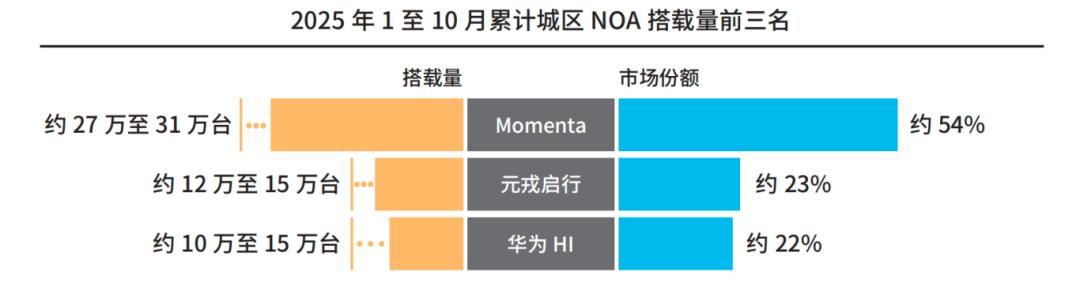
Core Insights - The article discusses the significant reshuffling in the Chinese advanced driving assistance market, particularly focusing on urban NOA (Navigation on Autopilot) as it approaches a critical penetration rate of over 10% by 2025, with expectations to reach 22% by 2026, leading to a market scale targeting millions of units [6][14]. Group 1: Market Dynamics - A number of players, including Maimo Zhixing and Dazhuo Intelligent, have exited the market, while Huawei, Yuanrong Qixing, and Momenta have emerged as the dominant trio, collectively holding 99% of the urban NOA market share from January to October 2025 [2][8]. - In October 2025, Yuanrong Qixing achieved the highest urban NOA installation rate, with a significant growth rate of 2.7 times compared to the average monthly installation from January to October 2025 [8][10]. Group 2: Competitive Strategies - The three leading companies have adopted different market strategies: Huawei focuses on high-end models, Momenta has a broad brand coverage, and Yuanrong Qixing targets mass-market models for data accumulation [9][10]. - Yuanrong Qixing's strategy emphasizes deep collaboration with a few key models to create "explosive" sales, resulting in significant sales increases for models like the Blue Mountain and Galaxy M9 [9][10]. Group 3: Future Projections - The competition is expected to intensify as the industry moves towards "million-unit production," with a projected annual output of 5 million high-level autonomous vehicles by 2026 [14][15]. - The article highlights the importance of data efficiency and closed-loop systems as critical competitive advantages in the evolving landscape of intelligent driving [14][15]. Group 4: Investment Trends - The investment landscape for autonomous driving has seen a significant rebound in 2025, with nearly 60 billion yuan raised, indicating a strong focus on leading and commercially viable projects [14][15].
中国电动汽车加速驶进英国市场
Xin Lang Cai Jing· 2026-01-27 04:21
本报驻英国特约记者 纪双城 本报记者 丁雅栀 "中国汽车制造商瞄准英国。"英国《金融时报》日前以此为题报道称,蔚来、埃安和极氪在内的中国车 企纷纷计划于今年在英国推出相关车型。报道认为,对于希望拓展海外市场的中国汽车制造商而言,英 国市场至关重要,因为英国并未对中国制造的电动汽车征收更高的关税。此外,由于缺乏本土的大众市 场汽车制造商,英国消费者也更容易接受新品牌。 根据英国汽车制造商和贸易商协会的统计,2025年,以名爵为代表的中国品牌在英国的市场份额较前一 年翻了一番,超过10%。仅在去年12月,比亚迪和奇瑞的市场份额就分别从一年前的1%和0.7%增长至 5%,而当月中国品牌的整体市场份额达到18%。 据报道,中国车企吉利去年进入英国市场,并表示希望每年销售10万辆汽车,而且将为其电动汽车电池 提供8年质保。2025年的其他进场者包括长安、小鹏和零跑汽车。 然而,前往英国市场对于中国车企来说也面临一些挑战,比如需要面临特斯拉、大众等欧美电动汽车的 激烈竞争。另外,钟师提醒,中国新能源车出口英国与出口欧洲其他国家并无本质区别,核心挑战仍集 中在售后服务与文化融入层面。英国消费者对首次接触的中国品牌服务要求更 ...