产业链出海

Search documents
从年亏13亿到盈利7亿,瑞浦兰钧怎么打赢的“翻身仗”?
Xin Lang Cai Jing· 2026-02-09 10:54
Core Viewpoint - Rui Pu Lan Jun is expected to achieve a net profit of 630 million to 730 million yuan in 2025, marking a turnaround from a loss of 1.353 billion yuan in 2024, resulting in an improvement of nearly 2 billion yuan in profit [2][20]. Financial Performance - In the first half of 2025, Rui Pu Lan Jun reported total revenue close to 9.5 billion yuan, a year-on-year increase of nearly 25% [5][23]. - The net loss was significantly reduced by 90.4% year-on-year, and gross profit surged by 177.8% to reach 829 million yuan [5][23]. - The total sales volume of lithium batteries reached 32.40 GWh in the first half of 2025, doubling year-on-year with a growth of approximately 100.2% [5][23]. Strategic Transformation - The turnaround is attributed to strategic adjustments, management reforms, and market focus initiated by President Feng Ting, who took office in November 2024 [7][25]. - The company implemented a deep reform centered on "strategic focus" and "cost reduction and efficiency enhancement," including the merger with Lan Jun New Energy to unify resources and eliminate internal friction [7][25]. Market Positioning - Rui Pu Lan Jun has shifted its focus to the commercial vehicle battery swap market, achieving a market share that ranks second nationally for both new energy heavy truck batteries and battery swap heavy truck batteries in the first half of 2025 [27]. - The company has successfully expanded into overseas markets, generating 2.663 billion yuan in overseas revenue in 2025 and establishing partnerships with several international companies [27]. Industry Context - The energy storage industry is transitioning from "scale competition" to "value competition," with technological commercialization becoming a core competitive advantage [12][30]. - The European market remains a key variable, with potential recovery expected as inventory depletion concludes and supportive policies emerge [12][30]. Future Outlook - Rui Pu Lan Jun plans to pursue three growth trajectories: collaborative growth of its business matrix, deepening globalization, and continuous technological leadership [33]. - The global energy storage market is projected to maintain a compound annual growth rate of 15%, with new installed capacity expected to reach 16 GW by 2030 [33].

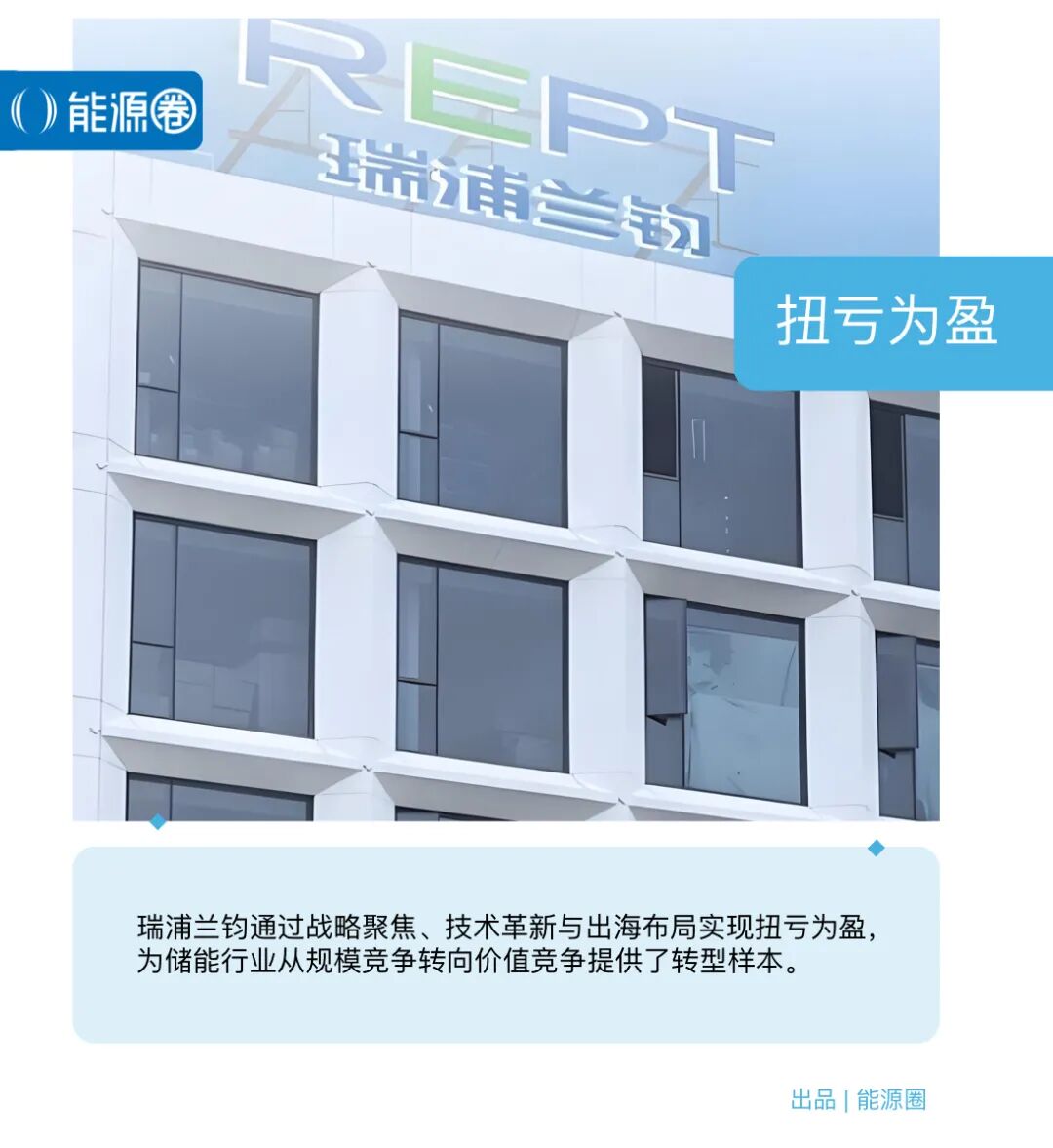
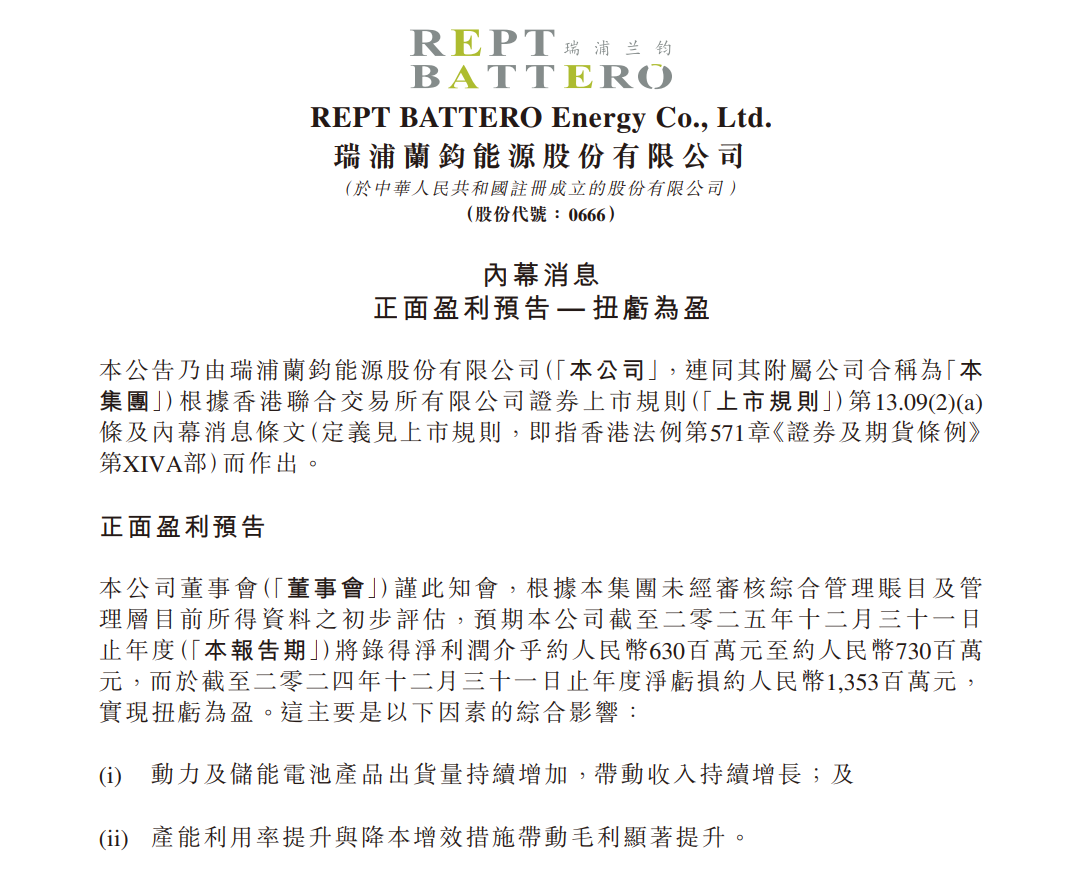
瑞浦兰钧发布盈利预喜公告,官宣25年实现扭亏为盈,底气是什么?
Sou Hu Wang· 2026-02-03 10:33
Core Viewpoint - Ruipu Lanjun has announced a profit forecast, expecting a net profit between approximately RMB 630 million to RMB 730 million by December 31, 2025, after a net loss of approximately RMB 1.353 billion for the year ending December 31, 2024, indicating a turnaround in performance driven by increased sales of power and energy storage battery products, improved capacity utilization, and cost reduction measures [1][3] Group 1: Financial Performance - The company reported a revenue of RMB 9.491 billion for the first half of 2025, representing a year-on-year growth of 24.9%, with a significant reduction in net loss by over 90% compared to the previous year [3] - The forecasted net profit for 2025 marks a significant recovery from the previous year's losses, showcasing the company's confidence in its operational improvements and market strategies [1][3] Group 2: Strategic Adjustments - Under the leadership of President Feng Ting, who took office in November 2024, the company has implemented strategic adjustments, resource integration, and internal reforms, contributing to its improved financial performance [3] - The company has shifted its strategic focus from "technology exploration" to a "customer demand-driven" approach, ensuring that technological advancements align closely with market needs [8] Group 3: Technological Advancements - The core technology platform "WenDing®" has successfully transitioned from laboratory to market, enhancing internal space utilization by 3%-5% and reducing direct current resistance (DCR) by 16% [8][9] - The company has developed several industry-leading products based on this technology, including a 392Ah energy storage cell with an energy efficiency of 95%-96.4% and a 588Ah ultra-large capacity cell achieving 96.6% efficiency in specific charging scenarios [9] Group 4: Global Expansion Strategy - Ruipu Lanjun is shifting its global strategy from simple product exports to "industrial chain export" and deep localization, exemplified by its investment in a battery factory in Indonesia with an initial planned capacity of 8GWh [11] - The company has signed strategic cooperation agreements with local firms in Indonesia and South Korea, significantly increasing its overseas revenue by 153.4% year-on-year to RMB 2.663 billion in 2024 [11] Group 5: Future Outlook - The company is positioning itself as a comprehensive energy solutions provider, aiming to integrate deeply into local green energy infrastructure in Southeast Asia, the Middle East, and Europe [15] - Ruipu Lanjun's global narrative is evolving from "going out" to "going in" and "integrating in," with a focus on sustainable innovation and maintaining its technological edge in the global energy revolution [15]
江苏:传统制造全链扎根
Jing Ji Ri Bao· 2026-01-28 21:59
Group 1 - Traditional industries are an indispensable part of the modern industrial system, with Jiangsu's traditional industries contributing over 50% of the province's industrial profits and over 60% of its operating income [1] - Jiangsu enterprises have deeply integrated into the global market through various strategies such as overseas factories, R&D centers, and brand localization, facilitating a transition in foreign trade from "quantitative expansion" to "qualitative leap" [1] - Yadea Technology Group showcases a wide range of innovative electric vehicles, including electric motorcycles and scooters, with strong demand in markets like South America and Southeast Asia, and has established production bases in Vietnam and Indonesia with planned annual capacities of 250,000 and 300,000 units respectively [1][2] Group 2 - Yadea's success in international markets is attributed to its customized approach, establishing R&D centers to meet local consumer demands and rapidly advancing overseas production and supply chain construction [2] - By the third quarter of 2025, seven electric two-wheeler companies in Xishan District of Wuxi have set up 14 overseas warehouses in nine countries, with exports reaching $350 million in the first half of 2025, a year-on-year increase of 31.9% [2] - Jiangsu Guanhua Medical Technology Co., Ltd. has transitioned from product export to industry chain globalization by establishing overseas factories for the production of dialysis equipment, while retaining core processes in China [2][3] Group 3 - Guanhua Medical occupies a leading position in the blood dialysis supply chain, contributing to the localization of dialysis production in countries along the Belt and Road Initiative, thereby solidifying "Made in China" in international markets [3] - The transformation of Jiangsu's traditional industries reflects a profound change in China's manufacturing export model, emphasizing the importance of cultural understanding, market demand insight, and industry development knowledge for successful global integration [3]

盘点2025年汽车产业政策新风向:从追求“规模速度”到比拼“质量效益”
Zhong Guo Qing Nian Bao· 2026-01-27 22:48
Core Insights - The Chinese automotive industry achieved significant milestones in 2025, with total vehicle production and sales showing steady growth, and new energy vehicle sales surpassing 10 million units for the first time, achieving a market penetration rate of over 50% [2][10] - A comprehensive set of policies was implemented to guide and correct the industry, with over 30 key standards and regulatory policies released by relevant departments, averaging more than 2.5 per month [2] Group 1: Market Competition and Regulation - The year 2025 marked a shift from "price wars" to "value wars," with a strong emphasis on curbing "involution" in the automotive sector through regulatory measures [3][4] - Key regulations included a "60-day payment cycle" for suppliers and a "price behavior compliance guideline" aimed at restoring order in the market and protecting supplier rights [3][4] - Major automakers like SAIC, BYD, and Geely adopted the 60-day payment cycle, which is seen as a move towards healthier industry ecology and stable cash flow for suppliers [3][4] Group 2: Safety and Technological Standards - Policies focused on safety in both intelligent connected vehicles and new energy vehicles were intensified, establishing a robust safety regulatory framework [5][6] - In the intelligent connected vehicle sector, new mandatory standards were introduced to ensure safety and prevent exaggerated claims about advanced driving capabilities [5] - The new national standards for electric vehicle batteries introduced stringent safety requirements, including tests for fire resistance and crash safety, which are considered the strictest in history [6] Group 3: Future Policy Directions - The continuity and foresight of policies in 2026 are expected to reinforce the stability of the automotive industry, with high standards established in 2025 set to be fully implemented [7] - Future competition will focus on the resilience and collaboration of the entire supply chain, emphasizing technological research, high-end manufacturing, and global operations [7] - Policies will increasingly support the development of cutting-edge technologies like L3-level autonomous driving and solid-state batteries, while promoting collaboration across the supply chain [7][10] Group 4: Global Expansion and Innovation - The push for "going global" is shifting from product export to "industry chain export" and "standard export," with a focus on building a complete ecosystem for Chinese automakers in international markets [9][10] - Companies like Leap Motor and Chery are rapidly expanding globally, utilizing diverse strategies to enhance their market presence and competitiveness [9][10] - The policies are driving innovation across the supply chain, with companies like Xinwangda developing advanced battery technologies to meet stringent safety and performance standards [8][9]
金鹰基金杨刚:市场正切换向盈利与估值双轮驱动的下半场
Xin Lang Cai Jing· 2026-01-21 08:35
Core Insights - The current market environment in 2026 differs significantly from 2015, with the recent rise to 4100 points driven by solid industrial foundations and profit support rather than just liquidity and risk appetite [1][5][6] - Opportunities in the market are emerging from accelerated global AI capital expenditure, with Chinese companies actively participating in various segments of the AI industry chain [1][6] - The ongoing geopolitical tensions, abundant liquidity, and economic recovery are contributing to rising prices of upstream resources, creating new investment opportunities [1][6] Market Dynamics - The A-share market is transitioning from a phase primarily driven by liquidity and risk appetite to one where both profits and valuations are expected to drive growth [2][7] - Recent increases in retail investor participation have led to heightened market sentiment, necessitating regulatory measures to ensure stability [2][7] - Short-term market corrections may occur due to over-exuberance, but patience and careful stock selection are advised for investors [2][7] Sector Focus - Continued attention is recommended for sectors such as AI computing power, semiconductors, and export-oriented industries like non-ferrous metals, electric grid equipment, and engineering machinery [2][7] - In the context of inflationary pressures, sectors like innovative pharmaceuticals and non-bank financials are suggested for consideration [2][7] Thematic Investment Opportunities - AI applications and commercial aerospace are highlighted as attractive investment themes, particularly after recent adjustments that may have alleviated short-term overheating [3][8] - The commercial aerospace sector, supported by strong policy backing and macro narratives like SpaceX, is expected to see continued upward momentum [3][8] - High-risk investors are encouraged to identify quality leaders within these sectors during periods of adjustment for long-term gains [3][8]
崔东树:2025年全国乘用车累计零售2378万辆 同比增长4%
智通财经网· 2026-01-10 23:21
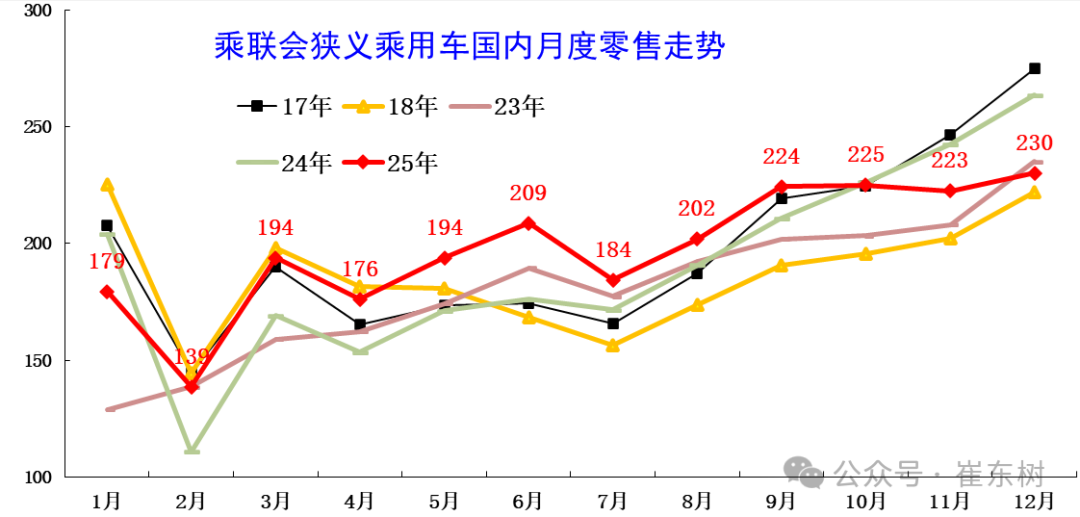
Core Insights - The retail sales of passenger cars in December 2025 reached 2.3 million units, representing a year-on-year decline of 13% but a month-on-month increase of 3% [1][7] - Cumulative retail sales for the year 2025 amounted to 23.78 million units, showing a year-on-year growth of 4% [1][7] - The wholesale growth rate for passenger cars in 2025 is projected at 9%, with a 25% growth rate for new energy vehicles, aligning with the growth expectations set for the "14th Five-Year Plan" [1] Retail Market Analysis - In December, the retail sales of fuel vehicles decreased by 30% year-on-year, while pure electric vehicle sales grew by 3% and range-extended vehicles increased by 19% [2] - The penetration rate of new energy vehicles in December reached 59%, indicating a significant shift towards a "new energy-dominated" market phase [2] - The cumulative export of self-owned fuel passenger vehicles in 2025 was 2.87 million units, down 7%, while self-owned new energy vehicle exports surged by 139% to 2.04 million units [2] Wholesale Market Trends - In December, the wholesale volume of passenger cars was 2.79 million units, down 9% year-on-year and 7% month-on-month, marking a rare decline for December [10][12] - The cumulative wholesale volume for the year reached 29.55 million units, reflecting a 9% year-on-year increase [12] - The production of passenger cars in December was 2.79 million units, a decrease of 5% year-on-year and 10% month-on-month [14] Production Insights - The production of passenger cars in December was 2.79 million units, which is 140,000 units lower than the historical peak of 2.93 million units in December 2024 [13][14] - The overall production for the year 2025 reached 29.61 million units, with a cumulative year-on-year growth of 10% [14] Export Performance - In December, the export of passenger cars (including complete vehicles and CKD) was 590,000 units, representing a year-on-year increase of 46% but a month-on-month decline of 2% [16] - The cumulative export for the year reached 5.74 million units, showing a 20% year-on-year growth [16] Inventory Dynamics - In December, the overall inventory of passenger cars decreased by 60,000 units, with a total inventory growth of 150,000 units for the year [19] - The inventory reduction in December was a result of proactive measures by manufacturers, contrasting with the previous year's inventory decline driven by retail demand [19] Promotional Strategies - The promotional intensity for new energy vehicles in December reached 10.1%, reflecting a stable promotional environment [22] - Traditional fuel vehicles maintained a promotional level of 24.3%, while luxury vehicles saw promotions rise to 29.1% [26][30] - The promotional pressure for conventional fuel and hybrid vehicles remained low, while new energy vehicle promotions were more aggressive [32]
“十五五”中国企业全球化:新出海、新伙伴、新未来
Jing Ji Guan Cha Wang· 2026-01-06 03:03
Core Insights - The article highlights the transformation of Chinese companies' international expansion strategies during the "15th Five-Year Plan" period, moving from simple product exports to a more integrated approach involving technology, brand, and ecosystem development [2][8]. Group 1: Project Developments - A 2600 MW solar power plant in Saudi Arabia, the largest in the Middle East, showcases the EPC capabilities of China Energy Engineering Group, integrating China's strong manufacturing with Schneider Electric's advanced technology [1]. - Schneider Electric collaborates with China Energy Engineering Group to provide electrical solutions for the solar project, demonstrating effective risk management in complex overseas environments [3]. Group 2: Globalization and Localization - The article emphasizes the need for Chinese companies to adopt a validated globalization methodology and seek reliable partners, particularly multinational corporations that understand both Chinese and global markets [3][6]. - Schneider Electric's extensive global network and deep understanding of the Chinese market position it as a key partner for Chinese companies looking to expand internationally [6][7]. Group 3: Collaborative Opportunities - Schneider Electric is actively partnering with various Chinese firms, such as China Power Construction and CATL, to explore third-party markets in the Middle East and Southeast Asia, contributing to local energy infrastructure [4]. - The collaboration with core suppliers like Jinrong Tianyu has led to significant upgrades in digitalization and internationalization, enhancing their global supply chain presence [4]. Group 4: Innovation and Technology Transfer - Schneider Electric's localized operations have resulted in a strong innovation network in China, producing advanced technologies like environmentally friendly switchgear and new generation circuit breakers that are now entering global markets [7][8]. - The partnership between Schneider Electric and Chinese companies facilitates the transfer of China's innovations in new energy and digitalization to broader markets, aligning with the global expansion of Chinese enterprises [8][9].
观车 · 论势 || 疾风知劲草,新局自此开
Zhong Guo Qi Che Bao Wang· 2026-01-05 01:24
Core Viewpoint - The Chinese automotive industry in 2025 is characterized by a "reversal," with a shift from irrational competition and price wars to a more regulated and innovative landscape [1][5]. Group 1: Industry Regulation and Order - The internal forces seeking order have awakened, leading to a collective consensus against "involution" in the industry, with various government departments implementing measures to regulate competition [1][2]. - The Ministry of Industry and Information Technology and other agencies have introduced comprehensive governance measures to address irrational competition, resulting in a significant reduction in promotional pricing and discounts in the passenger car market [1][2]. Group 2: Corporate Integration and Efficiency - Major automotive companies are undergoing integration to enhance efficiency and reduce costs, as seen with Geely's integration of Zeekr and NIO's consolidation of brands [2]. - The trend of corporate integration reflects a consensus among automakers to pool resources and strengthen their competitive positions in the market [2]. Group 3: Innovation and Technology - Innovation is driving the industry forward, with advancements in technology making features like assisted driving more accessible, as evidenced by a 64% penetration rate of combined assisted driving vehicles in the new car market [3]. - The automotive industry's boundaries are blurring as companies expand into areas like robotics and smart devices, indicating a long-term evolution of technology and business models [3]. Group 4: Market Expansion and Globalization - Incentive policies such as trade-in programs are effectively stimulating the existing market, while the expansion of charging networks and sales channels is awakening the potential of county-level markets [4]. - China's automotive exports reached 6.343 million units in the first 11 months of the year, marking an 18.7% year-on-year increase, with a shift towards new export models like technology and localized production [4]. Group 5: Future Outlook - The automotive industry is expected to continue addressing "involution" in 2026, with new guidelines being introduced to ensure compliance in pricing behavior [5]. - The industry aims to achieve stable growth while navigating uncertainties such as policy changes and international market conditions, striving for a more competitive and resilient automotive landscape [6].
当“蔚小理”跌出头部:2026车企淘汰赛全面加速
首席商业评论· 2026-01-01 04:42
Core Viewpoint - The Chinese automotive market is undergoing a significant transformation, with a shift from traditional fuel vehicles to electric vehicles (EVs), leading to a competitive landscape focused on profitability and safety in the face of potential negative growth in 2026 [2][5][20]. Group 1: Market Transformation - The penetration rate of new energy vehicles in China rose from 5.4% in 2020 to 53.6% by November 2025, indicating a rapid transition compared to Europe [3]. - The automotive industry's value metrics have shifted from traditional components to new standards such as range, smart cabin experience, and assisted driving capabilities [3]. - By 2025, the market dynamics have changed, with new energy vehicles becoming the dominant force, moving from trendsetters to market leaders [3]. Group 2: Competitive Landscape - In 2025, the focus for automotive companies will shift from competing between new energy and fuel vehicles to finding ways to remain profitable in a low-margin environment [5][20]. - The market is witnessing a significant increase in market share for domestic brands, with projections indicating that domestic brands will exceed 65% market share [8]. - The sales performance of new entrants like Xiaomi has been inconsistent, highlighting the challenges of maintaining consumer trust amid safety concerns [10]. Group 3: Safety and Technology - The automotive industry is experiencing a profound value return, with safety becoming a critical factor rather than a cost option [12]. - By 2025, many vehicles are equipped with L2-level smart driving features, and advancements in battery technology have led to significant improvements in range and charging speed [12][14]. - New regulations are set to enforce stricter safety standards for electric vehicle batteries, emphasizing the importance of safety in the competitive landscape [16][18]. Group 4: Future Outlook - The automotive market is expected to face a potential decline in growth, with forecasts suggesting a 1% to 3% increase or a possible 2% negative growth in 2026 [20][21]. - Policy changes, such as the reduction of tax incentives for new energy vehicles, may impact sales growth, particularly in the price-sensitive segment [21][23]. - Companies are encouraged to explore global markets and innovate in technology to create new value, with a focus on L3-level autonomous driving and smart vehicle integration [25][28].


朗华集团欧阳志军:“出海”内涵正从产品出口迈向产业链出海
Nan Fang Du Shi Bao· 2025-12-26 05:58
Core Insights - The forum "Intelligent Manufacturing Going Global: New Cross-Border Trends" highlighted the transformation of Chinese enterprises' overseas strategies from mere product exports to comprehensive industrial chain globalization [2][4]. Group 1: Industry Trends - The concept of "going global" has evolved significantly, shifting from simple product exports to a systematic approach involving the entire industrial chain [4]. - Geopolitical and trade environment changes pose challenges for companies relying solely on relocating factories or exporting finished products, necessitating collaboration across the supply chain to build regional industrial ecosystems [4]. Group 2: Company Overview - Langhua Group has established itself as a cornerstone for supporting Chinese industrial globalization, with a cross-border transaction volume reaching 130 billion RMB annually, serving over 20,000 B-end manufacturing enterprises [4]. - The company operates a global warehousing management area exceeding 3 million square meters, with a business network covering over 200 countries and regions [4]. Group 3: Solutions and Innovations - Langhua Group offers a dual-driven solution of "Supply Chain + Financial Technology" to address the core pain points of enterprises going global [5]. - The company has developed a service system linking its domestic supply chain financial technology platform, Langchain Technology, with its overseas licensed entity, Zhilang Bank [5]. Group 4: Financing Challenges - Traditional mortgage financing models are inadequate for the needs of industrial chain globalization, prompting Langhua to leverage deep integration and data insights to empower enterprises with credit based on real trade backgrounds [7]. - The company collaborates with domestic financial institutions to support overseas entities by utilizing the credit of domestic counterparts, effectively bridging domestic and international financing channels [7]. Group 5: Future Goals - Langhua Group aims to enhance its global supply chain service capabilities and become a trusted infrastructure service provider in the globalization of Chinese manufacturing through innovative supply chain financial models [7].