天合光能

Search documents
未知机构:hcdx马斯克美国未来3年或建200gw光伏产能用于数据中心供能利好光储产-20260123
未知机构· 2026-01-23 02:20
Summary of Key Points from Conference Call Industry Overview - The focus is on the solar photovoltaic (PV) industry, particularly in relation to data centers and the expansion of solar capacity in the United States driven by companies like SpaceX and Tesla [1][2]. Core Insights and Arguments - Elon Musk announced at the Davos Forum that SpaceX and Tesla aim to build 100 GW of solar capacity in the U.S. over the next three years, potentially exceeding previous market expectations of 10-20 GW per year [1][2]. - The anticipated solar capacity is likely to be used for both space and ground data center energy supply, indicating a significant shift in energy sourcing for these facilities [1][2]. - The technology preference for ground solar applications is leaning towards TOPCon technology, while space solar applications may initially favor HJT technology due to considerations of efficiency and degradation [3]. Equipment and Supply Chain Impact - The demand for solar equipment is projected to be substantial, with an estimated annual procurement need of 60-70 GW over three years, translating to approximately 120 billion, 250 billion, and 100 billion in revenue from silicon wafers, batteries, and components respectively, leading to a profit potential of 80-100 billion [4]. - Key suppliers in the solar equipment sector include: - Maiwei Co., a leading supplier of HJT equipment - Laplace and Jiejia Weichuang, leaders in TOPCon and perovskite equipment - Aotwei, covering various segments of battery and component production - Jingcheng Machinery and other companies involved in ultra-thin silicon and silicon carbide technologies [4]. Battery and Component Materials - The pricing dynamics show a significant premium for space solar components (over 100 CNY/W) compared to ground components (0.7 CNY/W), indicating a lucrative market for space solar technology [4]. - Companies like Dongfang Risheng have already begun supplying SpaceX, with plans to deliver 100,000 units monthly by 2026 [4]. - Jun Da Co. is collaborating with Shangyi Optoelectronics to advance perovskite tandem battery testing in satellites [4]. - Other notable manufacturers include JinkoSolar, Trina Solar, Longi Green Energy, and Canadian Solar, all of which are expanding their technological capabilities [4]. Energy Storage Considerations - The integration of solar energy into U.S. data centers necessitates the development of energy storage solutions, highlighting the interconnectedness of solar generation and storage needs [4].

重回1元/W时代?2026年光伏组件价格有三重强支撑
3 6 Ke· 2026-01-23 02:19
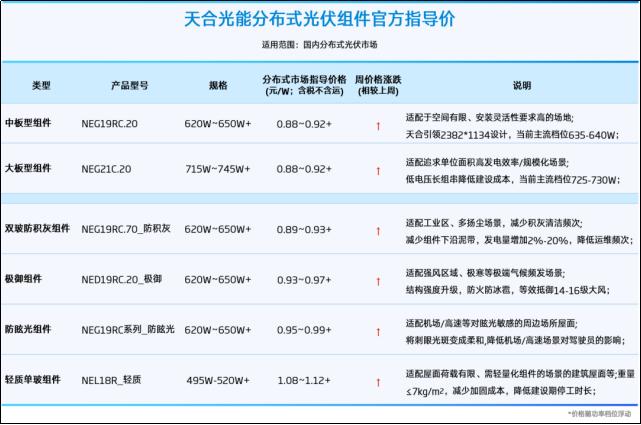
Core Viewpoint - The steady increase in photovoltaic module prices indicates a positive market trend, with major companies like Trina Solar raising their prices multiple times in January 2023, signaling strong demand and a potential return to the 1 yuan/W price point for modules [1][3]. Price Adjustments - Trina Solar has raised its distributed photovoltaic module market guidance price for the third time in January, with prices now ranging from 0.88 to 1.12 yuan/W depending on the module type [1][2]. - The average price of bifacial double-glass TOPCon modules reached approximately 0.7 yuan/W, reflecting a 0.3% increase from the previous week and a 1% increase from a month ago [3]. Demand Side - The photovoltaic industry has seen explosive growth since 2020, with China's new installed capacity expected to reach 277.17 GW in 2024, a significant increase from 48.2 GW in 2020 [4]. - Despite a generally pessimistic outlook for 2026, emerging markets like India are projected to see substantial growth, with an expected 25% increase in new installations [7][8]. Supply Side - The "anti-involution" policy is expected to continue, aiming to eliminate low-price competition and improve market conditions [10][12]. - Market-driven elimination of excess capacity is anticipated to accelerate in 2026, as many companies face financial difficulties and may exit the market [13][14]. Cost Factors - Rising silver prices, which have increased over 33% since the beginning of the year, are a significant factor driving up the costs of photovoltaic modules [15][17]. - The cancellation of export tax rebates is expected to increase cost pressures on exporting companies, further supporting price increases [18]. Overall Market Outlook - The combination of demand, supply, and cost factors is likely to keep module prices strong, with a potential return to the 1 yuan/W price point, indicating a recovery in the photovoltaic industry [19].



太空游来了!商业航天股继续回升,中超控股、巨力索具涨停
Jin Rong Jie· 2026-01-23 02:13
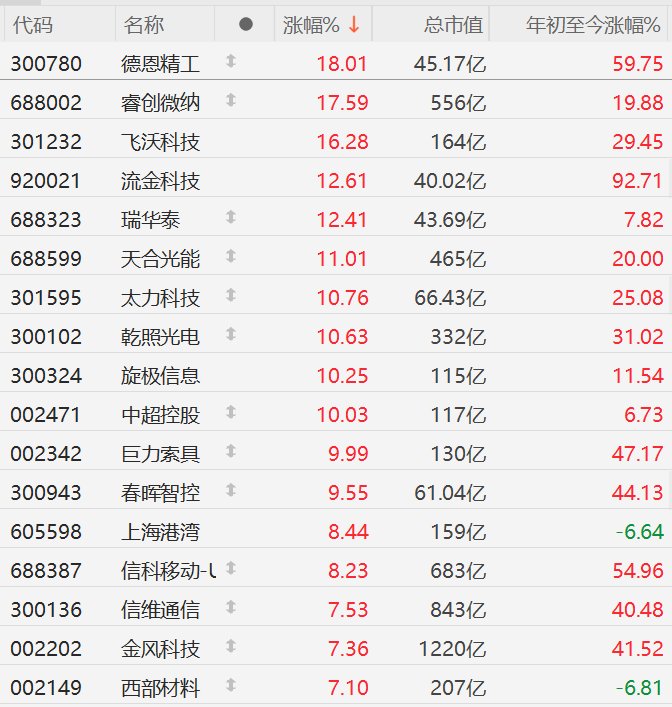
Group 1 - The A-share market saw a rebound in commercial aerospace stocks, with notable increases in share prices for several companies, including Deen Precision Engineering up 18% and Ruichuang Micro-Nano up over 17% [1][2] - Beijing Chuanqiu Space Technology Co., Ltd. announced that actor Huang Jingyu will join the first batch of Chinese commercial space travelers, planning to fly on the domestic reusable manned spacecraft "Chuanqiu No. 1" in 2028, with a ticket price of 3 million yuan [1] Group 2 - The stock performance of various companies in the commercial aerospace sector includes: - Deen Precision Engineering (300780) with a market cap of 4.517 billion yuan and a year-to-date increase of 59.75% [2] - Ruichuang Micro-Nano (688002) with a market cap of 55.6 billion yuan and a year-to-date increase of 19.88% [2] - Feiwo Technology (301232) with a market cap of 16.4 billion yuan and a year-to-date increase of 29.45% [2] - Other companies like Liujin Technology, Ruihua Tai, and Tianhe Energy also showed significant gains, with increases ranging from 10% to over 12% [1][2]






A股异动丨太空游来了!商业航天股继续回升,中超控股、巨力索具涨停
Ge Long Hui A P P· 2026-01-23 02:08
Core Viewpoint - The commercial aerospace sector in the A-share market is experiencing a rebound, with significant stock price increases for various companies following the announcement of China's first commercial space tourism initiative [1] Group 1: Stock Performance - Deen Precision Engineering (德恩精工) saw an increase of 18.01%, with a total market capitalization of 4.517 billion [2] - Ruichuang Micro-Nano (睿创微纳) rose by 17.59%, reaching a market cap of 55.6 billion [2] - Feiwo Technology (飞沃科技) increased by 16.28%, with a market value of 1.64 billion [2] - Other notable performers include: - Liujin Technology (流金科技) up 12.61% with a market cap of 4.002 billion [2] - Ruihua Tai (瑞华泰) up 12.41% with a market cap of 4.369 billion [2] - Trina Solar (天合光能) up 11.01% with a market cap of 46.5 billion [2] - Taili Technology (太力科技) up 10.76% with a market cap of 6.643 billion [2] - Qian Zhao Optoelectronics (乾照光电) up 10.63% with a market cap of 33.2 billion [2] - Xuanji Information (旋极信息) up 10.25% with a market cap of 11.5 billion [2] - Zhongchao Holdings (中超控股) up 10.03% with a market cap of 11.7 billion [2] - Ju Li Sockets (巨力索具) up 9.99% with a market cap of 13 billion [2] - Chunhui Intelligent Control (春晖智控) up 9.55% with a market cap of 6.104 billion [2] - Shanghai Port Bay (上海港湾) up 8.44% with a market cap of 15.9 billion [2] - Xinke Mobile (信科移动) up 8.23% with a market cap of 68.3 billion [2] - Xinwei Communication (信维通信) up 7.53% with a market cap of 84.3 billion [2] - Goldwind Technology (金风科技) up 7.36% with a market cap of 122 billion [2] - Western Materials (西部材料) up 7.10% with a market cap of 20.7 billion [2] Group 2: Space Tourism Announcement - Beijing Chuanqiu Space Technology Co., Ltd. announced the inclusion of actor Huang Jingyu in China's first commercial space travel lineup, planning to fly in 2028 aboard the domestic reusable spacecraft "Chuanqiu No. 1" [1] - The flight will last approximately 2.5 hours, crossing the Kármán line at 100 kilometers, allowing for 12 minutes of weightlessness [1] - The ticket price is set at 3 million, requiring a 10% deposit and completion of professional training [1]
新能源ETF(516160)强势拉升涨超3%,政策+资本双轮驱动,新能源全产业链迎发展新机遇
Xin Lang Cai Jing· 2026-01-23 02:03
Core Viewpoint - The renewable energy sector is experiencing positive momentum driven by supportive government policies and increasing demand in electric vehicles and energy storage [1][2][3] Group 1: Market Performance - The New Energy ETF (516160) rose by 3.02%, with a trading volume of 906.94 million yuan [1] - Key stocks in the index, such as Maiwei Co., Ltd. and Laplace, saw significant gains of 20.00% and 19.62% respectively [1] Group 2: Government Policies - On January 20, the Ministry of Finance released five documents outlining a package of favorable policies to support small and medium enterprises, private investment, and equipment upgrades [1] - Key focus areas for support include energy power, new energy vehicles, energy conservation, and small hydropower [1] Group 3: Industry Trends - The electric vehicle and energy storage sectors are entering a new growth cycle, with several automakers announcing ambitious sales targets for 2026 [2] - Global lithium battery production is projected to reach 2,297 GWh by 2025, marking a 48.5% year-on-year increase, with power batteries being the main growth driver [2] - CATL and Changan Automobile signed a five-year strategic cooperation memorandum focusing on advanced fields such as battery swapping and smart vehicles [2] Group 4: Supply Chain Dynamics - The supply and demand for lithium carbonate are expected to remain favorable, with China's production projected to reach 976,300 tons by 2025, a 49% increase [2] - A recent investment of 3.688 billion yuan by a major mining company aims to produce approximately 80,000 tons of lithium carbonate annually [2] Group 5: Technological Advancements - The solid-state battery sector is entering a critical phase of engineering and industrialization, with recent tests being conducted in extreme cold conditions [2] - The State Grid announced a fixed asset investment of 4 trillion yuan for the 14th Five-Year Plan period (2026-2030), a 40% increase from the previous period, aimed at achieving carbon peak by 2030 [3] - The integration of AI in manufacturing is being promoted to enhance productivity and support new industrialization [3] Group 6: Index Composition - The New Energy Index includes companies involved in renewable energy production, application, storage, and interaction devices, with the top ten weighted stocks accounting for 43.23% of the index [3]





科创新能源ETF(588830)昨日收涨1.61%,光伏反内卷持续推进
Xin Lang Cai Jing· 2026-01-23 01:36
Group 1 - The core viewpoint of the news is that the Chinese government is pushing for a shift in the photovoltaic industry from "price competition" to "innovation-driven" competition to combat "involution" [1][2] - The National Energy Administration highlighted that the root cause of "involution" in the photovoltaic industry is the shift from competing on technology and innovation to competing on price and scale [1] - A recent procurement by Huadian for 8GW of high-efficiency modules showed that 75% of the components met the high-efficiency standard (conversion efficiency ≥ 23.8%), indicating that only leading companies can meet these requirements [1] Group 2 - Changjiang Electric Power New Energy noted that the recent statements from the State Administration for Market Regulation and Huadian's large-scale procurement of high-efficiency components suggest that self-discipline in the photovoltaic industry will continue to advance [2] - The basic expectations for traditional photovoltaic have weakened previously, but recent developments have restored these expectations, solidifying the bottom of both the fundamental and financial aspects [2] - The trend in the photovoltaic market will need to be monitored closely, especially around mid-year, as demand expectations shift [2] Group 3 - The Science and Innovation New Energy ETF closely tracks the Shanghai Stock Exchange Science and Technology Innovation Board New Energy Index, which includes 50 large-cap stocks in the photovoltaic, wind power, and new energy vehicle sectors [3] - As of December 31, 2025, the top ten weighted stocks in the index include JinkoSolar, First Solar, Trina Solar, and others, accounting for 46.84% of the total index weight [3] Group 4 - The Science and Innovation New Energy ETF (588830), the ChiNext New Energy ETF (159261), and the Photovoltaic ETF (159863) are mentioned as key investment vehicles in the sector [4]
科创50ETF刷新近一个月高点
Mei Ri Jing Ji Xin Wen· 2026-01-22 15:58
科创50ETF(588000)追踪科创50指数,指数持仓电子行业超70%,与当前人工智能、机器人等前 沿产业的发展方向高度契合。同时涉及半导体、医疗器械、软件开发、光伏设备等多个细分领域,硬科 技含量高,看好中国硬科技长期发展前景的投资者建议持续关注。 相关ETF:科创50ETF(588000)。 每日经济新闻 (责任编辑:张晓波 ) 截至2026年1月22日 10点43分,科创50指数上涨0.43%,成分股龙芯中科上涨7.91%,中国通号上涨 5.11%,澜起科技上涨4.99%,天合光能上涨4.30%,西部超导上涨4.04%。科创50ETF(5880000)上涨 0.43%,最新价报1.62元,刷新近一个月高点,近1周累计上涨2.34%。 流动性方面,科创50ETF盘中换手3.31%,成交27.69亿元。近1月日均成交48.94亿元,居可比基金 第一。 财通证券认为,台积电CAPEX与业绩双超预期 先进制程封装加速增长,台积电作为全球半导体行 业的领导者,其持续投入先进制造技术和产能扩展表明,行业在技术革新和生产能力方面正在加速发 展。随着半导体需求的不断增长,相关领域的投资也将迎来新的机遇。基于这一背景, ...
最高预增628.43%!储能企业扎堆发布业绩预告
行家说储能· 2026-01-22 10:01
Core Viewpoint - The performance forecasts for 2025 from eight listed companies in the energy storage sector show a clear divergence, with four companies expecting losses while four anticipate profits or significant profit growth. Despite overall performance pressure, advancements in energy storage business are highlighted as a common positive aspect among these companies [2][4]. Group 1: Companies Expecting Losses - Trina Solar expects a net loss of 6.5 billion to 7.5 billion yuan, an increase from a loss of 3.443 billion yuan in the same period last year, primarily due to rising costs of key raw materials [5][6]. - Longi Green Energy forecasts a net loss of 6 billion to 6.5 billion yuan, a decrease from a loss of 8.592 billion yuan last year, citing a challenging operating environment in the photovoltaic industry [9]. - JinkoSolar anticipates a net loss of 5.9 billion to 6.9 billion yuan, shifting from a profit of 98.9276 million yuan last year, due to intensified price fluctuations and trade protection policies [10]. - JA Solar predicts a net loss of 4.5 billion to 4.8 billion yuan, slightly widening from a loss of 4.656 billion yuan last year, impacted by increased competition and declining sales prices [12]. Group 2: Companies Expecting Profits - Kstar Science expects a net profit of 600 million to 660 million yuan, a year-on-year increase of 52.21% to 67.43%, driven by a recovery in the European energy storage market [14]. - Penghui Energy forecasts a net profit of 170 million to 230 million yuan, recovering from a loss of 252 million yuan last year, attributed to increased sales orders and revenue growth [16]. - Hekang New Energy anticipates a net profit of 50 million to 75 million yuan, a significant increase of 385.62% to 628.43% compared to last year, focusing on green energy solutions and expanding its household energy storage business [18]. - Tongfei Co. expects a net profit of 240 million to 268 million yuan, a growth of 56.43% to 74.68% year-on-year, with significant contributions from its energy storage temperature control business [19][20].




光伏龙头企业“亏损潮”延续,专家:2026年三四月份有望迎来拐点
Hua Xia Shi Bao· 2026-01-22 09:35
Core Viewpoint - The photovoltaic industry is experiencing significant losses across all major segments, with a call for recovery and improvement in profitability by 2026, focusing on asset management and pricing power [2][11]. Group 1: Industry Performance - The photovoltaic sector is in a "dark moment," with all major segments, including silicon materials, wafers, cells, and modules, reporting losses [2]. - The overall performance of the industry is characterized by high inventory and weak demand, despite some signs of recovery in silicon material prices [3]. - The integrated companies face significant pressure, with a notable decline in profitability due to rising costs of key materials like silver paste [3][6]. Group 2: Company-Specific Insights - Daqo New Energy forecasts a net loss of 1 to 1.3 billion yuan for 2025, but with a reduced loss margin of 52.17% to 63.21% year-on-year due to improved operational efficiency [3]. - Longi Green Energy expects a net loss of 6 to 6.5 billion yuan, a reduction of over 2 billion yuan compared to the previous year, driven by increased production efficiency [5]. - Junda Co. anticipates a net loss of 1.5 to 1.2 billion yuan, significantly higher than the previous year's loss of 590 million yuan, citing supply-demand imbalance and price transmission issues [4]. Group 3: Component and Equipment Sector - Companies focusing on Bifacial (BC) modules, such as Aiko Solar, are seeing a significant reduction in losses, with expected losses narrowing from 5.319 billion yuan to between 1.9 billion and 1.2 billion yuan [5]. - The equipment sector, represented by Aotai Technology, is also facing declines, with expected revenue dropping by 26.71% to 30.50% year-on-year [8]. - Silver paste manufacturer Dike Co. is projected to shift from profit to loss, with expected losses of 200 to 300 million yuan due to rising silver prices [9]. Group 4: Future Outlook - The industry is still in a phase of "deleveraging and capacity reduction," but there are signs of recovery in upstream segments, with discussions about potential profitability improvements in 2026 [11][12]. - Aiko Solar reports that its ABC module sales volume is expected to double, indicating a positive trend despite overall losses [12]. - Analysts predict that the industry may see a shift from supply-demand pricing to cost-based pricing by early 2026, potentially improving profit margins significantly [12].





光伏行业预亏警报拉响!龙头股预亏近70亿元,股价却不跌反涨
2 1 Shi Ji Jing Ji Bao Dao· 2026-01-22 09:03
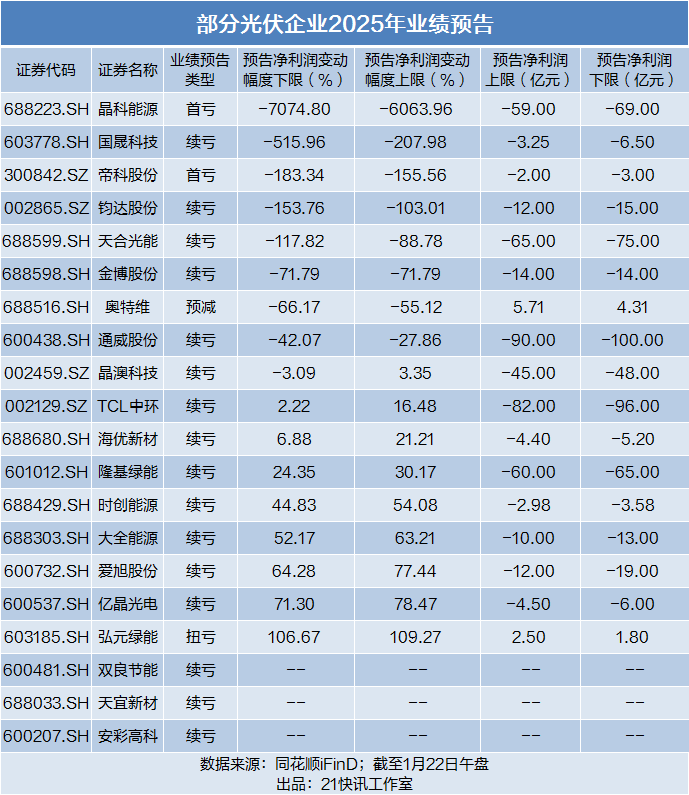
Core Viewpoint - JinkoSolar, a leading company in the photovoltaic industry, is expected to report a significant loss for the year 2025, marking its first annual loss in nearly a decade, despite a rise in its stock price on the announcement day [1] Group 1: Company Performance - JinkoSolar forecasts a net profit loss of between 59 billion to 69 billion yuan for 2025, with a non-recurring net profit loss estimated between 67 billion to 78 billion yuan, compared to a net profit of 0.99 billion yuan in the same period last year [1] - The company attributes its expected losses to intensified price fluctuations in the global photovoltaic supply chain and a general decline in profitability across various segments [1] - Other companies in the photovoltaic sector, including Trina Solar, LONGi Green Energy, and Tongwei Co., have also reported similar forecasts, indicating a trend of expected losses across the industry [2][4] Group 2: Industry Trends - As of January 22, 2023, 20 photovoltaic companies have disclosed their 2025 performance forecasts, with many expecting significant losses, highlighting a broader industry downturn [2] - Tongwei Co. anticipates losses of 90 billion to 100 billion yuan, citing ongoing supply surplus and price declines, while TCL Zhonghuan expects losses between 82 billion to 96 billion yuan due to persistent low prices [3][4] - The industry is facing challenges such as rising raw material costs and insufficient price transmission to downstream markets, which are squeezing profit margins for major players [4] Group 3: Positive Signals - Only Hongyuan Green Energy is expected to turn a profit, with a forecasted net profit of 1.8 billion to 2.5 billion yuan, attributed to its vertically integrated supply chain and strategic asset sales [5] - Some companies, like Aiko Solar, report a narrowing of loss margins compared to the previous year, indicating potential improvements in operational efficiency and cost management [5] - Analysts suggest that the space photovoltaic sector may emerge as a new growth area, driven by the demand for satellite internet and advancements in photovoltaic technologies [6]