科伦博泰

Search documents
2026年医药行业策略报告:黄金赛道:寻找中国的GlobalPharma-20251211
Western Securities· 2025-12-11 05:52
Group 1 - The core viewpoint of the report highlights that the pharmaceutical industry in China is experiencing a reversal in 2025, driven by innovative drugs, with significant benefits observed in the CXO and upstream supply chain sectors, particularly in the Hong Kong stock market where innovative drugs have seen a rise of over 80% year-to-date [1][4] - The report emphasizes that the core catalyst for innovative drugs comes from policy support and the realization of business development (BD) opportunities abroad, with notable transactions exceeding 1 billion USD, validating the international competitiveness of Chinese innovative drugs [1][2] - A significant reform in the payment sector is underway, with the introduction of a dual-track system for medical insurance, allowing for the inclusion of high-value innovative drugs in commercial insurance, addressing the gap in coverage for expensive treatments [1][2] Group 2 - The report indicates a rapid growth trend in the number of license-out transactions by Chinese pharmaceutical companies, with total upfront payments reaching 6.298 billion USD, a 53% year-on-year increase, and total transaction amounts reaching 118.862 billion USD, a 125% increase [2] - Looking ahead to 2026, the report suggests a shift from "BD-driven" to "data-driven" investment in innovative drugs, emphasizing the importance of clinical data validation and commercial capabilities for revenue growth [2] - Recommended stocks for investment include Heng Rui Medicine, Kelun-Biotech, and Teva Biopharmaceuticals, among others, while companies like Kangfang Biotech and Innovent Biologics are suggested for further attention [2][3] Group 3 - The overall profitability of the pharmaceutical sector remains stable, with a gradual improvement in the profitability of the pharmaceutical manufacturing industry, despite a slight decline in revenue growth [11][15] - The report notes a significant divergence within the industry, with the medical services sector performing well, while the profits of the biopharmaceutical sector have seen a substantial decline [28][29] - The report highlights that the medical insurance fund's income and expenditure growth rates are stabilizing, indicating a long-term trend towards cost control in medical insurance, which is essential for the sustainable development of the innovative drug industry [31][36]


生物医药行业:2025年医保及首版商保目录公布,中国药品价格登记系统上线,助力创新药发展
Ping An Securities· 2025-12-09 04:53
Investment Rating - The industry investment rating is "Outperform the Market," indicating that the industry index is expected to perform better than the market by more than 5% over the next six months [36]. Core Insights - The 2025 National Basic Medical Insurance, Maternity Insurance, and Work Injury Insurance Drug List, along with the first version of the Commercial Health Insurance Innovative Drug List, was released on December 7, 2025. This adjustment includes 114 new drugs, of which 50 are classified as Class 1 innovative drugs [3]. - The newly launched Chinese Drug Price Registration System aims to facilitate the global pricing system for innovative drugs and attract high-quality foreign drugs to the Chinese market, benefiting patients [4][5]. - The innovative drug sector is expected to continue its rise, with recommendations to focus on companies with rich pipeline layouts, high-potential innovative drugs, and leading technology platforms [11]. Summary by Sections Industry Developments - The 2025 drug list adjustment marks the eighth update since the establishment of the National Medical Insurance Bureau, reflecting ongoing efforts to enhance drug accessibility and innovation in China [3]. - The Chinese Drug Price Registration System, launched on December 2, 2025, allows pharmaceutical companies to independently declare drug prices, promoting a more transparent and globalized pricing structure [4][5]. Company Highlights - Yino Pharmaceutical has rapidly emerged in the metabolic disease treatment field since its establishment in 2014, with its core product, Isupreglutide α, receiving approval as a Class 1 innovative drug and entering commercialization [7]. Investment Strategy - The report suggests focusing on companies with diverse pipelines, such as Heng Rui Medicine, BeiGene, and China National Pharmaceutical Group, as well as those with high-potential innovative drugs like Sanofi and Kaiyin Technology [11]. - It also highlights the importance of companies with leading technology platforms, such as Dongcheng Pharmaceutical and WuXi AppTec, as well as upstream companies benefiting from overseas expansion [11]. Market Performance - The pharmaceutical sector experienced a decline of 0.74% last week, ranking 19th among 28 industries, while the Shanghai and Shenzhen 300 Index rose by 1.28% [14][24]. - As of December 5, 2025, the pharmaceutical sector's valuation stands at 29.30 times (TTM), with a premium of 17.46% over the overall A-share market [27].
新版医保目录新增50种一类创新药,涵盖肿瘤、慢病等多个领域
Bei Ke Cai Jing· 2025-12-08 11:01
Core Insights - The new National Medical Insurance Directory has added 114 new drugs, surpassing last year's addition of 91, with 50 being first-class innovative drugs, achieving an overall success rate of 88%, an improvement from 76% in 2024 [1][2] Group 1: New Drug Additions - The total number of drugs in the directory has increased to 3,253, significantly enhancing coverage for key areas such as oncology and chronic diseases [2] - The directory includes 38 global innovative drugs and 50 first-class innovative drugs, marking a historical high for new additions [2] - Notable inclusions are the first globally approved red blood cell maturation agent, Rotecip, for treating lower-risk myelodysplastic syndromes, and the first domestically developed IL-4Rα antibody drug, Kangyueda, for multiple indications [3][4] Group 2: Oncology Innovations - Several innovative oncology drugs have been added, including Tagolizumab, the first PD-L1 monoclonal antibody approved for nasopharyngeal carcinoma, and non-covalent BTK inhibitor, Jebatib, for relapsed mantle cell lymphoma [4][5][6] - ADCs (antibody-drug conjugates) have gained attention, with new entries like Lukanasatuzumab and Ruikangquzuzumab, targeting advanced breast cancer and non-small cell lung cancer [7][8] Group 3: Chronic Disease Treatments - The directory has included innovative drugs for chronic diseases, such as Novartis' PCSK9 mRNA interference drug for cholesterol management, addressing patients who cannot reach LDL-C targets [14] - AstraZeneca's biologic drug Benralizumab for severe eosinophilic asthma has also been added, providing targeted treatment options for patients [15][16] Group 4: Influenza Treatments - The new directory has incorporated two domestic antiviral drugs for influenza, Masurashave and Angladiv, which have shown promising clinical results in reducing symptoms and viral load [17]
香港医疗周报(12/1-12/5):医药流通和CXO板块表现相对较好,医保+商保“双目录”落地-20251208
Haitong Securities International· 2025-12-08 06:34
Investment Rating - The report rates multiple companies in the healthcare sector as "Outperform," including BeiGene, China Resources Pharmaceutical, JD Health, Innovent Biologics, WuXi Biologics, and many others [1]. Core Insights - The Hong Kong healthcare sector has shown resilience, with the Hang Seng Healthcare Index gaining 72.2% year-to-date, outperforming the Hang Seng Index by 41.1 percentage points [4][28]. - The implementation of the "dual catalogs" for basic medical insurance and commercial insurance is expected to support innovation in the pharmaceutical sector, with 114 new drugs added to the basic medical insurance catalog and a success rate of 88% [5][30]. - The report highlights the strong performance of the pharmaceutical distribution and CXO sectors, with respective gains of 2.0% and 1.7% in the past week [15][29]. Summary by Sections Market Performance - The Hang Seng Healthcare Index fell by 0.7% in the week of December 1-5, 2025, underperforming the Hang Seng Index by 1.6 percentage points [4][28]. - The pharmaceutical distribution sector and CXO services performed well, with increases of 2.0% and 1.7%, respectively [15][29]. Drug Catalog Implementation - The "National Basic Medical Insurance Catalog" and the first edition of the "Commercial Insurance Innovative Drug Catalog" were released, with 114 new drugs added to the basic insurance catalog [5][30]. - The commercial insurance catalog includes 19 innovative drugs, emphasizing support for innovation and addressing the needs of the elderly and children [13][30]. Company Highlights - Notable companies that performed well include Jinxin Fertility (+7.5%), Harbour BioMed-B (+5.3%), and WuXi Biologics (+4.7%) [15][29]. - The report suggests increasing focus on companies with strong performance certainty in the CXO sector and those with stable long-term demand in medical services [15][29].
医药行业周报(2025/12/01-2025/12/05):本周申万医药生物指数下跌0.7%,关注医保商保双目录发布-20251208
Shenwan Hongyuan Securities· 2025-12-08 04:34
Investment Rating - The report maintains a "positive" outlook on the pharmaceutical industry, particularly focusing on innovative drug sectors [3]. Core Insights - The pharmaceutical sector's performance saw a decline of 0.7% this week, while the Shanghai Composite Index rose by 0.4%. The pharmaceutical index ranked 21st among 31 sub-industries [3][4]. - The new National Medical Insurance Drug List added 114 drugs, including 50 innovative drugs, with an overall success rate of 88%, significantly up from 76% in 2024. The first commercial health insurance innovative drug list includes 19 drugs, enhancing coverage for critical areas such as cancer and chronic diseases [3][12][14]. - The establishment of the Chinese Drug Price Registration System allows companies to self-declare innovative drug prices, facilitating global pricing strategies for innovative drugs [17][18]. Market Performance - The pharmaceutical index's valuation stands at 29.3 times earnings, ranking 10th among 31 primary industries [6]. - The performance of various sub-sectors includes: raw materials (-2.5%), chemical preparations (-0.9%), and medical devices (-0.9%), while medical circulation saw an increase of 6.5% [6][4]. Recent Key Events - The report highlights significant clinical trial results from companies like Junsheng Pharmaceutical, which demonstrated advantages in glycemic control and cardiovascular benefits with its new drug HTD1801 [25]. - The report notes the strategic partnership between Kelun Pharmaceutical and Crescent for developing ADC therapies, with potential milestone payments reaching up to $1.25 billion [27][28]. - The report also mentions the IPO application of Lingke Pharmaceutical, focusing on innovative small molecule drugs for autoimmune and inflammatory diseases, with a post-investment valuation of 3.42 billion yuan [30]

中泰国际每日晨讯-20251208
ZHONGTAI INTERNATIONAL SECURITIES· 2025-12-08 03:24
Market Overview - The Hang Seng Index and the Hang Seng China Enterprises Index closed at 26,085 points and 9,198 points respectively, with weekly increases of 0.9% and 0.8% [1] - Total trading volume in Hong Kong stocks was HKD 933.2 billion, a decrease of 14.5% from the previous week [1] - The materials, industrials, and energy indices rose by 10.0%, 3.4%, and 3.1% respectively, while healthcare, real estate, and consumer staples indices fell by 0.8%, 0.2%, and 0.2% [1] - Major blue-chip stocks like Zijin Mining (2899 HK) and China Hongqiao (1378 HK) led the gains, rising by 12.1% and 9.3% respectively, while Shenzhou International (2313 HK) and Meituan (3690 HK) saw declines of 6.9% and 3.4% [1] Industry Dynamics - The performance of non-ferrous metals and gold stocks was strong, driven by expectations of tight copper supply and rising copper prices reaching USD 11,620, a recent high [2] - The semiconductor and AI sectors are gaining market attention, with energy demand expected to rise in the medium to long term, benefiting uranium and power equipment sectors [2] - The autonomous driving sector remains vibrant, with companies like WeRide (800 HK) and Pony.ai (2026 HK) seeing stock increases of 4%-5% [4] - The healthcare sector saw a slight decline, with the Hang Seng Healthcare Index dropping 0.7%, but companies like Kelun Biotech (6990 HK) showed resilience, rising 2.5% after announcing strategic partnerships [5] Specific Company Developments - Kelun Biotech announced a strategic partnership with Crescent Biopharma, involving exclusive rights for research and commercialization of antibody-drug conjugates and bispecific antibodies, with potential milestone payments totaling up to USD 1.25 billion [5] - In the uranium and power equipment sectors, companies like CGN Mining (1164 HK) and Harbin Electric (1133 HK) saw significant stock increases of 7.3% and 6.9% respectively, driven by positive market sentiment regarding AI's impact on energy demand [6]
重大突破!自费一针上百万元,5款抗癌药纳入商业保险
Mei Ri Jing Ji Xin Wen· 2025-12-07 22:20
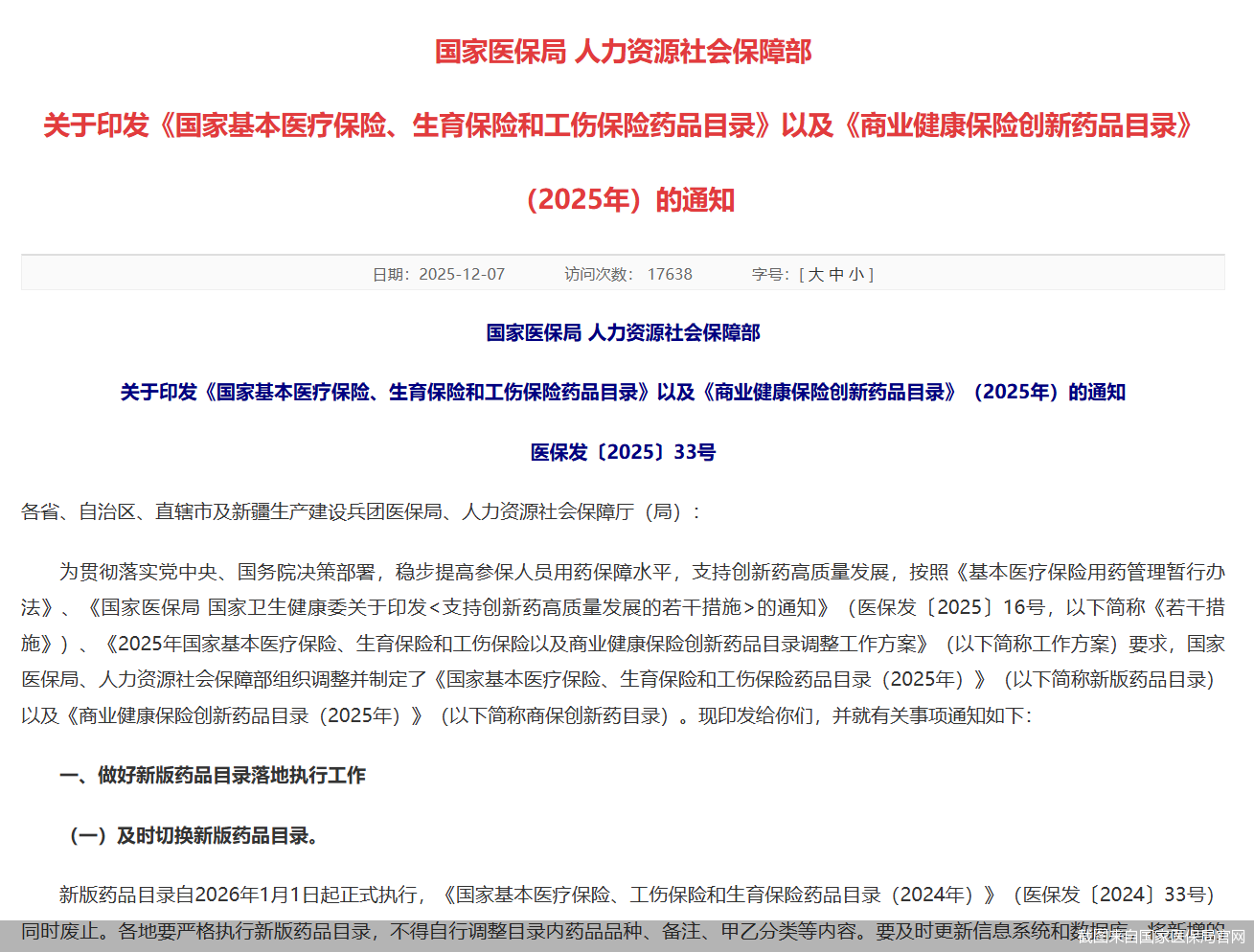
Core Insights - The 2025 National Medical Insurance Directory and the first Commercial Health Insurance Innovative Drug Directory were announced, marking a significant development in the pharmaceutical industry [1][3][10] - A total of 114 new drugs were added to the National Medical Insurance Directory, including 50 innovative drugs, which is expected to enhance patient access and support sustainable investment in drug development [1][2][3] National Medical Insurance Directory - The 2025 National Medical Insurance Directory includes 114 new drugs, with 50 classified as innovative drugs, such as Tislelizumab and domestic ADC drugs [1][3] - Companies like Kelun-Biotech and Kangnuo have successfully included their innovative drugs in the directory, reflecting strong government support for domestic innovation [3][4] - The total number of drugs in the National Medical Insurance Directory has increased to 3,253, with significant improvements in coverage for critical areas like oncology and chronic diseases [5][6] Commercial Health Insurance Innovative Drug Directory - The newly introduced Commercial Health Insurance Innovative Drug Directory includes five CAR-T cell therapies and several high-cost drugs for rare diseases, enhancing accessibility for patients [1][6][8] - The directory allows innovative drug companies to explore new payment channels outside of traditional medical insurance, potentially increasing patient access to high-value therapies [11][12] - The pricing for drugs in the Commercial Health Insurance Directory is expected to be more flexible, allowing for negotiations between companies and insurers, which could lead to better affordability for patients [8][12] Industry Impact - The introduction of the Commercial Health Insurance Innovative Drug Directory is seen as a milestone for improving drug accessibility and affordability, particularly for high-cost therapies [7][9][12] - The past decade has witnessed significant growth in China's innovative drug sector, with the new directory marking a pivotal moment in the industry's evolution [10][11] - The dual-track payment framework established by the National Medical Insurance and Commercial Health Insurance is expected to foster a more robust ecosystem for drug research and application in China [12]
国家医保目录新增114种药品:5款百万元CAR-T疗法纳入商保,企业代表直呼这是“重要里程碑”
Mei Ri Jing Ji Xin Wen· 2025-12-07 13:15
Core Insights - The 2025 National Medical Insurance Directory has added 114 new drugs, including 50 innovative drugs, which will significantly enhance patient access to essential medications [1][3][6] - The introduction of the Commercial Health Insurance Innovative Drug Directory marks a pivotal moment for the pharmaceutical industry, allowing for new payment channels beyond traditional insurance [11][12] Summary by Sections National Medical Insurance Directory - The 2025 National Medical Insurance Directory includes 114 new drugs, with 50 classified as innovative drugs, such as Tislelizumab and domestic ADCs [1][3] - The total number of drugs in the National Medical Insurance Directory has increased to 3,253, with significant improvements in coverage for critical areas like oncology and rare diseases [6] Commercial Health Insurance Innovative Drug Directory - The Commercial Health Insurance Innovative Drug Directory features five CAR-T cell therapies and two imported Alzheimer's drugs, addressing previously limited access due to high costs [1][7] - The directory aims to enhance the accessibility of high-value innovative drugs, with a focus on improving patient affordability [9][10] Industry Impact - The inclusion of innovative drugs in the National Medical Insurance Directory is expected to accelerate the transition from laboratory to patient access, providing crucial support for sustainable investment in pharmaceutical R&D [2][4] - The launch of the Commercial Health Insurance Innovative Drug Directory allows pharmaceutical companies to explore new payment avenues, fostering a dual-track pricing system that recognizes the value of innovative therapies [12] Company Responses - Companies like WuXi AppTec and CanSino Biologics have expressed optimism about the new directories, highlighting the government's support for domestic innovation and the potential for improved patient outcomes [4][5][11] - The introduction of the directories has prompted companies to collaborate closely with insurance providers to ensure effective implementation and patient access [12]
首版医保“双目录”出炉!新增药品超四成为一类创新药,CAR-T等19种药品进商保创新药目录
Bei Jing Shang Bao· 2025-12-07 07:26
Core Insights - The release of the 2025 National Basic Medical Insurance, Maternity Insurance, and Work Injury Insurance Drug Catalogs marks a significant step in enhancing drug accessibility and innovation in China, with a total of 114 new drugs added to the basic insurance catalog, including 50 innovative drugs, achieving an overall success rate of 88%, up from 76% in 2024 [1][5][9]. Summary by Sections Basic Medical Insurance Drug Catalog - A total of 114 new drugs were successfully added, with 50 classified as innovative drugs, reflecting an overall success rate of 88% [5][9]. - The total number of drugs in the national insurance catalog now stands at 3,253, including 1,857 Western medicines and 1,396 traditional Chinese medicines, with significant improvements in coverage for critical areas such as cancer, chronic diseases, mental health, rare diseases, and pediatric medications [5][9]. - The catalog includes drugs that fill gaps in basic insurance coverage, such as treatments for triple-negative breast cancer, pancreatic cancer, and other major diseases [9]. Commercial Health Insurance Innovative Drug Catalog - The first edition of the Commercial Health Insurance Innovative Drug Catalog includes 19 drugs, with a focus on high clinical value and innovation, particularly in oncology, rare diseases, and chronic conditions [11][12]. - Notable inclusions are CAR-T therapies and treatments for rare diseases like neuroblastoma and Gaucher disease, as well as Alzheimer's disease medications [11][12]. - The catalog emphasizes the distinction between basic insurance, which focuses on essential and proven therapies, and commercial insurance, which supports cutting-edge innovations [11][12]. Future Implications - The introduction of these catalogs is expected to enhance clinical medication standards and boost confidence in pharmaceutical R&D, ensuring better healthcare and injury treatment for the public [8]. - The ongoing adjustments to the drug catalogs reflect a commitment to improving the accessibility of innovative drugs and encouraging pharmaceutical companies to invest in research and development [10][11].

华创医药周观点:2025Q3海外心血管器械龙头收入拆分和管线进展 2025/12/06
华创医药组公众平台· 2025-12-06 10:02
Core Viewpoint - The article discusses the revenue breakdown and pipeline progress of leading cardiovascular device companies for Q3 2025, highlighting growth trends and market dynamics in the cardiovascular sector [11][15][21][27][33][38]. Market Review - The CITIC Medical Index decreased by 0.73%, underperforming the CSI 300 Index by 2.00 percentage points, ranking 22nd among 30 primary industries [7]. - Top-performing stocks included Haiwang Biological, Ruikang Medicine, and Guangdong Wannianqing, while the worst performers were ST Jingfeng and Kangzhi Pharmaceutical [7]. Overall Viewpoint and Investment Themes - **Innovative Drugs**: The domestic innovative drug industry is transitioning from quantity to quality, focusing on differentiated and internationalized pipelines, with a recommendation to pay attention to products that can ultimately generate profits by 2025 [9]. - **Medical Devices**: 1. The bidding volume for imaging equipment has significantly rebounded this year, with ongoing updates in equipment and supportive policies for home medical devices [9]. 2. The domestic market is seeing a notable increase in market share for leading domestic manufacturers due to the implementation of centralized procurement [9]. 3. The orthopedic sector is recovering well post-collection, with new innovations driving incremental revenue [9]. - **Innovation Chain (CXO + Life Science Services)**: There is an expected recovery in overseas investment and a potential bottoming out of domestic investment, indicating a new wave of innovation in the sector [9]. - **Pharmaceutical Industry**: The specialty API sector is anticipated to see cost improvements, leading to a new growth cycle [10]. Company-Specific Insights - **Abbott**: In Q3 2025, Abbott's cardiovascular revenue reached $3.137 billion, with a year-on-year growth of 12.5%. Key growth drivers included heart rhythm management and structural heart disease segments [15]. - **Medtronic**: Medtronic's cardiovascular revenue was $3.436 billion in Q3 2025, growing by 9.3%, with significant contributions from heart rhythm and heart failure segments [21]. - **Boston Scientific**: The company reported cardiovascular revenue of $3.343 billion, a 22.4% increase, driven by the growth of the Watchman and electrophysiology segments [27]. - **Johnson & Johnson**: The cardiovascular segment generated $2.213 billion in Q3 2025, with a 12.6% growth, supported by the acquisition of Shockwave and strong performance in electrophysiology [33]. - **Edwards Lifesciences**: The company achieved cardiovascular revenue of $1.55 billion, a 14.7% increase, with strong growth in transcatheter aortic valve replacement (TAVR) and mitral valve therapies [38]. Pipeline Developments - **Abbott**: The company is advancing its pipeline with new products in heart rhythm management and structural heart disease, including the AVEIR leadless pacemaker and Tendyne transcatheter mitral valve replacement system [16]. - **Medtronic**: The company is focusing on expanding its TAVR system and has received FDA approvals for several new products in the electrophysiology space [22]. - **Boston Scientific**: The company is enhancing its electrophysiology portfolio with the FARAPULSE PFA system, which has received FDA approval for expanded indications [28]. - **Johnson & Johnson**: The company is leveraging its acquisitions to enhance its product offerings in electrophysiology and heart failure management [34]. - **Edwards Lifesciences**: The company is expanding its TAVR and mitral valve product lines, with recent FDA approvals for new therapies [39].