Coherent

Search documents
【前瞻分析】2025年全球光模块行业市场需求及企业技术进展分析
Sou Hu Cai Jing· 2026-01-04 18:11
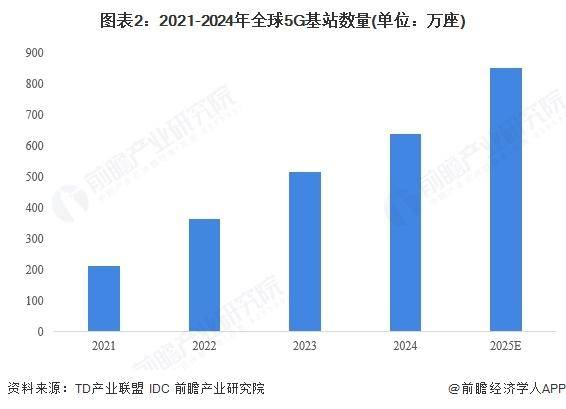
Group 1: Industry Overview - The deployment and expansion of 5G networks are significantly driving the demand for high-speed optical modules, which are essential for data transmission in 5G networks [1] - Different scenarios such as front-haul and mid-haul require differentiated transmission performance, pushing optical modules towards higher speeds to support emerging services like HD video and industrial IoT [1] - The global 5G base station deployment is projected to reach 6.376 million by 2024, a year-on-year increase of 23.3%, with a forecast of 8.5 million by 2025 [1] Group 2: Company Developments - Zhongji Xuchuang is the only global manufacturer to achieve mass production of 400G/800G silicon optical modules, with a high yield of 95% for its self-developed 1.6T silicon optical module [4] - NewEase focuses on integrating silicon photonics and LPO technology, with significant orders from Meta and Amazon for its 800G LPO silicon optical modules [4] - Coherent maintains a strong market share in 800G optical modules and is collaborating with Lumentum to develop next-generation solutions [4] Group 3: Competitive Landscape - The Chinese optical module industry is in a high-growth phase, with competitors categorized into three tiers based on revenue, with Zhongji Xuchuang leading the first tier with over 20 billion in revenue [5] - The competitive landscape is characterized by diverse technological routes and differentiated core advantages among leading companies, with a focus on self-research and global expansion [7] - Companies like Cambridge Technology and Guangxun Technology leverage vertical integration to enhance their product offerings and market responsiveness [7] Group 4: Technological Advancements - Companies are advancing in the 800G/1.6T high-end product space, with Zhongji Xuchuang showcasing its 3nm 1.6T OSFP series products at OFC2025 [8] - NewEase has entered mass production with its automated production lines in Thailand, focusing on high-end products and optimizing supply chain responsiveness [8] - Huagong Technology is enhancing its production capabilities and expanding its delivery network to meet the growing demand for 800G and 1.6T products [8]




北交所再现10倍新股,蘅东光盘中暴涨1120%
Huan Qiu Lao Hu Cai Jing· 2025-12-31 06:30
Group 1: Company Overview - Company "Hengdongguang" debuted on the Beijing Stock Exchange on December 31, with a peak intraday increase of over 1120%, reaching 388 CNY per share, and closing at 319.5 CNY, giving it a market capitalization of 21.75 billion CNY [1] - The company operates in the rapidly growing optical module sector and is recognized as a national "little giant" enterprise, with business segments including passive optical fiber wiring and passive inline optical devices [2] - Hengdongguang's core products include optical fiber connectors and multi-fiber parallel passive inline optical devices, serving notable clients such as AFL, Coherent, and Hisense [2] Group 2: Financial Performance - Revenue projections for Hengdongguang show significant growth, with expected revenues of 475 million CNY in 2022, 613 million CNY in 2023, and 1.315 billion CNY in 2024, reflecting a compound annual growth rate (CAGR) of 49.07% [2] - The net profit is projected to grow from 55 million CNY in 2022 to 148 million CNY in 2024, with a CAGR of 128.50% [2] - In the first half of 2025, the company achieved revenues of 1.021 billion CNY, a year-on-year increase of 105.84%, and a net profit of 143 million CNY, up 170.72% year-on-year [2] Group 3: Market Dynamics - The global optical communication industry is expected to see the market size of optical modules exceed 20 billion USD by 2027, with data centers becoming the largest application market [2] - Hengdongguang's sales are predominantly export-oriented, with 90% of total revenue coming from overseas markets in 2024, and the largest client, AFL Group from the USA, contributing 706 million CNY, accounting for over half of total revenue [3]
国盛证券:高速率光芯片前景广阔 看好光芯片景气周期
Zhi Tong Cai Jing· 2025-12-29 06:53
Core Insights - The global Ethernet optical module market is expected to grow rapidly, with a projected increase of 35% to reach $18.9 billion by 2026, driven by strong demand for AI infrastructure and the application of optical interconnect technology in AI scale-up networks [3][1] - The demand for optical chips, which are essential components of optical modules, is expected to remain tight due to increasing requirements for high-speed optical communication [4][3] Group 1: Optical Chip Market Dynamics - Optical chips, consisting of laser and detector chips, are critical for optical modules, primarily used for optical signal conversion and processing [1] - The EML laser chip market is projected to reach $3.71 billion by 2024 and grow to $7.41 billion by 2030, with a compound annual growth rate (CAGR) of 12.23%, dominated by a few international giants [2][1] - Silicon photonic modules are driving demand for continuous wave (CW) lasers due to their high integration, low power consumption, and suitability for high-speed short-distance transmission [2][1] Group 2: Demand Drivers and Supply Constraints - The demand for optical modules is expected to continue rising, with the global Ethernet optical module market projected to exceed $35 billion by 2030, supported by AI infrastructure and cloud service providers increasing GPU purchases [3][1] - Major companies like Coherent and Lumentum are expanding their production capacities to meet the growing demand for high-speed optical components, with Coherent's production capacity expected to double within a year [4][5] - Tower's silicon photonic business is anticipated to exceed $220 million in revenue by 2025, driven by strong demand for 1.6T products and significant investments in capacity expansion [6][5] Group 3: Company-Specific Developments - Coherent is experiencing strong growth in orders for 800G and 1.6T transceivers, with plans to expand production capabilities in multiple locations [4][1] - Lumentum has set a record for EML laser shipments driven by demand for 100Gbps products and is beginning to deliver CW lasers to 800G optical module manufacturers [5][1] - Broadcom's AI network demand has led to a significant increase in orders for optical components, with a backlog of approximately $73 billion, including $20 billion from network and optical interconnect products [7][1]


高速率光芯片前景广阔,看好光芯片景气周期
GOLDEN SUN SECURITIES· 2025-12-28 11:18
Investment Rating - The report maintains a "Buy" rating for the industry, specifically highlighting the potential of high-speed optical chips and the favorable market conditions for optical modules [5]. Core Insights - The optical chip market is expected to experience significant growth driven by AI demand, with the global EML laser chip market projected to reach 3.71 billion yuan in 2024 and grow to 7.412 billion yuan by 2030, reflecting a compound annual growth rate (CAGR) of 12.23% [1][27]. - The demand for optical modules is on the rise, with the global Ethernet optical module market expected to grow by 35% to 18.9 billion USD in 2026, and further double-digit growth anticipated from 2027 to 2030, potentially exceeding 35 billion USD by 2030 [3]. - The report emphasizes the critical role of optical chips in optical modules, which are essential for high-speed data transmission in various applications, including data centers and telecommunications [12][13]. Summary by Sections Section 1: Optical Chips - Optical chips are the core components of optical modules, essential for converting optical signals and determining transmission efficiency in communication systems [12]. - The EML laser chip, a high-end product, is in high demand due to its capabilities in long-distance and high-speed data transmission, particularly in AI applications [24][26]. - The market for EML chips is currently dominated by a few international giants, including Lumentum and Coherent, with domestic manufacturers striving to increase their market share through technological advancements [27][38]. Section 2: Silicon Photonic Modules - Silicon photonic modules are characterized by high integration, low power consumption, and cost-effectiveness, which are driving the demand for continuous wave (CW) lasers [2]. - The transition to higher data rates (800G/400G) necessitates the use of advanced laser chips, further boosting the demand for CW lasers [2]. Section 3: Market Dynamics - The report indicates a tight supply-demand situation for optical chips, driven by the increasing demand for optical modules in AI infrastructure and cloud computing [3]. - Major companies like Coherent and Lumentum are expanding their production capacities to meet the growing demand for high-speed optical components [6][7]. - The report highlights the expected growth in the optical module market, with significant contributions from AI-driven applications and the expansion of data center networks [3][28]. Section 4: Key Companies - Coherent is experiencing strong growth in demand for its 800G and 1.6T transceiver orders, with plans to double its production capacity in the coming year [5][6]. - Lumentum has reported record shipments of EML lasers, driven by demand for 100Gbps and 200Gbps products, and is expanding its production capacity to meet future needs [6][7]. - Tower Semiconductor is also seeing significant revenue growth from silicon photonic products, with plans for substantial capacity expansion [8].
通信行业 2026 年度投资策略:继续聚焦 AI 算力
Changjiang Securities· 2025-12-23 05:12
Group 1: Core Insights - The communication industry continues to focus on AI computing power, driven by the resonance of AI training and inference demand, with overseas CSPs continuously investing in computing power infrastructure [2][6] - The demand for optical interconnects is expected to increase significantly as the scale-up architecture evolves from in-cabinet to cross-cabinet and cluster designs [2][7] - Liquid cooling is transitioning from optional to a necessity due to rising cabinet power density, with overseas markets entering a realization phase and domestic commercialization accelerating [2][7] Group 2: Operators - The three major operators maintain stable performance, with a slight increase in profits despite revenue pressure, and improved cash flow quality [6][20] - Dividend payout ratios are steadily increasing, providing stable returns and valuation support for the sector, highlighting its attractiveness as a low-volatility defensive asset [6][24] Group 3: AI Computing Power - AI computing power remains in high demand, with both training and inference needs growing, leading to a clearer inflation logic in the network side [7][27] - The cost advantages of ASICs are accelerating their penetration, which is expected to enhance the share of optical modules in overall IT capital expenditures [7][45] - The growth of AI-related revenue is projected to continue, with significant increases in user engagement and request volumes for applications like Google's Gemini [27][30] Group 4: IDC (Internet Data Centers) - IDC valuations and positions are currently at the bottom range, with signs of marginal improvement in the industry [8][79] - Major internet companies are expected to significantly increase their capital expenditures in AI, which will positively impact the IDC market supply-demand dynamics [8][76] Group 5: Copper Connections - The acceleration of cabinet penetration is enhancing the outlook for copper connections, which are being integrated into high-end cabinet systems due to their low latency and power consumption advantages [8][82]
光模块,诞生十倍大牛股!创业板人工智能ETF(159363)放量涨3%直逼前高!海内外AI迎来密集催化
Xin Lang Cai Jing· 2025-12-22 11:30
周一(12月22日),光模块CPO继续发力上攻,重仓光模块的创业板人工智能涨超3%。其中,长芯博 创、致尚科技涨超12%,中际旭创涨超8%创收盘新高,新易盛涨超6%再创新高。值得注意的是,新易 盛股价从4月9日盘中最低价起算,时至今日盘中最高价,短短8个多月时间,新易盛股价完成十倍行 情,总市值突破4600亿元大关。 热门ETF方面,同类规模最大、流动性最佳的创业板人工智能ETF(159363)场内收涨3.05%,收盘价 回升至历史次高,全天放量成交6.46亿元。资金近一周做多热情高涨,累计借道159363加仓2.78亿元, 表明对创业板人工智能跨年行情的积极看多。 有分析人士指出,美股AI产业链的集体走强,将对本周A股相关个股带来提振。上周五,美股光通信概 念股全线走高,Lumentum大涨超10%,Credo Technology涨超8%,Coherent涨近6%;AI龙头英伟达涨 近4%,甲骨文、AMD涨超6%,美光科技涨近7%。 周一(12月22日),光模块CPO继续发力上攻,重仓光模块的创业板人工智能涨超3%。其中,长芯博 创、致尚科技涨超12%,中际旭创涨超8%创收盘新高,新易盛涨超6%再创新高。 ...


打新赚翻了!下周,又有新股来了
中国基金报· 2025-12-21 07:59
Summary of Key Points Core Viewpoint - The article highlights the upcoming IPOs of three new stocks in the A-share market, emphasizing the potential for significant profits for investors, as demonstrated by the recent success of the IPO of Muxi Co., which yielded profits of nearly 400,000 yuan per share for investors [2]. Group 1: Upcoming IPOs - Three new stocks are available for subscription next week: Shaanxi Tourism on December 22, New Guangyi on December 22, and Hengdongguang on December 23 [3][4]. - Shaanxi Tourism's subscription code is 732402, with an issue price of 80.44 yuan per share and a P/E ratio of 12.37, compared to the industry average of 26.90 [5][6]. - New Guangyi's subscription code is 301687, with an issue price of 21.93 yuan per share and a P/E ratio of 28.59, against an industry average of 57.92 [14]. - Hengdongguang's subscription code is 920045, with an issue price of 31.59 yuan per share and a P/E ratio of 14.99, compared to the industry average of 58.05 [20]. Group 2: Shaanxi Tourism Financials - Shaanxi Tourism's total issuance is 19.33 million shares, with a maximum subscription limit of 19,000 shares, requiring a minimum market value of 190,000 yuan in the Shanghai market [5]. - The company reported revenues of 2.32 billion yuan in 2022, 10.88 billion yuan in 2023, and projected revenues of 12.63 billion yuan in 2024, with a net profit of -720.73 million yuan in 2022, 427 million yuan in 2023, and 512 million yuan in 2024 [10][11]. - The company expects a revenue decline of 24.69% to 11.54% in 2025, with a projected net profit decrease of 27.50% to 14.80% [12]. Group 3: New Guangyi Financials - New Guangyi's revenues were 4.55 billion yuan in 2022, 5.16 billion yuan in 2023, and are projected to reach 6.57 billion yuan in 2024, with net profits of 81.51 million yuan in 2022, 83.28 million yuan in 2023, and 116 million yuan in 2024 [15]. - The company anticipates a revenue increase of 7.10% in 2025, with a projected net profit growth of 10.00% [17]. Group 4: Hengdongguang Financials - Hengdongguang's revenues were 4.75 billion yuan in 2022, 6.13 billion yuan in 2023, and are expected to reach 13.15 billion yuan in 2024, with net profits of 55.33 million yuan in 2022, 64.52 million yuan in 2023, and 148 million yuan in 2024 [21]. - The company projects a revenue increase of 60.45% to 67.30% in 2025, with net profits expected to rise by 82.13% to 102.36% [24][25].

2023年全球光模块现状及趋势分析 中国光模块厂商在全球市场崛起【组图】
Qian Zhan Wang· 2025-12-18 04:11
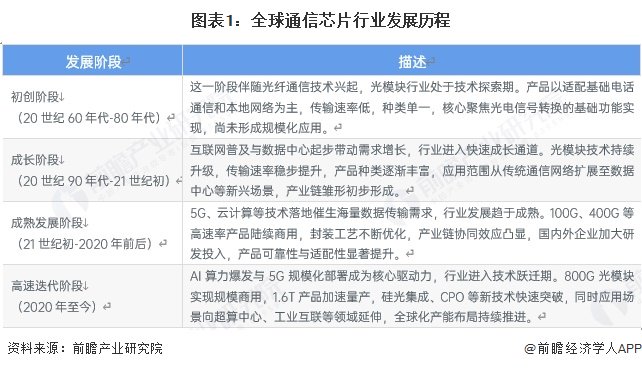
Core Insights - The global optical module industry is experiencing significant growth driven by advancements in technology and increasing demand from applications such as 5G, AI, and data centers [1][4][6]. Industry Development Stages - **Initial Stage**: The optical module industry began in the 1960s, focusing on basic functionalities for telephone communication with low transmission rates and limited product variety [2]. - **Growth Stage**: The 1990s to early 2000s saw rapid growth due to the rise of the internet and data centers, leading to improved transmission rates and a broader range of products [2]. - **Mature Development Stage**: From the early 2000s to around 2020, the industry matured with the commercialization of high-speed products like 100G and 400G, alongside enhanced reliability and compatibility [2]. - **High-Speed Iteration Stage**: Since 2020, the industry has entered a phase of rapid technological advancement, with the commercialization of 800G modules and accelerated production of 1.6T products, driven by AI and 5G deployments [2]. Market Demand and Growth - The deployment of 5G networks is significantly increasing the demand for high-speed optical modules, which are essential for supporting new business models and applications such as industrial IoT and high-definition video [4]. - The global optical transceiver market is projected to reach $14.4 billion in 2024, marking a 52% increase from $9.5 billion in 2023, driven by the rising demand for AI computing power [6]. Competitive Landscape - Chinese companies are increasingly dominating the global optical module market, with firms like Zhongji Xuchuang and NewEase achieving substantial revenue growth and entering the top ten global suppliers [10]. - In 2024, Zhongji Xuchuang's revenue is expected to grow by 114% to exceed $3.3 billion, while NewEase anticipates a 175% increase to $1.2 billion, reflecting their strong market positions [10]. Technological Advancements - Major optical module manufacturers are focusing on silicon photonics, with Chinese companies like Zhongji Xuchuang achieving mass production of 400G/800G silicon photonics modules and gaining significant market share [9]. - The integration of new technologies such as silicon photonics and CPO is expected to enhance product offerings and meet the growing demands of cloud service providers and AI ecosystems [9].
隔离器上游缺口—偏振片与法拉第片
2025-12-17 02:27
Summary of Key Points from Conference Call Records Industry Overview - The isolator market is facing supply-demand imbalances due to tight upstream material supplies, specifically Faraday rotators and polarizers, primarily controlled by overseas manufacturers such as Sumitomo, Coherent, Hoya, and Corning. This has led to price increases, creating opportunities for domestic manufacturers like Xinhua Guang and Fuzhijing [1][2][4] - Global infrastructure demand remains strong, but North America is experiencing shortages, impacting related supply chains. Space computing, as part of broader infrastructure, is expected to address ground energy shortages through commercial space technology [1][5][19] Key Insights and Arguments - The isolator is crucial in optical communication for ensuring unidirectional light transmission, with increasing demand and quality requirements, especially in North America [2] - The financial results of Broadcom and Oracle have caused market fluctuations, but the underlying demand remains strong. Concerns about AI demand and supply chain issues are significant [1][6][8] - The AI sector shows notable valuation disparities, with core AI stocks like TSMC and NVIDIA being relatively undervalued, while segments like power, fuel cells, and storage are overvalued [8] - NVIDIA's H200 offers significant cost-performance advantages, attracting major organizations like Alibaba and Tencent, and is pivotal in advancing AI technology [3][12][14] Market Dynamics - Broadcom's lack of a substantial upward revision in its 2026 guidance has led to market anxiety, despite strong financial performance. The stock dropped 10% post-earnings release due to concerns over AI demand and supply chain capabilities [6][7] - Oracle's recent financial performance raised concerns about cash flow and order fulfillment, particularly regarding its collaboration with OpenAI [9] Technological Developments - Companies are accelerating model iterations, with advancements like GPT-5.2 and Gemini 3.3 Pro showcasing different strengths in AI capabilities. NVIDIA maintains a competitive edge in computing power, although Google's TPU project has significant experience [10][11] - The light communication industry is thriving due to its high demand and favorable commercial landscape, with leading companies like Zhongji Xuchuang and Xinyi Sheng expanding their advantages in silicon photonics [17][18] Future Trends - Space computing is expected to grow significantly, driven by events like frequent rocket launches and the potential IPO of SpaceX, addressing energy supply issues through high-density solar energy [19][20][21] - Liquid cooling technology is gaining attention, with established companies maintaining dominance due to their experience and case studies, while new entrants face challenges in post-installation support and operational risks [22][23][24]
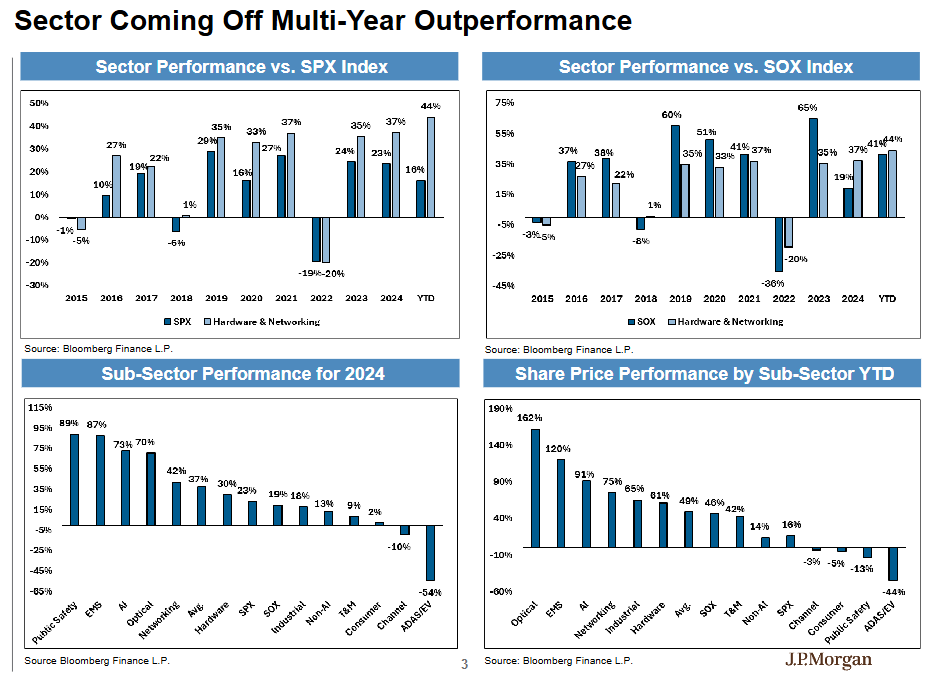
“坚定持有AI赢家,别轮换”!摩根大通硬件团队:2026年“网络”增长将超越“算力”
Hua Er Jie Jian Wen· 2025-12-16 12:08
Core Insights - Morgan Stanley's hardware team signals that investors should hold onto AI winner stocks rather than making large-scale rotations, emphasizing a structural shift where the "network infrastructure" sector is expected to outpace "compute" growth by 2026 [1][2] - The team estimates that AI-related companies currently have a valuation premium of only 26%, indicating that investor expectations for AI-driven profit growth are overly conservative, with actual growth projected to accelerate by 60%-80% [1][5] Investment Strategy - Following recent pullbacks, the team suggests that now is a good time to reassess AI investment portfolios, advocating for a "hold" strategy rather than a "full rotation" [2] Valuation and Growth Projections - AI business is expected to account for approximately 40% of revenue for AI-related companies by 2026, with a corresponding price-to-earnings ratio of about 35 times, suggesting that the market anticipates sustainable capital expenditure growth of only 30%, significantly lower than the projected 70% growth for 2024-2025 [5] - Early company outlooks indicate that AI will lead to an average revenue growth increase of 400 basis points and an average profit growth increase of 600 basis points, translating to a growth acceleration of nearly 60%-80% for industries previously thought to have only mid-single-digit growth [7] Structural Shift in Growth - A key viewpoint is that the growth of the network infrastructure sector is set to surpass compute growth, redefining the AI investment landscape [8] - AI switch revenue is projected to grow by 48% in 2026, 29% in 2027, and 25% in 2028, compared to overall data center switch industry growth rates of 23%, 19%, and 18% respectively, indicating that AI is becoming the primary growth driver in the switch industry [8] Capital Expenditure Trends - With the expansion of GPU clusters, the revenue from AI data center switches is expected to rise from 4% of the total switch market in 2022 to 57% by 2027, driven by larger cluster demands and the urgent need for optimized GPU utilization [10] - The optical interconnect market is expected to grow by 40% to $20 billion by 2026, maintaining a compound annual growth rate of 20% before 2030, while the telecom and data center interconnect market is projected to grow by about 15% to $5 billion by 2026 [12] Recommended Stocks - Morgan Stanley places network-related companies at a high ranking in their recommendations, with Arista Networks and Amphenol as top picks, followed by Celestica, Coherent, and Lumentum [16] Supply Chain Considerations - Despite the optimistic outlook, the team highlights supply chain constraints as a key issue for 2026, with bottlenecks expected in HBM inventory, CoWoS packaging, and optical component capacity [17] - The team maintains a positive outlook on AI infrastructure investment, forecasting that capital expenditures for large-scale vendors will exceed $150 billion in 2026, marking a historical high [17]