
博时基金

Search documents
【公募基金】“春季躁动”抢跑,成长和周期占优——公募基金指数跟踪周报(2025.12.22-2025.12.26)
华宝财富魔方· 2025-12-29 11:02
Group 1 - The core viewpoint of the article emphasizes the positive performance of the equity market, with the Shanghai Composite Index achieving an "eight consecutive days" rebound, driven by expectations of a "spring market" and increased trading volumes [3][7] - The macroeconomic environment is characterized by global liquidity easing, particularly in the U.S., which is expected to support financial asset prices. Domestic monetary policy aims for cross-cycle adjustments, with a long-term easing bias remaining intact [3][8] - The bond market showed signs of stabilization, with short-term yields declining while long-term yields remained volatile. The current economic recovery is still uncertain, limiting the potential for significant adjustments in the bond market [4][9] Group 2 - The public fund market is witnessing significant interest, as evidenced by the successful subscription of the 华夏中核清洁能源 REIT, which attracted over 160 billion yuan in subscriptions, indicating strong investor confidence [11][12] - The REITs market is experiencing a broad increase, with the 中证 REITs total return index rising by 1.56%, driven by sectors such as affordable housing and industrial parks [10] - The article highlights the performance of various fund indices, with the growth stock fund index showing a notable increase of 4.20% for the week, reflecting strong investor interest in growth-oriented investments [14][22]


金价新高也不慌?资管机构认可黄金压舱石地位 核心仓位保持稳定
2 1 Shi Ji Jing Ji Bao Dao· 2025-12-29 09:49
Core Viewpoint - The rising gold prices have led domestic asset management institutions to increasingly recognize gold's unique value in asset allocation, with a significant price increase of approximately 27% in 2024 and over 70% since 2025, outperforming most mainstream assets [1] Group 1: Reasons for Gold as a Strategic Asset - Gold's negative correlation with traditional financial assets like stocks and bonds, its ability to hedge against inflation and currency devaluation, and its function as a "cash substitute" during liquidity crises are the three main reasons for its inclusion in asset allocation [3][4] - Gold's long-term inflation resistance is emphasized, particularly in the context of high global debt and challenges to the dollar's credibility, making it a valuable non-sovereign credit asset [3] - The liquidity management aspect of gold allows asset managers to quickly convert it into cash during market stress, thus stabilizing the overall investment portfolio [4] Group 2: Market Outlook and Strategic Positioning - Despite concerns about potential price corrections due to recent highs, asset managers maintain that gold's strategic value in portfolios remains intact, supported by ongoing central bank purchases and geopolitical risks [5][6] - The long-term support for gold prices is attributed to continuous central bank buying, the trend of "de-dollarization," and the macroeconomic environment of declining real interest rates [5][6] - Asset managers are advised to maintain a stable core position in gold while tactically adjusting based on market conditions, focusing on risk hedging and long-term returns rather than short-term speculation [5][6] Group 3: Growth Potential of Gold in Asset Management - The domestic gold ETF market, currently around 240 tons with a market value close to 240 billion yuan, has significant room for growth compared to the 150 trillion yuan asset management market [7] - The "golden+" product strategy is seen as having immense potential in the domestic market, driven by a strong consumer base, low interest rates, and the influx of new capital from insurance and pension funds [7][8] - International experiences indicate that gold is increasingly viewed as a strategic core asset in portfolios, with successful strategies involving a mix of long-term holdings and tactical adjustments [8][9]

ETF 谋势:科创ETF冲量成色几何?
SINOLINK SECURITIES· 2025-12-29 09:41
1. Report Industry Investment Rating No relevant content provided. 2. Core View of the Report Last week (12/22 - 12/26), bond - type ETFs had a net capital inflow of 54.515 billion yuan. The net unit value of bond ETFs showed marginal recovery. There was no new issuance of bond ETFs. The trading volume and turnover rate of various bond ETFs showed different changes, and the performance of different types of bond ETFs also varied [2][12]. 3. Summary According to Relevant Catalogs 3.1 Issuance Progress Tracking - No new bond ETFs were issued last week [3][16]. 3.2 Stock Product Tracking - As of December 26, 2025, the circulating market values of interest - rate bond ETFs, credit - bond ETFs, and convertible - bond ETFs were 152.6 billion yuan, 426.4 billion yuan, and 60.9 billion yuan respectively, with credit - bond ETFs accounting for 66.6% of the total scale. The circulating market values of Haifutong CSI Short - term Financing ETF and Boshi Convertible - bond ETF ranked top two, at 65.1 billion yuan and 52.3 billion yuan respectively [18]. - Compared with the previous week, the circulating market values of interest - rate bond ETFs, credit - bond ETFs, and convertible - bond ETFs increased by 1.586 billion yuan, 31.621 billion yuan, and decreased by 2.768 billion yuan respectively. Products with significant scale growth last week included Yinhuakongchuangzhai ETF, Harvest CSI AAA Science and Technology Innovation Corporate Bond ETF, and Huatianfu CSI AAA Kechuang Bond ETF, with a year - on - year scale growth of over 6 billion yuan [20]. - Among credit - bond ETFs, the circulating market values of benchmark - market - making credit - bond ETFs and science - innovation bond ETFs were 124.8 billion yuan and 340.5 billion yuan respectively, increasing by 7.262 billion yuan and 56.694 billion yuan compared with the previous week [22]. 3.3 ETF Performance Tracking - Last week, the cumulative net unit values of interest - rate bond ETFs and credit - bond ETFs closed at 1.18 and 1.03 respectively [23]. - As of December 26, based on February 7 as the base date, the average cumulative return of benchmark - market - making credit - bond ETFs rose to 0.89%; based on July 17 as the base date, the cumulative return of science - innovation bond ETFs marginally recovered to 0.22%, returning to the positive range [29]. 3.4 Premium/Discount Rate Tracking - Last week, the average premium/discount rates of credit - bond ETFs, interest - rate bond ETFs, and convertible - bond ETFs were - 0.11%, - 0.06%, and - 0.10% respectively. The average trading price of credit - bond ETFs was lower than the fund's net unit value, indicating low allocation sentiment. Specifically, the weekly average premium/discount rates of benchmark - market - making credit - bond ETFs and science - innovation bond ETFs were - 0.25% and - 0.07% respectively [36]. 3.5 Turnover Rate Tracking - Last week, the turnover rate was in the order of interest - rate bond ETFs > credit - bond ETFs > convertible - bond ETFs. The weekly turnover rates of the three types of products all increased marginally, reaching 136%, 102%, and 84% respectively. Specifically, products such as Huaxia Shanghai Stock Exchange Benchmark - Market - Making Treasury Bond ETF, Southern CSI AAA Science and Technology Innovation Corporate Bond ETF, and Yongying Science - Innovation Bond ETF had relatively high turnover rates [41].
博时标普500ETF今日成交额增加7777.94万元,环比增加38.66%
Zheng Quan Shi Bao Wang· 2025-12-29 09:16
Core Insights - The trading volume of Bosera S&P 500 ETF (513500) reached 279 million yuan today, marking an increase of 77.7794 million yuan compared to the previous trading day, with a month-on-month growth rate of 38.66% [1] Group 1 - The trading volume indicates a significant increase in investor interest in the Bosera S&P 500 ETF [1] - The increase in trading volume could suggest a positive market sentiment towards the ETF [1] - The reported figures reflect a notable change in trading activity compared to the previous day [1]
洗牌+革新!2026公募五大趋势勾勒行业新蓝图
券商中国· 2025-12-29 08:55
Core Viewpoint - The Chinese public fund industry is transitioning from "rapid growth" to "high-quality development" after a significant self-revolution in 2025, marking a critical juncture for the industry [1][2]. Group 1: Shift in Growth Paradigm - The industry is moving from a "scale-first" approach to a "quality-first" mindset, focusing on "investor satisfaction" as the new growth paradigm [3]. - Under the guidance of the "Action Plan for Promoting High-Quality Development of Public Funds," the industry is optimizing fee structures and aligning interests between fund companies and investors, emphasizing long-term investment returns [3]. - The third phase of fee reform is solidifying, leading to a rational return of management fees, reducing investor costs, and fostering a service-driven and performance-driven model for fund companies [3]. Group 2: Industry Restructuring - A new wave of industry consolidation is anticipated, with some fund companies expected to grow stronger through mergers and resource integration, creating comprehensive financial entities [4]. - Smaller fund companies are finding success through differentiated competition, focusing on specialized areas such as quantitative strategies and public REITs, while those lacking distinct identities face survival challenges [4][5]. - The "Matthew Effect" will become more pronounced, with leading institutions leveraging brand and scale advantages, while smaller firms seek growth through niche positioning [4][5]. Group 3: Tooling and Granularity - The trend of "tooling" is leading to a new era of granular investment products, with fund companies developing increasingly detailed tools for asset allocation [6]. - Index products are evolving from broad categories to highly specialized offerings, providing low-cost entry points into specific sectors [6]. - Active equity funds are undergoing a "tooling transformation," with new regulations expected to enhance the clarity of investment styles and their associated alpha generation [7]. Group 4: AI in Investment Research - AI is transitioning from a supportive role to becoming a "second brain" in investment decision-making, enhancing cognitive capabilities and decision-making processes [8]. - The integration of AI into investment research is expected to evolve into a collaborative decision-making partnership, driving the industry towards a more industrialized model [9]. - AI will also enhance operational efficiency across governance, compliance, and risk management, while aiding in the design of more refined products [9]. Group 5: Sales Transformation - The fund sales sector is set to undergo a comprehensive restructuring, focusing on customer-centric approaches rather than scale-driven growth [10]. - Regulatory changes are prompting a shift in sales strategies, emphasizing long-term client relationships and real returns over initial sales figures [11]. - The sales ecosystem is expected to evolve towards a model that prioritizes sustained engagement and service quality, addressing the industry's historical issues of misalignment between fund performance and investor returns [11].

商业航天板块持续爆发,63位基金经理发生任职变动
Sou Hu Cai Jing· 2025-12-29 08:15
Market Performance - The A-share market showed mixed results on December 29, with the Shanghai Composite Index rising by 0.04% to 3965.28 points, marking a nine-day consecutive increase, while the Shenzhen Component Index fell by 0.49% to 13537.1 points, and the ChiNext Index decreased by 0.66% to 3222.61 points [1]. Fund Manager Changes - From December 27 to December 29, a total of 63 fund managers experienced changes in their positions, with 83 fund products announcing departures of fund managers during this period, involving 32 managers [3]. - Over the past 30 days (November 29 to December 29), 696 fund products saw changes in their fund managers, indicating significant turnover in the industry [3]. - The reasons for the changes included 26 managers leaving due to job changes, one due to personal reasons, four due to product expiration, and one due to resignation [3]. Fund Manager Performance - Dai Jie from Pengyang Fund currently manages assets totaling 298 million yuan, with the highest return of 235.16% achieved by the Hui'an Fengze Mixed A fund (003889) during his tenure of 6 years and 147 days [5]. - Zhang Xun, also from Pengyang Fund, manages assets of 10.543 billion yuan, with the highest return of 129.11% from the Pengyang Digital Economy Pioneer Mixed A fund (012456) over a tenure of 1 year and 124 days [5]. Fund Company Research Activity - In the past month (November 29 to December 29), Huaxia Fund conducted the most company research, engaging with 39 listed companies, followed by Southern Fund, Bosera Fund, and Huitianfu Fund, which researched 34, 32, and 31 companies respectively [7]. - The most researched industry was specialized equipment, with 146 instances, followed by the computer equipment industry with 111 instances [7]. Recent Fund Research Focus - In the last week (December 22 to December 29), Lingyi Zhizao, a company in the consumer electronics sector, was the most researched, receiving attention from 40 fund institutions [9]. - Other companies with significant research interest included Pulite, Nord Shares, and Desai Xiwai, with 28, 23, and 22 fund institutions respectively [9].





南方碳中和A今年涨71%也清盘?年内超280只产品离场,业绩好坏均难逃规模“生死线”
Xin Lang Cai Jing· 2025-12-29 08:07
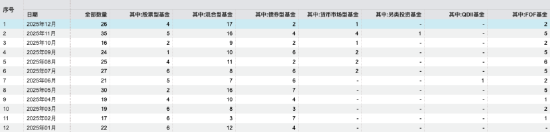
Core Insights - The public fund industry is experiencing a normalization of fund liquidations, with over 280 funds entering liquidation procedures by December 29, 2025, which is comparable to the 293 funds liquidated in 2024, indicating a trend of survival of the fittest within the industry [10][1][3] Fund Liquidation Structure - Among the 281 funds liquidated, mixed funds accounted for the largest share with 127 funds, representing over 45% of the total; followed by bond funds (53) and equity funds (51), with 36 FOF funds also liquidated [3][12] - The distribution of liquidated funds shows significant differentiation among fund management companies, with Bosera Fund leading with 16 liquidations, followed by Haifutong, Huaan, Huabao, and Nanfang Funds, each with 9 liquidations [3][12] Fund Age and Performance - The liquidated funds include both long-standing funds, such as those over ten years old, and newly established funds, with some funds like Huabao Yuan Shi A being liquidated within six months despite achieving a positive return of 11.35% [4][14] - A total of 235 out of 281 liquidated funds triggered termination clauses primarily due to asset sizes falling below 50 million yuan, highlighting that both performance and size are critical for fund survival [5][14] Performance Insights - Notably, some funds with strong performance, such as Nanfang Carbon Neutral A with a return of 71.03% this year, still faced liquidation due to not meeting asset thresholds, indicating a trend where investors redeem funds after achieving returns, leading to rapid size declines [6][15] - Conversely, funds with poor performance, such as Huabao Zhongzheng 1000 A, which has a cumulative return of -63.95%, also faced liquidation, reflecting a lack of sustainable operational capability [6][15] Industry Implications - The trend of liquidations is seen as a natural outcome of market evolution, with industry experts suggesting that investors should prioritize funds of moderate size and avoid those with high institutional ownership [8][17] - The reduction in the "shell" value of funds, due to lower approval and issuance thresholds, has led to a market environment where underperforming funds are not maintained, indicating a shift from a focus on initial launches to ongoing operational sustainability [8][17]
年内超280只基金清盘!混合型127只占半壁江山,博时基金共16只成“清盘王”,多只绩优基金亦难幸免
Xin Lang Cai Jing· 2025-12-29 07:56
Core Insights - The public fund industry is experiencing a normalization of fund liquidations, with over 280 funds entering liquidation by December 29, 2025, which is comparable to the 293 funds liquidated in 2024, indicating a trend of survival of the fittest in the industry [12][10][20] Fund Liquidation Overview - Among the 281 liquidated funds, mixed funds lead with 127 funds, accounting for over 45%, followed by bond funds (53) and equity funds (51) [3][14] - The distribution of liquidated funds shows significant differentiation among institutions, with Bosera Fund having the highest number of liquidations at 16, followed by several others with 9 and 8 liquidations [3][14] Fund Age and Performance - The liquidated funds include both long-standing funds over ten years old and newly established funds under one year, highlighting a diverse age range [4][15] - Notably, some funds, despite achieving positive returns, were still liquidated due to insufficient asset size, such as Huabao Yuanxi A, which had a return of 11.35% but was terminated due to net asset value falling below 50 million [6][16] Reasons for Liquidation - A significant majority of the liquidated funds, 235 out of 281, were forced to liquidate due to triggering contract termination clauses, primarily because their size remained below 50 million [7][17] - Even high-performing funds like Southern Carbon Neutral A, which had a return of 71.03%, faced liquidation due to not meeting asset size requirements, indicating a trend where investors redeem funds after achieving returns, leading to rapid size decline [8][18] Industry Implications - The trend of fund liquidations reflects a shift in the industry from a focus on initial launches to an emphasis on sustained performance, with investors encouraged to select funds with moderate sizes and avoid those with high institutional ownership [10][20] - The reduction in the "shell" value of funds, due to lower approval and issuance thresholds, has led to a market environment where underperforming funds are not maintained, resulting in a natural selection process within the industry [10][20]
博时基金刘玉强:“小巨人”乘风起,如何精准布局专精特新?
Xin Lang Cai Jing· 2025-12-29 07:33
博时基金 指数与量化投资部基金经理 刘玉强 什么是"专精特新"政策? 刘玉强:流动性确实是投资专精特新企业需要考虑的重要因素。部分上市时间较短的企业日均成交额可 能仅在几千万元级别,这或许会给大资金运作带来一定挑战。不过我们也注意到,随着市场关注度提 升,优质"小巨人"企业的流动性正在显著改善,部分龙头公司日均成交额已达到数十亿元水平。从换手 率指标看,专精特新企业的活跃度普遍高于中证2000指数成分股。(数据来源:wind,截止2025年12月 19日) 博时专精特新主题基金的投资策略有何特点? 刘玉强:"专精特新"是我国在特定历史背景下推出的重要产业政策。全球产业链供应链正在加速重构, 关键技术领域竞争白热化,培育自主可控的产业链迫在眉睫。国内方面,中国经济正从高速增长转向高 质量发展阶段。"专精特新"政策旨在培育一批在细分领域具有核心技术、市场占有率高、质量效益优 的"排头兵"企业。"专精特新"政策意味着发展模式的转变:从依赖规模扩张转向创新驱动,从追求速度 转向注重质量。这些企业通过攻克关键核心技术,不仅有望提升产业链供应链韧性,还有望带动整体制 造业向价值链高端攀升、实现科技自立自强。 专精特新"小 ...
盟升电子股价跌5.03%,博时基金旗下1只基金位居十大流通股东,持有151.44万股浮亏损失368万元
Xin Lang Cai Jing· 2025-12-29 05:42
12月29日,盟升电子跌5.03%,截至发稿,报45.90元/股,成交6.04亿元,换手率7.68%,总市值77.08亿 元。 截至发稿,肖瑞瑾累计任职时间8年361天,现任基金资产总规模66.68亿元,任职期间最佳基金回报 282.63%, 任职期间最差基金回报-40.56%。 风险提示:市场有风险,投资需谨慎。本文为AI大模型自动发布,任何在本文出现的信息(包括但不 限于个股、评论、预测、图表、指标、理论、任何形式的表述等)均只作为参考,不构成个人投资建 议。 资料显示,成都盟升电子技术股份有限公司位于四川省成都市天府新区兴隆街道桐子咀南街350号,成 立日期2013年9月6日,上市日期2020年7月31日,公司主营业务涉及卫星应用技术领域相关产品的研发 及制造,是一家卫星导航和卫星通信终端设备研发、制造、销售和技术服务。主营业务收入构成为:卫 星导航78.22%,卫星通信20.66%,租赁1.12%。 责任编辑:小浪快报 从盟升电子十大流通股东角度 数据显示,博时基金旗下1只基金位居盟升电子十大流通股东。博时科创板三年定开混合(506005)三 季度新进十大流通股东,持有股数151.44万股,占流通股的 ...
