Stellantis N.V.

Search documents
事关中国?欧盟被曝将取消内燃机禁令,德国支持,西班牙反对
Guan Cha Zhe Wang· 2025-12-13 01:27
Core Viewpoint - The European Union is considering the repeal of the 2035 ban on internal combustion engine (ICE) vehicles, driven by pressure from member states like Germany and Italy, amid concerns over competitiveness against Chinese electric vehicle manufacturers [1][12]. Group 1: EU Policy Changes - The European People's Party (EPP) leader Manfred Weber announced that the European Commission will propose the repeal of the ICE ban on December 16 [2][3]. - Instead of a complete ban, a new proposal will require a 90% reduction in CO2 emissions for new registered vehicles starting in 2035 [3]. - There will be no target for 100% reduction in carbon emissions by 2040 [4]. Group 2: Industry Reactions - The announcement led to a rise in the European STOXX 600 automotive index by 0.8%, with traditional ICE manufacturers like Renault, Porsche, and Volkswagen seeing stock increases of 1.3% to 3% [6]. - German automakers such as Mercedes-Benz and BMW support the repeal, while companies like Volvo, which have invested heavily in electrification, oppose it, fearing it undermines future regulatory confidence [7]. Group 3: Diverging Opinions Among EU Members - Germany and Italy advocate for the repeal due to fears of losing competitiveness against Chinese firms, while Spain opposes it, citing risks to employment and the transition to electric vehicles [10][11]. - Spanish Prime Minister Sánchez warned that weakening the ban could delay modernization investments and harm the EU's goal of becoming a leader in electric vehicle manufacturing [11]. Group 4: Competitive Landscape - The EU's decision to potentially repeal the ban reflects anxiety over the competitive pressure from Chinese electric vehicle manufacturers, as evidenced by a significant increase in the registration of Chinese brands in Europe [15]. - In the first half of the year, 5.1% of new car registrations in 28 European countries were from Chinese brands, nearly doubling from the previous year [15].


96亿元储能大单签订!
鑫椤储能· 2025-12-12 06:53
关注公众号,点击公众号主页右上角" ··· ",设置星标 "⭐" ,关注 鑫椤储能 资讯~ 封面图 | 图虫创意 12月9日, 三星SDI 发布消息,其美国子公司(SDI America•SDIA)已与一家美国能源基础设施 开发运营公司签署协议,将为其储能系统供应磷酸铁锂电池, 合同价值超过2万亿韩元(约合96.2 亿元人民币), 占三星SDI今年预计销售额(约13万亿韩元)的15%, 将从 2026年开始持续供 应三年。 具体来看,此次三星 SDI供应的磷酸铁锂电芯将安装在电池储能系统解决方案 SBB 2.0 中,这是 一款20英尺集装箱式储能系统,内部集成了电池和消防安全设备。值得注意的是,SBB 2.0是三星 SDI首款使用方形磷酸铁锂电池的储能系统,这也是韩系电池企业从三元电池转向磷酸铁锂电池的重 要标志。通过研发推出磷酸铁锂电池,三星SDI可以最大限度发挥材料的价格竞争力优势,还通过差 异化材料和板材加工技术提升了能量密度。 三星 SDI表示,所供应的电池将通过公司美国工厂现有生产线改造生产制造。此前,三星SDI曾与 Stellantis联合建设运营一家动力电池工厂,以面向美国电动汽车市场需求。但是 ...
赛轮轮胎20251211
2025-12-12 02:19
Summary of SAILUN TIRE Conference Call Company Overview - **Company**: SAILUN TIRE - **Industry**: Tire Manufacturing Key Points Industry and Market Dynamics - SAILUN has maintained high growth despite challenges from the US-China trade war, the pandemic, and soaring shipping costs, with expectations for accelerated growth in high-end tire business by 2026 [2][3] - The company is actively addressing the EU's anti-dumping investigations by shifting production to Cambodia and Vietnam, maintaining high operational rates [2][5] - The global point-based capacity layout is crucial for mitigating overseas trade policy disruptions [2][3] Production Capacity and Strategy - SAILUN plans to achieve production capacities of 3 million semi-steel tires in Indonesia and 6 million in Mexico, with additional capacities for full steel and non-road tires [2][6] - The company has adjusted its supply chain strategy to focus on promising enterprises and product quality, aiming for domestic supply to reach 2.4 million tires by 2025 and double to 5 million by 2026 [2][7][8] Financial Performance and Projections - Despite external pressures, SAILUN's pre-tax profits reached new highs in Q3, indicating resilience and strong performance [3] - The company expects a significant opportunity in the domestic full steel tire market by 2026, particularly due to infrastructure projects in Xinjiang and Tibet [4][18] Product Development and Innovations - The "Liquid Gold" tire has seen over 10% growth in domestic sales, with plans to integrate this material into luxury tires through the acquisition of US-based VOGUE Tires [4][21] - The company has established stable supply relationships with major manufacturers like Caterpillar and John Deere in the non-road vehicle sector [12] Challenges and Responses - The EU's anti-dumping investigation is expected to yield preliminary results by December 2023, with potential high tariffs impacting sales [5] - SAILUN has proactively reduced exports to Europe to avoid being classified as dumping, shifting orders to Cambodia and Vietnam [5][16] Competitive Landscape - SAILUN's market share in the US and Europe is increasing, with domestic brands gaining traction against established foreign brands due to cost control and product performance [18] - The company is focusing on high-performance products in the racing and off-road tire segments, which, while lower in volume, contribute significantly to brand image and profitability [15][24] Future Outlook - The company is optimistic about future growth, anticipating a "double hit" in performance and valuation due to improving external factors and a strong market position [23] - SAILUN aims to increase its market share in the global tire market, currently below 15%, with a goal to compete with leading foreign brands like Michelin and Goodyear in the next 3-5 years [23][24] Conclusion - SAILUN TIRE is strategically positioned to navigate current market challenges while capitalizing on growth opportunities in both domestic and international markets, with a strong focus on innovation and quality improvement across its product lines [24]

激战欧洲,锂电巨头大迁徙
3 6 Ke· 2025-12-11 23:11
Core Insights - The article discusses the global expansion of Chinese lithium battery manufacturers, particularly focusing on their investments in Europe and North America to adapt to changing market dynamics and regulatory environments [1][2][3]. Group 1: Market Dynamics - Domestic battery production capacity utilization in China has dropped to a warning level, while overseas markets, particularly Europe and North America, show increasing demand for electric vehicles and energy storage [1][2]. - The average selling price of key battery products in China has decreased by over 35% in the past two years, while raw material costs have fluctuated significantly, squeezing profit margins [8][9]. Group 2: Strategic Investments - CATL's investment in a joint battery factory in Zaragoza, Spain, exceeds 30 billion RMB, with a planned capacity of 50GWh, focusing on cost-effective lithium iron phosphate batteries for Stellantis [3][4]. - EVE Energy's factory in Hungary is in the critical phase of mechanical and electrical installation, with a planned capacity of 28GWh, while Guoxuan High-Tech's factory in Slovakia has completed initial construction with a capacity of 20GWh [5][6][7]. Group 3: Regulatory Challenges - The U.S. Inflation Reduction Act (IRA) and the EU's new battery law impose significant barriers, requiring local production and stringent carbon footprint regulations, which compel Chinese companies to establish manufacturing bases abroad [2][10][11]. - The EU's new battery law necessitates a comprehensive tracking system for the carbon footprint of battery components, increasing the operational complexity for Chinese manufacturers in Europe [14]. Group 4: Operational Challenges - Chinese companies face significant challenges in adapting to local supply chains and regulatory environments when establishing factories abroad, including longer approval processes and the need for local compliance [13][14]. - The transition from exporting battery products to building factories and hiring local workers represents a substantial shift in operational strategy for Chinese lithium battery firms [8][12]. Group 5: Future Outlook - The strategic decision to expand overseas is seen as essential for survival, with companies aiming for 40% of their production capacity to be located internationally by 2030 [12][17]. - The focus is shifting from merely being a cost-effective manufacturer in China to becoming a recognized provider of high-tech solutions in global markets [12][17].




New Direct Connection-licensed Dodge Charger Scat Pack Nose Certified for ABC-sanctioned Late Model Competition
Prnewswire· 2025-12-11 16:15
Core Points - The Dodge Charger Scat Pack Nose has been certified for 2026 Approved Body Configuration (ABC)-sanctioned Late Model competition, produced by Five Star Racecar Bodies [2][7] - The new Charger Nose is designed to reflect the aggressive styling of the next-generation Dodge Charger, featuring the Fratzog logo, and will be showcased at the Performance Racing Industry (PRI) Show [3][7] - Direct Connection is the official source for high-performance parts for Dodge, Jeep, and Ram vehicles, and is involved in various motorsports initiatives [4][9] Product Details - The Charger Scat Pack Nose underwent rigorous wind tunnel testing to meet competitive racing standards, ensuring compliance with balance, drag, and downforce requirements [5][6] - Constructed from a high-impact proprietary plastic blend, the nose is available in four colors: white, black, blue, and red, with a complete line of accessories for easy installation [5][7] - The Charger Nose and graphics kits will be available for order starting January 1, 2026 [10] Industry Impact - The approval of the Charger Nose marks a significant step in Stellantis' involvement in motorsports, alongside the Ram brand's return to NASCAR in 2026 [9] - Direct Connection's initiatives, including the Charger Hustle Stuff Drag Pak, aim to support grassroots racers and enhance the performance vehicle market [8][9] - The new Dodge Charger lineup for 2026 includes the 550-horsepower Charger Scat Pack, powered by the 3.0L Twin Turbo SIXPACK H.O. engine, expanding the brand's performance offerings [14]


Major automakers say China poses 'clear and present threat' to US auto industry
Yahoo Finance· 2025-12-11 16:14
Core Viewpoint - Major automakers are urging the U.S. government to prevent Chinese government-backed automakers and battery manufacturers from establishing manufacturing plants in the U.S., citing the industry's future at stake [1][2]. Group 1: Industry Concerns - The Alliance for Automotive Innovation states that China poses a significant threat to the U.S. auto industry, urging lawmakers to maintain prohibitions on importing vehicles from Chinese manufacturers [2]. - The group emphasizes that no amount of investment by U.S. automakers can counteract China's ability to oversupply the market due to government subsidies, which could lead to dumping practices [3]. Group 2: Legislative Actions - Representative John Moolenaar advocates for Congress to codify prohibitions on Chinese-connected vehicles, which were established during the final days of the Biden administration [4]. - Moolenaar highlights that China has rapidly become the world's largest auto exporter, shipping 6 million vehicles abroad last year at prices below market rates, which U.S. and allied automakers cannot compete with [5]. Group 3: National Security Concerns - There are national security concerns regarding Chinese-imported vehicles, particularly the risk that Beijing could disable these vehicles using Chinese-made software or components during a major confrontation [6].


激战欧洲 锂电巨头大迁徙
经济观察报· 2025-12-11 13:30
Core Viewpoint - Chinese lithium battery giants are expanding globally to seek new growth opportunities and navigate through market cycles, with a focus on establishing manufacturing capabilities in Europe and Southeast Asia [2][4][12]. Group 1: Global Expansion Initiatives - CATL and Stellantis have initiated a joint battery factory in Zaragoza, Spain, with a planned capacity of 50 GWh, aiming for production by the end of 2026 [6]. - EVE Energy is advancing its factory construction in Debrecen, Hungary, with a planned capacity of 28 GWh, while Guoxuan High-Tech is establishing a 20 GWh battery factory in Slovakia [9]. - Aiming for a localized supply chain, companies like Xinwanda are also expanding in Thailand, with over 17.4 GWh of planned battery capacity [10]. Group 2: Market Dynamics and Challenges - Domestic battery utilization rates are declining, leading to price wars that erode profits, while overseas markets, particularly in Europe and North America, show increasing demand for electric vehicles and energy storage [3][12]. - The Inflation Reduction Act (IRA) in the U.S. and the EU's new battery regulations impose significant barriers, necessitating local production to meet supply chain localization requirements [3][14]. Group 3: Profitability and Strategic Shifts - Despite domestic pressures, overseas operations for companies like CATL and EVE Energy show profit margins 5 to 10 percentage points higher than domestic margins [4][13]. - The shift from being "Chinese suppliers" to "global manufacturers" is crucial for survival, as companies aim to establish a competitive edge in international markets [4][12][15]. Group 4: Operational Challenges in Foreign Markets - Chinese companies face significant operational challenges in adapting to local conditions, including supply chain issues and regulatory compliance in Europe and the U.S. [18][20]. - The EU's stringent environmental regulations require companies to trace the carbon footprint of all battery components, adding complexity to operations [20]. Group 5: Future Outlook - The strategic focus for many Chinese lithium battery companies is to increase overseas production capacity to over 40% by 2030, aiming to become recognized as reliable high-tech solution providers in global markets [15][21]. - Despite the challenges, companies are committed to overcoming obstacles to establish themselves as global players in the lithium battery industry [21][22].

三大股指期货齐跌,甲骨文业绩重燃AI泡沫担忧,市场静待盘后博通财报
Zhi Tong Cai Jing· 2025-12-11 12:06
Market Overview - US stock index futures are all down ahead of the market opening, with Dow futures down 0.18%, S&P 500 futures down 0.57%, and Nasdaq futures down 0.78% [1] - European indices show mixed performance, with Germany's DAX up 0.20%, UK's FTSE 100 up 0.15%, France's CAC40 up 0.46%, and the Euro Stoxx 50 up 0.38% [2][3] - WTI crude oil prices fell by 1.45% to $57.61 per barrel, while Brent crude oil prices dropped by 1.41% to $61.33 per barrel [3][4] Federal Reserve Insights - Market expectations indicate two rate cuts by the Federal Reserve in 2026, despite the Fed's latest forecast suggesting only one cut [5] - The Fed has raised its 2026 economic growth forecast from 1.8% to 2.3% and expects inflation to decrease from 2.6% to 2.4% [5] Oil Shipping Industry - There is a significant shortage of oil tankers, leading to new vessels being sent empty to load crude oil instead of refined products [6] - OPEC and non-OPEC producers have increased output, while sanctions on Russia and risks in the Red Sea have disrupted traditional shipping routes [6] Company Earnings and Forecasts - Broadcom (AVGO.US) is expected to report Q4 earnings with a revenue increase of 24.5% year-over-year to $17.5 billion, driven by AI spending [7] - Oracle (ORCL.US) reported increased spending on AI but failed to convert this into expected cloud revenue, causing its stock to drop over 11% in pre-market trading [8] - Adobe (ADBE.US) provided optimistic guidance for FY2026, expecting revenue between $25.9 billion and $26.1 billion, but the market response was muted due to ongoing concerns about AI profitability [8] - Synopsys (SNPS.US) reported Q4 revenue of $2.26 billion, a 38% increase, and provided a positive outlook for FY2026 revenue [9] - Stellantis (STLA.US) is shifting its strategy under new CEO Antonio Filosa to prioritize sales growth over profit margins, aiming to regain market share in North America and Europe [10]



美股前瞻 | 三大股指期货齐跌,甲骨文业绩重燃AI泡沫担忧,市场静待盘后博通财报
智通财经网· 2025-12-11 11:44
Market Overview - US stock index futures are all down before the market opens, with Dow futures down 0.18%, S&P 500 futures down 0.57%, and Nasdaq futures down 0.78% [1] - European indices show mixed performance, with Germany's DAX up 0.20%, UK's FTSE 100 up 0.15%, France's CAC40 up 0.46%, and the Euro Stoxx 50 up 0.38% [2][3] - WTI crude oil is down 1.45% at $57.61 per barrel, while Brent crude oil is down 1.41% at $61.33 per barrel [4] Federal Reserve Insights - Market expectations indicate two rate cuts by the Federal Reserve in 2026, despite the Fed's latest forecast suggesting only one cut [4] - The Fed has raised its 2026 economic growth forecast from 1.8% to 2.3% and expects inflation to decrease from 2.6% to 2.4% [4] Currency and Economic Outlook - Société Générale predicts a short-term bearish outlook for the US dollar, but expects it to regain strength by the end of 2026 due to the relative advantages of the US economy [5] - The bank highlights that weak US economic data, particularly in the labor market, is a core focus affecting the forex market [5] Shipping and Oil Industry - There is a significant shortage of oil tankers, leading to new vessels sailing empty to load crude oil, disrupting traditional shipping logic [6] - OPEC and non-OPEC producers have increased output, while sanctions on Russia and risks in the Red Sea have complicated shipping routes [6] Company Earnings and Performance - Broadcom (AVGO.US) is expected to report Q4 earnings with a projected revenue increase of 24.5% year-over-year to $17.5 billion, driven by AI spending [7] - Oracle (ORCL.US) reported increased spending on AI but failed to convert this into expected cloud revenue, causing its stock to drop over 11% in pre-market trading [8] - Adobe (ADBE.US) provided optimistic guidance for FY2026, expecting revenue between $25.9 billion and $26.1 billion, but the market response was muted due to ongoing concerns about AI profitability [9] - Synopsys (SNPS.US) reported Q4 revenue of $2.26 billion, a 38% increase, and provided a positive outlook for FY2026, exceeding market expectations [10] - Stellantis (STLA.US) is shifting its strategy under new CEO Antonio Filosa to prioritize sales growth over profit margins, aiming to regain market share in North America and Europe [11] Corporate Control and Political Dynamics - The control battle for Warner Bros. has intensified, with political implications as potential buyers Netflix and Paramount are scrutinized for their funding sources [12]

放下身段抢市场!Stellantis(STLA.US)新CEO启动“急救室”整改行动:放弃高利润狂追销量
智通财经网· 2025-12-11 10:04
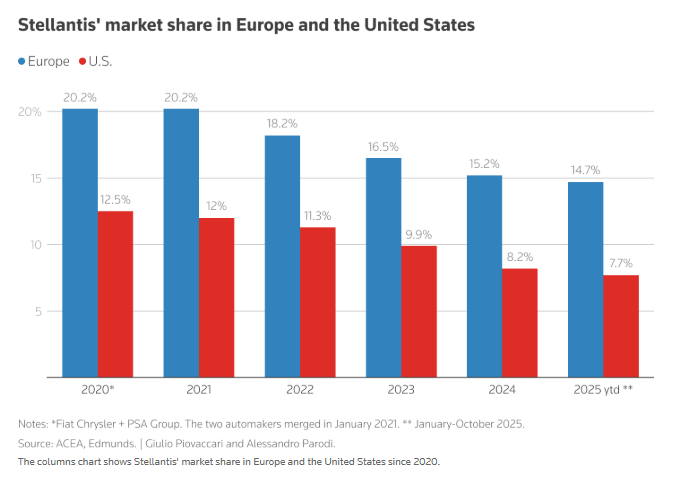
Core Viewpoint - Stellantis is shifting its strategy under new CEO Antonio Filosa, prioritizing sales growth over profits by expanding low-margin fleet sales and investing in budget models to regain market share in North America and Europe [1][2]. Group 1: Strategic Changes - Filosa's immediate goal is to exceed conservative analyst expectations for sales and revenue this year, following a significant drop in U.S. sales under the previous CEO [1][2]. - The new strategy includes restarting fleet sales in the U.S., which target rental companies and government agencies, despite their lower profit margins [3][11]. - Filosa is also addressing long-standing issues by evaluating the future viability of Stellantis's 14 brands, including Fiat and Maserati [3][19]. Group 2: Market Performance - Initial results show that Stellantis's North American sales increased by 6% year-over-year in Q3, marking the first growth in eight quarters [2]. - Stellantis's market share in the U.S. has fallen below 8%, a record low compared to 12.5% in 2020 [5]. - The company plans to invest $13 billion in the U.S. market to boost sales and counteract negative impacts from tariffs [10]. Group 3: Long-term Goals and Challenges - Filosa has abandoned aggressive electric vehicle sales targets set by the previous CEO, focusing instead on core brands like Jeep and budget models [8][10]. - The company aims for a long-term adjusted operating profit margin of 6%-8%, although analysts predict it will remain in the low single digits for the next few years [13]. - There is a recognition among major investors that fundamental changes will take years, and they are not pressuring for immediate profit margin improvements [12][15]. Group 4: Brand Integration and Market Strategy - Filosa is assessing the potential consolidation of Stellantis's brands, particularly in Europe where market overlap is significant [19]. - The company faces challenges in regaining market share in Europe due to brand redundancy and competition [19]. - The next few months are critical for Stellantis to demonstrate recovery in the U.S. market, which could provide more time for strategic planning [19].