江淮汽车

Search documents
汽车行业周报:中欧电车价格承诺机制落地,多地开放2026年汽车补贴,长城发布归元平台-20260120
Guohai Securities· 2026-01-20 09:13
Investment Rating - The report maintains a "Recommended" rating for the automotive industry [1] Core Insights - The implementation of the China-Europe electric vehicle price commitment mechanism is expected to stabilize sales expectations for Chinese electric vehicles in Europe and promote the high-end and localized transformation of automakers [5][13] - Multiple provinces have opened applications for the 2026 automotive replacement subsidy, indicating a clear path for local governments to implement the policy [14] - Great Wall Motors has launched the "Guiyuan" platform, which is the world's first native AI all-power platform, designed to support various power forms and enhance development efficiency [6][14] - The report expresses a positive outlook for 2026, highlighting opportunities in the high-end upgrade of domestic brands and the acceleration of smart technology penetration [15][16] Summary by Sections Recent Performance - The automotive sector outperformed the Shanghai Composite Index with a 1-week increase of 0.5% from January 12 to January 16, 2026, while the Shanghai Composite Index decreased by 0.4% [17] - The performance of individual stocks varied, with notable increases in companies like Ideal Auto (+2.4%) and declines in others like Li Auto (-3.5%) [17][23] Key Companies and Earnings Forecast - Key companies recommended include: - Jianghuai Automobile - Leap Motor - Great Wall Motors - BYD - SAIC Motor - China National Heavy Duty Truck [7][8] - Earnings per share (EPS) forecasts for selected companies show growth, with Great Wall Motors expected to reach an EPS of 2.03 in 2026 [8] Industry Indicators - In December 2025, automotive production and sales reached 3.296 million and 3.272 million units, respectively, with a year-on-year decrease of 2.1% and 6.2% [42] - New energy vehicles accounted for approximately 52% of total new vehicle sales, indicating a significant market shift towards electrification [42]



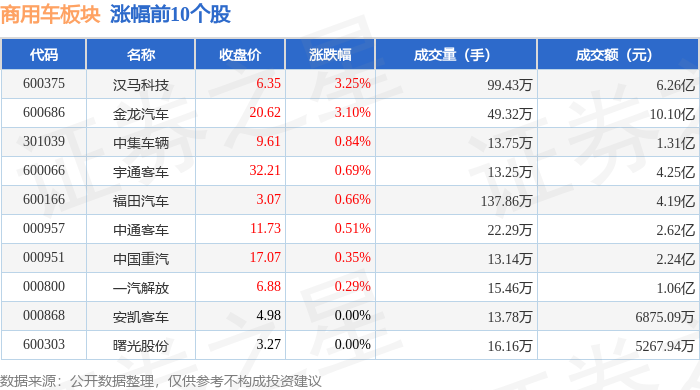
商用车板块1月20日涨0.07%,汉马科技领涨,主力资金净流出2.35亿元
Zheng Xing Xing Ye Ri Bao· 2026-01-20 08:51
Group 1: Market Overview - The commercial vehicle sector increased by 0.07% on January 20, with Hanma Technology leading the gains [1] - The Shanghai Composite Index closed at 4113.65, down 0.01%, while the Shenzhen Component Index closed at 14155.63, down 0.97% [1] Group 2: Stock Performance - Hanma Technology (600375) closed at 6.35, up 3.25% with a trading volume of 994,300 shares and a transaction value of 626 million [1] - King Long Automobile (600686) closed at 20.62, up 3.10% with a trading volume of 493,200 shares and a transaction value of 1.01 billion [1] - Other notable performers include CIMC Vehicles (301039) at 9.61, up 0.84%, and Yutong Bus (600066) at 32.21, up 0.69% [1] Group 3: Fund Flow Analysis - The commercial vehicle sector experienced a net outflow of 235 million from institutional investors, while retail investors saw a net inflow of 331 million [2] - The detailed fund flow indicates that King Long Automobile had a net inflow of 709.24 million from institutional investors, while Hanma Technology had a net inflow of 35.31 million [3] - Other companies like Yutong Bus and Foton Motor showed mixed fund flows, with Yutong Bus having a net inflow of 977.17 million from institutional investors [3]




2家车企预告2025年度亏损,合计超60亿
Di Yi Cai Jing· 2026-01-20 07:57
Group 1 - Multiple automakers have released their performance forecasts for 2025, with Beiqi Blue Valley expecting a net loss of 4.35 billion to 4.65 billion yuan, marking the lowest loss since 2020 [2] - Beiqi Blue Valley's sales are projected to reach nearly 210,000 units in 2025, an increase of 84.06% year-on-year, but the company remains in a loss phase due to insufficient scale effects [2] - Jianghuai Automobile anticipates a net loss of approximately 1.68 billion yuan in 2025, a reduction of about 100 million yuan compared to the previous year, with losses attributed to declining export business and investment losses from Volkswagen Anhui [3] Group 2 - Volkswagen Anhui, in which Jianghuai holds a 25% stake, is expected to incur losses exceeding 4.3 billion yuan in 2025, contributing to Jianghuai's financial struggles [3] - SAIC Motor is the only automaker among those reporting that expects a positive net profit for 2025, projected between 9 billion to 11 billion yuan, representing a year-on-year increase of 438% to 558% [4] - The growth in SAIC Motor's net profit is primarily driven by a 12.32% increase in wholesale vehicle sales and the reduction of asset impairment provisions in its joint ventures [4]


北汽蓝谷6年来最小亏损额,2025年降到50亿以内了
Di Yi Cai Jing· 2026-01-20 06:16
Group 1 - Beiqi Blue Valley has accumulated losses exceeding 33.8 billion yuan over the past six years, with an expected net profit loss of 4.35 billion to 4.65 billion yuan for 2025, marking the lowest loss since 2020 [1] - The company anticipates a sales volume of nearly 210,000 units in 2025, representing a year-on-year growth of 84.06%, but remains in a loss phase due to insufficient scale effects [1] - The main growth driver for Beiqi Blue Valley in the previous year was the A0-class electric vehicle, the Extreme Fox T1, which sold over 56,000 units in four months, although its profit contribution is limited [1] Group 2 - JAC Motors is also expected to incur significant losses in 2025, with an estimated net profit loss of around 1.68 billion yuan, a reduction of approximately 100 million yuan compared to the previous year [2] - The losses for JAC Motors are partly attributed to a decline in export business and a confirmed investment loss of about 1.08 billion yuan from its stake in Volkswagen Anhui, which is projected to lose over 4.3 billion yuan in 2025 [2] - Volkswagen Anhui has faced substantial losses, with nearly 10 billion yuan in losses over the past two years, and plans to launch four new models in 2026, although achieving sales recovery may be challenging [2] Group 3 - The future performance improvement for JAC Motors may hinge on the launch of the Zun Jie product line, with expectations for a flagship MPV and SUV model in 2026 [3] - Among A-share listed passenger car companies, SAIC Motor is the only one expected to report a positive net profit for 2025, with an estimated profit of 9 to 11 billion yuan, reflecting a year-on-year growth of 438% to 558% [3] - The profit growth for SAIC Motor is driven by a 12.32% increase in wholesale vehicle sales and a reduction in net profit due to asset impairment provisions from its joint ventures [3]
A股融资保证金比例下调首日:买入金额下降20.35% 热门股分歧显现
Mei Ri Jing Ji Xin Wen· 2026-01-20 05:10
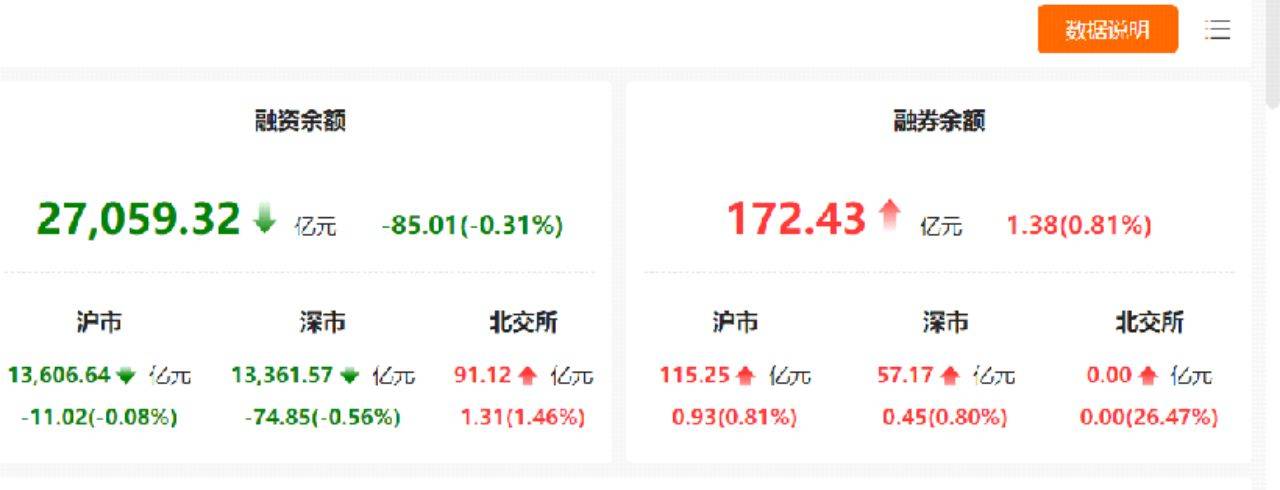
Group 1 - The core point of the article is that A-shares experienced a decline in financing margin on the first trading day, with a significant drop in financing buy amounts compared to previous weeks [1][2] - On January 19, the total financing buy amount for A-shares was 267.4 billion yuan, a decrease of 20.35% from 335.7 billion yuan the previous Friday, and a 40.68% drop from the peak of 450.8 billion yuan on January 14 [1][2] - The financing balance in the market decreased for the first time this year, totaling 2.71 trillion yuan, down by 8.5 billion yuan, indicating that the amount of financing repayment slightly exceeded the financing buy amount [2][5] Group 2 - Only the Beijing Stock Exchange saw an increase in financing balance, which rose by 9.1 billion yuan, a growth of 1.46% [3] - The margin for short selling also saw a slight increase, with a rise of 0.0138 billion yuan, indicating growing market divergence as the Shanghai Composite Index approached the 4100-point mark [4][5] - On January 19, among 3372 stocks eligible for margin trading, only 1619 stocks had a net financing inflow, with 33 stocks exceeding a net inflow of 100 million yuan [6][8] Group 3 - Analysts from Changcheng Securities noted that the market is likely to stabilize after a period of rapid growth, with a focus on performance and fundamentals in the upcoming earnings season [8] - Dongguan Securities highlighted that the recent slowdown in A-share market momentum is a normal consolidation following excessive short-term trading, with overall macro policies remaining accommodative [8]
A股融资保证金比例下调首日:买入金额下降20.35%,热门股分歧显现
Sou Hu Cai Jing· 2026-01-20 04:57
Core Viewpoint - The A-share market experienced a significant decline in financing buy amounts following the adjustment of the financing margin requirement, indicating a cautious sentiment among investors [1][2]. Financing and Margin Adjustments - On January 19, the total financing buy amount in the A-share market was 267.4 billion yuan, a decrease of 20.35% from 335.7 billion yuan the previous Friday, and a 40.68% drop from the peak of 450.8 billion yuan on January 14 [1][2]. - The financing margin requirement for new contracts was raised from 80% to 100%, effective January 19, which contributed to the decline in financing buy amounts [2]. - The total market financing balance decreased to 2.71 trillion yuan, marking the first decline of the year, with a reduction of 8.5 billion yuan [2]. Market Sentiment and Investor Behavior - Despite the overall decline, the North Exchange saw an increase in financing balance by 9.1 billion yuan, reflecting continued investor interest in technology and growth sectors [3]. - The margin balance slightly increased by 0.138 billion yuan, indicating a mixed sentiment as the Shanghai Composite Index approached the 4100-point mark [4]. - On January 19, only about half of the 3372 stocks with margin trading saw net financing inflows, with 1619 stocks experiencing net buy, suggesting increased investor divergence [6]. Specific Stock Performance - The top three stocks by financing buy on January 19 were Tebian Electric, Zhongji Xuchuang, and Xinyi Sheng, with financing buy amounts of 2.758 billion yuan, 2.096 billion yuan, and 2.090 billion yuan, respectively, while their financing repayments were higher [6]. - Jianghuai Automobile led net financing buy with 362 million yuan, followed by Unisplendour and Jingce Electronics with net buys of 282 million yuan and 267 million yuan, respectively [7]. Market Outlook - Analysts from Great Wall Securities noted that the market has shown increased activity and sentiment since the beginning of the year, with a potential return to stability after a period of rapid gains [8].
财通证券:汽车销量走弱来自政策的不及预期 关注高端化智能化主线
智通财经网· 2026-01-20 03:53
Core Viewpoint - The passenger car market and new energy vehicle market are showing weak performance due to market policies, but the overall vehicle sector is believed to have bottomed out after multiple adjustments. The company maintains its existing vehicle strategy and suggests focusing on three structural directions: high-end, intelligent, and overseas expansion [1][3]. Market Performance - From January 1 to 11, 2026, nationwide retail sales of passenger cars reached 328,000 units, representing a year-on-year and month-on-month decline of 32% and 42%, respectively. Among these, new energy vehicle sales were 117,000 units, with a year-on-year and month-on-month drop of 38% and 67%. The penetration rate of new energy vehicles stands at 35.5% [2]. Demand Weakness Analysis - The decline in sales is attributed to policies falling short of expectations. The reduction in purchase tax and the proportional subsidy have increased costs for consumers in the mid-to-low-end market, leading to a stronger wait-and-see sentiment among buyers. This has resulted in a shift back to traditional fuel vehicles, with anticipated demand in January not materializing. The effectiveness of the subsidy policy appears weak at this time [3]. Market Dynamics - Weak demand for passenger cars may not necessarily be negative, as it could clarify the competitive landscape in the mid-to-low-end market. The current market is characterized by a high preference for cost-effectiveness, and the focus remains on the new car cycle. The market is currently in a low season with fewer new car launches, but a wave of new car releases is expected around late April during the Beijing Auto Show [4]. Investment Recommendations - High-end Focus: Given the weak performance in the mid-to-low-end market, the company recommends selecting firms with structural beta and a clear high-end path, such as Jianghuai Automobile and Xiaomi Group, while paying attention to the new car cycle of BAIC Blue Valley [5]. - Intelligent Development: Intelligent technology is seen as a necessary path for the next phase of the automotive industry, with a core recommendation for XPeng Motors, focusing on opportunities related to new valuations [5]. - Overseas Expansion: Although the process of overseas expansion is lengthy, opportunities still exist, with BYD being a key recommendation, particularly regarding its overseas progress and potential profit contributions [5].

A股,两融降温!结束10连增
Zheng Quan Shi Bao Wang· 2026-01-20 03:21
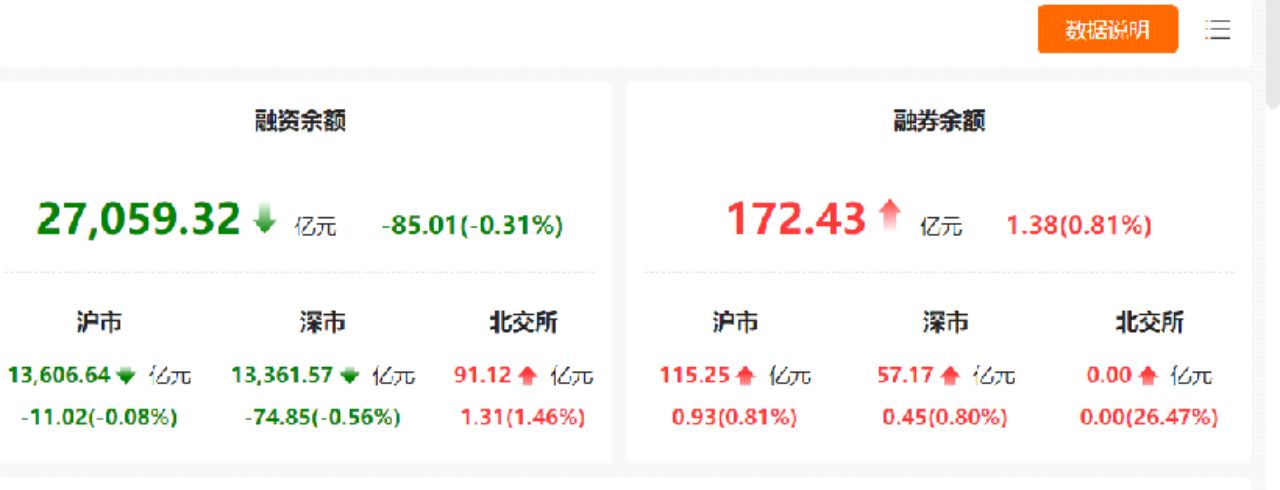
Core Insights - The implementation of new margin requirements has led to a decline in the margin trading market, with a notable drop in both margin balance and trading volume on the first day of the new regulations [2][3][4]. Group 1: Market Overview - On January 19, 2026, the margin trading balance in the A-share market was approximately 27,232 billion yuan, a decrease of about 84 billion yuan from the previous trading day, ending a streak of 10 consecutive increases [3]. - The financing balance on the same day was around 27,059 billion yuan, down by approximately 85 billion yuan, also marking the end of a 10-day growth trend [3]. - The total margin trading volume on January 19 was about 2,684 billion yuan, the first time it fell below 3,000 billion yuan since January 6, 2026, and the lowest single-day figure for the year [3]. Group 2: Regulatory Changes - The new regulation, which increased the minimum margin requirement for investors from 80% to 100%, took effect on January 19, 2026, and applies only to new financing contracts [4]. - Existing financing contracts and their extensions are still governed by the previous margin requirements [4]. Group 3: Stock Performance - Despite the overall decline in margin trading balance, many stocks still maintain high margin balances, with 17 stocks having margin balances exceeding 10 billion yuan as of January 19 [5]. - Notably, stocks such as China Ping An, Dongfang Wealth, and Ningde Times have margin balances exceeding 20 billion yuan [5].
A股,两融降温!结束10连增
证券时报· 2026-01-20 03:13
Core Viewpoint - The implementation of new margin requirements has led to a decline in the margin trading balance and trading volume in the A-share market, indicating a cooling off in the margin trading environment [2][4][5]. Group 1: Margin Trading Regulations - On January 19, 2026, the minimum margin requirement for investors financing the purchase of securities was raised from 80% to 100% [5]. - This adjustment applies only to new financing contracts, while existing contracts will continue under previous regulations [5]. Group 2: Market Impact - On the first day of the new regulations, the margin trading balance decreased to approximately 27,232 billion yuan, a reduction of about 84 billion yuan from the previous trading day, ending a streak of 10 consecutive increases [4]. - The financing balance on January 19 was about 27,059 billion yuan, down by approximately 85 billion yuan, also marking the end of a 10-day growth trend [4]. - The total margin trading volume on January 19 was around 2,684 billion yuan, the first time it fell below 3,000 billion yuan since January 6, and the lowest single-day figure for 2026 [4]. - The proportion of margin trading volume to total A-share trading volume decreased to 9.82%, the first time it has been below 10% since December 16, 2025, down from 11.01% on January 16 [4]. Group 3: High Margin Balances in Selected Stocks - Despite the overall decline in margin trading balances, many stocks still maintain high margin balances, with 17 stocks having balances exceeding 10 billion yuan as of January 19 [7]. - Notably, stocks such as China Ping An, Dongfang Wealth, and Ningde Times have margin balances exceeding 20 billion yuan [7].

33股受融资客青睐,净买入超亿元
Zheng Quan Shi Bao· 2026-01-20 02:05
Group 1 - As of January 19, the total market financing balance is 2.71 trillion yuan, a decrease of 8.5 billion yuan from the previous trading day [1] - The financing balance for the Shanghai Stock Exchange is 1.36 trillion yuan, down 1.1 billion yuan, while the Shenzhen Stock Exchange's balance is 1.34 trillion yuan, down 7.5 billion yuan [1] - The North Exchange saw an increase in financing balance to 9.11 billion yuan, up 131 million yuan [1] Group 2 - On January 19, a total of 1,619 stocks received net financing purchases, with 486 stocks having net purchases exceeding 10 million yuan, and 33 stocks exceeding 100 million yuan [1] - Jianghuai Automobile topped the list with a net purchase of 362 million yuan, followed by Unisplendour and Jingce Electronics with net purchases of 282 million yuan and 267 million yuan, respectively [1] - Industries with significant net purchases include electronics, power equipment, and non-ferrous metals, with 10, 6, and 3 stocks respectively [1] Group 3 - The average financing balance as a percentage of market capitalization for stocks with significant net purchases is 4.76% [2] - Zhejiang Wenlian has the highest financing balance at 1.48 billion yuan, accounting for 10.95% of its market capitalization [2] - Other companies with high financing balance ratios include Jianghuai Automobile at 10.63%, Haibo Technology at 9.90%, and Demingli at 9.17% [2] Group 4 - The top net purchases on January 19 include Jianghuai Automobile with a 4.77% increase, Unisplendour with a 2.77% increase, and Jingce Electronics with a 6.26% increase [3] - Jianghuai Automobile's latest financing balance is approximately 1.20 billion yuan, representing 10.63% of its market capitalization [3] - Other notable companies include Top Group, Lanke Technology, and New Spring Shares, with net purchases of 191 million yuan, 191 million yuan, and 186 million yuan, respectively [3] Group 5 - Additional significant net purchases include Zhejiang Wenlian with a 10.95% financing balance ratio, Demingli at 9.17%, and Meinian Health at 7.52% [4] - Companies like China Ping An and Goldwind Technology also show notable financing balances, with respective ratios of 4.41% and 3.96% [4] - The report highlights various sectors, including electronics, machinery, and power equipment, indicating diverse investment interests among financing clients [4]