
百威亚太

Search documents
百威亚太(01876) - 2025 Q1 - 业绩电话会
2025-05-08 04:32
Financial Data and Key Metrics Changes - In the first quarter, total volumes and revenue decreased by 6.1% and 7.5% respectively, with revenue per hectoliter declining by 1.5% due to negative geographic and channel mix [8] - Normalized EBITDA decreased by 11.2%, and the normalized EBITDA margin contracted by 140 basis points [8] - In APAC West, volumes and revenue decreased by 8.6% and 11.7% respectively, with normalized EBITDA decreasing by 17.6% [8] - In China, volumes declined by 9.2%, and revenue declined by 12.7%, with revenue per hectoliter declining by 3.9% [9] Business Line Data and Key Metrics Changes - The in-home channel saw increased volume and revenue contributions, indicating a shift in consumer behavior towards in-home consumption [9] - Marketing investments for Budweiser and Harbin were increased to connect with consumers and drive market share [10] - In APAC East, volumes and revenues increased by 11.9% and 11.7% respectively, with normalized EBITDA increasing by 24.4% [11] Market Data and Key Metrics Changes - In South Korea, volume increased by double digits, supported by shipment phasing ahead of a price increase announced in April [12] - The company reported a decrease in cost of sales by 1.5% on a per hectoliter basis, driven by commodity tailwinds and cost management initiatives [13] Company Strategy and Development Direction - The company aims to adapt to evolving market conditions and focus on a winning brand portfolio, premium route to market, and a resilient team to drive sustainable growth [6] - The strategy remains focused on premiumization and digitalization, with an emphasis on market share and in-home channel growth [19][20] - The company is committed to expanding its route to market and enhancing distribution capabilities, particularly in the in-home channel [29] Management's Comments on Operating Environment and Future Outlook - Management noted that consumer confidence in China remains low, particularly in key regions, but there are positive indicators from upcoming holidays [17][18] - The company is closely monitoring the impact of tariffs in Guangdong but has not yet seen a significant shift in consumer behavior [44][45] - Future focus will be on executing the strategy effectively and adapting to market conditions as needed [46] Other Important Information - The company is leveraging technology to enhance commercial capabilities and drive value creation for stakeholders [10] - The partnership with Swire Coca-Cola is seen as a significant opportunity for growth in the in-home channel [85] Q&A Session All Questions and Answers Question: Update on Q2 performance in China - Management indicated that consumer confidence remains low, but there are positive signs from upcoming holidays, and pricing strategies will be considered based on market conditions [17][18] Question: Competition in Guangdong province - Management acknowledged the competitive landscape in Guangdong and emphasized the importance of expanding the Harbin brand and enhancing distribution in the in-home channel [25][26] Question: Core plus plus strategy and trade-up volume - Management explained that the core plus plus segment serves as an accessible upgrade for consumers, with a focus on product superiority and brand differentiation [36][38] Question: Impact of tariffs on consumer behavior in Guangdong - Management stated that it is too early to quantify the impact of tariffs, but they are monitoring the situation closely [44][45] Question: On-trade recovery in China - Management remains conservative about on-trade recovery, noting that consumer occasions are still growing in the in-home channel [53][54] Question: Cooperation with Swire Coca-Cola - Management reported positive outcomes from the partnership and expressed optimism for future collaboration in the in-home channel [85][86] Question: Competitive edge of Harbin Beer - Management highlighted Harbin's national brand status and cultural significance, along with ongoing premiumization efforts [91][92]

百威亚太(01876) - 2025 Q1 - 业绩电话会
2025-05-08 04:30
Financial Data and Key Metrics Changes - In Q1 2025, total volumes and revenue decreased by 6.1% and 7.5% respectively, with revenue per hectoliter declining by 1.5% due to negative geographic and channel mix [7][8] - Normalized EBITDA decreased by 11.2%, and the normalized EBITDA margin contracted by 140 basis points [7] - In APAC West, volumes and revenue decreased by 8.6% and 11.7% respectively, with normalized EBITDA decreasing by 17.6% [7][8] Business Line Data and Key Metrics Changes - In China, volumes declined by 9.2%, with revenue declining by 12.7% and revenue per hectoliter down by 3.9% [8] - The in-home channel saw increased volume and revenue contributions, indicating a shift towards premiumization in this segment [9] - In APAC East, volumes and revenues increased by 11.9% and 11.7% respectively, with normalized EBITDA increasing by 24.4% [11] Market Data and Key Metrics Changes - In South Korea, volume increased by double digits, supported by shipment phasing ahead of a price increase announced in April [12] - The company reported strong performance in the in-home channel, with a focus on expanding distribution and market share [30] Company Strategy and Development Direction - The company aims to adapt to evolving market conditions and execute with discipline to capture growth, focusing on market share, in-home channels, and mega brands like Budweiser and Harbin [5][20] - The strategy emphasizes premiumization and a digitalized ecosystem, with a commitment to optimizing business operations [20][76] Management's Comments on Operating Environment and Future Outlook - Management noted that consumer confidence in China remains low, impacting sales, particularly in Guangdong, but sees potential for improvement during holiday periods [17][56] - The company is focused on executing its strategy effectively, with an emphasis on enhancing distribution and expanding the in-home channel [49] Other Important Information - The company has increased marketing investments for Budweiser and Harbin to connect with consumers and drive market share [10] - The usage and reach of the BEES platform for B2B wholesaler and customer engagement continued to expand, indicating a focus on technology and commercial capabilities [11] Q&A Session Summary Question: Update on Q2 performance in China - Management indicated that consumer confidence remains low, particularly in key regions, but sees potential for improvement during holiday periods [17] Question: Competition in Guangdong province - Management acknowledged the competitive landscape in Guangdong and emphasized the importance of expanding in-home coverage and distribution to maintain market share [30] Question: Core plus plus strategy and trade-up volume - Management explained that the core plus plus segment serves as an accessible upgrade for consumers, with a focus on superior product offerings to drive growth [39] Question: Impact of tariffs in Guangdong - Management stated it is too early to quantify the impact of tariffs on consumer behavior but emphasized focusing on execution and adapting strategies as needed [46] Question: On-trade recovery in China - Management remains conservative about on-trade recovery, noting that consumer confidence is a key factor and that in-home consumption continues to grow [56] Question: Cooperation with Swire - Management highlighted successful trials in Hubei and Anhui provinces and expressed optimism about future collaboration opportunities [86] Question: Future of Harbin Beer - Management emphasized Harbin's unique position as a national brand with a strong heritage and commitment to premiumization, aiming to leverage its brand power for growth [92]
白酒公司高管集体降薪,有人一年少了四百万
21世纪经济报道· 2025-05-08 03:52
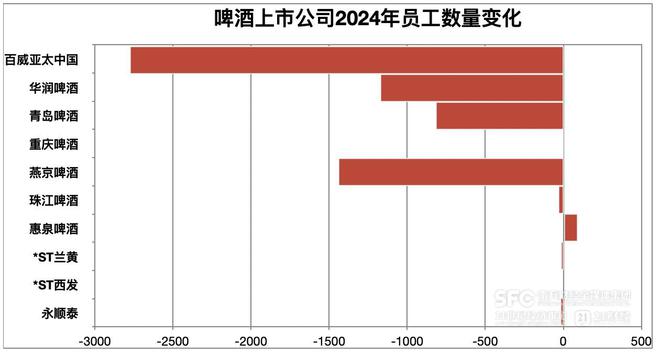
Core Viewpoint - The article discusses the contrasting employment trends in the beer and liquor industries during the current adjustment period, highlighting that while beer companies have reduced their workforce significantly, liquor companies, particularly leading brands, have increased their employee numbers despite facing revenue declines [2][11]. Employment Trends in Beer Industry - Over the past year, the beer industry has seen a reduction of over 6,000 employees across 10 listed companies, with major players like Budweiser APAC and China Resources Beer each reducing their workforce by over 1,000 [5][8]. - The overall employment in the beer sector has decreased to below 300,000, primarily due to declining sales and revenue in the industry [2][5]. - The reduction in workforce is attributed to decreased demand for production and sales roles, particularly for temporary workers during peak seasons [8][9]. Employment Trends in Liquor Industry - In contrast, the liquor industry has experienced an increase of over 3,900 employees, with only 7 out of 22 listed liquor companies reporting reductions [9][12]. - Leading liquor companies such as Kweichow Moutai and Yanghe Brewery have added over 1,000 employees each, indicating a robust demand for production roles [9][12]. - The increase in employment is partly driven by the need to meet production demands and the social responsibility of state-owned enterprises to maintain employment levels [12][13]. Salary Adjustments - While the overall employment levels in liquor companies have increased, there has been a notable reduction in executive compensation, with many high-ranking officials seeing salary cuts of hundreds of thousands [16][17]. - In contrast, the average salary for non-executive employees has remained stable or even increased in some companies, such as Water Well and Kweichow Moutai, which reported a rise in average non-executive salaries [20][21]. Future Outlook - The article suggests that the current adjustment period for the liquor industry is not yet over, and further developments in cost-cutting measures and employee compensation will need to be monitored [21].






信达国际控股港股晨报-20250508
Xin Da Guo Ji Kong Gu· 2025-05-08 02:44
Market Overview - The Hang Seng Index faces initial resistance at 23,000 points, influenced by U.S. President Trump's announcement to suspend new tariffs for 90 days while increasing tariffs on Chinese imports [2] - The market anticipates stronger economic support measures from the central government, including additional bond issuance in Q3 to stimulate domestic demand and mitigate tariff impacts [2][6] - Recent developments suggest a potential reduction in tariffs by the U.S., with positive progress reported in U.S.-China trade negotiations [2] Sector Outlook - There is a positive outlook for domestic consumption stocks, driven by expectations of increased policy support for consumer spending [3] Corporate News - Geely Automobile (0175) proposes a privatization of Zeekr at a 13.6% premium [5] - XPeng Motors (9868) is rumored to be considering a spin-off for its Hong Kong or U.S. listing [5] - Contemporary Amperex Technology Co., Ltd. (CATL) is reportedly planning a Hong Kong IPO with a discount of less than 10% [5] - Pop Mart (9992) non-executive director sold 11.91 million shares, realizing HKD 2.27 billion [5] - Old Town Gold (6181) plans a share placement at an 8% discount to raise HKD 2.7 billion [5] - Budweiser (1876) reported an 18% decline in first-quarter profit [5] - Hongteng Precision (6088) has terminated the sale of Autotalks [5] Economic Indicators - The U.S. Federal Reserve maintained interest rates, citing increased uncertainty in the economic outlook, with expectations of two rate cuts totaling 0.5% this year [6][12] - The People's Bank of China announced ten measures to enhance macroeconomic control, including a 0.5% reduction in the reserve requirement ratio and a decrease in policy interest rates [10] - China's foreign exchange reserves increased for four consecutive months, with a total of USD 3.2817 trillion as of the end of April, reflecting a rise of USD 41 billion [11] - Hong Kong's PMI for April remained at 48.3, indicating a continued contraction in the private sector [11]
恒指收升29点,大市成交增长
Guodu Securities Hongkong· 2025-05-08 02:34
每日投资策略 恒指收升 29 点 大市成交增长 · 2025 年 5 月 8 日 国都港股操作导航 | 海外市场重要指数 | 收市 | 幅度 | | --- | --- | --- | | 道琼斯工业指数 | 41,113.97 | 0.70% | | 标普 500 指数 | 5,631.28 | 0.43% | | 纳斯达克综合指数 | 17,738.16 | 0.27% | | 英国富时 100 指数 | 8,559.33 | -0.44% | | 德国 DAX 指数 | 23,115.96 | -0.58% | | 日经 225 指数 | 36,779.66 | -0.14% | | 台湾加权指数 | 20,546.49 | 0.12% | | 内地股市 | | | | 上证指数 | 3,342.67 | 0.80% | | 深证成指 | 10,104.13 | 0.22% | | 香港股市 | | | | 恒生指数 | 22,691.88 | 0.13% | | 国企指数 | 8,242.25 | -0.23% | | 红筹指数 | 3,792.67 | 0.11% | | 恒生科技指数 | 5,20 ...
酒业迈入降本增效周期:三大啤酒企业去年减员超千人,白酒公司高管集体降薪|酒业财报观察
2 1 Shi Ji Jing Ji Bao Dao· 2025-05-08 00:19
Core Viewpoint - The current adjustment period in the liquor industry shows contrasting trends between beer and liquor companies, with beer companies reducing staff significantly while liquor companies are expanding their workforce despite a general slowdown in performance [1][2][3]. Beer Industry - In the past year, beer companies have collectively reduced their workforce by over 6,000 employees, with major companies like Budweiser APAC and China Resources Beer leading the cuts [5][6]. - Budweiser APAC saw the largest reduction, decreasing from 21,181 employees at the end of 2023 to 18,401 by the end of 2024 [1]. - The overall decline in the beer industry is attributed to a drop in sales and revenue, leading to decreased demand for production and sales staff [8][9]. Liquor Industry - In contrast, the liquor industry has seen an increase in employee numbers, with 22 listed liquor companies collectively adding over 3,900 employees, bringing the total to over 174,000 [11][12]. - Major liquor companies like Kweichow Moutai and Yanghe Distillery increased their workforce by over 1,000 employees each [11]. - The increase in staffing is driven by production needs and a commitment to social responsibility, as many liquor companies are state-owned and are responding to government calls for job stability [12][13]. Salary Trends - While the overall workforce in the liquor industry is expanding, executive salaries have seen significant reductions, with many high-ranking officials experiencing pay cuts of hundreds of thousands of yuan [17][20]. - For instance, the chairman of Kuaizhou Moutai saw a drop in salary from 364.4 million yuan to 264.4 million yuan [17]. - In contrast, the average salary for non-executive employees in the liquor sector has remained relatively stable, with only a few companies reporting slight declines [22][24]. Future Outlook - The current adjustment phase in the liquor industry is ongoing, with expectations for further changes in cost management and employee compensation [24]. - Industry experts suggest that the liquor sector may face a turning point, indicated by market dynamics such as inventory control and pricing strategies [24].
百威亚太第一季度净利润2.34亿美元,预估2.346亿美元。第一季度营收14.6亿美元,预估15.2亿美元。第一季度毛利率51%,预估50.3%。第一季度调整后息税折旧及摊销前利润4.85亿美元,预估4.98亿美元。第一季度调整后息税前利润3.31亿美元,预估3.431亿美元。
news flash· 2025-05-07 23:05
| | 2025年 | 2024年 | | | --- | --- | --- | --- | | | 第一季度 | 第一季度 | ワ | | 總銷量(十萬公升) | 19,741 | 21.115 | | | 收入 | 1.461 | 1.643 | | | 毛利 | 745 | 846 | | | 毛利率 | 51.0% | 51.5% | | | 正常化除息稅折舊攤銷前盈利² | 485 | 572 | | | 正常化除息稅折舊攤銷前盈利率 | 33.2% | 34.8% | -14 | | 正常化除息税前盈利 | 331 | 408 | | | 正常化除息稅前盈利率 | 22.7% | 24.8% | -18 | | 百威亞太股權持有人應佔溢利 | 234 | 287 | | | 百威亞太股權持有人應佔正常化溢利 | 235 | 297 | | | 正常化每股基本盈利(以美分計 )3 | 1.78 | 2.26 | | 第一季度毛利率51%,预估50.3%。 第一季度调整后息税折旧及摊销前利润4.85亿美元,预估4.98亿美元。 第一季度调整后息税前利润3.31亿美元,预估3.431亿美元。 百威亚太 ...

百威亚太(01876) - 2025 Q1 - 季度业绩
2025-05-07 23:00
Sales Performance - Total sales volume for Q1 2025 was 19,741 million liters, a decrease of 6.1% compared to Q1 2024[13] - In Q1 2025, sales volume in China decreased by 9.2%, with inventory management measures accounting for approximately 25% of the decline[16] - Total sales volume for Q1 2025 decreased by 6.1% to 19,741 thousand liters compared to Q1 2024[39] - In the Asia-Pacific region, sales volume in the eastern region increased by 11.9% year-over-year, while the western region saw a decline of 8.6%[43] Revenue and Profitability - Revenue for Q1 2025 was $1,461 million, down 7.5% from $1,643 million in Q1 2024[8] - Revenue in China fell by 12.7%, while revenue per hundred liters decreased by 3.9%[16] - Total revenue for Q1 2025 was $1,461 million, compared to $1,643 million in Q1 2024, reflecting a decline of 11.1%[42] - Normalized net profit attributable to equity holders was $235 million, down from $297 million in Q1 2024[10] - The net profit for Q1 2025 was $242 million, down from $293 million in Q1 2024, representing a decrease of 17.4%[42] EBITDA and Operating Profit - Normalized EBITDA for Q1 2025 was $485 million, reflecting an 11.2% decrease from $572 million in Q1 2024[9] - Normalized EBITDA decreased by 17.1% due to revenue performance and operational deleveraging[16] - Normalized EBITDA for Q1 2025 dropped by 14.4% to $331 million, down from $408 million in Q1 2024[39] - The normalized operating profit (EBIT) for Q1 2025 was $331 million, compared to $408 million in Q1 2024, a decline of 18.9%[42] Cost and Margin Analysis - Cost of sales for Q1 2025 was $716 million, a reduction of 7.5% compared to the previous year[6] - The gross profit margin for Q1 2025 was 51.0%, slightly down from 51.5% in Q1 2024[13] - The normalized EBITDA margin for Q1 2025 was 33.2%, down 140 basis points from 34.8% in Q1 2024[39] - The company reported a normalized operating margin of 33.2% for Q1 2025, down from 34.8% in Q1 2024[42] Market Challenges and Strategies - The company faced challenges in the Chinese market due to unfavorable regional and channel mix, impacting sales performance[12] - The company remains focused on its brand portfolio, marketing channels, and agile team to navigate the current market environment[5] - The company launched a new packaging design for Budweiser in March 2025 to attract a new generation of adult consumers[16] - In Q1 2025, the sales of zero-sugar Harbin Ice Pure increased by approximately 70%, connecting with health-conscious young adults[16] - The company’s marketing resources were increased for Budweiser and Harbin to strengthen brand power and market share[16] Financial Overview - The financial data presented is normalized to exclude the effects of currency conversion and scope changes related to acquisitions and divestitures[38] - The financial performance metrics are based on internal records and are not independently audited[38] - The effective tax expense for Q1 2025 was $95 million, compared to $117 million in Q1 2024, indicating a reduction in tax burden[42] Company Background - The company operates in two geographical segments: Eastern Asia Pacific (mainly Korea, Japan, and New Zealand) and Western Asia Pacific (China, India, Southeast Asia, and exports)[41] - The company employs over 21,000 staff across 47 breweries in the Asia Pacific region[36] - The company is a subsidiary of Anheuser-Busch InBev, which has over 600 years of brewing history[36]
啤酒2024年报及2025年一季报总结:25Q1恢复性增长,期待旺季量价提速
Soochow Securities· 2025-05-07 13:20
Investment Rating - The report maintains an "Accumulate" rating for the beer industry, indicating a positive outlook for investment opportunities in this sector [1]. Core Insights - The beer industry experienced a recovery in Q1 2025 after a challenging 2024, with revenue and profit showing signs of growth. Specifically, the beer sector's revenue for 2024 was CNY 68.038 billion, down 1.67% year-on-year, while net profit increased by 6.05% to CNY 7.290 billion. In Q1 2025, revenue reached CNY 20.043 billion, up 3.68% year-on-year, and net profit rose by 10.62% to CNY 2.519 billion [11][22][24]. Summary by Sections 1. Q1 Performance and Cost Elasticity - The beer sector faced pressure in 2024, but Q1 2025 showed recovery with revenue and profit growth. The revenue for 2024 was CNY 68.038 billion, with a net profit of CNY 7.290 billion. In Q1 2025, revenue was CNY 20.043 billion, and net profit was CNY 2.519 billion, indicating a recovery trend [11][22]. - Cost elasticity has been a key factor in maintaining profit margins, with a steady increase in gross profit margins throughout 2024 and into Q1 2025 [19][20][55]. 2. Future Growth Potential - The report anticipates a positive trend in volume and price in the upcoming quarters, particularly as the industry enters a low base period in Q2 and Q3 2025. The recovery in the restaurant sector is expected to support beer sales [48][50]. - The focus on mid-to-high-end beer products continues to drive growth, with brands like Qingdao Beer and Yanjing Beer expected to perform well due to their strong market positions and product upgrades [53][54]. 3. Investment Recommendations - The report suggests increasing exposure to quality leaders such as Qingdao Beer and Yanjing Beer, which are positioned well for growth in the upcoming consumption peak season. The recommendation is based on their strong cash flow and dividend yield potential [6][24]. - The report highlights the importance of monitoring the recovery of the restaurant sector and the impact of consumption stimulus policies on beer sales [50][52].


青岛啤酒收购即墨老酒100%股权 多元化能否打开增长空间?
Xin Lang Cai Jing· 2025-05-07 12:13
面对每天上千份上市公司公告该看哪些?重大事项公告动辄几十页几百页重点是啥?公告里 一堆专业术语不知道算利好还是利空?请看智通财经公司新闻部《速读公告》栏目,我们派 驻全国的记者们将于公告当晚为您带来准确、快速、专业的解读。 公告数据显示,即墨黄酒厂总资产为约9亿元,净资产为约2亿元。2024年,即墨黄酒实现主营业务收入 约1.66亿元,同比增长13.5%; 实现净利润3047万元,同比增长38.0%。"消费行业3倍PB,20倍PE,在一 级半市场来说,略高一点,不过即墨黄酒厂拥有的'即墨老酒'品牌在当地知名度很高,给出一个略高的 溢价,比较合理。" 青岛啤酒表示,即墨黄酒与青岛啤酒同属发酵酒类行业,随着即墨黄酒的加入,将进一步丰富青岛啤酒 产品线,拓宽市场渠道,为广大消费者提供更加多元化的选择。在品牌及产品宣传推广、销售网络与渠 道等方面与公司现有优势市场和资源进行协同,进一步扩大市场影响力。 从市场销售淡旺季上,"即墨老酒"与啤酒产品可以形成市场销售的互补效应,构建更具市场竞争力的跨 品类产品组合,在巩固传统产品市场地位的同时开辟新的增长点。 有观察人士表示,随着整个啤酒市场的萎缩和高端化进入尾声,头部啤酒 ...