
北方稀土

Search documents
工业有色ETF万家(560860)半日收涨5.11%,规模、份额均创成立以来新高!
Xin Lang Cai Jing· 2026-01-26 03:47
Group 1 - The industrial non-ferrous metal sector is experiencing significant gains, with the CSI Industrial Non-Ferrous Metal Theme Index (H11059) rising by 5.14% as of January 26, 2026, and individual stocks such as Vanadium Titanium and Xinyi Silver Tin hitting the daily limit up [1] - The latest scale of the Industrial Non-Ferrous ETF Wan Jia (560860) reached 14.378 billion yuan, with a total of 7.582 billion shares, both hitting record highs since inception, and a net inflow of 60.1082 million yuan was recorded [1] - Silver prices have surged past 100 USD/ounce, driven by heightened global risk aversion due to tariff increases by Trump, accelerated gold reserve purchases by central banks, and reduced US Treasury holdings by emerging markets [1] Group 2 - Long-term underinvestment in copper mine capital expenditures, combined with frequent supply disruptions, is shifting the copper supply-demand balance from tight equilibrium to substantial shortage [2] - The upcoming interest rate cuts by the Federal Reserve in 2026 and the "anti-involution" in the smelting sector are expected to push copper prices beyond previous highs, indicating a clear upward trend in the overall pricing center for industrial metals [2] - The top ten weighted stocks in the CSI Industrial Non-Ferrous Metal Theme Index (H11059) as of December 31, 2025, include major players such as Luoyang Molybdenum, Northern Rare Earth, and China Aluminum, collectively accounting for 56.18% of the index [2]
稀有金属ETF基金(561800)盘中上涨3.15%,规模创近1月新高!钨价持续创历史新高,供需错配格局难解
Xin Lang Cai Jing· 2026-01-26 03:13
Group 1 - The core viewpoint of the news highlights the strong performance of rare metal ETFs and the significant price increases in tungsten and lithium, driven by supply constraints and rising demand [1][2][3] Group 2 - As of January 26, 2026, the CSI Rare Metals Theme Index (930632) rose by 3.18%, with key stocks such as Vanadium Titanium Co. increasing by 10.13% and China Tungsten High-tech by 8.98% [1] - The top ten weighted stocks in the CSI Rare Metals Theme Index accounted for 59.54% of the index as of December 31, 2025, including companies like Luoyang Molybdenum and Northern Rare Earth [1] - The rare metal ETF fund (561800) reached a new high of 229 million yuan as of January 23, 2026, with a net inflow of 18.92 million yuan over the past ten trading days [1] Group 3 - The tungsten market is experiencing significant supply-demand imbalances, with black tungsten concentrate prices rising by 11.43% to 536,000 yuan/ton and ammonium paratungstate increasing by 12.06% to 790,000 yuan/ton [2] - Supply constraints are due to reduced domestic mining quotas and production slowdowns, while demand is bolstered by seasonal restocking ahead of the Spring Festival [2] - Lithium carbonate prices are expected to continue rising, supported by supply disruptions and a decrease in weekly production by 1.72% in January [2] Group 4 - The rare metal ETF fund (561800) tracks the CS Rare Metals Index, which has one of the highest energy metal contents, particularly lithium and cobalt, indicating potential for continued benefits [3]
中国稀土:2026 年稀土展望电话会要点-China Rare Earths_ Takeaways from Rare Earth 2026 Outlook Call
2026-01-26 02:49
Summary of China Rare Earths 2026 Outlook Call Industry Overview - **Industry**: Rare Earths - **Key Players**: Northern Rare Earth High-Tech (NRE), China Rare Earth Resources and Technology (CRE), JL Mag Rare-Earth Core Insights - **Supply Discipline**: China's rare earth supply discipline has transitioned to a structural level due to the extension of smelting and separation quotas to imported ores starting in 2025, reducing supply elasticity across the system. SMM anticipates a ~10% year-over-year growth in China's supply for 2026E [2][3] - **Imports**: US-origin rare earth ore imports have dropped to nearly zero since August 2025, following MP Materials' export suspension to China. This supply gap has been compensated by increased imports from Africa, while Myanmar's supply share is expected to decline due to rising tax uncertainty and political risks [3] - **Exports**: SMM forecasts approximately 9% year-over-year growth in exports for 2026E [4] Recycling and Demand - **Recycling**: Recycling has become a significant marginal supplier, with recycled PrNd accounting for ~25% of total PrNd supply in 2025, projected to rise to ~35% in 2026 due to planned capacity additions [4] - **Demand Growth**: SMM expects magnet demand to grow by 15-18% year-over-year in 2026E, driven by the adoption of NEVs (20% production growth), wind power (10% installation growth), air conditioners (11% production growth), and industrial robotics (8-10% growth). Humanoid robots are still in early stages, contributing less than 3% to total demand [5] Pricing Outlook - **Pricing Expectations**: SMM anticipates a slightly tight balance in 2026E, with potential short-term price spikes reaching ~Rmb700k/t. HREE pricing is more influenced by policy than supply dynamics [8] Company Valuations - **Northern Rare Earth (NRE)**: Valued at Rmb72 using a P/B-based methodology, reflecting a 9.5x target 2026E P/B, which is a +2.0 standard deviation premium to its historical average. The valuation considers structural demand growth and tighter resource control [9] - **China Rare Earth (CRE)**: Valued at Rmb61.6 with a 12x target 2026E P/B, set at +1.5 standard deviations above its historical average, reflecting similar structural factors as NRE [11] - **JL Mag Rare-Earth**: Valued at Rmb32.6 for JL Mag-A and HK$25.3 for JL Mag-H based on 2027E earnings, applying lower P/E multiples to account for potential downside risks in the robotics sector [14][16] Risks - **Key Risks for NRE and CRE**: Include demand growth uncertainty in downstream applications, unexpected capacity expansions outside China, trade barriers, price volatility, policy adjustments in China, emergence of alternative materials, and sector consolidation activities [10][12] Conclusion The rare earth sector is poised for growth driven by structural changes in supply discipline, increasing demand from various industries, and a significant role of recycling. However, companies must navigate geopolitical risks and market volatility as they position themselves for the future.


金属-关注供给扰动带来的板块机会
2026-01-26 02:49
Summary of Key Points from Conference Call Records Industry Overview - **Metals Sector**: The focus is on supply disruptions creating opportunities within the metals sector, particularly in precious metals, industrial metals, and energy metals [1][5]. Core Insights and Arguments Precious Metals - **Long-term Drivers**: The precious metals market benefits from global de-dollarization, central bank gold purchases, and increased ETF investments. The Chinese central bank is a major player, purchasing 24-25 tons of gold in 2025 [4]. - **Current Prices**: Gold and silver prices have reached new highs, with gold at 44,981 CNY and silver at 103 CNY. The demand for silver is expected to rise due to high physical and investment demand [2][10]. - **ETF Trends**: The trend of increasing ETF investments in gold is expected to continue, supporting price growth [8]. Industrial and Energy Metals - **Price Increases**: Significant price increases have been observed in copper, aluminum, tin, and lithium, with lithium prices surpassing 180,000 CNY. Supply constraints due to geopolitical issues and ESG factors are limiting supply growth [2][5]. - **Copper Supply Issues**: Supply disruptions from strikes in Chile are expected to keep copper prices strong in the short term [3][17]. - **Lithium Market Outlook**: The lithium market is optimistic due to increased demand from electric vehicles and energy storage, despite recent price surges posing short-term risks [12]. Nickel Market - **Supply Concerns**: The nickel market is closely watching Indonesia's nickel quota, which could lead to a supply shortage if reduced to 260 million tons. The demand from the EV sector is expected to grow, but caution is advised [13][15]. Aluminum Market - **Current Trends**: Aluminum prices are supported by geopolitical events and recovering demand from downstream processing industries. The market is expected to remain tight due to limited domestic supply growth [21][23]. Silver Market - **Demand Dynamics**: The silver market has been in a supply shortage since 2021, with fluctuations in physical and investment demand. Despite a decrease in photovoltaic demand, overall demand is expected to rise, supporting price increases [9][10]. Steel Industry - **Current Performance**: The steel industry shows mixed performance, with production growth in some areas but overall demand expected to remain stable due to reduced real estate activity. Investment opportunities are seen in companies with strong fundamentals [30][32]. Other Important Insights - **Investment Recommendations**: Focus on companies with competitive advantages in the metals sector, including leading firms in precious metals and energy metals. Specific recommendations include companies like Tianqi Lithium and Northern Rare Earth [28]. - **Market Sentiment**: The overall sentiment in the metals market is optimistic, driven by strong demand and supply constraints, with potential for price increases across various metals [2][5][12]. This summary encapsulates the key points discussed in the conference call, highlighting the dynamics within the metals sector and providing insights into future trends and investment opportunities.
有色ETF鹏华(159880)涨近5%,贵金属强势拉升
Sou Hu Cai Jing· 2026-01-26 02:43
Group 1 - The core viewpoint is that precious metals, particularly gold and silver, have reached historical highs due to rising global tensions and market speculation regarding the Federal Reserve's leadership and interest rate policies [1] - Spot gold peaked at $5082.60 and spot silver reached $108.58, both marking record highs [1] - The market anticipates that the Federal Reserve may pause interest rate cuts from January to April, which could limit short-term upward pressure on precious metals [1] Group 2 - The Zhongzheng Nonferrous Metals Industry Index (399395) surged by 4.58%, with notable increases in individual stocks such as Vanadium Titanium Co. (+10.13%), Silver Nonferrous (+10.03%), and Hunan Gold (+10.01%) [1] - The top ten weighted stocks in the Zhongzheng Nonferrous Metals Industry Index account for 51.65% of the index, including companies like Zijin Mining and China Northern Rare Earth [2]
现货黄金突破5080美元创新高!有色金属ETF(512400)飙升大涨4.62%,白银有色、湖南黄金均涨停
Xin Lang Cai Jing· 2026-01-26 02:31
Core Viewpoint - The colored metal ETF (512400) is experiencing significant growth, driven by rising prices in precious and industrial metals, with expectations for continued upward momentum in the sector due to various macroeconomic factors [1][2][3]. Group 1: Market Performance - As of January 26, 2026, the colored metal ETF (512400) increased by 4.62%, with a trading volume of 1.108 billion yuan and a turnover rate of 2.8% [1]. - The index tracking the colored metal sector, the Zhongzheng Shenwan Colored Metal Index, saw notable gains in individual stocks, including silver rising by 10.03%, Hunan Gold by 10.01%, and Xingye Silver Tin by 9.99% [1]. - The colored metal sector has attracted significant investment, with over 36 billion yuan net inflow into colored metal-themed ETFs (excluding gold) this year, bringing the total scale to over 100 billion yuan [2]. Group 2: Price Trends and Predictions - On January 26, spot gold prices surpassed $5,080 per ounce, marking a new high with an intraday increase of over 2%, while spot silver rose over 3% to reach $106.83 per ounce [2]. - Historical patterns suggest that gold prices may increase between 10% and 35% in 2026, influenced by expectations of Federal Reserve interest rate cuts, instability in the US dollar, midterm elections, and geopolitical uncertainties [2]. - The recent surge in metals such as gold, silver, tin, and lithium indicates a potential bull market for colored metals, with ongoing valuation adjustments lagging behind commodity price increases [2]. Group 3: Investment Sentiment and Strategies - Fund companies and investors are increasingly focusing on the colored metal sector, with public funds significantly increasing their positions in this industry by the fourth quarter of 2025 [2]. - Current market narratives driving global asset performance include the weakening of the US dollar credit cycle, the formation of a new monetary system anchored by gold pricing, and the reconfiguration of global supply chains [3]. - The colored metal ETF (512400) closely tracks the Zhongzheng Shenwan Colored Metal Index, which comprises 50 listed companies in the colored metal and non-metal materials sectors, reflecting the overall performance of this industry [3].





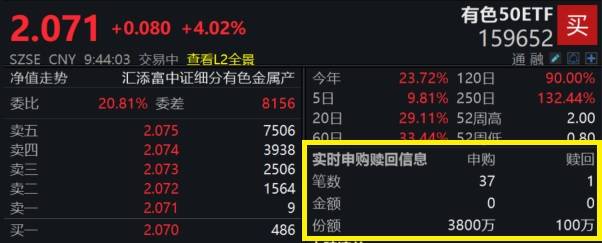
见证历史!金银铜集体飙涨,有色史诗级行情爆发!紫金矿业涨超4%,有色50ETF(159652)涨超4%,开盘10分钟吸金超7000万!
Sou Hu Cai Jing· 2026-01-26 02:07
Core Viewpoint - The non-ferrous metal sector has experienced a significant surge, with the Non-Ferrous 50 ETF (159652) rising over 4% and attracting substantial capital inflow, indicating strong investor interest in this sector [1][3]. Market Performance - On January 26, the Non-Ferrous 50 ETF (159652) saw a capital inflow exceeding 70 million CNY within the first 10 minutes of trading, following a total inflow of over 160 million CNY in the previous two days [1]. - Precious metals also saw a collective surge, with spot gold prices surpassing 5000 USD/ounce for the first time, and silver and platinum prices increasing by over 3% and reaching 2800 USD/ounce, respectively [1][3]. Supply Chain Dynamics - A strike at Capstone Copper's Mantoverde copper mine in Chile, involving 645 workers, has contributed to supply concerns, as negotiations have stalled [1]. - The global mining capital expenditure has been historically low, with a 3.3% decline in exploration investments for solid minerals in 2024, indicating potential supply constraints in the future [9]. Economic and Macro Factors - Analysts suggest that central banks' strategic asset allocation is a core support for the current rise in gold prices, with expectations of monthly purchases of 60 tons of gold by central banks [3]. - The weak dollar environment, driven by the Federal Reserve's monetary policy, is expected to boost the prices of dollar-denominated commodities, including non-ferrous metals [7]. Investment Opportunities - The Non-Ferrous 50 ETF (159652) is highlighted for its high copper (34%) and gold (12%) content, making it a leading option for investors looking to capitalize on the non-ferrous metal supercycle [13]. - The ETF's index has shown a cumulative return of 99.61% since 2020, driven by earnings rather than valuation increases, indicating a strong performance outlook [16].

有色金属:关注供给扰动带来的板块机会
GUOTAI HAITONG SECURITIES· 2026-01-26 01:46
Investment Rating - The report assigns an "Overweight" rating for the industry [5] Core Insights - The report emphasizes the importance of macroeconomic factors such as monetary policy, macro expectations, geopolitical dynamics, and supply disruptions in influencing metal prices [2] - Precious metals are expected to continue their upward trend due to geopolitical events in North America, concerns over the US dollar and treasury bonds, and increased central bank gold purchases [6] - Copper prices are anticipated to remain strong due to supply disruptions in Chile and expectations of a potential interest rate cut by the Federal Reserve [6] - Aluminum prices are expected to maintain a strong performance supported by macroeconomic factors and increased production capacity [6] - Energy metals show strong demand with continuous inventory depletion, particularly lithium, despite seasonal production declines [6] Summary by Sections Supply Disruptions and Opportunities - Gold prices have risen significantly, with SHFE gold increasing by 8.00% to 1,115.64 CNY per gram and COMEX gold by 8.44% to 4,983.10 USD per ounce [9] - Silver prices have also surged, with SHFE silver up 10.62% to 24,965 CNY per kilogram and COMEX silver up 16.63% to 103.26 USD per ounce [10] Industry and Stock Performance - The SW non-ferrous metals index increased by 6.03% last week, outperforming major indices [16] - The report highlights that industrial metal prices have shown mixed performance, with copper and aluminum prices increasing while lead and zinc prices have decreased [25] Metal Prices and Inventory - Copper prices rose to 101,340 CNY per ton on SHFE, reflecting a 0.57% increase, while LME copper increased by 2.44% to 13,115 USD per ton [12] - Aluminum prices on SHFE increased by 1.53% to 24,290 CNY per ton, supported by improved production and demand [11] Macro Data Tracking - The report tracks macroeconomic indicators, including CPI and PPI, which are crucial for understanding the broader economic environment affecting metal prices [29][44] Precious Metals - The report notes that low inventory levels and expectations of liquidity easing are driving precious metal prices higher [50] - Central bank gold purchases and ETF holdings are expected to support gold prices in 2026 [6] Copper Market - Supply disruptions in Chile, including strikes at major copper mines, are expected to support copper prices [12] - The report anticipates that copper prices may experience fluctuations based on macroeconomic developments, particularly related to interest rates [65] Energy Metals - Lithium inventory continues to decline, indicating strong demand, while the market is cautious about production disruptions from key mines [13] - The cobalt sector is facing high prices due to tight raw material supply, with companies extending their operations into downstream sectors [13]
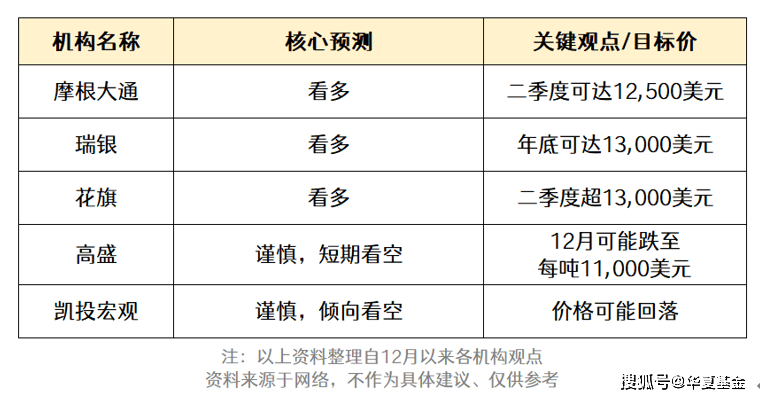
机构观点“多空对决”,会影响有色金属后续的投资逻辑吗?
Sou Hu Cai Jing· 2026-01-26 01:00
Core Viewpoint - The recent divergence in views among international investment banks regarding copper prices indicates a potential volatility in the non-ferrous metal sector, with some institutions optimistic while others express caution [1][2]. Group 1: Institutional Predictions - Morgan Stanley predicts a bullish outlook for copper, forecasting a price of $12,500 per ton by Q2 [2] - UBS shares a similar optimistic view, projecting a year-end price of $13,000 [2] - Citigroup also maintains a positive stance, expecting prices to exceed $13,000 in Q2 [2] - Conversely, Goldman Sachs advises caution, suggesting a potential drop to $11,000 per ton in December [2] - Capital Economics leans towards a bearish outlook, indicating a possible price decline [2] Group 2: Price Trends and Market Dynamics - Copper prices surged from $11,000 in early December to over $13,300, surpassing some optimistic forecasts [3] - Goldman Sachs warns that the current high prices have attracted speculative investments, which may suppress short-term actual consumption [5] - The speculative enthusiasm for copper is linked to concerns over potential tariffs following the U.S. Section 232 investigation, which led to significant imports of refined copper [6] Group 3: Long-term Demand Drivers - The fundamental narrative supporting copper prices revolves around its role as a "green metal" and "AI metal," driven by global infrastructure upgrades, electric vehicle adoption, and AI data center construction [7] - The ongoing demand for copper is expected to remain strong, as long as the underlying growth story persists [7] - The non-ferrous metal ETF funds track A-share listed companies rather than futures prices, meaning the performance of mining and refining companies will directly benefit from rising copper prices [7][8] Group 4: Investment Considerations - The non-ferrous metal ETF fund tracks a diversified index, with copper comprising 33% of the index, followed by aluminum and gold, indicating a balanced exposure to various metals [8] - Given the current global economic landscape and rising risk aversion, the non-ferrous metal ETF fund is expected to maintain a strong investment rationale throughout the year [8]
能源金属行业周报:碳酸锂价格短期或继续上行,看好价格重估背景下的关键金属全面行情
HUAXI Securities· 2026-01-26 00:45
Investment Rating - The industry rating is "Recommended" [3] Core Views - Short-term raw material supply tightness is expected to support nickel prices, with LME nickel spot price reaching $18,630 per ton, up 5.70% from January 16 [1] - The cobalt market is anticipated to see continued price increases due to structural supply tightness, with electrolytic cobalt priced at 438,000 yuan per ton, down 3.74% from January 16 [2][5] - Domestic antimony supply remains tight, supporting antimony prices, with average prices for antimony ingots at 160,500 yuan per ton [6] - Lithium carbonate prices are expected to continue rising, with a market average of 171,100 yuan per ton, up 8.36% from January 16 [8][19] - Supply uncertainties in the rare earth market are expected to support prices, with significant legislative changes in Vietnam impacting global supply [20] - Tin prices are supported by uncertainties in overseas supply, with LME tin prices at $54,200 per ton, up 9.66% from January 16 [11][21] - Tungsten market supply-demand imbalance is notable, with white tungsten concentrate prices at 535,500 yuan per ton, up 5.93% from January 16 [13][22] - Uranium supply tightness is expected to persist, with global uranium prices at $63.51 per pound, significantly higher than historical lows [14][15] Summary by Sections Nickel and Cobalt Industry - Nickel prices are supported by supply constraints, with Indonesia's nickel mining production quota expected to be reduced to 250-260 million tons [1][16] - Cobalt supply is projected to remain tight, with Congo's export quotas confirmed to extend into 2026 [2][17] Antimony Industry - Antimony prices are supported by long-term supply tightness, with domestic production facing seasonal disruptions [6][18] Lithium Industry - Lithium carbonate prices are expected to remain strong due to demand support and ongoing supply constraints, with significant price increases noted [8][19] Rare Earth Industry - Legislative changes in Vietnam are tightening global rare earth supply, with China maintaining a dominant position in the market [20] Tin Industry - Tin prices are supported by uncertainties in overseas supply, particularly from Myanmar and Congo [11][21] Tungsten Industry - The tungsten market is experiencing a supply-demand imbalance, with prices expected to rise further due to limited new supply [13][22] Uranium Industry - Uranium prices are supported by ongoing supply tightness and geopolitical factors affecting production [14][15]