
工业有色ETF万家

Search documents
权益ETF周度跟踪:工业有色和稀土获逆势布局-20260308
HUAXI Securities· 2026-03-08 07:52
Report Industry Investment Rating No information provided in the given content. Core Viewpoints of the Report - Combining the "Gain/Loss - Crowding" quadrant chart and ETF fund flow, there are gaming opportunities in the industrial non - ferrous metals and rare earth sectors [1]. - The oil and gas and power grid equipment sectors led the gains from March 2 - 6, becoming the market's main lines, while the gaming and media sectors had significant declines [1]. - Industrial non - ferrous metals and rare earths received reverse capital increases, presenting potential opportunities, while the power grid equipment may be volatile in the short term, and the oil and gas sector's future is highly uncertain [1]. Summary by Directory 1. Market Review: Oil and Gas and Power Grid Equipment Led the Gains - **Overall Market Trend**: From March 2 - 6, the market declined and then stabilized. As of March 6, 2026, the closing price of the Wind All - A Index was 6783.03, a 2.30% drop from February 27 [6]. - **Performance of Major Indexes**: Large - cap stocks outperformed. The Shanghai Composite Index and CSI 300 Index fell 0.93% and 1.07% respectively, while the STAR 50 Index and CSI 1000 Index had larger declines of 4.95% and 3.64% [7]. - **ETF Fund Flow**: Stock - type ETFs had a net outflow of 7.349 billion yuan from March 2 - 6, a narrower outflow compared to February 24 - 26. Broad - based index ETFs had a net outflow of 42.875 billion yuan, while theme index ETFs had a net inflow of 23.533 billion yuan, and industry index ETFs had a net inflow of 13.731 billion yuan [10][11]. - **Market Focus**: The market focused on the oil and gas and power grid equipment sectors. The oil and gas index rose 9.50% with a crowding degree of 3.7%, reaching a new high since 2020. The power grid equipment index rose 5.49%, and its crowding degree increased from the 98.7% percentile to the 99.7% percentile since 2020. The gaming and media sectors fell 7.44% and 7.04% respectively, and their crowding degrees decreased for the second consecutive week. The rare earth and industrial non - ferrous metals sectors fell 7.00% and 4.74% respectively, with a slight decrease in crowding degree [14][15]. 2. Future Focus: Rare Earths and Industrial Non - Ferrous Metals May Present Gaming Opportunities - **Fund Flow Analysis**: Industrial non - ferrous metals and rare earths received reverse capital increases. The Industrial Non - Ferrous Metals ETF Wanjia and Rare Earth ETF Jiashi fell 4.91% and 7.15% respectively, but had net inflows of 559 million yuan and 1.991 billion yuan [22]. - **Power Grid Equipment**: The power grid equipment ETF had a net inflow of 5.284 billion yuan from March 2 - 5, accounting for 17.49% of its fund size. However, its crowding degree reached 3.92%, at the 99.7% percentile since 2020, and there may be a risk of adjustment [23]. - **Oil and Gas**: The oil and gas ETF had a net inflow of 5.108 billion yuan from March 2 - 5. The sector's future depends on the development of the US - Iran situation [26]. - **Gaming and Media**: The media ETF and gaming ETF fell 7.29% and 6.99% respectively, with net outflows of 1.505 billion yuan and 538 million yuan. If the HALO trading trend remains unchanged, these two industries will continue to face pressure [26].
ETF收评 | 稀有金属板块领涨,稀有金属ETF、稀土ETF嘉实涨4%
Ge Long Hui· 2026-02-27 07:35
Market Overview - The Shanghai Composite Index rose by 0.39%, while the ChiNext Index fell by 1.04% [1] - The total trading volume in the Shanghai, Shenzhen, and Beijing markets was 25,055 billion yuan, a decrease of 512 billion yuan compared to the previous day [1] - Over 3,200 stocks across the three markets experienced gains [1] Sector Performance - Rare metal stocks saw a surge, with significant increases in magnesium and tungsten stocks [1] - The rare metal ETFs, including the Rare Metal ETF and Rare Earth ETF, reported gains of 4.68% and 4.11% respectively [1] - The power sector showed strength, with the Power ETF and Green Power ETF rising by 2.73% and 2.53% respectively [1] - The steel sector also performed well, with the Steel ETF increasing by 2.45% [1] Declining Sectors - The ChiNext Growth ETF and the Deep Growth ETF both fell by 2% [1] - The semiconductor sector experienced declines, with the Semiconductor Equipment ETF and the Sci-Tech Semiconductor ETF dropping by 2.16% and 2.15% respectively [1]
有色金属概念股走强,工业有色相关ETF涨超2%
Mei Ri Jing Ji Xin Wen· 2026-02-11 06:58
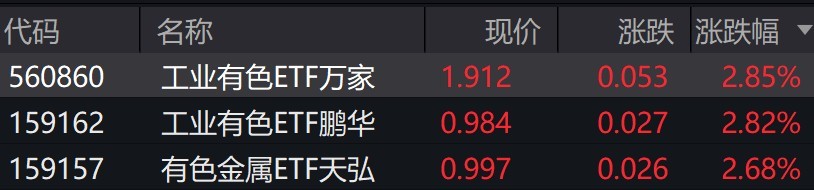
Group 1 - The core viewpoint of the news highlights a strong performance in the non-ferrous metal sector, with notable increases in stocks such as Northern Rare Earth rising over 5% and both Luoyang Molybdenum and Western Mining increasing by over 2% [1] - Industrial non-ferrous related ETFs also saw gains, with an overall increase of over 2% in the market [1] Group 2 - Specific ETF performance includes: - Industrial Non-Ferrous ETF Wanji at a price of 1.912, up by 0.053 or 2.85% - Industrial Non-Ferrous ETF Penghua at a price of 0.984, up by 0.027 or 2.82% - Non-Ferrous Metal ETF Tianhong at a price of 0.997, up by 0.026 or 2.68% [2] - Analysts indicate that despite short-term market fluctuations, the long-term outlook for cyclical resource sectors like industrial non-ferrous remains promising, driven by industrial structural optimization and sustained demand growth [2] - Based on performance trend models, the current valuation of the industrial non-ferrous sector is deemed reasonable, with potential for a rebound, suggesting investors focus on its potential performance within the industry chain to capitalize on investment opportunities from recent declines [2]




工业金属基本面韧性凸显,工业有色ETF万家(560860)强势反弹,午后上涨4.15%
Xin Lang Cai Jing· 2026-02-03 06:13
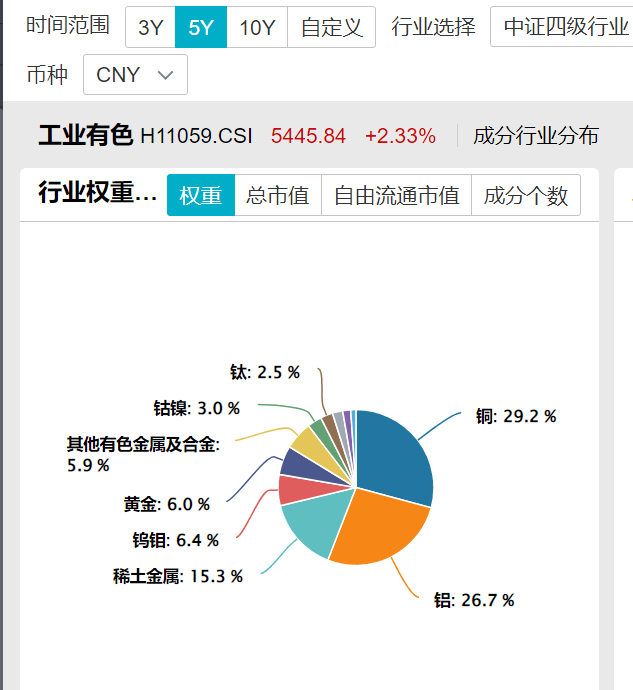
Group 1 - The industrial metal sector is experiencing a strong performance, with the industrial non-ferrous ETF Wan Jia (560860) rising by 4.15% and the CSI Industrial Non-Ferrous Metal Theme Index (H11059) component stocks showing significant gains, including Dongyang Sunshine up by 8.65% and Shenghe Resources up by 6.86% [1] - Recent industrial metal prices have shown a trend of rising and then retreating, but the fundamental support remains intact. Dongwu Securities noted a 5.74% increase in the industrial metal sector last week, despite a pullback in copper and aluminum prices due to unexpected U.S. inflation data and market sentiment shifts [1] - Supply-side pressures continue, with imported copper concentrate treatment charges (TC) dropping to -49.5 USD/ton, and Southern Copper Corporation forecasting a decline in copper production to 911,400 tons in 2026 [1] Group 2 - The CSI Industrial Non-Ferrous Metal Theme Index (H11059) top ten weighted stocks include Luoyang Molybdenum, Northern Rare Earth, and China Aluminum, accounting for a total of 55.71% of the index [2] - The industrial non-ferrous ETF Wan Jia (560860) closely tracks the CSI Industrial Non-Ferrous Metal Theme Index, covering strategic resources such as copper, aluminum, and rare earths, with off-market investors able to access it through linked funds [2]
ETF主力榜 | 工业有色ETF万家(560860)主力资金净流入1.99亿元,居可比基金第一-20260202
Xin Lang Cai Jing· 2026-02-02 08:43
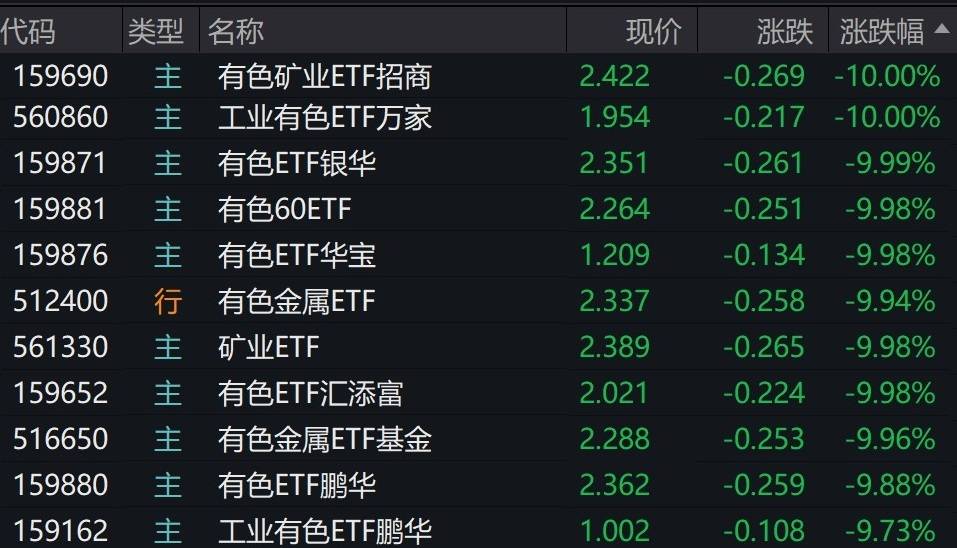
Group 1 - The core viewpoint of the article highlights that the Industrial Color ETF Wan Jia (560860.SH) experienced a significant decline of 9.98% on February 2, 2026, despite attracting a net inflow of 199 million yuan from major funds (transactions over 1 million yuan) [1] - Over the past five trading days, the fund has seen net inflows on four occasions, totaling 136 million yuan, which positions it as the leader among comparable funds [1] - The latest trading volume for the Industrial Color ETF Wan Jia reached 852 million shares, with a total transaction amount of 1.536 billion yuan, also ranking first among comparable funds [1]
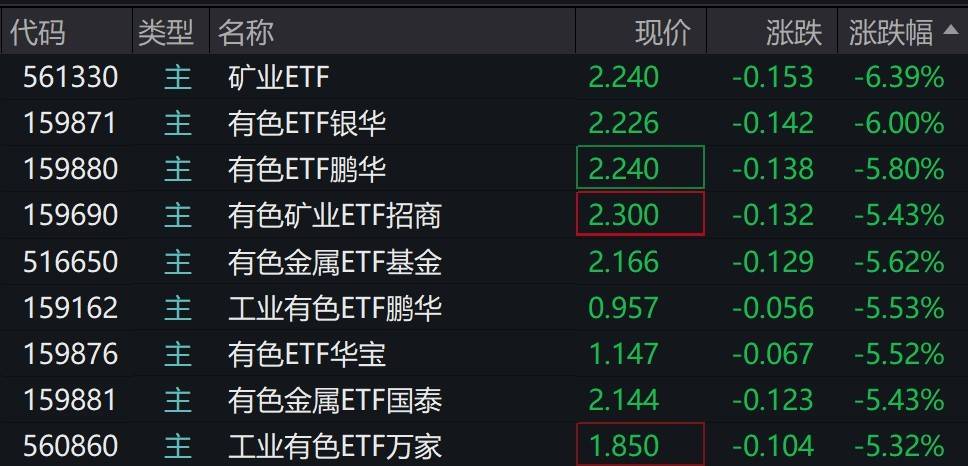
有色金属概念股走弱,矿业、有色相关ETF跌超5%
Sou Hu Cai Jing· 2026-02-02 02:08
Group 1 - The core viewpoint of the news highlights a significant decline in the performance of non-ferrous metal stocks, with companies like Shandong Gold and Zhongjin Gold hitting the daily limit down, and Northern Rare Earth dropping over 5% [1] - Mining and non-ferrous related ETFs have also seen a decline of over 5% due to market influences [1] Group 2 - Recent reports indicate that not only precious metals like gold and silver have risen significantly, but industrial metals such as copper and aluminum, as well as energy metals like cobalt and lithium, have also shown good growth, with multiple metals reaching historical or phase highs [2] - The super cycle of non-ferrous metals is attributed to three main factors: the weakening trend of the dollar due to the Federal Reserve's interest rate cuts, supply-demand gaps caused by declining ore grades and rising marginal costs in major mines, and domestic policies aimed at optimizing excess capacity [2]




ETF收评 | AI硬件走强,通信ETF、通信ETF广发涨3%
Ge Long Hui· 2026-01-30 07:14
Market Performance - The Shanghai Composite Index fell by 0.96%, while the ChiNext Index rose by 1.38% [1] - There was a significant decline in gold and base metal stocks, with several hitting the daily limit down [1] - Sectors such as liquor, real estate, brokerage, and oil & gas experienced notable declines [1] Sector Highlights - Commercial aerospace, fintech, photovoltaic, and AI application sectors underwent adjustments [1] - CPO and Yushu robotics concept stocks were active, while agricultural stocks strengthened [1] ETF Movements - The A500 ETF saw a notable increase of 5.6% [1] - AI hardware showed strength, with CPO concept stocks rising during the session [1] - The Guotai Fund's communication ETF and Guangfa communication ETF both increased by 3% [1] - The chip design sector was active, with the Guolianan Fund's Sci-Tech chip design ETF rising by 2.3% [1] Commodity and Metal Sector - The metal sector experienced a deep correction, with gold stock ETFs and related stocks hitting the daily limit down [1] - The non-ferrous metal sector also saw a decline, with the industrial non-ferrous ETF from Wanji hitting the daily limit down [1]
有色金属概念股走低,多只有色相关ETF跌停
Sou Hu Cai Jing· 2026-01-30 02:36
Group 1 - The core viewpoint of the news is that non-ferrous metal stocks have declined significantly, with companies like Luoyang Molybdenum, Huayou Cobalt, China Aluminum, Shandong Gold, Yun Aluminum, and Zhongjin Gold hitting their daily limit down [1] - Affected by the market trend, many non-ferrous related ETFs also experienced limit down [1] Group 2 - Recent reports indicate that not only precious metals like gold and silver have seen significant increases, but industrial metals such as copper and aluminum, as well as energy metals like cobalt and lithium, have also performed well, with multiple metals reaching historical or phase highs [2] - The reasons for the super cycle in non-ferrous metals are primarily threefold: first, the Federal Reserve's interest rate cut cycle has led to a weakening dollar, which supports the rise in non-ferrous metal prices denominated in dollars; second, there is a supply-demand gap, with industrial metals like copper facing supply pressures due to declining ore grades, rising marginal costs, and previous reductions in mining capital expenditures, while demand is driven by AI, new energy, and infrastructure construction; third, domestic "anti-involution" policies are optimizing excess capacity, which helps promote supply-demand balance [2]
全球金属价格齐升!铜铝同日创新高,工业有色ETF万家(560860)月内大涨36%,最新规模突破160亿元!
Sou Hu Cai Jing· 2026-01-29 10:23
Core Viewpoint - The global metal market has experienced a strong surge, with the Industrial Nonferrous ETF Wan Jia (560860) reaching a new high, driven by significant increases in various metal stocks and a notable rise in ETF performance since the beginning of the year [1][3]. Group 1: ETF Performance - The Industrial Nonferrous ETF Wan Jia (560860) has risen by 36.63% year-to-date, reflecting strong investor interest and market dynamics [1]. - The ETF has attracted nearly 700 million in capital over the past five days and over 4.6 billion in the last 20 days, indicating robust inflows and a rapid expansion of fund shares, which increased by 41% within the month [3]. - As of January 29, the ETF's trading volume reached 2.087 billion, with a turnover rate of 12.48%, showcasing strong liquidity and active trading [3]. Group 2: Valuation and Market Trends - The ETF's valuation is at a historical low, with a latest price-to-earnings ratio (PE-TTM) of 20.53, indicating that it is undervalued compared to its historical performance [4]. - On January 29, LME copper prices broke the 14,000 USD mark, reaching a peak of 14,125 USD/ton, while LME aluminum prices surpassed 3,300 USD/ton, marking a three-year high [4]. Group 3: Future Demand Outlook - The demand for industrial metals is expected to structurally explode, driven by factors such as AI data centers, significant investments in the national grid, and increased penetration of electric vehicles, particularly for copper [5]. - Aluminum demand is being supported by trends in solar energy, energy storage, and the substitution of aluminum for copper, with low social inventory levels in China [5]. - Tin supply is constrained due to low global reserve-to-production ratios and ongoing geopolitical tensions affecting production, particularly in Myanmar and the Democratic Republic of Congo, leading to significant supply uncertainties [5].
股票ETF成交活跃 行业主题产品“吸金”显著
2 1 Shi Ji Jing Ji Bao Dao· 2026-01-27 13:18
Core Viewpoint - The A-share market is experiencing a cooling trend, leading to a significant shift in ETF investments from broad-based ETFs to sector-specific ETFs, with substantial net outflows from major broad-based ETFs and inflows into thematic ETFs [1][2][3] Summary by Sections ETF Market Dynamics - As of January 23, 2026, the total net outflow from the CSI 300 ETF and the CSI 1000 ETF reached 336.9 billion and 78 billion respectively since the beginning of the year, while thematic ETFs, particularly in resources and technology, attracted a total of 158.5 billion in net inflows [1][4] - The week of January 12-16 saw a net outflow of 141.6 billion from stock ETFs, which increased to 333.1 billion in the following week, marking a historically significant outflow [1][2] Performance of Broad-based vs. Thematic ETFs - From January 19-23, the CSI 300 ETF experienced a net outflow of 237.3 billion, while the CSI 1000 ETF and the SSE 50 ETF saw outflows of 71.7 billion and 36.1 billion respectively [2] - The net outflows for the CSI 300 ETF, CSI 1000 ETF, and SSE 50 ETF from January 5-23 were approximately 336.9 billion, 78 billion, and 56.2 billion respectively [2] Institutional Investor Behavior - Institutional investors hold a significant portion of ETFs, with over 1.5 trillion in ETF holdings reported as of the end of Q4 2025, primarily in the CSI 300 ETF [3] - Despite the outflows, the CSI 300 ETF remains a major holding for institutional investors, with an estimated 1 trillion still held in ETFs by these investors [3] Sector-specific ETF Inflows - Thematic ETFs, particularly in sectors like non-ferrous metals and chemicals, have seen strong inflows, with 50 ETFs collectively attracting 158.5 billion from January 5-23 [4][5] - Notably, three ETFs exceeded 10 billion in net inflows, including the Southern Non-ferrous Metals ETF (12.6 billion), Huaxia Power Grid Equipment ETF (11.9 billion), and Penghua Chemical ETF (10.3 billion) [5] Market Outlook - Analysts suggest that the shift in ETF investments indicates a structural rebalancing rather than a complete exit from the market, which may lead to deeper market trends and structural opportunities [7][8] - The current market dynamics suggest a transition from valuation recovery to a phase driven by fundamentals, with a focus on sectors with clear industry trends and performance support [8]