地平线

Search documents
周观点 | 海内外龙头共振 机器人催化可期【民生汽车 崔琰团队】
汽车琰究· 2025-09-07 14:51
Core Viewpoint - The automotive sector is experiencing growth driven by new policies and increasing demand for electric vehicles, with a focus on intelligent and globalized development of domestic brands [4][12][15]. Group 1: Weekly Data - In the week of August 25-31, 2025, passenger car sales reached 523,000 units, up 4.2% year-on-year and 9.5% month-on-month; new energy vehicle sales were 290,000 units, up 13.9% year-on-year and 8.1% month-on-month; new energy penetration rate was 55.3%, down 0.7 percentage points month-on-month [2][47]. - The automotive sector in A-shares rose by 1.0% from September 1 to September 5, outperforming the Shanghai and Shenzhen 300 index, which increased by 0.6% [3][30]. Group 2: Investment Recommendations - Recommended companies include Geely Automobile, Xiaopeng Motors, Li Auto, BYD, Xiaomi Group, Berteli, Top Group, Xinquan Co., Hu Guang Co., and Chuncheng Power [4][7][15]. - In the parts sector, focus on intelligent driving companies such as Berteli, Horizon Robotics, and Kobot; for new forces in the industry chain, recommend H-chain companies like Xingyu Co. and Hu Guang Co. [7][17]. Group 3: New Models and Orders - New model orders are performing well, with weekly sales for August showing a positive trend; Geely's merger with Zeekr received strong shareholder approval, marking a significant step in the "One Geely" strategy [6][13]. - The new Aion M7 model has started pre-orders, with over 150,000 orders in 24 hours, indicating strong market interest [6][13]. Group 4: Policy Impact - The continuation of the vehicle replacement policy is expected to stimulate demand; the new policy includes subsidies for scrapping older vehicles, which is anticipated to stabilize demand for 2025 [14][39]. - The expansion of the subsidy range to include vehicles meeting the National IV emission standards is expected to further boost the market [39][41]. Group 5: Motorcycle and Heavy Truck Market - The motorcycle market is expanding rapidly, with significant growth in large-displacement motorcycles; sales in July 2025 for motorcycles over 250cc reached 88,000 units, up 21.7% year-on-year [21][23]. - Heavy truck sales in July 2025 were 85,000 units, up 45.6% year-on-year, supported by policies encouraging the replacement of older vehicles [24][26].



汽车和汽车零部件行业周报20250907:海内外龙头共振,机器人催化可期-20250907
Minsheng Securities· 2025-09-07 13:28
Investment Rating - The report maintains a positive investment rating for the automotive and automotive parts industry, highlighting strong performance and growth potential in various segments [5]. Core Insights - The automotive sector is experiencing a robust recovery, with significant growth in passenger vehicle sales and a notable increase in new energy vehicle penetration [1][3]. - The report emphasizes the importance of intelligent and electric vehicles, predicting accelerated growth in these areas, particularly for quality domestic brands [12][13]. - The robotics sector is highlighted as a new catalyst for growth, with major players like Tesla advancing in humanoid robot production, which is expected to impact the automotive supply chain positively [2][15]. Summary by Sections Weekly Overview - The automotive sector outperformed the market, with the A-share automotive sector rising by 1.0% from September 1 to September 5, 2025, compared to a 0.6% increase in the CSI 300 index [1][25]. - Key companies recommended for investment include Geely, Xpeng, Li Auto, BYD, and Xiaomi, among others [10]. Weekly Data - In the fifth week of August 2025, passenger car sales reached 523,000 units, a year-on-year increase of 4.2% and a month-on-month increase of 9.5% [1][34]. - New energy vehicle sales for the same period were 290,000 units, with a penetration rate of 55.3% [1][34]. Key Developments - Geely's merger with Zeekr received shareholder approval, marking a significant step in its "One Geely" strategy [3][11]. - The introduction of new models, such as the Aion M7, is expected to drive sales further, with pre-orders exceeding 150,000 units within 24 hours [3][11]. Investment Recommendations - The report recommends focusing on quality domestic brands that are accelerating in intelligence and globalization, specifically naming Geely, Xpeng, Li Auto, BYD, and others [4][12]. - In the parts sector, companies involved in intelligent driving and new energy vehicle supply chains are highlighted, including Berteli, Horizon Robotics, and Top Group [4][13]. Robotics Sector Insights - The report notes the increasing pace of domestic humanoid robot manufacturers entering the market, with significant production goals set by Tesla for its Optimus robot [2][15]. - The potential for robotics to integrate with the automotive supply chain is emphasized, suggesting a strong overlap between automotive parts and robotics manufacturing [17]. Motorcycle and Heavy Truck Markets - The motorcycle market is seeing growth in the mid to high displacement segments, with sales of 250cc and above motorcycles increasing significantly [18][19]. - The heavy truck market is expected to benefit from expanded subsidy policies aimed at replacing older vehicles, with sales showing a year-on-year increase of 45.6% in July 2025 [20][21].
南昌博士造智驾芯片,8个月狂涨880亿
2 1 Shi Ji Jing Ji Bao Dao· 2025-09-07 08:39
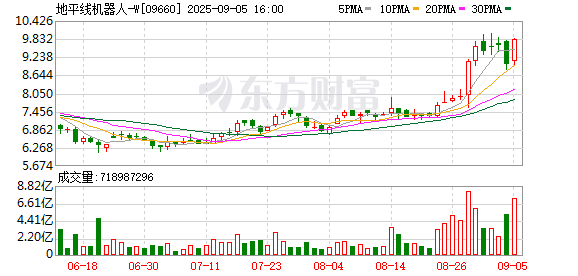
Core Viewpoint - Horizon Robotics, founded by Yu Kai, has seen a significant surge in stock price and market capitalization, reaching approximately HKD 136 billion, an increase of about HKD 88 billion since the beginning of the year [2]. Group 1: Company Performance - Horizon Robotics has capitalized on the growing demand for intelligent driving solutions, with its "Journey" chip family achieving cumulative shipments of over 10 million units [3]. - The company reported a revenue of CNY 1.57 billion for the first half of the year, marking a year-on-year increase of 67.6% [3]. - Despite the revenue growth, the company has not yet achieved profitability, with an operating loss of CNY 1.59 billion during the same period [8]. Group 2: Market Position and Partnerships - Horizon Robotics collaborates with nearly all major Chinese automakers, including Volkswagen, BYD, and Li Auto, with nearly 400 new vehicle models confirmed by the end of June [4]. - The company holds a market share of 45.8% for basic driving assistance solutions and 32.4% for overall solutions among Chinese automakers [12]. - The average selling price of Horizon's automotive products and solutions has increased to 1.7 times that of the same period last year [16]. Group 3: Future Prospects - The company is targeting the RoboTaxi market, with plans to collaborate with several operating companies in the second half of the year [18]. - Horizon Robotics aims to deploy millions of its HSD system in the next 3 to 5 years, enhancing its data testing capabilities for RoboTaxi technology [18]. - The penetration rate of advanced driving assistance systems among domestic brands is expected to rise from 51% at the end of 2024 to 59% in the first half of 2025 [6]. Group 4: R&D and Innovation - The company invested CNY 2.3 billion in R&D in the first half of the year, a 62% increase year-on-year [9]. - Horizon Robotics emphasizes high R&D investment to maintain its market position, with a focus on developing advanced chip generations [10].
突破1000万套!营收猛增67%!为什么是地平线?
混沌学园· 2025-09-06 11:58
Core Viewpoint - Horizon Robotics has demonstrated impressive growth with a 67.6% year-on-year revenue increase to 1.567 billion yuan in the first half of the year, alongside a remarkable gross margin of 65.4% [2][4] Financial Performance - The company has two main revenue sources: products and solutions, and software and licensing services, with both categories contributing nearly equally to total revenue [4] - Revenue from products and solutions surged 3.5 times year-on-year to 778 million yuan, with a shipment of 1.98 million units, where mid-to-high-end product solutions accounted for 49.5% of total shipments and contributed over 80% of revenue [4] - Software and licensing services generated 738 million yuan, reflecting a 6.9% year-on-year growth, serving over 30 automotive companies [5] Product Development - The Journey 6E chip has entered mass production, with initial models covering popular brands such as MG, Roewe, and Chery, and nearly 400 new models have been designated, over 100 of which feature mid-to-high-level assisted driving capabilities [6] - Despite expanding business scale leading to increased losses (operating loss of 1.592 billion yuan, net loss of 1.333 billion yuan), R&D investment reached 2.3 billion yuan, a 62% increase year-on-year, focusing on urban intelligent driving and cloud services [6] Strategic Methodologies - The company follows two fundamental strategic methodologies: competing in areas with no competition and avoiding risky ventures [9][10] - The first strategy emphasizes focusing on edge computing applications, such as robotics and smart vehicles, rather than competing directly with dominant players like NVIDIA [9] - The second strategy involves a strong emphasis on cash flow management, ensuring financial stability even during restructuring phases [10] Iterative Development - Horizon Robotics has undergone three iterations in its business strategy, evolving from a broad vision of becoming a leader in edge AI chips to a focused approach on automotive applications [15][17] - The first phase was marked by a lack of clear direction, leading to challenges in identifying practical applications for AI chips [16] - The second phase saw a pivot towards automotive chips, aligning with the industry's rapid growth and recognizing vehicles as the next generation of smart terminals [17] - The third phase shifted focus from basic functionality to emotional value, aiming to create products that resonate with consumers [19] Future Outlook - The company envisions a future where robots assist humans in various tasks, aiming to become a significant player in the robotics era, akin to Microsoft and Intel in their respective domains [21] - Horizon Robotics acknowledges the complexities of the commercial landscape and emphasizes the importance of understanding customer needs as a core principle of business design [23] - The journey over the past decade illustrates that successful companies can navigate through cycles by betting on unexplored territories while adhering to fundamental principles [24]

自动驾驶赛道动能足 头部企业收入整体向好
Shang Hai Zheng Quan Bao· 2025-09-05 20:19
Group 1 - The automotive industry is experiencing a rapid increase in the penetration rate of L2-level assisted driving and the scaling of L4-level autonomous driving, driven by the integration of new energy and intelligent technologies [1] - By mid-2025, the penetration rate of assisted driving in domestic brands rose from 51% at the end of 2024 to 59%, with mid-to-high-level assisted driving functions increasing from 20% to 32% [2] - Companies like Horizon Robotics and Hesai Technology reported significant revenue growth, with Horizon's revenue increasing by 67.6% to 1.567 billion yuan and Hesai's revenue exceeding 710 million yuan, up over 50% year-on-year [2] Group 2 - L4-level autonomous driving companies are advancing towards large-scale and normalized operations, with companies like Pony.ai and WeRide reporting revenue growth of 75.9% and 60.8% respectively [4] - The Robotaxi business is gaining traction, with platforms like Cao Cao Mobility and Ruqi Mobility operating over 300 Robotaxi vehicles and completing significant autonomous driving test mileage [4] - The economic model for autonomous driving is approaching profitability, with estimates suggesting that a fleet of 1,000 Robotaxi vehicles is needed to reach the breakeven point in first-tier cities [4][5]

自动驾驶秋招大批量开始了(蔚小理/博世/地平线等)
自动驾驶之心· 2025-09-05 16:03
Group 1 - The autumn recruitment for the autonomous driving industry has begun, with companies like Weilai, Xiaopeng, Bosch, Horizon, and Momenta announcing recruitment events [1] - An autonomous driving autumn recruitment mutual assistance group has been established for individuals to join and exchange information [1]

最近,自动驾驶的需求已经疯掉了......
自动驾驶之心· 2025-09-05 16:03
Core Viewpoint - The article emphasizes the establishment of a comprehensive community focused on autonomous driving technology, aiming to facilitate knowledge sharing, technical discussions, and career opportunities among members from academia and industry [5][13]. Group 1: Community Overview - The "Autonomous Driving Heart Knowledge Planet" community integrates video, text, learning paths, Q&A, and job exchange, currently boasting over 4,000 members, with a goal to reach nearly 10,000 in the next two years [5][8]. - The community has organized discussions around nearly 40 technical directions in autonomous driving, including multimodal large models, closed-loop simulation, and sensor fusion, catering to both beginners and advanced learners [3][8]. Group 2: Learning and Development - The community provides structured learning paths for various aspects of autonomous driving, including end-to-end learning, VLA (Vehicle Language Architecture), and data annotation practices, significantly reducing research time for members [5][11]. - Members can access a wealth of resources, including over 60 datasets related to autonomous driving, and numerous open-source projects to facilitate hands-on learning [29][30]. Group 3: Networking and Career Opportunities - The community has established job referral mechanisms with multiple autonomous driving companies, allowing members to connect with potential employers and receive guidance on job applications [9][59]. - Regular interactions with industry leaders are organized to discuss trends, technical directions, and production challenges in autonomous driving, enhancing members' understanding of the industry landscape [6][62]. Group 4: Technical Focus Areas - Key technical focus areas include end-to-end autonomous driving, multimodal large models, world models, and various sensor fusion techniques, with detailed discussions and resources available for each topic [31][36][38]. - The community also addresses practical applications and challenges in the field, such as the integration of 3DGS and closed-loop simulation, and the relevance of multi-sensor fusion in current job markets [6][21].
这批人,正纷纷拿到融资
3 6 Ke· 2025-09-05 00:00
Group 1 - The recent financing activities in the embodied intelligence robotics sector highlight the strong momentum of industry development and continued capital interest in this field [1][2] - Companies like Zhifang and Wujie Power are rapidly securing significant funding, indicating a trend where experienced professionals from the autonomous driving sector are transitioning into the embodied intelligence space [2][5] - The integration of technology and innovation in the embodied intelligence sector presents substantial opportunities, as the technical foundations of autonomous driving are closely related to the requirements of embodied intelligence robotics [2][7] Group 2 - Zhifang has completed multiple rounds of financing, with significant participation from various investors, including industry capital, to support the development of its robot models and global market expansion [3][4] - The company has already received over 500 orders for its robots, primarily from sectors such as automotive manufacturing, semiconductor, and biotechnology, indicating strong market demand [4] - The company aims to establish itself as a comprehensive intelligent robot service provider, focusing on both hardware manufacturing and advanced model development [4][6] Group 3 - A notable trend is the migration of talent from the autonomous driving industry to the embodied intelligence sector, with many high-profile executives starting new ventures [5][6] - The overlap in technology between autonomous driving and embodied intelligence, such as environmental perception and decision-making capabilities, facilitates this talent transition [7][9] - The shared technological foundation allows for the reuse of core components and algorithms, making the shift from autonomous driving to embodied intelligence a natural progression [7][9]
VLA和World Model世界模型,哪种自动驾驶路线会胜出?
自动驾驶之心· 2025-09-04 23:33
Core Viewpoint - The article discusses the advancements and differences between Vision-Language-Action (VLA) models and World Models in the context of autonomous driving, emphasizing that while VLA is currently dominant, World Models possess inherent advantages in understanding and predicting physical realities [3][4][30]. Group 1: VLA vs. World Models - VLA currently dominates the market, with over 95% of global models generating videos for autonomous driving training rather than direct application [3]. - World Models are considered to have a significant theoretical advantage as they enable end-to-end learning without relying on language, directly linking perception to action [3][4]. - Proponents of World Models argue that they can understand the physical world and infer causal relationships, unlike VLA, which primarily mimics learned patterns [4][6]. Group 2: Development and Architecture - The World Model framework consists of three main modules: Vision Model (V), Memory RNN (M), and Controller (C), which work together to learn visual representations and predict future states [11]. - The architecture of World Models has evolved, with notable developments like RSSM and JEPA, which focus on combining deterministic and stochastic elements to enhance performance [15][17]. - JEPA, introduced in 2023, emphasizes predicting abstract representations rather than pixel-level details, significantly reducing computational requirements [17][19]. Group 3: Advantages and Challenges - World Models have two main advantages: they require less computational power than VLA and can utilize unlabelled data from the internet for training [19]. - However, challenges remain, such as the need for diverse and high-quality data to accurately understand physical environments, and the limitations of current sensors in capturing all necessary information [19][20]. - Issues like representation collapse and error accumulation in long-term predictions pose significant hurdles for the effective deployment of World Models [21][22]. Group 4: Future Directions - The integration of VLA and World Models is seen as a promising direction, with frameworks like IRL-VLA combining the strengths of both approaches for enhanced performance in autonomous driving [22][28]. - The article suggests that while VLA is likely to prevail in the near term, the combination of VLA with World Model enhancements could lead to superior outcomes in the long run [30].

科博达拟3.45亿元收购科博达智能科技60%股权 切入智能驾驶核心赛道
Ju Chao Zi Xun· 2025-09-04 14:34
Group 1 - The company Kobot has announced a cash acquisition of 60% equity in Shanghai Kobot Intelligent Technology from Shanghai Keshih, with a transaction price of 345 million yuan [2] - Following the acquisition, Kobot Intelligent Technology will become a subsidiary of the listed company and will be included in the consolidated financial statements starting from September 30, 2025 [2] - The acquisition aligns with the Chinese government's policy to encourage listed companies to focus on their core business and improve development quality through mergers and acquisitions [2] Group 2 - Kobot Intelligent Technology, established in October 2022, specializes in the research and production of automotive intelligent central computing platforms and related domain controllers [2] - The company has established deep collaborations with leading software algorithm companies and semiconductor solution providers, aiming to develop intelligent driving solutions for major global automotive brands [2] - The projected sales revenue from its designated projects is expected to exceed 20 billion yuan, with two domestic mainstream automotive brands already achieving large-scale production of related products [2] Group 3 - The agreement includes a profit commitment from Shanghai Keshih, ensuring that Kobot Intelligent Technology achieves a cumulative net profit of no less than 630 million yuan from August to December 2025 and during the 2026-2030 period [3] - Despite the profit commitment, the company has been operating at a loss since its establishment, and its business is influenced by macroeconomic conditions, industry cycles, and technological development [3] - Kobot emphasizes that the acquisition will enable it to quickly enter the core product segment of automotive intelligence, enhancing its technological capabilities and market resources [3] Group 4 - The transaction is expected to enhance cooperation with leading semiconductor manufacturers, improve the high-end semiconductor supply chain, and promote the upgrade of manufacturing processes towards "efficient intelligent manufacturing" [3] - This strategic move is anticipated to elevate the company's core competitiveness and market position in the automotive electronics sector [3] - The acquisition is in line with the company's development strategy and is expected to open new business growth opportunities, enhancing profitability and sustainable development [3]