
润泽科技

Search documents
润泽科技股价涨5.01%,建信基金旗下1只基金重仓,持有7.79万股浮盈赚取18.62万元
Xin Lang Cai Jing· 2025-12-01 02:55
Group 1 - The core viewpoint of the news is that Runze Technology has seen a stock price increase of 5.01%, reaching 50.11 CNY per share, with a total market capitalization of 81.897 billion CNY [1] - Runze Technology, established on June 27, 2007, and listed on April 24, 2015, primarily operates in the data center service sector, with IDC business contributing 64.67% and AIDC business 35.33% to its revenue [1] Group 2 - According to fund holdings, one fund under Jianxin Fund has a significant position in Runze Technology, with Jianxin China Manufacturing 2025 Stock A (001825) reducing its holdings by 49,600 shares to 77,900 shares, representing 4.9% of the fund's net value [2] - Jianxin China Manufacturing 2025 Stock A has experienced a year-to-date loss of 14.43%, ranking 4205 out of 4206 in its category, and a one-year loss of 11.88%, ranking 4005 out of 4008 [2]

AI人工智能ETF(512930)涨近1%,AI大模型接连取得突破
Xin Lang Cai Jing· 2025-12-01 02:36
Core Insights - The AI sector is experiencing significant growth, with the Zhongzheng AI Theme Index (930713) rising by 0.79% and key stocks like Beijing Junzheng (300223) and Zhongke Xingtou (688568) showing notable increases in their share prices [1][2] - The rapid development of AI large models and applications is supported by continuous investment in computing infrastructure, emphasizing the importance of high-performance, low-latency networks [2] Group 1: Market Performance - The Zhongzheng AI Theme Index has seen a rise of 0.79%, with component stocks such as Beijing Junzheng increasing by 5.10% and Zhongke Xingtou by 4.63% [1] - The AI Artificial Intelligence ETF (512930) has also increased by 0.78%, currently priced at 2.07 yuan [1] Group 2: Technological Advancements - AI large models are achieving breakthroughs in both theoretical and practical applications, with Alibaba's "Qianwen" app surpassing 10 million downloads in just one week, marking it as the fastest-growing AI application globally [1] - The DeepSeekMath-V2 model has introduced a self-verification mechanism, achieving gold medal status in the International Mathematical Olympiad, showcasing China's innovation in foundational algorithms [1] Group 3: Industry Outlook - The report from CITIC Securities highlights that the growth of AI large models is closely tied to ongoing investments in computing infrastructure, with a focus on optical interconnection technology [2] - The top ten weighted stocks in the Zhongzheng AI Theme Index account for 63.92% of the index, indicating a concentration of investment in leading companies within the AI sector [2]

科创创业人工智能ETF华泰柏瑞(159139)发售中,机构:人工智能行业当前处于政策、技术、需求三维共振阶段
2 1 Shi Ji Jing Ji Bao Dao· 2025-12-01 02:13
Group 1 - The first batch of Sci-Tech Innovation and Entrepreneurship Artificial Intelligence ETFs has been launched for sale from November 28 to December 5, 2025 [2] - The Huatai-PB Sci-Tech Innovation and Entrepreneurship AI ETF (159139) tracks the CSI Sci-Tech Innovation and Entrepreneurship AI Index (932456), which was released on May 14 this year [2] - The index combines the strengths of the Sci-Tech Board and the growth potential of the Entrepreneurship Board, signaling regulatory support for strategic emerging industries [2] Group 2 - As of the end of November, the top ten weighted stocks in the Sci-Tech Innovation AI index include companies like Zhongji Xuchuang, Xinyi Sheng, and Hanwha Techwin, accounting for 72.27% of the index [2] - The index is primarily concentrated in the Information Technology (49.15%) and Communication Services (47.45%) sectors [2] - The State Council issued a strategic deployment in August to deeply integrate artificial intelligence with various industries [2] Group 3 - On November 26, six departments, including the Ministry of Industry and Information Technology, released a plan to enhance the adaptability of supply and demand in consumer goods, promoting AI applications across the consumer electronics sector [3] - The plan aims to establish three trillion-level consumer fields and ten hundred-billion-level consumption hotspots by 2027, with a focus on consumer electronics and smart wearable products [3] - Dongxing Securities believes that the AI industry is currently in a phase of policy, technology, and demand resonance, with strong upward potential in industry prosperity [3]



月度金股组合(2025年12月)-20251201
Zhongyuan Securities· 2025-11-30 23:30
Group 1 - The A-share market experienced a significant adjustment in November 2025, with high valuation growth stocks undergoing notable corrections while value and dividend stocks showed relative resilience [2][17] - Economic data for November indicated a weak recovery in investment and consumption, with exports declining due to high base effects and holiday impacts. However, CPI growth turned positive, and PPI declines narrowed, suggesting a mild recovery in prices [2][17] - The central bank's report emphasized maintaining relatively loose social financing conditions to support "steady growth," alongside various policies aimed at stimulating domestic demand and private investment [2][17] Group 2 - For December 2025, a balanced investment strategy is recommended, focusing on high-dividend defensive assets like banks and power companies due to cautious investor sentiment, while also gradually positioning in high-growth sectors like TMT and industrial machinery as valuations have returned to reasonable levels [3][18] - The recommended stocks for December 2025 include: 002850.SZ Keda Li, 300037.SZ Xinzhou Bang, 601058.SH Sailun Tire, 603755.SH Richen Co., 300442.SZ Runze Technology, 002046.SZ Guoji Precision, 002714.SZ Muyuan Foods, 688041.SH Haiguang Information, 688498.SH Yuanjie Technology, and 688313.SH Shijia Photon [4][22] Group 3 - The monthly gold stock portfolio for November 2025 yielded a return of -2.16%, outperforming the CSI 300 index by 0.21 percentage points and the ChiNext index by 1.82 percentage points [6][9] - The cumulative return of the monthly gold stock portfolio as of November 28, 2025, was 42.86%, surpassing the CSI 300 index by 27.73 percentage points, while slightly underperforming the ChiNext index by 0.01 percentage points [13]


越南拟推《人工智能法》 中企出海可在合规框架下聚焦三大优势领域
Xin Hua Cai Jing· 2025-11-30 07:55
Core Viewpoint - Vietnam's draft Artificial Intelligence Law aims to establish a balanced regulatory framework that emphasizes human-centric principles while managing risks and encouraging innovation. This will be Vietnam's first dedicated law for the AI sector, expected to take effect in March 2026 if approved [1][2]. Regulatory Framework - The draft law encompasses a broad regulatory scope, covering both domestic and foreign entities operating AI in Vietnam, as well as systems developed abroad that serve Vietnamese users, ensuring accountability for foreign tech suppliers [2]. - A four-tier risk classification system is proposed, categorizing AI systems into: - Prohibited: Systems that pose severe threats to national security, human dignity, and social order [2]. - High-risk: Systems in critical sectors like finance and healthcare, requiring government compliance assessment before market entry [2]. - Medium-risk: Systems that interact directly with users or generate content, necessitating clear AI attribute labeling [3]. - Low-risk: Systems with minimal socio-economic impact, subject to voluntary regulation and post-monitoring [4]. Incentive Policies - The draft law introduces several incentive measures to foster a healthy AI industry ecosystem: - Establishment of a national AI database for enterprise registration and monitoring, offering infrastructure support and tax incentives for participating companies [5]. - Encouragement of public-private partnerships in AI infrastructure, recognizing digital assets as legitimate contributions for financing [5]. - Planning for AI clusters in high-tech parks and universities, providing shared facilities and tax incentives [5]. - Introduction of a sandbox testing mechanism for SMEs and innovative startups to test new AI products in a controlled environment [5]. Market Opportunities for Chinese Companies - Chinese AI companies are encouraged to focus on three key areas in Vietnam: AI infrastructure, technology applications, and end products, while adhering to compliance requirements [6]. - In AI infrastructure, Vietnam is emerging as a hotspot for investments, with significant cost advantages compared to other ASEAN countries, making it attractive for data center development [7]. - In AI technology applications, there is a strong demand in sectors like smart cities and transportation, with several Chinese firms already establishing partnerships in Vietnam [8]. - In the end products sector, Chinese companies are deepening their presence, particularly in commercial smart devices and consumer electronics, with ongoing collaborations in Vietnam [9].
全球感知|越南拟推《人工智能法》 中企出海可在合规框架下聚焦三大优势领域
Xin Hua Cai Jing· 2025-11-30 06:50
Core Points - Vietnam's National Assembly is discussing the draft of the "Artificial Intelligence Law," which aims to establish a human-centered approach to AI activities, balancing risk management and innovation incentives. If approved, the law is expected to take effect in March 2026 [1][2]. Regulatory Framework - The draft law includes a comprehensive regulatory scope covering both domestic and foreign entities engaged in AI activities in Vietnam, as well as systems developed abroad that serve Vietnamese users, ensuring that foreign technology providers cannot evade regulatory responsibilities [2]. - A four-tier risk classification system is proposed, categorizing AI systems into four risk levels: - Prohibited: Systems that pose severe threats to national security, human dignity, and social order [2]. - High Risk: Systems in critical sectors like finance, healthcare, and education that require government compliance assessment before market entry [3]. - Medium Risk: Systems that interact directly with users or generate content, which must clearly indicate their AI nature and ensure user awareness [4]. - Low Risk: Systems with minimal socio-economic impact, subject to voluntary regulation and post-monitoring [5]. Incentive Policies - The draft law introduces several incentive policies to foster a healthy AI industry ecosystem: - Establishment of a national AI database for enterprise registration and monitoring, with priority support for companies that participate in data sharing [6]. - Encouragement of public-private partnerships in AI infrastructure, recognizing digital assets as legitimate contributions for financing [6]. - Planning for AI clusters in high-tech parks and research institutions, providing shared facilities and tax incentives [6]. - Introduction of a sandbox testing mechanism for SMEs and innovative startups to test new AI products in a controlled environment [6]. Market Opportunities for Chinese Companies - Chinese AI companies looking to enter the Vietnamese market should focus on three key areas: AI infrastructure, technology applications, and end products, while adhering to compliance requirements [7]. - Vietnam is emerging as a hotspot for AI data center investments, with significant cost advantages compared to other ASEAN countries, making it an attractive market for infrastructure development [7]. - There is a strong demand for AI technology applications in smart cities, smart tourism, and smart transportation, with several Chinese companies already establishing partnerships in these areas [8]. Challenges and Considerations - Companies must be aware of the increased compliance thresholds and operational costs associated with the new law, particularly for high-risk AI systems that require prior assessments [9]. - The requirement for foreign suppliers to designate a legal representative in Vietnam adds complexity to operations and resource integration [9]. - Despite rapid market growth, challenges remain in talent availability, data flow standards, and industry ecosystem maturity, necessitating long-term investment and localization efforts [9].

“科技+港股红利”两手抓!盘中获资金抄底的创业板人工智能ETF华夏(159381)翻红,港股央企红利ETF(513910)四季度以来净流入超10亿
Ge Long Hui· 2025-11-28 03:57
Group 1 - The artificial intelligence ETF from the ChiNext market, managed by Huaxia, rebounded by 0.79% after a previous decline, with a net subscription of 12 million units and an estimated net inflow of 19.968 million yuan [1] - The technology and Hong Kong dividend strategies are seeing increased investment as they decline, with the ChiNext AI ETF experiencing a cumulative pullback of over 12% from October 29 to November 24, yet attracting a net inflow of 349 million yuan during this period [1] - The Hong Kong central enterprise dividend ETF has also seen a cumulative pullback of 4% since November 13, with continuous buying over 11 trading days, resulting in a net inflow of 307 million yuan, and over 1 billion yuan net inflow since the fourth quarter [1] Group 2 - The ChiNext AI ETF has a significant exposure to the Google chain, with 48% of its component stocks linked to it, providing a stable response to fluctuations between the Nvidia and Google chains [1] - The Hong Kong dividend strategy funds are favored due to their lower valuation compared to A-share dividend indices and higher dividend yields, making them attractive to institutional investors looking to secure profits towards year-end [1] - The ChiNext AI ETF has over 50% CPO content and the lowest fee rate among AI indices, with key stocks including Xinyiseng, Zhongji Xuchuang, Tianfu Communication, and Runze Technology [2]
AI泡沫论升温,智能体为何迎来爆发元年?
Xin Lang Cai Jing· 2025-11-27 07:13
Core Viewpoint - The AI industry is experiencing a dual narrative in 2025, with a significant market correction in global tech stocks while the AI agent sector is witnessing explosive growth, particularly in China, where the market size is projected to increase from 4.75 billion yuan in 2024 to 7.84 billion yuan, representing over 60% growth [1][6]. Group 1: Evolution of AI Agents - AI agents are defined as software programs capable of autonomously understanding, planning, and executing complex tasks, fundamentally differing from traditional AI assistants [2]. - The emergence of AI agents is a result of technological advancements, transitioning from early models that were primarily for demonstration to sophisticated systems capable of logical reasoning and multi-modal understanding [3][4]. - The core value of this evolution is transforming intelligence from a cost into a productivity driver, as articulated by industry leaders [5]. Group 2: Major Investments and Market Dynamics - The growth of AI agents is fueled by strategic investments from global tech giants, which are based on clear commercial return expectations, creating a positive cycle of research, implementation, and profitability [6]. - Companies like Baidu and Tencent are leading the charge with innovative AI solutions, such as Baidu's self-evolving AI agent and Tencent's integration within its WeChat ecosystem [7]. - The commercial value of AI agents is evident across various sectors, including healthcare, retail, and finance, where they are significantly enhancing operational efficiency and reducing costs [8]. Group 3: Underlying Factors for Growth - The rapid growth of AI agents is attributed to the convergence of technological maturity, rising demand, and an improved ecosystem [9]. - Breakthroughs in technology have drastically reduced the cost of large model inference by 90% and increased speed by tenfold, addressing previous scalability issues [10]. - The pressing need for cost reduction and efficiency in businesses drives the adoption of AI agents, which offer non-intrusive solutions that integrate seamlessly with existing systems [11]. Group 4: Future Outlook - The future of AI agents is expected to shift from scaling to refinement, ushering in a new era of human-machine collaboration, with predictions indicating that 60% of enterprises will rely on AI agents for core operations by 2026 [12]. - Despite existing challenges such as communication delays and talent shortages, the evolution of AI agents is seen as a necessary phase in technological advancement, distinguishing them from past speculative bubbles [13].



“易中天”同日大涨,通信ETF、通信设备ETF、创业板人工智能ETF涨超5%
Ge Long Hui A P P· 2025-11-26 08:46
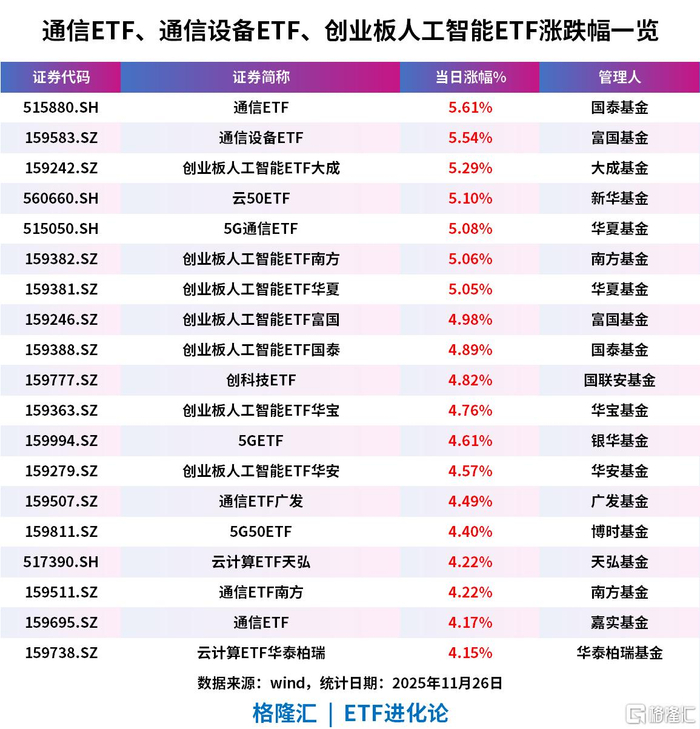
Market Overview - The A-share market showed mixed performance with the Shanghai Composite Index down 0.15% to 3864 points, while the Shenzhen Component Index rose 1.02% and the ChiNext Index increased by 2.14% [1] - Total market turnover was 1.8 trillion yuan, a decrease of 29 billion yuan from the previous trading day, with nearly 3600 stocks declining [1] Sector Performance - The CPO (Cloud, Platform, and Other) concept remained active, with notable stock performances including a 13.25% increase for Zhongji Xuchuang, reaching a historical high, and increases of 8.66% for Xinyi and 6.24% for Tianfu Communication [1] - Various ETFs related to communication and artificial intelligence saw significant gains, with several exceeding 5% increases, including the Communication ETF and multiple AI-focused ETFs [1][2] ETF Highlights - The Communication ETF tracked by the communication equipment index has a combined weight of over 81% in "optical modules, servers, copper connections, and optical fibers" [3] - The ChiNext AI ETF includes major stocks such as Xinyi and Zhongji Xuchuang, with over 50% CPO content [4] AI Industry Insights - Recent favorable catalysts in the global AI sector have led to increased capital expenditures from domestic and international AI giants, with expectations for sustained high growth in the AI market [4] - Alibaba reported a 34% year-on-year growth in cloud revenue and triple-digit growth in AI-related product revenue for nine consecutive quarters, with a capital expenditure of 31.5 billion yuan for the quarter [4] - The Singapore National AI Strategy is shifting towards Alibaba's open-source architecture, indicating a significant expansion of Chinese open-source AI models globally [5] Chip and Technology Developments - Domestic AI chip advancements are progressing well, with Alibaba's self-developed AI inference chips and other domestic chips expected to reduce reliance on overseas computing power [5] - The AI computing power industry is experiencing high demand across various segments, with a focus on the transition from 800G to 1.6T technology [5][6] - Despite potential changes in the computing chip landscape, A-share related component manufacturers are expected to benefit regardless of competition outcomes [6]
谷歌TPU、阿里AI+云引爆!5G通信ETF(515050)、创业板人工智能ETF华夏(159381)双双翻红涨3%
Ge Long Hui· 2025-11-26 02:40
Group 1 - The AI hardware sector experienced a rebound, with the ChiNext AI ETF and 5G communication ETF both recovering from a 1% decline to gain 3% [1] - Nvidia's stock initially dropped 7% but later emphasized that its chips offer "higher performance, versatility, and interchangeability" compared to Google's TPU and other ASIC chips, which are typically designed for single companies or functions [1] - Market attention is shifting towards the efficient architecture brought by Google's TPU supply chain, which includes TPU, OCS (Optical Switching), and CPO [1] Group 2 - Alibaba's revenue for the second fiscal quarter exceeded expectations, with strong growth in its AI and cloud as well as consumer businesses; management indicated plans for additional investments in AI beyond the previously committed 380 billion yuan over three years [1] - Guosheng Securities highlighted that the strong earnings reports from Google's Gemini 3 and Nvidia outline a core cycle in AI industry development: model upgrades drive demand for computing power, while growth in computing power supports model innovation [1] - The AI core computing layer, represented by the 5G communication ETF (515050), rose by 3.27%, covering 30% optical modules, 12% PCBs, 15% server leaders, and 12% high-speed copper connections, with key stocks including optical module leaders Xinyi and Zhongji Xuchuang [1] Group 3 - The ChiNext AI ETF Huaxia (159381) showed a gain of 3.54%, with over 50% of its weight in CPO-related stocks, including Xinyi and Zhongji Xuchuang (optical modules), Tianfu Communication (optical devices), and Runze Technology (IDC/cloud computing) [2]