
蔚来

Search documents
销量环比下滑超20%,单车成本激增7000元:2026车市开局承压
Xin Hua Cai Jing· 2026-02-04 01:16
Core Viewpoint - The automotive market in China experienced a significant month-on-month decline in January 2026, influenced by changes in tax policies and early consumer demand, while year-on-year sales remained relatively stable [1]. Group 1: Market Performance - In January 2026, the retail sales of narrow passenger vehicles in China were approximately 1.8 million units, representing a month-on-month decrease of 20.4% and a slight year-on-year increase of 0.3% [1]. - The retail sales of new energy vehicles (NEVs) in January were around 800,000 units, showing a year-on-year decline of 40.2%, but a month-on-month growth of 7.5% [1]. - Major traditional automakers like SAIC and Geely surpassed BYD in sales, with SAIC selling 327,000 units (up 23.9% year-on-year) and Geely selling 270,200 units (up 1.3% year-on-year) [2]. Group 2: New Energy Vehicle Segment - In the new energy vehicle sector, brands like Xiaomi, Hongmeng Zhixing, and NIO saw significant year-on-year growth, with Xiaomi's sales increasing by 95% to over 39,000 units [3][4]. - NIO delivered 27,200 units in January, marking a 96% year-on-year increase, driven by the new ES8 model [4]. - Conversely, companies like XPeng and Li Auto experienced declines, with XPeng's deliveries down 47% month-on-month and 34% year-on-year [4]. Group 3: Cost Pressures - The automotive industry is facing rising costs, with single-vehicle costs increasing by 4,000 to 7,000 yuan due to surging prices of key materials like lithium, aluminum, and DRAM [5][6]. - The price of battery-grade lithium carbonate rose from 75,700 yuan per ton at the beginning of 2025 to 146,600 yuan per ton by February 3, 2026, a nearly 94% increase [5]. - UBS reported that the cost increases in metals and chips could compress profit margins significantly, with potential reductions of 33% to 93% for vehicles priced at 150,000 yuan [6]. Group 4: Strategic Directions - To counteract rising costs and stagnant market demand, automakers are focusing on international expansion, with Chery exporting 119,600 units in January, accounting for nearly 60% of its total sales [7]. - BYD's overseas sales exceeded 100,000 units, a year-on-year increase of 43.3%, while Geely's exports grew by over 120% [7]. - Companies are also targeting the high-end market, with Great Wall Motors launching the WEY brand's flagship V9X, indicating a competitive push in the premium segment [9]. Group 5: Market Outlook - The automotive consumption index for January 2026 was reported at 31.1, reflecting a cautious consumer sentiment influenced by various factors, including the upcoming Spring Festival and changes in tax policies [10]. - Industry experts suggest that the market may not see a clear recovery until March or the end of the first quarter [10].




主导权交接之后:2025汽车产业的核心命题与答案
Xin Lang Cai Jing· 2026-02-04 01:13
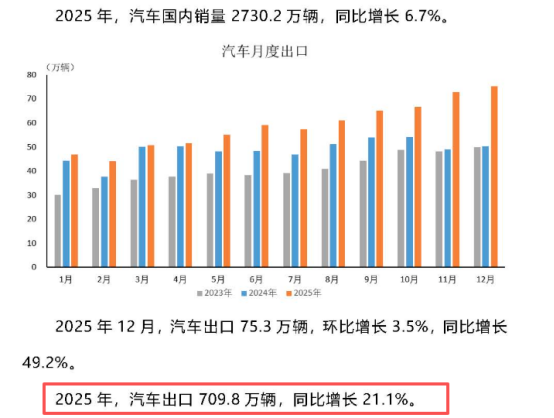
Group 1 - The core point of the article is that the Chinese automotive industry underwent significant transformation in 2025, marked by the integration of electrification and intelligence, leading to a restructured global competitive landscape [2][3][40] - The penetration rate of new energy vehicles (NEVs) in China surpassed 50% for the first time, indicating a shift from optional to mainstream status, driven by policy support, corporate efforts, and consumer acceptance [4][41] - The automotive export volume reached 7.098 million units in 2025, a year-on-year increase of 21.1%, reflecting a structural change in the export market towards higher-end models and a focus on established markets like Europe [7][44] Group 2 - The issuance of L3 autonomous driving licenses marked a transition from technical demonstrations to commercial availability, indicating that L3 technology is now accessible to consumers [10][49] - The establishment of the new Changan Automobile Group represents a significant milestone in the Chinese automotive industry's evolution, aimed at enhancing global competitiveness and driving high-quality development [12][52] - The trend of internal restructuring among automotive companies signifies a shift from expansion to efficiency, focusing on resource optimization and reducing redundancy in operations [14][55] Group 3 - The rapid growth of the six-seat SUV market in 2025, with monthly sales increasing from 25,000 to nearly 100,000 units, reflects changing family travel needs in China [22][68] - The decline of the range-extended electric vehicle (EREV) market, with a cumulative sales growth of only 10.2% compared to 34.2% for battery electric vehicles (BEVs), indicates a clear shift towards pure electric vehicles as the dominant technology [30][75] - The introduction of new battery safety standards emphasizes the importance of safety in the development of new energy vehicles, marking a maturation of the industry [21][65][66]

富特科技(301607):车载电源头部企业,HVDC技术同源潜力十足
Soochow Securities· 2026-02-04 01:08
Investment Rating - The report assigns a "Buy" rating for the company, with a target price of 70.4 CNY per share based on a 30x PE for 2026 [6][12]. Core Insights - The company is a leading third-party provider of on-board high-voltage power systems in China, benefiting from strong demand from major clients like Xiaomi and NIO, and is expected to maintain high growth rates in revenue and profit [12][46]. - The company has a robust product matrix in the new energy vehicle sector, focusing on high-performance and integrated power solutions, with significant growth potential in both domestic and overseas markets [12][31]. - The HVDC (High Voltage Direct Current) technology presents a substantial market opportunity, with the company leveraging its existing technology to enter this growing segment [12][46]. Summary by Sections 1. Company Overview - Established in 2011, the company has become a top player in the on-board power supply sector, achieving a market share of 8% in the domestic OBC industry by mid-2025 [12][46]. - The company has developed strong relationships with major automotive manufacturers, including Xiaomi, NIO, and Renault, which enhances customer loyalty and market presence [12][18]. 2. Financial Performance - The company reported revenues of 1,835 million CNY in 2023, with projections of 4,154 million CNY by 2025, reflecting a growth rate of 114.8% [6][12]. - Net profit is expected to reach 230.35 million CNY in 2025, representing a year-on-year increase of 143.49% [6][12]. 3. Market Dynamics - The demand for on-board power systems is driven by the rapid growth of the new energy vehicle market, with global sales projected to reach 2,070 million units in 2025 [46][49]. - The company is actively expanding its overseas market presence, with expectations of significant revenue growth from international clients [12][46]. 4. Research and Development - The company places a high emphasis on R&D, which has enabled it to maintain a competitive edge in technology and product offerings [12][31]. - Ongoing investments in R&D are aimed at developing next-generation products, including those utilizing GaN and SiC semiconductor technologies [12][31]. 5. Future Outlook - The company anticipates continued growth in both domestic and international markets, with a projected CAGR of 6.2% for the domestic market and 18.1% for the overseas market from 2025 to 2030 [12][49]. - The HVDC market is expected to reach 176.8 billion CNY by 2030, providing a significant growth avenue for the company [12][46].
富特科技:车载电源头部企业,HVDC技术同源潜力十足-20260204
Soochow Securities· 2026-02-04 00:24
Investment Rating - The report assigns a "Buy" rating for the company, with a target price of 70.4 CNY per share based on a 30x P/E ratio for 2026 [1]. Core Insights - The company is a leading player in the automotive power supply sector, benefiting from significant growth in demand from major clients such as Xiaomi and NIO, as well as expanding overseas projects [6][12]. - The company has a strong focus on R&D, which has allowed it to maintain a competitive edge in product offerings, particularly in the high-performance and high-integration segments of automotive power supplies [12][31]. - The HVDC (High Voltage Direct Current) technology presents a substantial market opportunity, with projections indicating a market size of 176.8 billion CNY by 2030, leveraging the company's existing technological advantages [12][31]. Summary by Sections 1. Company Overview - The company was established in 2011 and has become a leading third-party automotive power supply provider in China, achieving a market share of 8% in the OBC (On-Board Charger) sector by mid-2025 [12]. - The company has developed a diverse product matrix, including on-board chargers, DC/DC converters, and integrated power systems, catering to the growing demand in the new energy vehicle market [12][13]. 2. Financial Performance - The company reported revenues of 1.835 billion CNY in 2023, with projections of 4.154 billion CNY by 2025, reflecting a growth rate of 114.8% [1]. - The net profit attributable to shareholders is expected to reach 230.35 million CNY in 2025, representing a year-on-year increase of 143.49% [1]. 3. Market Dynamics - The automotive power supply market is experiencing rapid expansion, driven by increasing demand for new energy vehicles, with global sales projected to reach 20.7 million units in 2025 [46]. - The company is actively expanding its overseas market presence, with significant growth in international revenues, which accounted for over 17% of total revenue in the first half of 2025 [12][16]. 4. R&D and Technological Advancements - The company places a high emphasis on R&D, with plans to invest in new product development and production capacity, including a fundraising initiative to raise up to 528 million CNY for these purposes [28][30]. - The transition towards HVDC technology is expected to enhance the company's product offerings and market position, as it aligns with industry trends towards higher efficiency and reliability [12][31]. 5. Competitive Landscape - The domestic automotive power supply market is characterized by a clear competitive hierarchy, with the company positioned among the top players, including competitors like BYD and Weimars [39][41]. - The company has established deep partnerships with major automotive manufacturers, which enhances customer loyalty and market penetration [18][20].
“宝,马上”,车企马年“邪修”营销
汽车商业评论· 2026-02-03 23:09
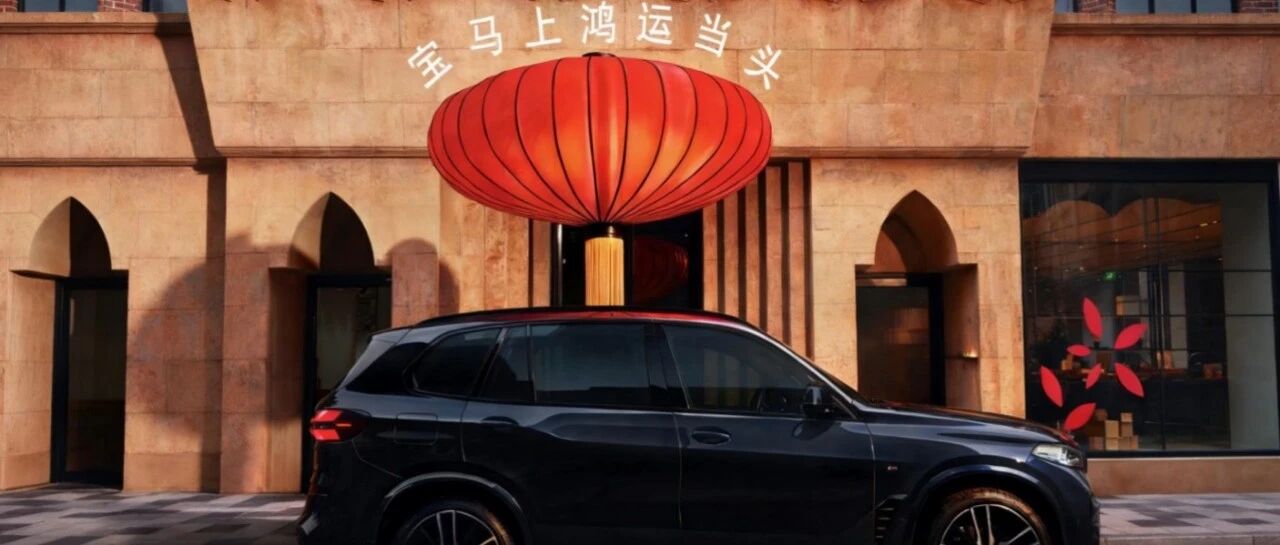
Core Viewpoint - The article discusses innovative marketing strategies adopted by automotive companies during the winter sales season in January 2026, highlighting how they engage consumers through unique experiences and cross-industry collaborations [3][4]. Group 1: Winter Marketing Strategies - January is a critical month for car companies, often referred to as the winter testing season, where numerous companies gather in regions like Inner Mongolia for vehicle testing [5]. - Traditional testing methods are becoming less effective in attracting attention, leading companies to create engaging winter experiences, such as Great Wall Motors' collaboration with Harbin Tourism Bureau for the "Harbin Ice and Snow Happy Week" [8][10]. - The "Long Spring First Ice Pot," a giant ice structure in Changchun, has become a popular destination, attracting over 1,000 vehicles for ice drifting experiences since its opening on January 10, 2026 [10][12]. Group 2: Cross-Industry Collaborations - Cross-industry marketing remains a popular strategy, with companies like Wangwang and Dong Mingzhu engaging in partnerships to attract consumer attention [15][20]. - Notable interactions include a humorous exchange between GAC Group's chairman and Gree Electric's chairman, which, despite being misinterpreted, enhanced the collaboration's visibility [22]. - BMW's playful marketing campaign during the New Year featured various humorous themes, effectively combining cultural elements with brand promotion [23][25]. Group 3: Community Engagement Initiatives - Xiaopeng Motors launched a "1000 Mobile Charging Stations" initiative, providing charging cables to 1,000 car owners, addressing the real needs of consumers during the Spring Festival [29][30]. - This initiative not only alleviates charging anxiety but also fosters a sense of community among car owners, enhancing brand warmth and consumer pride [33]. Group 4: Cultural and Brand Positioning - Volvo's innovative marketing approach involved a real-life simulation of a racing game, effectively engaging consumers by mimicking gaming experiences [34][37]. - GAC Aion capitalized on local cultural phenomena by creating a music video related to a trending song, thereby connecting emotionally with the audience [38][41]. - NIO's collaboration with the talk show "Thirteen Invitations" reflects a commitment to deeper values and long-term engagement rather than superficial marketing [42][45]. Group 5: Year-End Reflections and Celebrations - The automotive industry has seen a surge in year-end celebrations, with companies like Chasing and Mercedes-Benz using these events to enhance brand image and consumer engagement [49][51]. - The collective celebration of Mercedes-Benz's 140th anniversary showcased the industry's youthful spirit and creativity, with various brands participating in playful marketing campaigns [51].



【光大研究每日速递】20260204
光大证券研究· 2026-02-03 23:07
Group 1: Market Overview - The market sentiment is currently high, with over 60% of stocks in the CSI 300 index showing an upward trend, indicating a slight decrease in the proportion of rising stocks compared to the previous month [5] - Momentum indicators suggest a bullish outlook for the near future, with both fast and slow lines trending upwards [5] - The CSI 300 index is currently in a sentiment boom zone, reflecting positive market conditions [5] Group 2: Real Estate Sector - Multiple regions have initiated old housing buyback programs, accelerating the "old for new" strategy, which is expected to stabilize the real estate market [6] - Shanghai's Fengxian district has completed the first batch of registrations for 50 families under the "old for new" program, while Hangzhou's Fuyang district has also launched similar initiatives [6] - The government’s direct purchase of second-hand homes is aimed at promoting sales and reducing inventory, signaling a potential recovery in the housing market [6] Group 3: Automotive Sector - In January, the performance of new energy vehicles was weak, with various automakers increasing purchase incentives [8] - Li Auto's delivery volume decreased by 7.5% year-on-year and 37.5% month-on-month to 27,668 units; NIO's deliveries increased by 96.1% year-on-year but fell by 43.5% month-on-month to 27,182 units; Xpeng's deliveries dropped by 34.1% year-on-year and 46.6% month-on-month to 20,011 units [8] Group 4: Chemical Sector - Qicai Chemical and Huanliang Technology have established an AI laboratory to significantly shorten product development cycles, marking a shift from experience-driven to model-driven approaches in the chemical industry [7] - The implementation of AI in the chemical sector is becoming essential due to national policies and the need to reduce competition [7] Group 5: Company Performance - Zhongxin Fluorine Materials expects to turn a profit in 2025, projecting a net profit of 16-20 million yuan, and plans to raise 186 million yuan for expanding its BPEF projects [8] - Baihehua plans to invest up to 100 million yuan in a project to produce 1,000 tons of PEEK materials annually, capitalizing on the growing market for high-end applications [8] - Great Wall Motors reported a 10.2% increase in revenue to 222.79 billion yuan for 2025, but net profit fell by 21.7% to 9.91 billion yuan, indicating pressure on profitability [9]
白银涨8%,黄金涨6%;深圳一西贝门店被指违约停业!西贝最新回应;浙江警方通报:“网购娃娃菜中毒事件”夫妻涉敲诈勒索罪丨每经早参
Mei Ri Jing Ji Xin Wen· 2026-02-03 22:52
Group 1 - International precious metal prices have rebounded significantly, with spot gold rising over 7% at one point and currently up 6.44% at $4956.21 per ounce, while COMEX gold futures are up 6.68% at $4963.5 per ounce. Spot silver has increased by 8.03% to $85.46 per ounce, and COMEX silver futures are up 9.85% at $84.6 per ounce [2][4]. - The U.S. stock market saw all three major indices close lower, with the Dow Jones down 0.34%, Nasdaq down 1.43%, and S&P 500 down 0.83%. Notably, popular tech stocks experienced declines, with Broadcom dropping over 3% and Microsoft, Nvidia, and Meta each falling over 2% [4]. - The international oil prices have collectively risen, with WTI crude oil up 3.12% at $64.08 per barrel and Brent crude oil up 2.88% at $68.21 per barrel [4]. Group 2 - The Central Committee of the Communist Party of China and the State Council released the No. 1 Central Document for 2026, focusing on agricultural modernization and rural revitalization, emphasizing the need for technological innovation in agriculture and the promotion of breakthrough varieties [6]. - The Ministry of Industry and Information Technology of China is pushing for breakthroughs in future industries such as 6G, quantum technology, and bio-manufacturing, highlighting the importance of strategic planning and technological supply [8]. - The People's Bank of China announced it will conduct a buyout reverse repurchase operation of 800 billion yuan to maintain ample liquidity in the banking system, with a term of three months [9]. Group 3 - A couple in Zhejiang has been criminally charged for extortion related to a recent online incident involving contaminated vegetables, with the local police confirming the ongoing investigation [10]. - A significant number of reservations were made for the Lingyin Temple after it announced free entry, but 380,000 people failed to show up, prompting the temple to revise its reservation policies [11]. - Recent rumors regarding potential increases in VAT rates for the gaming and financial sectors have been dismissed by experts, who confirmed that no such changes are currently planned [12].

BYD, NIO, LI Auto, XPEV, Xiaomi: China's EV War Is Heating Up
Seeking Alpha· 2026-02-03 22:23
Group 1 - The electric vehicle (EV) industry is highly competitive but offers significant growth potential for companies with the right products [1] - Cash Flow Club focuses on businesses with strong cash generation, emphasizing the importance of timing in investment for maximizing rewards [1] Group 2 - The article highlights the performance of major EV companies in January, indicating a need for analysis of their market positions and product offerings [1]


特斯拉市场竞争力分析报告(2026版):特斯拉再购用户有望激活大纯电车市
腾易科技· 2026-02-03 13:47
Investment Rating - The report indicates a strong potential for Tesla's resale market in China, suggesting a favorable investment outlook for companies targeting Tesla's existing user base [3][54]. Core Insights - Tesla is expected to activate a significant resale demand from nearly 3 million users in China during the 14th Five-Year Plan, with 70% of these users showing an intention to switch brands [3][54]. - The report highlights that Tesla's current product lineup, primarily focused on the 200,000 to 350,000 yuan price range, may not adequately meet the diverse needs of its aging user base, leading to a loyalty rate of only about 30% [5][54]. - The emergence of new competitors, particularly Chinese high-end brands, is anticipated to reshape the competitive landscape in the high-end automotive market as they seek to capture Tesla's resale users [3][54]. Summary by Sections User Demographics and Behavior - Tesla's new buyers are predominantly younger, with an average age under 36, while resale users are mainly middle-aged, averaging over 40 years old [10][11]. - Resale users prioritize safety, space, comfort, and range, contrasting with new buyers who focus more on price [14][18]. Market Dynamics - The report notes that Tesla's resale users have a strong demand for family-oriented vehicles, particularly for self-driving trips, which may not be fully satisfied by Tesla's current offerings [18][20]. - Competitors like Wanjie, Ideal, and NIO are positioned to benefit significantly from Tesla's resale users due to their focus on larger, energy-efficient vehicles that cater to family needs [27][35]. Competitive Landscape - By 2025, nearly 50% of Tesla's potential outflow users are expected to gravitate towards Chinese high-end brands, with Wanjie leading the charge [27][54]. - The report emphasizes that traditional luxury brands (BBA) are struggling to attract Tesla's resale users, capturing only about 20% of this demographic, while new entrants are gaining traction [41][54]. Future Outlook - The report predicts that the 14th Five-Year Plan will be a critical period for capturing Tesla's resale users, with significant opportunities for brands that can adapt to the changing preferences of this demographic [54][62]. - It suggests that the introduction of larger electric vehicles by competitors could further challenge Tesla's market position, especially as Tesla remains committed to its current product strategy [48][54].

科博达:经过多年客户结构优化,公司已覆盖数十家全球知名整车厂商
Zheng Quan Ri Bao Wang· 2026-02-03 13:40
Core Viewpoint - The company has optimized its customer structure over the years, establishing partnerships with numerous global automotive manufacturers and transitioning from a "pure supplier" to a "strategic partner" model [1] Group 1: Customer Partnerships - The company has established relationships with major automotive groups including Volkswagen Group (and its subsidiaries Audi, Porsche, Bentley, and Lamborghini), FAW Group, SAIC Volkswagen, BMW, Mercedes-Benz, Ford, SAIC General Motors, PSA, Stellantis, Jaguar Land Rover, Renault, Nissan, Toyota, Li Auto, NIO, Xpeng, Geely, BYD, Cummins, and Weichai [1] - The company aims to deepen cooperation with top-tier clients globally, integrating into their supply chains to create a mutually beneficial ecosystem for automotive components [1] Group 2: Strategic Collaboration - The company is focused on upgrading its role from a simple supplier to a strategic partner, embedding itself within the global supply chain of its clients [1] - In response to global industrial division demands, the company seeks to secure a long-term competitive position by offering more competitive products, technologies, and services [1] Group 3: Technological Innovation - The company collaborates with leading global clients in cutting-edge areas such as intelligent driving, intelligent power distribution systems (Efuse), and domain controllers, engaging in joint research and innovation [1] - The goal is to promote the application of technological achievements in client operations, thereby building a mutually beneficial industrial ecosystem [1]
