
国光电气

Search documents
华创交运公用可控核聚变双周报(第5期):核聚变能科技与产业大会召开,可控核聚变产业化进展或加速推进-20260119
Huachuang Securities· 2026-01-19 12:44
Investment Rating - The report maintains a "Recommended" rating for the controllable nuclear fusion industry, indicating an expectation of significant growth in the sector over the next 3-6 months [3][49]. Core Insights - The 2026 Nuclear Fusion Energy Technology and Industry Conference held in Hefei is expected to accelerate the industrialization of nuclear fusion, with major procurement projects and collaborations being signed [1][8]. - Star Ring Fusion has completed a 1 billion RMB Series A financing round, which will expedite the commercialization of nuclear fusion technology, aiming to complete engineering validation by 2028 and establish a demonstration reactor by around 2032 [9][1]. - The report anticipates that the domestic nuclear fusion projects will see a total investment of approximately 146.5 billion RMB from 2025 to 2028, marking a significant increase in capital expenditure [8][1]. Summary by Sections Industry Overview - The report highlights the successful completion of the REBCO high-temperature superconducting tape by Eastern Superconductors, which plays a crucial role in the development of advanced superconducting models for nuclear fusion [2][11]. Investment Recommendations - The report continues to recommend companies such as Hezhong Intelligent and Lianchuang Optoelectronics, while suggesting attention to Guoguang Electric [3][23]. - In the magnet segment, companies like Western Superconductors, Yongding Co., and Jingda Co. are highlighted for their high value contribution [3][33]. - For internal structural components and others, the report recommends companies like Sihua Electronics, Yingliu Co., and Wanyi Technology, while suggesting to pay attention to Antai Technology and Jiuli Special Materials [3][34]. Market Trends - The report notes a significant increase in bidding activity, with a total of 1.28 billion RMB in new bids reported in the first half of January 2026, indicating a robust growth trajectory in the nuclear fusion sector [7][12]. - The market performance in early January 2026 shows notable gains for several companies, with New Wind Power leading at +42% [22][26]. Future Outlook - The report emphasizes that controllable nuclear fusion is now included in top-level planning as a future industry, with capital expenditures expected to rise significantly, leading to increased orders across the industry chain [1][8]. - The next 3-5 years are projected to be a peak period for nuclear fusion project tenders, with substantial investments anticipated [1][8].
四万亿投资来袭!募密集加仓,你的基金触“电”了吗?
Xin Lang Cai Jing· 2026-01-19 08:59
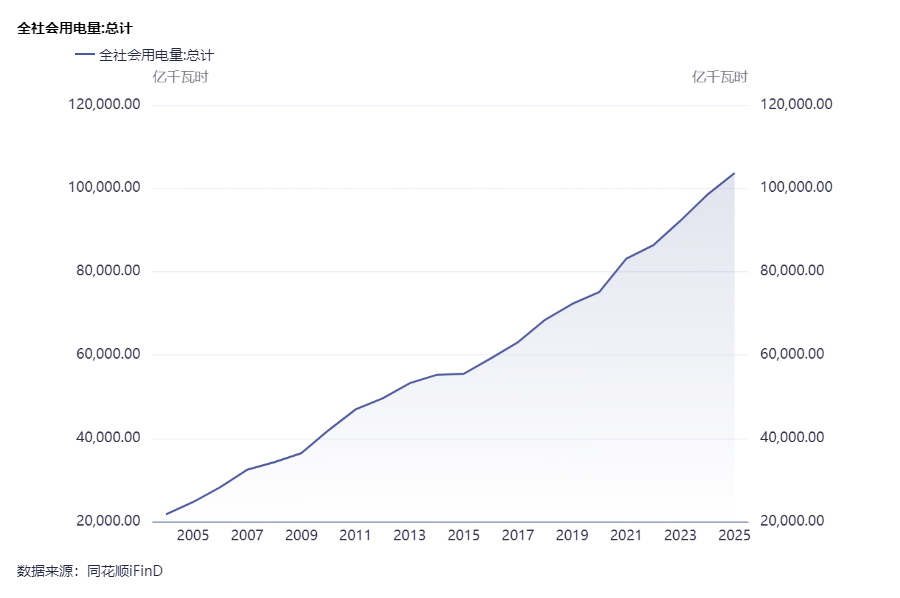
近期国家电网又有重磅消息披露:1月15日,国家电网宣布将在"十五五"期间投入4万亿元进行固定资产投资,这一数字较"十四五"期间增长40%。加上南方 电网的投资,全国年均电网投资或将突破1万亿元大关。 这笔史无前例的"4万亿大单"不仅像一颗投入资本市场的深水炸弹,激起了整个电力产业链的涟漪。更是把整条电网产业链按在聚光灯下:资本有了确定 性,订单有了确定性,估值模型直接切换至"能源基建2.0"赛道,电力系统重塑的阿尔法空间被一次性摊开在桌面上。 电力缺口的持续扩大或成为行业未来爆发点 从国内来看,全社会用电量正从"温和爬坡"切换为"陡峭拉升"。国家能源局最新月报显示,2025年1—11月全国累计用电8.94万亿千瓦时,同比+7.2%,增速 创2012年以来同期峰值;即便在高基数效应下,电网调度口径仍把2026—2028年复合增速锚定在6.3%—6.8%,远高于2016—2020年4.2%的平均值。 国内用电总量增速明显 数据来源:同花顺iFinD 数据区间:2005-2025 这其中AI对于电力的巨大需求成为主因,2025年底全国标准机架规模突破1200万架,对应用电量2600亿千瓦时;AI大模型训练负荷的利用 ...

华福证券:Meta签超6GW核电协议 小堆成AI能源重要支撑
Zhi Tong Cai Jing· 2026-01-19 04:00
Core Insights - Meta has signed a nuclear power agreement exceeding 6 gigawatts, becoming the largest nuclear power purchaser among tech giants, aimed at providing stable and clean energy for its AI data centers to address the surge in electricity demand [1][2] Group 1: Agreement Details - The agreement includes support for multiple companies' small modular reactor (SMR) projects, with a focus on providing power for AI data centers [1] - Meta's collaboration includes a 1.2-gigawatt supply from Oklo's small reactor project in Ohio and a 2.1-gigawatt purchase agreement for future projects from TerraPower [1] - Meta has also reached a separate agreement with Constellation Energy for power supply from an existing nuclear power plant [1] Group 2: Energy Demand and Solutions - The electricity demand for U.S. data centers is projected to increase by at least 30% by 2030, making energy supply a bottleneck for the AI industry [2] - SMR projects are seen as a key solution to provide long-term energy security for Meta's AI data centers, supporting low-carbon goals and surpassing competitors like Amazon and Alphabet in scale [2] Group 3: Industry Trends and Innovations - The technology sector is increasingly focusing on SMR and fusion companies to create tailored energy solutions for data centers, with fission technology expected to be commercialized before fusion [3] - Companies like Jingye Intelligent are advancing their SMR technology development, with a core R&D team already established [3] Group 4: Investment Opportunities - Companies to watch include Jingye Intelligent, which plans to establish an SMR subsidiary focused on AI data center power supply; and Jiadian Co., which leads in nuclear pump products [4] - Other notable companies include Guoguang Electric, Lanshi Heavy Industry, Kexin Electromechanical, and Jiangsu Shentong, all of which are involved in various aspects of the nuclear energy supply chain [4]

可控核聚变行业周报:2026核聚变能科技与产业大会开幕,星环聚能完成10亿元A轮融资
GUOTAI HAITONG SECURITIES· 2026-01-19 03:00
Investment Rating - The report assigns an "Accumulate" rating for the controlled nuclear fusion industry [26]. Core Insights - The controlled nuclear fusion sector is experiencing significant growth, with increasing procurement demands and notable financing activities, such as the completion of a 1 billion RMB Series A funding round by Star Ring Fusion [3][22]. - The 2026 Nuclear Fusion Technology and Industry Conference highlighted advancements in plasma technology, including the successful operation of the "Xuanlong-50U" hydrogen-boron plasma high-confinement mode discharge, marking a significant milestone in fusion research [16][19]. - The establishment of the Fusion Financial Institutions Alliance aims to facilitate the transition of nuclear fusion from laboratory research to engineering and commercialization, involving 130 financial and technology service institutions [24][25]. Summary by Sections Market Performance - During the week of January 12-16, the nuclear fusion index fell by 3.22%, underperforming the broader market indices [8][11]. Tender and Bid Information - Significant procurement activities were reported, focusing on superconducting materials and structural components, with total procurement amounts nearing 100 million RMB [10][13]. Domestic and International News - The 2026 Nuclear Fusion Technology and Industry Conference, held in Hefei, attracted over 1,500 participants and featured major procurement projects and collaborations [14][19]. - Japan announced the opening of three top fusion research facilities to private enterprises, marking a shift towards public-private collaboration in fusion technology [19][20]. Investment Dynamics - Star Ring Fusion's 1 billion RMB Series A financing is one of the largest in the domestic fusion energy sector, indicating strong confidence in the commercialization of next-generation energy technologies [22]. - The Fusion Financial Institutions Alliance was formed to enhance capital efficiency and support the commercialization of nuclear fusion technologies [24][25]. Investment Recommendations - The report suggests focusing on key components of controlled nuclear fusion, including magnets, power supplies, and structural components, with specific companies highlighted for potential investment [26].


西部证券晨会纪要-20260119
Western Securities· 2026-01-19 02:39
Group 1: Commercial Aerospace - The commercial aerospace sector is transitioning from "single satellite testing" to "constellation networking," with significant growth expected as China develops reusable rocket technology and increases satellite launches [5][6][7] - The "Zhuque-3" rocket has a launch capacity of 21.3 tons, surpassing the Falcon 9's initial recovery capacity, indicating a strong foundation for future satellite launches [6] - The market potential for domestic satellite launches is substantial, with an estimated annual demand for approximately 4,000 satellites, suggesting a significant growth trajectory for the industry [6][7] Group 2: Automotive Industry - Spring Power (603129.SH) is projected to achieve net profits of 1.907 billion, 2.371 billion, and 2.805 billion yuan from 2025 to 2027, with a target market capitalization of 49.8 billion yuan based on a 21x PE ratio for 2026 [2][13] - The company is positioned as a leader in all-terrain vehicles and large-displacement motorcycles, with competitive advantages in performance and cost-effectiveness compared to international competitors [13][14] - The electric two-wheeler segment is expected to contribute significantly to revenue growth, with sales reaching 250,500 units and revenue of 872 million yuan in the first half of 2025, reflecting a year-on-year increase of 652.06% [15] Group 3: Financial Sector - The introduction of the "Derivatives Trading Supervision Management Measures" aims to regulate the derivatives market, enhancing the legal framework and promoting the development of the derivatives business [32][33][34] - The measures emphasize the importance of derivatives in managing risks and supporting the real economy, indicating a growing focus on regulatory oversight in the financial sector [32][34] - Major securities firms are expected to benefit from the regulatory changes, particularly those with strengths in derivatives trading, as the market becomes more structured and opportunities for growth arise [34] Group 4: Macro Financial Data - In December, new loans totaled 910 billion yuan, with a year-on-year decrease compared to the previous year, while corporate loans showed signs of recovery [18][19] - The social financing growth rate slowed, primarily due to government financing constraints, indicating a need for policy adjustments to stimulate economic activity [19][20] - The central bank's recent rate cuts and liquidity measures suggest a continued effort to support economic growth and maintain stable financing conditions [20][40]
一天两枚火箭发射失利!具体原因正在分析排查
Shen Zhen Shang Bao· 2026-01-19 02:04
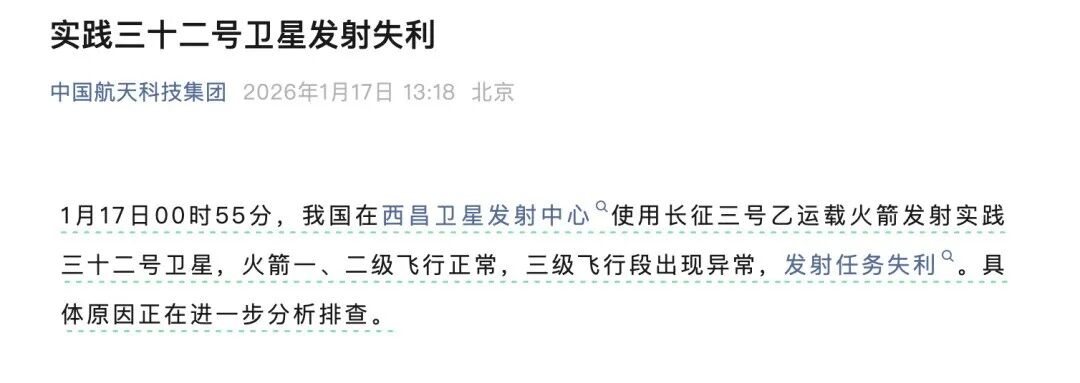
Core Viewpoint - The recent failures of two rocket launches in China highlight the challenges faced by both state-owned and private aerospace companies in achieving reliable launch capabilities [1][3][5]. Group 1: Long March 3B Rocket - The Long March 3B rocket, developed by China Aerospace Science and Technology Corporation, experienced an anomaly during its third stage flight on January 17, leading to the failure of the launch of the Shijian-32 satellite [1][3]. - This rocket has a historical success rate, with 115 launches conducted, of which 110 were successful, 3 failed, and 2 were partially successful [3]. Group 2: Star River Dynamics - Star River Dynamics, a private commercial rocket company established in 2018, also faced a launch failure on January 17 with its Gushenxing-2 rocket during its maiden flight [5][6]. - The company has raised over 5.3 billion yuan through multiple funding rounds, with a notable 2.4 billion yuan raised in its D round, achieving a post-investment valuation of 15 to 16 billion yuan [6]. Group 3: Industry Context - The Chinese aerospace industry is experiencing a high launch frequency, with a record 92 launches in 2022, indicating a growing demand for satellite deployment [7]. - The commercial space sector is still transitioning from technology validation to large-scale operations, facing challenges such as low rocket supply, insufficient payload capacity, and high launch costs [8]. Group 4: Future Prospects - There is an expectation for private rocket companies to complement state efforts in meeting high-frequency launch demands, with a focus on developing reusable liquid rockets to reduce costs and increase launch frequency [9]. - The commercial aerospace index has seen a significant increase of over 40% since December, although many related stocks have diverged from their fundamental valuations [10].

北美“电荒”催生大机遇,基金抢筹电力赛道
Zheng Quan Shi Bao Wang· 2026-01-18 23:19
Core Insights - The power crisis triggered by the surge in AI computing power is creating new opportunities for public funds to explore Chinese power equipment assets overseas [1] - Public funds are intensively reallocating their portfolios, prioritizing the power equipment sector as a key investment area [2] Group 1: Investment Trends - Major public funds such as Ping An Fund, Debon Fund, and others are increasing their positions in smart distribution and gas turbine sectors, with companies like Yingliu Co., Jereh, and Dongfang Electric becoming core holdings [2] - New ETFs focused on power equipment and energy infrastructure are being launched by institutions like Invesco Great Wall and Huabao Fund, indicating a strong interest in this sector [2] Group 2: Supply and Demand Dynamics - The ongoing power gap in North America has led fund managers to recognize the critical role of traditional power sources, with Morgan Stanley raising the projected power shortfall for U.S. data centers from 44 GW to 47 GW [3] - The International Energy Agency warns that global data center power demand will exceed 900 TWh by 2030, with NVIDIA's GPU clusters alone consuming 150-200 GW of power [3] Group 3: Market Performance - The power equipment sector saw an overall increase of over 40% in 2025, with specific segments like smart distribution and gas turbine components rising over 60% [5] - Companies like Siyuan Electric have seen their stock prices soar, with a cumulative increase of 14 times since 2020, benefiting from the upgrade of power grids and overseas demand [4] Group 4: Strategic Insights - The consensus that "AI's end is electricity" is driving public funds to focus on power equipment, as the demand for stable power sources in data centers is increasing [6] - Fund managers emphasize the importance of energy as a hard asset in the context of the AI revolution, highlighting the need for rapid upgrades in power infrastructure to meet growing energy demands [6][7]

可控核聚变行业系列专题三:美国聚变产业整合加速,技术突破频出,“工程化”逻辑持续加强
ZHESHANG SECURITIES· 2026-01-18 10:06
Investment Rating - The industry investment rating is "Positive" (maintained) [6] Core Insights - The report highlights accelerated integration in the US fusion industry, with frequent technological breakthroughs and a continuous strengthening of the "engineering" logic [1] - International cooperation is advancing, with significant policy support at both national and international levels, emphasizing the strategic urgency of major economies in seizing future energy dominance [1][13][17] - The report notes substantial progress in various technological pathways, particularly in Tokamak device construction and other fusion technology routes, indicating a robust trajectory towards commercialization [2][19][25] Policy Insights - National policies are increasingly supportive of fusion energy, with the Chinese government explicitly including fusion technology in its "14th Five-Year Plan" [1][11] - A cooperation agreement between China and France has been established, marking a new phase in international collaboration on fusion technology [13][14] - South Korea has advanced its fusion energy goals by moving the timeline for fusion power generation from the 2050s to the 2030s, highlighting the urgency among global economies [17][18] Industry Developments - Significant advancements in Tokamak devices include the completion of key plasma control coils for the JT-60SA, which is set to facilitate high-parameter experiments in 2026 [2][19] - The CRAFT facility has successfully passed its first performance test, confirming that its core components meet design specifications [21] - China's ITER project has officially commenced mass production of its first wall components, a critical step in the development of fusion reactors [22] Capital Market Activity - The US fusion industry is experiencing rapid consolidation, with notable mergers such as Trump Media and Technology Group's acquisition of TAE Technologies, which is set to launch the world's largest commercial fusion power plant [3][27][29] - Initial public offerings and significant funding rounds for startups in the fusion sector are on the rise, indicating growing investor confidence in fusion technology [3][33][36] Investment Recommendations - The report suggests focusing on midstream equipment companies such as Lianchuang Optoelectronics, Xuguang Electronics, and others, as well as upstream material suppliers like Yongding Co. and West Superconducting [4][37]
公募密集加仓电力赛道!北美“电荒”催生新机遇?
券商中国· 2026-01-18 09:33
Core Viewpoint - The ongoing power crisis in North America, driven by the surge in AI computing power, is creating new opportunities for public funds to explore Chinese power equipment assets abroad [1][4]. Group 1: Public Fund Strategies - Major public funds have begun to heavily invest in the power equipment sector, viewing it as a key area for growth in 2026, with firms like Ping An Fund and Debon Fund increasing their stakes in smart distribution and gas turbine sectors [2][3]. - The issuance of new ETFs focused on power equipment and energy infrastructure is being accelerated by several institutions, indicating a strong belief in the sector's growth potential [3]. Group 2: Market Demand and Supply Dynamics - The power shortage in North America is becoming a critical issue, with Morgan Stanley raising its forecast for the cumulative power gap in U.S. data centers from 44 GW to 47 GW, equivalent to the total electricity consumption of nine Miami cities [4]. - The International Energy Agency warns that global data center electricity demand will exceed 900 TWh by 2030, with NVIDIA's GPU clusters alone consuming 150-200 GW, highlighting the urgent need for power supply solutions [4]. Group 3: Performance of Key Stocks - The stock of Siyi Electric, a leading power equipment company, has surged, achieving a historical high with a cumulative increase of 14 times since 2020, benefiting from the demand for smart distribution and ultra-high voltage equipment [5][6]. - Other stocks linked to North American markets, such as Harbin Electric and Weisheng Holdings, have also seen significant gains, with Weisheng's revenue from North America contributing to a 7-fold increase in stock price over the past year [6]. Group 4: Investment Logic and Insights - The consensus among industry experts is that "the end of AI is electricity," which is driving public funds to invest in power equipment as a necessary complement to the AI industry [8]. - Fund managers emphasize the importance of stable power sources for data centers, indicating that the demand for gas turbines and power grid upgrades will continue to grow as AI technology expands [8][9]. - The energy power equipment sector is seen as a high-potential area that benefits from both the expansion of AI computing and supportive government policies for new power systems [9]. Group 5: Export Trends - Data from the General Administration of Customs shows that China's transformer exports reached 57.9 billion yuan from January to November 2025, marking a 36% year-on-year increase, with the average export price rising from $12,000 to $20,800 per unit [7].

Meta签超6GW核电协议,小堆成AI能源重要支撑:机械设备
Huafu Securities· 2026-01-18 06:46
Investment Rating - The industry rating is "Outperform the Market," indicating that the overall return of the industry is expected to exceed the market benchmark index by more than 5% in the next 6 months [14]. Core Insights - Meta has signed a nuclear power agreement exceeding 6 GW, becoming the largest nuclear power purchaser among large tech companies. The agreement includes significant small modular reactor (SMR) projects, supporting Oklo's project in Ohio with up to 1.2 GW of power and TerraPower's two small reactors with a future purchase agreement for 2.1 GW [3][4]. - The demand for electricity in U.S. data centers is projected to increase by at least 30% by 2030, making electricity a bottleneck for AI industry development. Nuclear power, being clean and stable, provides long-term energy security for Meta's AI data centers, promoting the implementation of new small reactor technologies and aligning with low-carbon goals [4][5]. Summary by Sections Nuclear Power Agreements - Meta's agreements include collaborations with Oklo and TerraPower, focusing on small modular reactors to meet the growing energy demands of AI data centers [3][4]. Energy Demand and AI - The report highlights the increasing electricity consumption in data centers and positions small modular reactors as a key solution to address the energy needs of AI technologies [4][5]. Investment Opportunities - The report suggests monitoring several companies involved in the SMR sector, including: 1. Jingye Intelligent, which plans to establish an SMR subsidiary focused on AI data center power supply [5]. 2. Jiadian Co., whose helium fan is the only power device for the fourth-generation high-temperature gas-cooled reactor [5]. 3. Guoguang Electric, which provides critical components for ITER projects [5]. 4. Lanshi Heavy Industry, covering upstream nuclear fuel systems to downstream spent fuel processing [5]. 5. Kexin Electromechanical, which has developed high-temperature gas-cooled reactor products [5]. 6. Hailu Heavy Industry, servicing various reactor types including third and fourth generation [5]. 7. Jiangsu Shentong, which has secured over 90% of orders for nuclear-grade valves in new nuclear power projects in China [5].