瑞幸

Search documents
外卖大战时代的新茶饮,原来是生死内功局
3 6 Ke· 2025-09-03 07:20
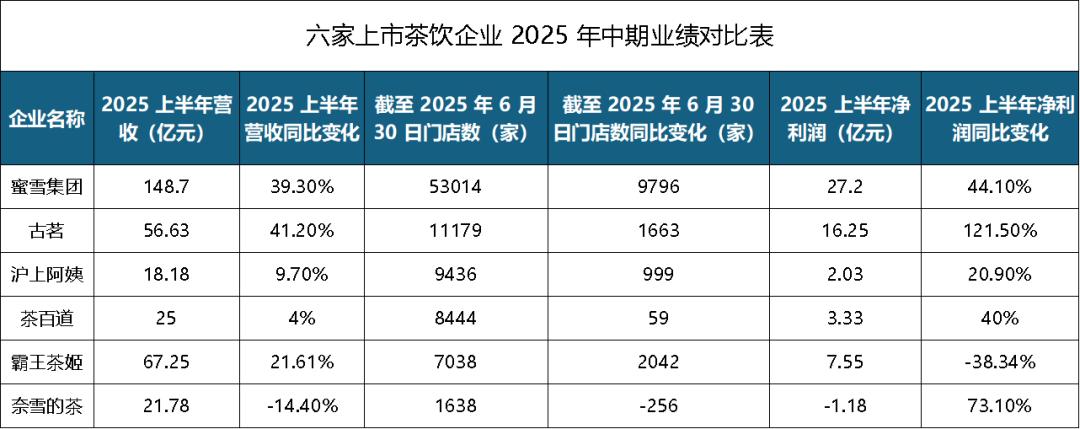
Core Viewpoint - The recent delivery subsidy war has led to a temporary boost in sales for tea beverage stocks, particularly milk tea, but raises questions about the sustainability of this growth once subsidies are withdrawn [1][5][11]. Group 1: Financial Performance of Listed Tea Beverage Companies - Six listed tea beverage companies have shown a divergence in their financial performance for the first half of 2025, with significant differences in revenue growth and profitability [2]. - Mixue Group reported a revenue of 14.87 billion yuan, a year-on-year increase of 39.3%, and a net profit of 2.72 billion yuan, up 44.1% [2]. - Gu Ming achieved a net profit of approximately 1.625 billion yuan, a staggering increase of 121.5%, with revenue of 5.663 billion yuan, up 41.2% [3]. - Other companies like Hu Shang A Yi and Cha Bai Dao showed modest growth, while Ba Wang Cha Ji experienced a decline in net profit despite revenue growth [4]. - Nai Xue's Tea reported a revenue of 2.178 billion yuan, a decline of 14.4%, and a net loss of 118 million yuan, indicating significant challenges in maintaining market position [4]. Group 2: Impact of Delivery Subsidy War - The delivery subsidy war has unexpectedly disrupted the tea beverage industry, with analysts suggesting that subsidy resources will increasingly concentrate on leading brands [5][7]. - High order volumes are primarily manageable by top tea beverage brands, which possess the necessary supply chain capabilities to meet increased demand [5][8]. - The competition has led to a "Matthew Effect," where companies with strong supply chains benefit the most, while smaller brands struggle to survive [8][11]. - Gu Ming reported a peak weekly delivery order volume of over 8 million, a threefold increase compared to normal levels, highlighting the impact of the subsidy war on operational capacity [8]. Group 3: Future Industry Trends - As subsidies are expected to diminish, the demand stimulated by these incentives may also decline, leading to a potential market shakeout [11][12]. - Companies are encouraged to focus on strengthening their supply chains and diversifying product offerings to remain competitive in a challenging market environment [12][13]. - The introduction of coffee products by brands like Gu Ming and Mixue indicates a strategic shift towards cross-category competition, which may become a key growth area [9][12].

开卖599元外套,霸王茶姬要做“百货店”?
3 6 Ke· 2025-09-03 01:23
Core Insights - Bawang Chaji has expanded its product line to include clothing, which has surprised consumers and sparked discussions about its brand strategy [1][11] - The company aims to position itself as a competitor to Starbucks, with ambitions to modernize and globalize Chinese tea culture [10][24] - Despite a significant increase in store count and revenue growth, Bawang Chaji has faced a decline in net profit and same-store sales, raising concerns about its market performance [18][19] Group 1: Product Expansion - Bawang Chaji has launched a clothing line with a premium pricing strategy, including items like denim jackets priced at 599 yuan and t-shirts at 199 yuan, which are higher than some fast-fashion brands [1][18] - The brand's merchandise strategy has evolved from simple promotional items to a diverse range of products, including bags and accessories, which have gained popularity among consumers [13][23] - The company has developed a unique "1+1+9+N" franchise model that allows for efficient market expansion and localized product offerings [14][15] Group 2: Market Performance - Bawang Chaji reported a 21.61% increase in revenue to 6.725 billion yuan in the first half of the year, but net profit fell by 38.22% to 755 million yuan [18][19] - The company has 7,038 stores globally, with a net increase of 598 stores in the first half of the year, but has seen a decline in average monthly GMV and same-store sales [18][19] - The brand's stock performance has been volatile, with a significant drop of 54.3% from its peak shortly after its IPO, indicating market skepticism about its business model [24][26] Group 3: Brand Strategy - Bawang Chaji is attempting to create a long-term customer relationship by diversifying its product offerings and enhancing its brand image to appeal to younger consumers [21][27] - The company aims to leverage its cultural heritage and unique aesthetic to attract international consumers, particularly in the North American market [27][29] - The brand's strategy includes positioning itself as a lifestyle brand, moving beyond traditional tea consumption to encompass broader lifestyle aesthetics [23][29]

5万家店赚27亿,蜜雪冰城还能跑多快?
投中网· 2025-09-02 06:33
Core Viewpoint - The article discusses the performance and challenges of Mixue Ice City, highlighting its significant revenue growth and expansion while addressing concerns about profitability and food safety issues [6][19]. Financial Performance - In the first half of 2025, Mixue Ice City achieved revenue of 14.875 billion yuan, a year-on-year increase of 39.3%, and a profit of 2.718 billion yuan, up 44.1% [6][8]. - The company opened nearly 10,000 new stores within a year, bringing the total to over 53,000 globally, with a daily average of about 27 new stores [6][8]. Market Position and Strategy - Mixue Ice City primarily targets lower-tier cities, with 57.6% of its stores located in third-tier and below cities, indicating significant growth potential in first-tier cities [9]. - The brand's marketing expenses are relatively low, with sales and distribution costs increasing by 40.2% to 913.7 million yuan, representing 6.1% of total revenue [9][10]. Brand and Consumer Engagement - The "Snow King" brand image has become deeply ingrained in consumer consciousness, contributing to its strong market presence and effective consumer engagement strategies [9][10]. - The brand has leveraged social media, with over 54.2 billion views on Douyin, and has engaged in promotional activities to enhance consumer interaction [10]. Challenges and Risks - Despite growth, Mixue Ice City faces challenges such as declining single-store profitability and food safety incidents, which have raised concerns about brand management [15][18]. - The number of store closures has increased, with 1,187 closures reported in the first half of 2025, up 48.6% from the previous year [16][17]. Expansion and Future Outlook - Mixue Ice City is pursuing international expansion, although its overseas store count has decreased from 4,895 to 4,733, focusing on optimizing existing operations [12][16]. - The company is also developing a second growth curve through its sub-brand Lucky Coffee, which aims to penetrate the coffee market with low pricing strategies [12][13].

蜜雪冰城的选择题:幸运咖快一点,出海慢一点
36氪未来消费· 2025-08-28 12:50
Core Financial Performance - In the first half of 2025, the company achieved a revenue of 14.87 billion yuan, representing a year-on-year growth of 39.3% [5] - The net profit for the same period was 2.72 billion yuan, with a year-on-year increase of 44.1% [5] - The total number of global stores reached 53,014, with an addition of 9,796 stores compared to the same period last year, primarily driven by growth in mainland China [5] Store Expansion and Market Penetration - The growth rate of new stores in mainland China accelerated significantly, with a quarter-on-quarter increase of approximately 16% in H1 2025, compared to only 7% in H2 2024 [5] - Most new stores are located in third-tier cities and below, with 5,707 new stores in these areas, accounting for nearly 60% of the total new openings [5] - The company aims to penetrate approximately 30,000 town markets across the country for future store growth [5] Same-Store Sales and External Factors - Although same-store sales growth data was not disclosed, it is estimated that same-store growth approached 9% in H1 2025 [5] - The rise in delivery services has positively impacted sales performance across the tea beverage sector [5] Cost Management and Profitability - Despite rising costs for coffee beans and lemons, the overall gross margin for H1 2025 was 31.6%, only a slight decrease of 0.3% from the previous year [6] - The company attributes the stable gross margin to the decline in sugar and milk prices, as well as improved supply chain efficiency [6] Lucky Coffee's Growth Potential - Lucky Coffee has seen significant expansion, with over 7,000 signed stores as of July 2025, compared to approximately 4,000 at the end of 2024, indicating a growth rate of 150% if the target of 10,000 stores is met by the end of 2025 [7] - The focus of expansion has shifted to first- and second-tier cities, with a validated profitability model for single stores in first-tier cities [7] Product Strategy and Market Positioning - Lucky Coffee differentiates itself from the company's other brand, Mixue Ice City, by focusing on freshly brewed coffee using a semi-automatic coffee machine and factory-roasted beans [9] - The introduction of the "fruit coffee" series aims to leverage the company's existing supply chain advantages, utilizing frozen fruit purees from Mixue [9] International Expansion and Operational Efficiency - The number of overseas stores grew to 4,733 in H1 2025, a net increase of 128 stores year-on-year, but a decrease from 4,895 in H2 2024 due to optimization efforts in Indonesia and Vietnam [12] - The company is focusing on improving operational efficiency in overseas markets, with daily sales per relocated store increasing by over 50% [12] - Plans for global expansion continue, with new stores opening in Kazakhstan and Malaysia, and a production base in Hainan aimed at supporting Southeast Asian markets [13]

“消费刺客”退烧
创业邦· 2025-08-27 15:31
Core Viewpoint - The article discusses the challenges faced by Baiguoyuan, a fruit retail brand, highlighting its struggle with consumer trust and market dynamics as it attempts to maintain high pricing amidst changing consumer expectations and competitive pressures [6][8][12]. Group 1: Baiguoyuan's Performance - On August 15, 2025, Baiguoyuan issued a mid-year earnings warning, projecting a revenue decline of up to 25% year-on-year, with a net loss estimated between 330 million to 380 million yuan. The actual revenue was reported at 4.376 billion yuan, a decrease of 21.8%, with a net loss of 342 million yuan and a 27% drop in store count to 4,386 [8][9]. - The brand's previous model, which relied on high-quality standardized fruit to command a premium price, has faltered due to quality control issues and a disconnect between consumer expectations and actual product quality [8][10][12]. Group 2: Market Dynamics - The article notes a broader trend of high-priced consumer brands facing pressure as the market shifts towards value and cost efficiency. This is evident in the new tea and coffee sectors, where brands like Heytea and Luckin Coffee have adjusted their pricing strategies to remain competitive [14][16]. - The oversupply in the market has led to a significant number of closures, with over 20,000 beverage outlets disappearing in the past year, indicating intense competition and a shift in consumer preferences towards lower-priced options [19][21]. Group 3: Consumer Behavior Changes - Consumer behavior is shifting towards prioritizing value and cost-effectiveness, influenced by economic factors such as declining asset values and rising debt obligations. This has resulted in a higher savings rate and reduced discretionary spending [21][22]. - The article highlights that even affluent cities like Beijing and Shanghai are experiencing slower retail growth compared to national averages, reflecting a broader trend of cautious consumer spending [21][22]. Group 4: Future Outlook for Baiguoyuan - Baiguoyuan is at a crossroads, needing to either establish advantages in scale, efficiency, and cost control or create unique value propositions to survive in a market increasingly divided between cost-driven and experience-driven brands [27][28]. - The brand's current positioning, caught between high convenience and high operational costs, limits its ability to compete effectively in a price-sensitive environment [28].

电影票房破 10亿元人民币,IP授权“火出圈”--“浪浪山小妖怪”何以“取真经”?
Zhong Guo Chan Ye Jing Ji Xin Xi Wang· 2025-08-27 06:22
Core Insights - The animated film "Wang Wang Mountain Little Monsters" has become a box office dark horse, surpassing 1 billion RMB in cumulative box office as of August 18, setting a record for Chinese animated films and entering the top ten in Chinese animation box office history [1] - The film has also successfully expanded its IP development, collaborating with over 30 well-known brands to launch more than 800 derivative products, significantly enhancing its market reach and consumer engagement [1][4] Film Narrative and Reception - The film presents a relatable story that resonates with audiences, featuring four unnamed little monsters who pretend to be heroes while genuinely seeking enlightenment, creating a unique comedic effect [2] - The narrative innovatively deconstructs the traditional "Journey to the West" story, focusing on the perspectives of lesser-known characters, which enhances audience identification and emotional connection [2][7] - The film's visual aesthetics combine traditional Chinese painting techniques with cinematic elements, creating a captivating visual experience that contributes to its positive reception [3] IP Development Strategy - The film's IP development was strategically planned alongside its creation, leading to collaborations with brands in various sectors, including automotive, food and beverage, and publishing [4] - The successful launch of derivative products, particularly plush toys and lifestyle items, has generated significant sales, with over 7 million RMB in sales on the first day of release [5] - The company is exploring immersive experiences and events to further engage audiences and expand the film's influence beyond traditional cinema [6] Future Prospects and Market Trends - The film's IP development is part of a broader trend in the industry, where successful animated films are increasingly monetized through diverse product offerings and brand collaborations [8] - The company aims to leverage its full industry chain advantages to increase non-ticket revenue and explore new market boundaries in sectors like tourism, dining, and retail [8]

“消费刺客”退烧
虎嗅APP· 2025-08-26 13:44
Core Viewpoint - The article discusses the challenges faced by Baiguoyuan, a fruit retail brand, highlighting its failure to adapt to changing consumer expectations and market dynamics, leading to significant financial losses and a decline in brand trust [5][6]. Group 1: Baiguoyuan's Mistakes - Baiguoyuan was once seen as a model of consumption upgrade, relying on high-quality fruit to justify premium pricing [8][9]. - The brand's promise of quality became a liability when it failed to consistently deliver, leading to a loss of consumer trust [9][11]. - The founder's comments about "educating consumers" were perceived as out of touch, exacerbating the disconnect between the brand and its customer base [10]. Group 2: Market Trends and Competition - The article notes a broader trend of high-priced brands in various sectors, such as new tea drinks and coffee, adjusting their pricing strategies to remain competitive [12][13]. - The oversupply in the market has led to increased competition, with many brands struggling to differentiate themselves [15][16]. - Economic factors, including declining asset values and rising savings rates, have shifted consumer behavior towards more cautious spending [18][19]. Group 3: Future of Consumer Goods - The article suggests a bifurcation in the market, with brands either competing on cost efficiency or creating unique value propositions [22][23]. - Baiguoyuan is caught between these two strategies, lacking the cost advantage of low-price competitors and the unique experience offered by niche brands [26][27]. - The brand must either enhance its operational efficiency or develop a distinctive value proposition to survive in the evolving market landscape [27][28].

“消费刺客”退烧
Hu Xiu· 2025-08-26 00:07
Core Viewpoint - The controversy surrounding the founder of Baiguoyuan's statement on "educating consumers" highlights the disconnect between brand management and consumer expectations, leading to significant financial losses for the company [1][7][11]. Group 1: Company Performance - Baiguoyuan issued a mid-year earnings warning on August 15, 2025, predicting a revenue decline of up to 25% year-on-year, with a net loss estimated between 330 million to 380 million yuan [2]. - The actual revenue reported was 4.376 billion yuan, a year-on-year decrease of 21.8%, with a net loss of 342 million yuan and a reduction in store count by approximately 27% to 4,386 stores [2][6]. Group 2: Market Trends - The rapid shift in consumer sentiment and market dynamics indicates that brands resisting these changes will incur significant costs, as seen with Baiguoyuan [3][4]. - The high-priced consumer segment is facing pressure, with the narrative of consumption upgrading being challenged as market realities shift [4][9]. Group 3: Consumer Behavior - Baiguoyuan's previous model relied on high-quality fruit to justify premium pricing, but issues with product quality have eroded consumer trust [5][6]. - The founder's comments reflect a misalignment with consumer expectations, as consumers are becoming more price-sensitive and pragmatic [7][11]. Group 4: Industry Dynamics - The new consumption landscape is marked by a decline in high-priced brands across various sectors, including tea and coffee, as companies adjust pricing strategies to remain competitive [10][11]. - The oversupply in the market has led to increased competition, with many brands struggling to differentiate themselves, resulting in a significant number of closures in the beverage sector [15][19]. Group 5: Future Outlook - The industry is transitioning towards two distinct business models: cost-driven efficiency and value-driven experience, with brands needing to adapt to survive [30][32]. - Baiguoyuan must either establish advantages in scale and cost control or create unique value propositions to avoid being squeezed out of the market [36][37].
蜜雪冰城加速托举第二增长曲线
财富FORTUNE· 2025-08-25 13:05
Core Viewpoint - The article discusses the expansion strategy of Mixue Ice City and its coffee brand, Lucky Coffee, focusing on their growth in both domestic and international markets, particularly in Southeast Asia [2][5][6]. Group 1: Expansion Plans - Lucky Coffee is preparing to open five stores in Malaysia, marking its first international expansion [2]. - The brand aims to reach over 10,000 stores by the end of this year, with current store numbers exceeding 7,000 [5]. - Mixue Ice City plans to have over 46,000 global stores by early 2025, with nearly 5,000 located outside mainland China, primarily in Southeast Asia [2][5]. Group 2: Market Position and Competition - As of the end of 2023, Lucky Coffee has become the fourth largest fresh coffee brand in China with nearly 3,000 stores [4]. - The coffee market in China has been highly competitive, and Lucky Coffee has faced challenges, including store closures and stagnation in growth [4]. - Lucky Coffee will compete with other Chinese brands like Luckin Coffee and Kudi in Southeast Asia, with Kudi having a rapid expansion plan aiming for 50,000 stores globally by the end of 2025 [8]. Group 3: Supply Chain and Operational Efficiency - Mixue Ice City has established a robust supply chain system that supports both its brand and Lucky Coffee, allowing for cost-effective operations [6]. - The company operates 27 self-managed warehouses in China and 7 in Southeast Asia, totaling approximately 69,000 square meters [6]. - The recent IPO on the Hong Kong Stock Exchange is expected to enhance Mixue Ice City's global expansion and supply chain capabilities [6]. Group 4: Financial Performance and Market Challenges - Following a downgrade by UBS, Mixue Ice City's stock price has declined from nearly 620 HKD to below 500 HKD due to high valuations and challenges in overseas markets [7]. - The company aims to utilize 66% of the proceeds from its global offering to upgrade its supply chain [6].
灵智数科:2025年中国消费市场趋势洞察报告v1.0
Sou Hu Cai Jing· 2025-08-19 07:30
Core Insights - The report emphasizes that the transformation of the Chinese consumer market is not merely a shift from "old to new consumption," but a value reconstruction centered around users' "task needs" [1][3] - The core of new consumption lies in the precise decoding of user tasks, where brands must identify unmet needs in segmented scenarios [1][3] Group 1: Market Changes - The traditional "80/20 rule" is being disrupted, with the rise of lower-tier markets becoming a key growth driver, as county-level consumers express an 82% satisfaction rate with "quality-price ratio" [2][19] - Consumer demographics are experiencing growth at both ends: younger generations in lower-tier markets favor domestic products, while the aging population is driving emotional consumption such as pet ownership [2][19] - The restructuring of business logic is evident in various dimensions, including channel and supply chain innovation, personalized services, and the rise of the "small employment" model [2][19] Group 2: Brand Strategies - Brands need to focus on "equality, intelligence, and humanity" to build barriers through scene adaptability, enabling long-term growth in a competitive market [3][10] - Successful brands like Pop Mart and Luckin Coffee illustrate how understanding user tasks can lead to innovative solutions that resonate with consumers [2][27] - The report highlights the importance of local culture in brand expansion, with companies like Huaxizi and Chayan Yuesheng integrating Eastern aesthetics into their products [2][9] Group 3: Future Trends - The future consumer market will be characterized by a "user-defined demand" dynamic, where brands must adapt to the evolving needs of consumers [3][10] - The report suggests that the essence of new consumption is a "democratization of consumption," where technology reduces information gaps and consumers seek to affirm their social status through purchases [9][10] - The shift from "brand-defined demand" to "user-employing brands" signifies a fundamental change in the relationship between consumers and brands [10][11]