
荣昌生物

Search documents
医药周报:春节期间医药行业重点事件梳理
Guolian Minsheng Securities· 2026-02-23 07:45
Investment Rating - The report maintains a "Recommended" rating for the pharmaceutical industry [5] Core Insights - The underlying logic of the current pharmaceutical industry era is innovation and international expansion, with a focus on innovative drugs and technology-driven sectors [2][3] - The report highlights the strong performance of the CRO market and suggests a dual investment strategy focusing on both "0 to 1" technology innovation and low-position stocks [2][3] - The report emphasizes the ongoing trend of BD (Business Development) transactions in innovative drugs, with significant growth expected in 2026 [4][15] Summary by Sections 1. Key Events in the Pharmaceutical Industry During the Spring Festival - Innovative drug BD transactions have seen a strong start, with significant overseas development and registration progress for key products [13][14] - The total amount of BD transactions for innovative drugs in China for 2026 has already surpassed one-third of the total for 2025 [15] - The revision of the National Essential Medicines List Management Measures may signal changes in the essential medicines directory [28] 2. Pharmaceutical Market Review and Hotspot Tracking - The pharmaceutical sector's performance was relatively weak, with a weekly decline of 0.81%, ranking 20th among all industries [34][38] - The total trading volume for pharmaceuticals was 401.12 billion yuan, accounting for 3.83% of the total market, below the historical average of 7.09% [55] - The report notes a rising valuation level for the pharmaceutical industry, with a PE ratio of 29.25, which is below the historical average [52] 3. Stock Performance Review - The report lists the top-performing stocks, including Dongyangguang and Zhendemedical, while highlighting the underperformers like Huayuan Biology and *ST Sailong [58][59]


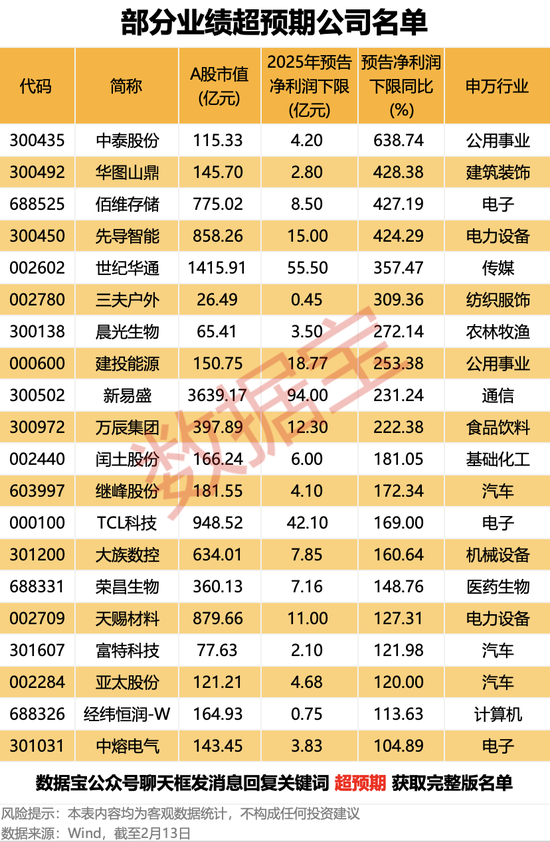
业绩超预期,56股上榜!融资客潜伏多只行业龙头
Xin Lang Cai Jing· 2026-02-22 23:45
这些超预期的表现,不仅反映了上市公司实际财务表现优于市场预期,还彰显出良好的经营状况和稳健 的增长态势,为投资者带来信心,成为观察经济复苏和行业发展趋势的重要窗口。 据证券时报·数据宝统计,截至2月13日(下同),已公布2025年度业绩预告、业绩快报或者年报的上市 公司中,券商研报明确给予"超预期"评价的公司有56家。这份"超预期"名单中,一个清晰的轮廓浮现出 来:龙头公司正成为业绩增长的"领跑者"。 业绩超预期不仅反映企业自身的经营实力,也是宏观经济环境、行业趋势和政策导向的风向标。 业绩超预期公司名单出炉 春节前后,A股市场进入2025年年报业绩预告、快报的披露高峰期,部分上市公司通过一系列改革措 施,经营效率大幅提升,同时受益于产品供需格局优化、行业景气度提升以及资产处置等影响,实现了 业绩的超预期增长。 数据显示,这些业绩超预期的公司中,超过八成的A股市值超过100亿元,其中更是不乏紫金矿业、兴 业银行、新易盛、中信证券、药明康德等14家千亿市值巨头。这些头部企业正以其迅猛的成长性,重新 锚定产业价值,并吸引资本向高质量发展主线加速汇聚。 以有色金属龙头紫金矿业为例,公司预计2025年净利润为510亿 ...


港股异动 | 医药股多数走高 歌礼制药-B(01672)涨超6% 康方生物(09926)涨超5%
智通财经网· 2026-02-20 07:08
Group 1 - The pharmaceutical stocks have shown a general upward trend, with notable increases in companies such as Genscript Biotech (up 6.33%), Kintor Pharmaceutical (up 5.23%), and Junshi Biosciences (up 4.39%) [1] - The Chinese innovative drug licensing market has continued its strong growth into 2026, with total transaction amounts exceeding $33.28 billion in the first quarter, surpassing the highest quarterly upfront payment levels of 2025 [1] - According to Open Source Securities, the innovative drug sector has experienced a correction over the past two quarters, but long-term prospects for quality stocks are favorable, suggesting an increase in sector allocation focusing on companies with established overseas opportunities and high clinical data performance [1] Group 2 - Donghai Securities previously indicated that the innovative drug sector is entering a phase of accelerated profit realization by 2025, with companies like Innovent Biologics and Rongchang Biopharmaceutical achieving profitability, while others like 3SBio and Shanghai Yizhong are expected to see significant performance increases [2] - The strong performance of the innovative drug sector validates the effectiveness of the domestic innovative drug business model, with core product volume growth supported by medical insurance becoming the foundation for performance growth, while external collaborations such as BD are crucial for enhancing earnings [2]

中国创新药产业加速迈向全球价值链核心
Jing Ji Guan Cha Wang· 2026-02-18 03:24
Core Insights - The Chinese innovative pharmaceutical industry is transitioning from "importing and imitating" to "innovating and exporting," enhancing its global influence and authority in the innovative drug sector [1] - In early 2026, the market for outbound licensing transactions in China's innovative drugs continued its strong growth, with the first quarter's transaction amount exceeding $33.28 billion, setting a historical record [1][2] - By 2025, the total value of China's innovative drug license-out transactions reached $140.27 billion, a significant increase from $2.56 billion in 2017, making China the global leader in this sector [2] Transaction Growth - The growth in China's innovative drug licensing transactions is driven by the dual pressures of a "patent cliff" and "innovation demand" in the global pharmaceutical industry [1] - In 2026, the upfront payment scale in just one month approached half of the total for the entire year of 2025, indicating a rapid increase in transaction volume and quality [2] - The structure of transactions is evolving, with a shift from simple rights transfers to deep binding models based on technology platform sharing and global R&D collaboration [2][3] Strategic Partnerships - Notable collaborations include partnerships between Innovent Biologics and Eli Lilly, as well as between 3SBio and Pfizer, showcasing the trend of comprehensive capability partnerships rather than mere product supply [3] - Leading pharmaceutical companies are adopting a dual strategy of "independent R&D + global licensing," creating a sustainable innovation cycle [3] Financial Performance - Over 70% of innovative pharmaceutical companies reported positive revenue growth in 2025, with cash flow from outbound licensing contributing to a virtuous cycle with capital market financing [4] - The evolving payment system in China, which combines basic medical insurance with commercial insurance, supports a stable cash flow from the domestic market while enhancing long-term corporate value through global collaborations [4] Global Impact - The trend of outbound licensing is reshaping cooperation rules and competitive dynamics in the global pharmaceutical industry, with Chinese companies increasingly playing a proactive and critical role [4][6] - The collaboration between companies like Innovent and Takeda exemplifies a mutually beneficial partnership that leverages global channels and local clinical capabilities [4] Market Sentiment - Despite market fluctuations, analysts generally view high-quality innovative pharmaceutical companies as attractive long-term investments, reflecting a dual recognition of explosive innovative potential and structural growth resilience in the Chinese pharmaceutical industry [5] Industry Dynamics - The surge in outbound licensing is prompting local companies to balance "bringing in" and "going out," with the latter gaining prominence and indicating international market recognition of China's innovative drug quality [6] - There is a need for rational and cautious approaches in the face of rising transaction prices and potential market uncertainties, emphasizing the importance of thorough scientific and commercial due diligence [6]

创新药出海开年跑出“加速度”:产业迈入2.0时代
Jing Ji Guan Cha Wang· 2026-02-18 02:45
Core Insights - The Chinese innovative pharmaceutical industry has entered the 2.0 era, shifting from "import imitation" to "innovation output," with new forms like license-out and new co indicating a transformation in internationalization [1] - In the first quarter of 2026, the total transaction amount for Chinese innovative drug licensing (BD) exceeded $33.28 billion, surpassing the highest quarterly level of 2025, marking a shift from a "follower" to a core driver in the global innovation value chain [1][2] - The explosive growth in BD transactions is attributed to multiple factors, including the global pharmaceutical industry's "patent cliff" and "innovation demand," alongside China's recognized R&D efficiency and clinical capabilities [1] Transaction Growth - In 2025, the total value of China's innovative drug license-out transactions reached $140.27 billion, a significant increase from $2.56 billion in 2017, accounting for 49% of global innovative drug licensing transactions, surpassing the U.S. for the first time [2] - In January 2026, the upfront payment scale approached half of the total for 2025, with total transaction amounts reaching 22% of 2025's total [2] - The quality of transactions is also improving, with frequent occurrences of upfront payments exceeding $100 million and 37 transactions exceeding $1 billion, second only to the U.S. [2] Transaction Structure - The upgrade in transaction structure is a core feature of China's innovative drug internationalization, with traditional "selling seedlings" models being replaced by "technology platform output" and "global R&D collaboration" [2][3] - Notable collaborations include Innovent Biologics and Eli Lilly, where the partnership is based on a new molecule, demonstrating deep trust in China's R&D capabilities [2] Strategic Transformation - Leading pharmaceutical companies are adopting a dual strategy of "independent R&D + global licensing," creating a sustainable innovation ecosystem [3] - Examples include BeiGene's revenue surpassing 36 billion yuan in 2025, showcasing strong commercialization capabilities, and other companies achieving breakeven for the first time [3] Financial Performance - Over 70% of innovative pharmaceutical companies achieved revenue growth in 2025, with cash flow from BD transactions and IPO funding providing substantial resources for the industry [4] - The combination of domestic market cash flow and global licensing is creating a dual-driven model that reduces financial risks and accelerates the conversion of innovative results [4] Industry Ecosystem - The internationalization of innovative drugs is reshaping the global pharmaceutical landscape, with predictions of the emergence of global Chinese pharmaceutical giants [4] - Collaborations like that between Innovent Biologics and Takeda illustrate the strategic partnerships that enhance project advancement efficiency [4] Investment Trends - The innovative drug sector has seen a correction over the past two quarters, but long-term prospects for quality targets remain favorable, suggesting increased allocation [5] - The "dumbbell strategy" proposed by CICC highlights the dual characteristics of "innovation output" and "steady growth" in the Chinese innovative drug industry [5][6] Market Dynamics - An increasing number of Chinese innovative pharmaceutical companies are transitioning from "license-in" to proactive "license-out," achieving record high transaction amounts and gaining recognition in international markets [6] - Horizontal cooperation and integration among domestic pharmaceutical companies are accelerating to optimize resource allocation and address market competition and regulatory challenges [6]
中国创新药出海交易额暴涨10倍破千亿美元!信达生物88.5亿美元合作震撼全球
Jin Rong Jie· 2026-02-16 13:56
Core Insights - The IBI EXPO 2026 Biopharmaceutical Innovation Conference will provide a high-level platform for communication and collaboration in the innovative drug industry [1] - Recent favorable news in the innovative drug sector includes a significant increase in licensing agreements, with Chinese companies signing $137.7 billion in deals in 2025, nearly a tenfold increase from 2021 [1][2] - The trend of Chinese biopharmaceutical companies entering international licensing agreements is accelerating, with major collaborations such as the $8.85 billion deal between Innovent Biologics and Eli Lilly [1][5] Market Focus - The IBI EXPO 2026 conference serves as a catalyst for the innovative drug sector, highlighting the substantial growth in licensing agreements and the transition from research investment to commercial realization [2] - The number of licensing agreements reached 186 in 2025, with a total transaction value of $137.7 billion, marking a record high for the past decade [3][5] - Companies like Innovent Biologics and Rongchang Biopharma are transitioning from loss to profit, indicating a clear improvement in the overall profitability of the industry [2][3] Broker Insights - Open Source Securities notes that the period from 2017 to 2026 is a "golden decade" for Chinese pharmaceutical companies, with licensing agreements skyrocketing from $2.562 billion in 2017 to $137.7 billion in 2025 [3] - The overall revenue growth in innovative drugs is evident, with over 70% of companies reporting positive revenue growth in 2025, showcasing strong commercial capabilities [3] - The innovative drug sector has seen a price correction over the past two quarters, but long-term prospects remain positive, suggesting an increase in sector allocation [3] Related Industries - The innovative drug sector is transitioning from a research investment phase to a commercialization phase, with significant implications for the CXO (Contract Research Organization) industry, which is expected to benefit from increased orders [5] - The new business model of external licensing is expected to enhance the early-stage research pipeline, benefiting companies involved in drug discovery and clinical trials [4][5] - The trend of Chinese innovative drugs "going global" is becoming systematic, with major collaborations indicating a shift towards international development [5] Industry Chain Companies - Heng Rui Medicine is a representative company in the domestic chemical innovative drug sector, with a diverse pipeline and ongoing internationalization efforts [7] - Sanofi Biopharma has received approval for its self-developed monoclonal antibody, further enriching its commercial product pipeline [7] - Companies like Rongchang Biopharma and Ailis are demonstrating strong revenue growth and successful international collaborations, indicating a positive trend in the innovative drug sector [7][8]


跟着大资金选股!公募调仓科创板,猛攻电子、医药
市值风云· 2026-02-14 10:09
Core Viewpoint - The article discusses the current funding logic in the market, highlighting the significant movements of public funds in the technology sector, particularly in the semiconductor and biopharmaceutical industries, as they adjust their portfolios based on performance and valuation metrics [3][8]. Group 1: Public Fund Movements - Public funds have shown a notable shift in their holdings, particularly in the STAR Market, with the STAR 50 Index rising by 12.1% this year [3][4]. - The total market capitalization of STAR Market companies reached 10.4 trillion yuan, with the technology sector dominating, accounting for 62.1% of the total market cap [5][6]. - The semiconductor industry remains the core focus for fund allocation, with 12 companies in the sector having a market capitalization exceeding 10 billion yuan [9][11]. Group 2: Semiconductor Sector Insights - The market's pricing anchor for the semiconductor sector has shifted from "valuation expansion" to "performance realization," emphasizing the importance of actual earnings [13][14]. - Key drivers for future growth in the semiconductor sector include strong order backlogs, profit growth through acquisitions and expansions, and sustained price increases in advanced processes [13][14]. - Public funds have significantly increased their holdings in semiconductor materials, chip design, and equipment, with companies like ShenGong Co. seeing an 11% increase in fund holdings [15][21]. Group 3: Biopharmaceutical Sector Insights - The biopharmaceutical sector is a critical area for public funds, with major holdings in companies like BeiGene and United Imaging Healthcare, although the sector has faced a reduction in holdings for several key companies [24][26]. - The article notes that innovative drug companies are currently under pressure, with significant reductions in holdings observed in companies like BaiLi TianHeng and RongChang Biopharma [26][28]. - Despite the challenges, companies with strong earnings potential and innovative drug pipelines are still attracting interest from public funds, indicating a selective investment approach [35][40].





医药行业专题报告:25Q4持仓调整筑底,2026年医药板块有望迎来修复性机会
Guoxin Securities· 2026-02-14 00:45
Investment Rating - The investment rating for the pharmaceutical and biotechnology sector is "Outperform the Market" (maintained) [2] Core Insights - The pharmaceutical sector underperformed the market in Q4 2025, with the overall sector down by 9.3% compared to a slight decline of 0.2% in the CSI 300 index. Notably, the pharmaceutical commercial segment showed a positive performance with a 5.3% increase, while other segments like medical services and biological products experienced significant declines [4][8] - The total net asset value of pharmaceutical funds decreased to 358.4 billion yuan, a 9.0% decline quarter-on-quarter. This marks the first time since 2019 that passive pharmaceutical funds (181.8 billion yuan) surpassed active funds (176.5 billion yuan) [4][14] - The overall pharmaceutical holdings across all funds dropped to 7.97%, a decrease of 1.71 percentage points. Active pharmaceutical funds maintained a high concentration with a holding ratio of 97.45% [23] Summary by Sections 1. Market Review - In Q4 2025, the pharmaceutical and biotechnology sector lagged behind the CSI 300 index, with a decline of 9.3%. The chemical pharmaceuticals segment fell by 9.6%, biological products by 12.4%, and medical devices by 10.6% [8] 2. Pharmaceutical Fund Size - As of Q4 2025, the net asset value of pharmaceutical funds was 358.4 billion yuan, down 9.0% from the previous quarter. Active funds accounted for 176.5 billion yuan, a 14.6% decrease, while passive funds reached 181.8 billion yuan, down 2.8% [14] 3. Pharmaceutical Holdings Ratio - The pharmaceutical holdings ratio for all funds was 7.97%, down 1.71 percentage points. Active pharmaceutical funds had a holding ratio of 97.08%, while passive funds had 97.83% [23] 4. Holdings Structure Analysis - The highest sub-sector holding in Q4 2025 was chemical preparations at 37.5%, followed by other biological products at 20.8%. The largest increases in holdings were seen in traditional Chinese medicine (+0.98 percentage points) and chemical preparations (+0.62 percentage points) [29] 5. Additions and Reductions in Holdings - The top three pharmaceutical stocks by the number of funds holding them were Heng Rui Medicine (498 funds), WuXi AppTec (408 funds), and Mindray Medical (204 funds). Notably, Heng Rui Medicine saw a reduction of 236 funds, while Ying En Biological-B experienced an increase of 47 funds [84][88]
艾伯维2025年Q4财报超预期,上调2026年盈利指引
Jing Ji Guan Cha Wang· 2026-02-13 19:36
Financial Performance - In early February 2026, AbbVie reported Q4 2025 sales of $16.6 billion, exceeding market expectations of $16.4 billion; adjusted EPS was $2.71, above the analyst average estimate of $2.65. The company raised its 2026 adjusted EPS guidance to a range of $14.37 to $14.57, higher than the market expectation of $14.22, reflecting confidence in this year's performance [1]. Business Developments - In Q4, Botox sales reached $717 million, marking the first growth since Q3 2024 and surpassing market expectations. The company implemented new marketing strategies, such as the "Naturally You" campaign, to revive its aesthetic business. However, Botox is included in the U.S. federal Medicare price negotiation list, which may lead to price adjustments starting in 2028 [2]. - The neuroscience segment generated $10.767 billion in revenue for 2025, a 19% year-over-year increase, making it the fastest-growing segment. AbbVie plans to strengthen its pipeline through internal R&D and external collaborations, including the acquisition of Cerevel Therapeutics, with a focus on Parkinson's disease therapies like Tavapadon, which has been submitted for approval [3]. - The oncology segment reported $6.655 billion in revenue for 2025, showing a slowdown in growth. However, new drugs performed well, with the global first c-Met ADC drug Teliso-V approved in May 2025, and sales of CD3×CD20 bispecific antibody Epkinly and FRα ADC drug Elahere increasing by 85.5% and 44%, respectively. The company completed over 10 transactions in 2025, totaling over $13 billion, and secured exclusive licensing for PD-1/VEGF bispecific antibody RC148 with Rongchang Bio in January 2026, further expanding its oncology pipeline [4]. - The immunology segment achieved $30.4 billion in revenue for 2025, a 14% year-over-year increase. Despite a decline in Humira sales due to patent expiration, new drugs Skyrizi and Rinvoq showed strong demand, with Q4 sales of $5 billion and $2.4 billion, respectively, supporting the business transition [5].

Analysis-China biotech licensing boom to hit record in 2026 as pipeline swells
Yahoo Finance· 2026-02-13 09:32
By Kane Wu and Andrew Silver HONG KONG/SHANGHAI, Feb 13 (Reuters) - Global drugmakers are stepping up their search for China‑developed experimental medicines as they cut costs ahead of patent expirations, with industry analysts predicting licensing deals will surge to a fresh record this year. The value of such deals signed by companies in the greater China region - which includes Hong Kong, Macau and Taiwan - rose nearly tenfold last year from 2021 to an unprecedented $137.7 billion, according to data ...