
TOP TOY

Search documents
潮玩品牌,从拼“上架”到抢“上市”
3 6 Ke· 2025-10-15 09:12
Core Insights - The潮玩 industry is witnessing a collective move towards IPOs, driven by internal and external pressures, marking a significant shift in the industry landscape [4][10][12] - The潮玩 market is expected to grow significantly, with a projected total value of 110.1 billion yuan by 2026, reflecting an annual growth rate of over 20% [2] Group 1: Reasons for the IPO Rush - The潮玩 industry is facing a transformation due to changes in market dynamics, regulatory environments, and the need for companies to adapt to a more rational consumer base [4][5] - The era of relying solely on a few popular IPs and blind box strategies is over, as market saturation has led to diminished consumer excitement [5][6] - Companies are now competing on three fronts: IP reserves, channel penetration, and user engagement, which are essential for sustainable growth [6][7] Group 2: Capital Market Dynamics - The investment landscape for潮玩 has evolved, with 2018 marking a peak in VC/PE investment, and the current period being a critical exit window for investors [7][9] - The success of companies like泡泡玛特 has increased investor understanding and acceptance of潮玩, leading to favorable conditions for IPOs [8][9] Group 3: Different Business Models - TOP TOY represents a "channel-driven" model, leveraging a vast distribution network but lacking unique IP development, with over 52.8% of its revenue coming from external IPs [14][15] - 卡游 and Hitcard exemplify an "ecosystem-driven" approach, focusing on collectible card games that foster a strong user community, but face risks related to dependency on a young audience [15][16] - 泡泡玛特 follows an "IP-driven" model, achieving 99.1% of its revenue from proprietary products, but must continuously innovate to maintain consumer interest in its IPs [16][18] Group 4: Industry Challenges and Future Directions - Domestic潮玩 companies lag behind international giants like三丽鸥 and迪士尼 in building a comprehensive IP ecosystem, often relying on short-term strategies [20][21] - Key shortcomings include a lack of long-term IP management, shallow user connections, and ineffective international expansion strategies [22][23][24] - To succeed,潮玩 companies must transition from product suppliers to emotional service providers, focusing on IP co-creation, cross-media storytelling, and compliance-driven innovation [25][26]




当不了Labubu的盲盒,堆满好特卖
3 6 Ke· 2025-10-15 03:52
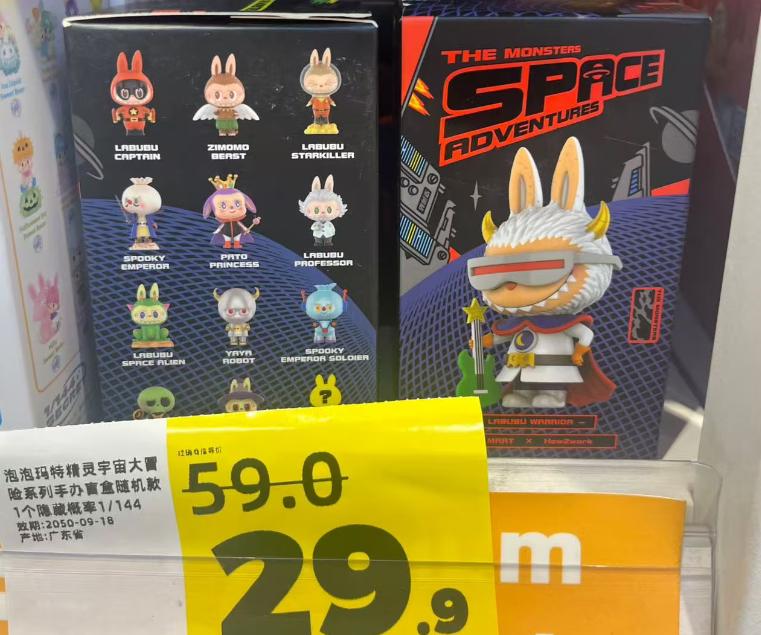
Core Insights - The rise of discount stores like "Hao Te Mai" is reshaping the blind box market, attracting consumers with significantly lower prices compared to traditional offerings [1][9] - The phenomenon of "discount blind boxes" reflects an oversupply in the blind box economy, highlighting structural contradictions within the industry [1][9] - Companies must strategically manage their IP to avoid their products being sold at discount prices, which can impact their market value and brand perception [1][9] Group 1: Consumer Behavior - Young consumers are drawn to "Hao Te Mai" for its "bone-breaking prices," allowing them to purchase multiple blind boxes for a fraction of the original cost [1][5] - The discount store offers a mix of popular and lesser-known IPs, but often features outdated or less desirable products, leading to a perception of "picking up trash" rather than valuable finds [1][2][5] - There is a growing skepticism among consumers regarding the authenticity of the products sold at such low prices, with some associating the store with counterfeit goods [7][8] Group 2: Industry Dynamics - The influx of blind boxes into discount channels like "Hao Te Mai" can indicate that these products are underperforming, which may negatively affect the overall profitability of the companies involved [9][10] - Successful companies like Pop Mart have managed to create a strong market presence by developing proprietary IPs, allowing them to maintain higher profit margins and avoid reliance on external IPs [10][13] - The competitive landscape is shifting, with new entrants seeking to replicate the success of established brands, but many still struggle to create hit IPs, leading to a higher likelihood of unsold inventory [19][24] Group 3: Business Strategy - Companies are exploring various strategies to develop successful IPs, including collaborations with artists and internal design teams to enhance their product offerings [15][16] - The marketing approach has evolved, with companies testing new IPs through social media before committing to larger production runs [16][19] - "Hao Te Mai" is adjusting its product mix to focus more on blind boxes and other trending items, aiming to improve sales efficiency and adapt to changing consumer preferences [23][24]
广州版“大疆”、广州版“泡泡玛特”,都要去香港上市了
Sou Hu Cai Jing· 2025-10-14 18:03
Group 1 - The core viewpoint of the articles highlights the emerging strength of Guangzhou's industries, with companies like XAG Technology and TOP TOY preparing for IPOs in Hong Kong, indicating a growing entrepreneurial ecosystem in the region [1][2] - XAG Technology, a leading agricultural robotics company based in Guangzhou, has filed for an IPO on the Hong Kong Stock Exchange, boasting a global market share of 10.7% in agricultural robots and 17.1% in agricultural drones, ranking second worldwide [1] - XAG Technology is projected to achieve revenue exceeding 1 billion yuan in 2024, reflecting a year-on-year increase of 73.4%, and has an estimated valuation of 7.3 billion yuan according to Hurun Research Institute [1] - TOP TOY, a notable player in the trendy toy sector, has also submitted its listing application to the Hong Kong Stock Exchange, with a current valuation of 10.2 billion HKD following a successful A-round financing of 59.426 million USD [1] - The parent company of TOP TOY, Miniso, is a well-known retail enterprise in Guangzhou, with a market capitalization of approximately 55 billion HKD [1] Group 2 - The articles suggest that while Guangzhou has a broad industrial ecosystem with several promising companies, it often lacks a dominant player in each sector [2] - Many successful companies in Guangzhou tend to be acquired by larger corporations once they reach a certain scale, indicating a potential challenge for local firms to grow independently [2]

从TOP TOY看我国潮玩行业发展趋势:构建多元化IP矩阵,深化全渠道布局
Shenwan Hongyuan Securities· 2025-10-14 14:44
Investment Rating - The report rates the investment outlook for the toy industry as positive, highlighting the growth potential of TOP TOY as a leading player in the market [3]. Core Insights - TOP TOY, a brand under Miniso, has established a comprehensive integrated platform for the toy industry, achieving significant growth since its inception in 2020. The company has expanded its store count to 293 and increased its self-developed product ratio to 47.2%, resulting in substantial revenue and profit growth [3][4]. - The Chinese toy industry is experiencing rapid growth, with retail sales projected to rise from 207 billion yuan in 2019 to 587 billion yuan in 2024, reflecting a compound annual growth rate (CAGR) of 23.2%. This growth is driven by consumer demand for identity recognition and emotional resonance through products [3][4]. - TOP TOY has built a diverse IP matrix and a robust multi-channel sales strategy, enhancing its competitive advantage. The company has developed 17 proprietary IPs and collaborates with 43 licensed IPs, alongside over 600 external IPs, to strengthen its market presence [3][4]. Summary by Sections Company Performance - TOP TOY has demonstrated strong performance, with revenue increasing from 6.79 billion yuan in 2022 to 19.09 billion yuan in 2024, achieving a record growth rate of 115.3% in 2023. The company turned a profit in 2023 with a net profit of 2.12 billion yuan, and further growth is expected in 2024 [18][21]. - The company's gross margin improved significantly, reaching 32.4% in the first half of 2025, driven by an increase in self-developed products [21][24]. Industry Growth - The global entertainment merchandise industry is expanding, with the market size projected to grow from $44.8 billion in 2019 to $82.2 billion in 2024, and further to $194.8 billion by 2030, indicating a CAGR of 12.9% [35][36]. - The Chinese toy industry is expected to grow rapidly, with retail sales projected to reach 2.133 trillion yuan by 2030, driven by emotional connections and social interactions among consumers [35][36]. IP and Product Strategy - TOP TOY has developed a comprehensive IP matrix, including proprietary, licensed, and external IPs, enhancing its product offerings and market reach. The company has successfully launched popular self-developed IPs, contributing significantly to its revenue [53][57]. - The product matrix includes diverse categories such as figurines, 3D models, and plush toys, with figurines expected to dominate the market share, projected to reach 51.2% by 2030 [43][60]. Sales Channels and Marketing - The company has established a mature multi-channel sales network, with significant contributions from offline distributors and franchisees. Online sales are also growing rapidly, with a notable increase in revenue from e-commerce platforms [66][70]. - TOP TOY employs a comprehensive marketing strategy that includes immersive in-store experiences and online engagement through social media and e-commerce, enhancing customer interaction and brand loyalty [84][90].
TOP TOY港股IPO:依赖授权IP、外采占比过半、名创优品是最大经销商
Xin Lang Cai Jing· 2025-10-14 07:16
Core Viewpoint - TOP TOY has submitted its listing application to the Hong Kong Stock Exchange, aiming to raise funds for various strategic initiatives, including IP development and global market expansion [3][4]. Financial Performance - TOP TOY has experienced significant revenue growth, with income increasing from RMB 678.8 million in 2022 to RMB 1.91 billion in 2024, representing a compound annual growth rate (CAGR) of 67.7% [9]. - The adjusted net profit has shown a rapid increase, from a loss of RMB 38.2 million in 2022 to a profit of RMB 180 million in 2025 [9]. Revenue Structure - The company's revenue is heavily reliant on licensed IP products and externally sourced products, which together account for nearly 100% of total revenue [4][11]. - In 2025, revenue from licensed IP products was RMB 889 million, while self-developed IP products contributed only RMB 6.8 million, indicating a significant dependency on external sources [11][13]. Market Position and Strategy - TOP TOY is recognized as the largest and fastest-growing collectible toy brand in China, with a product matrix that includes figures, 3D models, and plush toys [6]. - The company plans to expand its domestic store count from 299 to between 380 and 400 by the end of 2023, with a long-term goal of opening 1,000 stores globally [8][9]. Sales Channels - The sales structure is primarily composed of offline distributors, which accounted for 51.6% of total revenue in the first half of 2025, with the largest distributor being its parent company, MINISO [20][21]. - The sales model includes direct retail, sales through franchise partners, and sales to offline distributors, with the latter being the most significant contributor to revenue [16][20]. Competitive Landscape - TOP TOY's business model differs fundamentally from that of its competitor, Pop Mart, positioning itself as a collectible retail store rather than a self-branded retailer [10][14]. - The competition between TOP TOY and Pop Mart is expected to intensify, particularly in core urban markets and global expansion efforts [14]. Financial Health - TOP TOY's financial health is concerning, with a debt-to-asset ratio exceeding 100% and liquidity ratios below safe thresholds, indicating potential financial instability [23].
TOP TOY港股IPO:依赖授权IP、外采占比过半、名创优品是最大经销商 潮玩买手能否复刻泡...
Xin Lang Cai Jing· 2025-10-14 07:08
Core Viewpoint - TOP TOY has submitted its listing application to the Hong Kong Stock Exchange, aiming to raise funds for various strategic initiatives, despite its impressive revenue growth being overshadowed by significant risks related to its business model and reliance on licensed IP products [2][4][18]. Group 1: Financial Performance and Growth - TOP TOY's revenue has seen rapid growth, increasing from 678.8 million RMB in 2022 to an expected 1.91 billion RMB in 2024, representing a compound annual growth rate (CAGR) of 67.7% [5][7]. - The company reported adjusted net profits of -38.2 million RMB in 2022, 213 million RMB in 2023, and 294 million RMB in 2024, indicating a trend of increasing profitability [5][7]. - As of June 30, 2025, TOP TOY's revenue for the first half of the year reached 1.36 billion RMB, with a year-on-year growth rate of 58.51% [5][7]. Group 2: Business Model and Revenue Structure - TOP TOY's revenue is heavily reliant on licensed IP products, which account for nearly 100% of total revenue, while self-developed IP products contribute only a negligible amount [2][9][11]. - The sales structure shows that the highest proportion of sales comes from distributors, with 51.6% of total revenue generated through this channel in the first half of 2025 [15][16]. - The company has a significant dependency on its parent company, Miniso, which serves as its largest distributor, raising concerns about its operational independence [12][16]. Group 3: Market Position and Competitive Landscape - TOP TOY is recognized as the largest and fastest-growing collectible toy brand in China, with plans to expand its store count from 299 to 1,000 globally over the next five years [4][5]. - The company aims to establish a "China Toy Going Global Alliance" to enhance its international market presence, competing directly with established players like Pop Mart [5][11]. - The strategic focus on expanding its own IP development is critical, as the current reliance on licensed IP limits pricing power and long-term profitability [11][18]. Group 4: Challenges and Risks - The company faces challenges in developing its own IP, with only 17 self-owned IPs compared to 43 licensed IPs, which may hinder its ability to compete effectively in the market [8][11]. - TOP TOY's gross margin is significantly lower than that of competitors like Pop Mart, with margins reported at 19.9% to 32.7% compared to Pop Mart's 57.49% to 70.34% [17][18]. - Financial health indicators show that TOP TOY has a high debt ratio, with an asset-liability ratio exceeding 100%, indicating potential liquidity issues [18].
名创开启分拆:TOP TOY“单飞”验成色
Hua Er Jie Jian Wen· 2025-10-11 09:12
Core Insights - TOP TOY, a潮玩 brand under Miniso, has submitted an IPO application to the Hong Kong Stock Exchange, aiming to raise approximately $300 million [1] - The brand has emerged as the largest and fastest-growing潮玩 collection brand in China, with a projected GMV exceeding 2.4 billion yuan in 2024 [2] - TOP TOY's growth is closely tied to Miniso's resources and market strategies, particularly as Miniso accelerates its North American expansion [2][3] Company Growth and Market Position - TOP TOY was established during the market boom following the listing of Pop Mart and has since become a significant player in the潮玩 industry [2] - The brand has expanded to 299 stores by September 2025, with operations extending to Thailand and Japan [2] - TOP TOY's revenue for 2024 is projected to reach 1.9 billion yuan, reflecting a year-on-year growth of 16.8% [3] Business Model and Channel Strategy - TOP TOY operates under a "light asset" model, leveraging Miniso's extensive retail network, with 85% of its stores being partner-operated [3][4] - Approximately 50% of TOP TOY's annual sales come from its relationship with Miniso, indicating a heavy reliance on Miniso's distribution channels [4][9] - The partnership with Yonghui Supermarket, where Miniso is the largest shareholder, may provide additional sales channels for TOP TOY [4] Financial Performance and Projections - In the first half of 2025, TOP TOY's revenue from搪胶毛绒 products reached 146 million yuan, a 2.3-fold increase compared to the previous year [4] - Sales expenses doubled to 160 million yuan in the first half of 2025, primarily due to investments in overseas market expansion [6][7] Challenges and Strategic Considerations - TOP TOY faces operational challenges due to rapid expansion, with inventory turnover days increasing from 38.1 to 50.5 days [7] - The average transaction value and product price have decreased by 10%, impacting same-store GMV growth rates [7] - The brand's reliance on external IPs remains a concern, with self-developed IP contributing only 0.36% of total revenue in 2024 [12][20] IP Development and Future Outlook - TOP TOY has made strategic acquisitions to enhance its IP portfolio, increasing its self-developed IPs from 8 to 17 [23] - The company aims to establish a stronger presence in the潮玩 market by developing proprietary IPs, which is crucial for long-term competitiveness [21][22] - Future projections indicate a decline in revenue contribution from Miniso, expected to drop below 40% by 2028 [9][10]
要上市的TOP TOY,能打过泡泡玛特吗?
Hu Xiu· 2025-10-11 06:33
名创优品旗下潮玩品牌TOP TOY正式向港交所递交招股书,寻求分拆上市。TOP TOY定位潮玩集合零 售,近年增长迅速,但与依赖自有IP的行业龙头泡泡玛特相比,在IP壁垒和盈利能力上仍有差距。 ...
TOP TOY要选自己的路
Xin Lang Cai Jing· 2025-10-10 23:43
Core Insights - TOP TOY, a潮玩 brand under Miniso, is seeking to raise approximately $300 million through an IPO on the Hong Kong Stock Exchange, aiming to enhance its IP matrix, global market presence, brand marketing, and digital capabilities [1] - Despite being a latecomer in the潮玩 industry, TOP TOY has shown significant growth, positioning itself as the "largest and fastest-growing潮玩集合 brand in China" [2][3] Company Overview - Established in 2020, TOP TOY sells products across various categories, including self-owned IP, licensed IP, and third-party IP, with a portfolio of 17 self-owned IPs [2] - The company is projected to achieve a GMV of 2.4 billion yuan in 2024, ranking third among China's top five潮玩 retailers by retail sales [2] Financial Performance - TOP TOY's revenue is expected to grow from 679 million yuan in 2022 to 1.909 billion yuan in 2024, reflecting a compound annual growth rate of 67.7% [3] - The company turned a profit in 2023, with net profits of 212 million yuan, 297 million yuan, and 180 million yuan for 2023, 2024, and the first half of 2025, respectively [3] Market Strategy - TOP TOY leverages Miniso's supply chain and distribution channels to rapidly market products based on globally recognized IPs, achieving significant sales figures [4] - As of June 30, 2025, TOP TOY operates 293 stores globally, with a significant number being franchise stores, indicating aggressive channel expansion [4] Dependency on Miniso - Miniso remains TOP TOY's largest channel and customer, with sales to Miniso accounting for 36.8%, 53.5%, and 48.3% of TOP TOY's revenue in 2022, 2023, and 2024, respectively [5] Challenges and Risks - The reliance on licensed IP poses a challenge for TOP TOY's long-term profitability, as competition for IP rights increases and costs rise [6][8] - The company has struggled with developing its own IP, leading to a shift towards a lower-risk model of licensed IP [7] Future Directions - TOP TOY is attempting to enhance its self-owned IP portfolio through acquisitions and collaborations with artists, aiming to create unique products that stand out in the market [10] - The company has seen improvements in profitability, with self-developed products accounting for 49.1% of revenue in 2024, up from less than 40% in 2022 [11] Competitive Landscape - The潮玩 industry is characterized by the need for brands to create emotional connections with consumers, as demonstrated by successful brands like泡泡玛特 [12] - TOP TOY's future success will depend on its ability to establish a distinct brand identity and not solely rely on external IP and Miniso's ecosystem [12]
TOP TOY 招股书梳理报告:中国规模最大、增速最快的潮玩集合品牌,产品与渠道双轮驱动-20251010
GUOTAI HAITONG SECURITIES· 2025-10-10 11:48
Investment Rating - The report assigns an "Accumulate" rating for the industry [1][57]. Core Insights - The company, as a wholly-owned subsidiary of Miniso Group, is the largest and fastest-growing trendy toy collection brand in China, actively building an IP matrix and significantly increasing the proportion of self-developed products [4][5]. - The global market for trendy toys is expected to reach $213.3 billion by 2030, with the Chinese market projected to grow from 82.5 billion yuan in 2025 to 213.3 billion yuan by 2030 [22][24]. - The company has established a diverse IP matrix through collaborations with top global IPs like Sanrio and Disney, enhancing its product offerings and consumer engagement [33][35]. Summary by Sections 1. Development History - The company began its trendy toy business in 2020 and has since established a comprehensive store network in mainland China, with plans to expand internationally by the end of 2024 [9]. 2. Industry Overview - The rise of emotional value and the expansion of IP influence are driving rapid growth in the pan-entertainment product industry, with the global market expected to grow from $44.8 billion in 2019 to $194.8 billion by 2030 [15][18]. - The trendy toy industry, characterized by high collectible value and driven by IP, is projected to grow significantly, with the Chinese market expected to reach 825 billion yuan by 2025 and 2,133 billion yuan by 2030 [22][24]. 3. Company Profile - The company is recognized as the largest and fastest-growing trendy toy collection brand in China, achieving a GMV of 2.4 billion yuan in 2024, with self-developed products contributing nearly 50% of revenue [32][33]. - Revenue has increased from 678.8 million yuan in 2022 to 1.9088 billion yuan in 2024, with a compound annual growth rate (CAGR) of 67.7% [32][47]. 4. Financial Analysis - The company's revenue grew from 678,800 yuan in 2022 to 1,908,800 yuan in 2024, with a CAGR of 67.7%, and a revenue of 1,360,200 yuan in the first half of 2025, representing a year-on-year growth of 58.5% [47][48]. - The gross margin has improved significantly, rising from 19.9% in 2022 to 32.7% in 2024, maintaining 32.4% in the first half of 2025 [47][49].