
海康威视

Search documents
12月2日深证国企ESGR(470055)指数跌0.74%,成份股芒果超媒(300413)领跌
Sou Hu Cai Jing· 2025-12-02 11:00
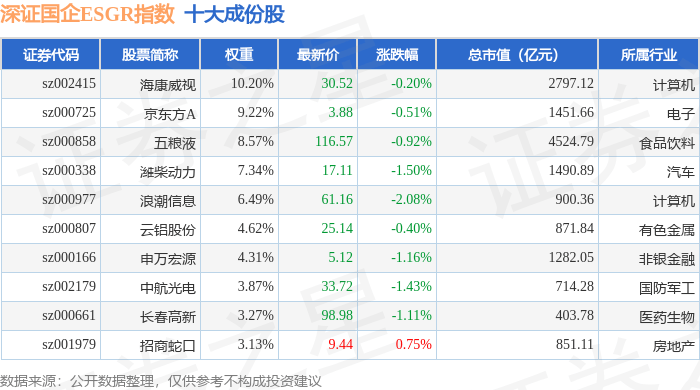
Core Points - The Shenzhen State-owned Enterprise ESGR Index (470055) closed at 1557.84 points, down 0.74%, with a trading volume of 20.645 billion yuan and a turnover rate of 0.89% [1] - Among the index constituents, 18 stocks rose while 30 stocks fell, with Shougang Co., Ltd. leading the gainers at 3.49% and Mango Excellent Media Co., Ltd. leading the decliners at 2.91% [1] Index Constituents - The top ten constituents of the Shenzhen State-owned Enterprise ESGR Index include Hikvision (10.20% weight, latest price 30.52 yuan, market cap 279.712 billion yuan), BOE Technology Group (9.22% weight, latest price 3.88 yuan, market cap 145.166 billion yuan), and Wuliangye Yibin Co., Ltd. (8.57% weight, latest price 116.57 yuan, market cap 452.479 billion yuan) [1] - Other notable constituents include Weichai Power (7.34% weight, latest price 17.11 yuan, market cap 149.089 billion yuan) and Inspur Information (6.49% weight, latest price 61.16 yuan, market cap 90.036 billion yuan) [1] Capital Flow - The net outflow of main funds from the index constituents totaled 1.627 billion yuan, while speculative funds saw a net inflow of 217 million yuan, and retail investors had a net inflow of 1.41 billion yuan [1] - Detailed capital flow for specific stocks shows that Zhongtung High-tech had a main fund net inflow of 14.8 million yuan, while Yanjing Beer experienced a net outflow of 42.176 million yuan from retail investors [2] Recent Adjustments - In the last ten days, the Shenzhen State-owned Enterprise ESGR Index underwent adjustments, adding 15 new stocks and removing 15 stocks [2] - New additions include Yunda Co., Ltd. (market cap 13.746 billion yuan) and Tai Sheng Wind Power (market cap 7.376 billion yuan), while removals include Zhongke Sanhuan and BOE Technology Group [3]


离开深圳:国产机器人的“精度”在长三角
3 6 Ke· 2025-12-02 07:50
Core Insights - The article discusses the contrasting developments in the robotics industry in China, highlighting the rapid production capabilities in the Pearl River Delta and the precision challenges faced in the Yangtze River Delta [1][12] - It emphasizes the importance of precision in robotics, stating that without it, robots cannot perform high-value tasks and will remain limited to basic functions [10][11] Group 1: Robotics Production and Development - The Pearl River Delta, particularly Shenzhen, has made robot manufacturing accessible, leading to a surge in production and a competitive environment [1] - The Yangtze River Delta, including Shanghai, Suzhou, and Hangzhou, focuses on refining the precision and control of robots, which is crucial for their effective operation [1][12] Group 2: Precision Challenges - Robots currently exhibit a disconnect between high intelligence and low physical capability, often resulting in delayed responses and imprecise movements [2][3] - Shanghai is identified as a key location for improving control systems, with innovations like the ViLLA architecture aimed at reducing latency in robotic movements [3][5] Group 3: Hardware and Material Science - Suzhou and Kunshan are recognized for their expertise in hardware precision, addressing issues related to wear and tear in robotic components [6][8] - The article highlights the significance of material science and precision engineering in overcoming the limitations of current robotic technologies [8][11] Group 4: Integration of AI and Lightweight Materials - Hangzhou is noted for its advancements in lightweight materials and AI integration, which enhance the agility and responsiveness of robots [9] - The combination of AI vision and reduced weight is crucial for improving the operational capabilities of robots, allowing them to navigate environments more effectively [9] Group 5: The Importance of Precision in Robotics - Precision is deemed essential for robots to gain respect and perform valuable tasks in industrial settings, with a clear distinction between low and high precision applications [10][11] - The article concludes that achieving high precision requires continuous effort in material science and engineering, emphasizing that shortcuts are not viable in this field [11][12]


工业AI助力制造业智能化转型升级
China Securities· 2025-12-02 05:45
Investment Rating - The report maintains an "Outperform" rating for the computer sector [4] Core Insights - The industrial software sector is experiencing robust growth driven by policy support and technological advancements, with a projected market size of CNY 354.14 billion in 2024, reflecting an 11.2% year-on-year increase [2][21] - The integration of AI with industrial software is accelerating, enhancing capabilities in design, production control, and operational management, which is crucial for achieving the "Made in China 2035" goals [3][49] - The market structure shows a significant presence of foreign companies in high-end segments, while domestic firms are gaining ground in production control and management software due to localized services and cost advantages [25][38] Summary by Sections Policy Support - The "14th Five-Year Plan" emphasizes the importance of intelligent manufacturing, aiming for over 70% digital penetration in large manufacturing enterprises by 2025 [2][18] - Recent policies indicate a sustained commitment to upgrading industrial software and operating systems as core technologies for high-quality development [19][20] Industrial Software Market Growth - The industrial software market is projected to reach CNY 765 billion by 2029, with a compound annual growth rate (CAGR) of 19.1% [2][21] - The market is characterized by a high share of foreign companies in high-end sectors, while domestic firms are making strides in embedded software and management solutions [25][26] AI Integration - AI is transforming industrial software, enabling generative design in CAD and enhancing simulation capabilities in CAE, which improves efficiency and reduces costs [41][42] - The combination of AI with production control systems like DCS and PLC is creating closed-loop intelligent systems that optimize decision-making and enhance production efficiency [44][47] Future Outlook - The report anticipates that industrial software will be a key focus area in the upcoming "15th Five-Year Plan," with policies likely to support breakthroughs in critical areas of design and production control [20][21] - The integration of physical AI is expected to drive advancements in various industries, enhancing simulation and predictive capabilities [66][69]
工信部听取人工智能终端行业协会筹备意见,AI人工智能ETF(512930)备受关注
Xin Lang Cai Jing· 2025-12-02 05:28
Core Viewpoint - The establishment of the China Artificial Intelligence Terminal Industry Association is deemed significant for promoting high-quality development in the AI terminal industry, as discussed in a recent meeting organized by the Ministry of Industry and Information Technology [1]. Group 1: Market Performance - As of December 2, 2025, the CSI Artificial Intelligence Theme Index (930713) showed mixed performance among its constituent stocks, with Zhongke Xingtou (688568) leading with a gain of 2.21%, followed by Xinyi Sheng (300502) at 1.44%, and Jingchen Co. (688099) at 1.29% [1]. - The AI Artificial Intelligence ETF (512930) is currently priced at 2.08 yuan [1]. Group 2: Industry Insights - Dongwu Securities indicates that the current AI development process is primarily driven by large models, with China and the U.S. as the leading regions in the AI industry, both intensifying their investments in infrastructure and hardware [1]. - The global AI industry scale is expected to rapidly surpass previous benchmarks, with AI anticipated to lead a global innovation industry resonance [1]. Group 3: Index Composition - As of November 28, 2025, the top ten weighted stocks in the CSI Artificial Intelligence Theme Index (930713) include Zhongji Xuchuang (300308), Xinyi Sheng (300502), and Cambricon (688256), collectively accounting for 63.92% of the index [2]. - The AI Artificial Intelligence ETF (512930) closely tracks the CSI Artificial Intelligence Theme Index, which selects 50 listed companies involved in providing foundational resources, technology, and application support for AI [1][2].
见好就收?年末基金“攻守战”,基金经理操作不一
Zheng Quan Shi Bao Wang· 2025-12-01 23:44
Core Viewpoint - The market is entering the fourth quarter, with many funds that have accumulated gains throughout the year adopting a defensive stance to lock in profits and mitigate ranking volatility risks [1][5]. Group 1: Fund Performance and Strategy - Several actively managed equity funds, such as Yimin Service Leading, have reportedly reduced their positions to preserve gains, evidenced by their stable net value despite market downturns [2][3]. - The Yimin Service Leading fund, which had a significant portion of its holdings in major stocks, managed to limit its decline to only 0.72% during a market drop, suggesting a strategic reduction in exposure [2][3]. - Historical performance indicates that the Yimin Service Leading fund has successfully navigated market downturns through flexible position adjustments, achieving over 30% returns this year with a maximum drawdown of approximately 6% [2][3]. Group 2: Fund Size and Flexibility - The flexibility in adjusting positions is attributed to the relatively small size of the funds, such as Yimin Service Leading with 44 million yuan and Yimin Advantage Enjoy with 55.53 million yuan, allowing for quicker tactical changes [3]. - Smaller fund sizes enable managers to execute both offensive and defensive strategies more effectively, enhancing their ability to respond to market conditions [3]. Group 3: Market Sentiment and Future Outlook - The fourth quarter is critical for performance evaluation, with institutions shifting focus from generating excess returns to securing existing profits and avoiding volatility [5][6]. - New funds launched in November, such as Ping An New Energy Selection, have shown significant net value changes, indicating a belief in future market performance despite recent volatility [5]. - The market sentiment reflects a divergence in views among institutions regarding future trends, with some optimistic about potential policy stimuli and market resilience [6].
见好就收?年末基金“攻守战”,基金经理操作不一
券商中国· 2025-12-01 23:31
Core Viewpoint - The article discusses the shift in investment strategies among mutual funds as they approach the end of 2025, with many funds adopting a defensive stance to lock in profits and mitigate risks associated with market fluctuations [1][2][3]. Group 1: Fund Performance and Strategy - As the market enters the fourth quarter, many previously high-performing sectors are experiencing volatility, prompting some actively managed equity funds to take profits and reduce positions to preserve gains [3]. - For instance, the Yimin Service Leading Fund, which had significant holdings in companies like BOE Technology Group and Ping An Insurance, managed to limit its decline to only 0.72% during a market downturn, suggesting a possible reduction in its position [3]. - Historical data indicates that the Yimin Service Leading Fund has successfully navigated market downturns by adjusting its positions, achieving over 30% returns this year with a maximum drawdown of approximately 6% [3]. Group 2: Fund Size and Flexibility - The flexibility in adjusting positions is largely attributed to the relatively small size of the funds, such as the Yimin Service Leading Fund with a size of only 44 million yuan, allowing for quicker tactical changes [4]. - Smaller fund sizes enable managers to execute defensive and offensive strategies more effectively, providing an advantage in rapidly changing market conditions [4]. Group 3: Market Sentiment and Future Outlook - Despite the general belief in long-term investment, fund managers are increasingly focusing on tactical adjustments to enhance investor experience amid market volatility [5]. - Some newly established funds are actively entering the market, with 41 new active equity funds launched in November alone, indicating a belief in future market opportunities despite recent fluctuations [6]. - Research from Dongwu Securities highlights that the fourth quarter is crucial for performance, with institutions shifting focus from seeking excess returns to securing existing profits and avoiding ranking volatility [7]. Group 4: Investment Themes and Expectations - The article notes a divergence in views among institutions regarding future market trends, with some expecting sustained benefits from themes like self-sufficiency in industrial chains amid a resilient domestic capital environment [7]. - The expectation of potential policy stimulus in December may lead to stronger domestic market performance compared to overseas markets [7].

12月1日深证国企ESGR(470055)指数涨0.83%,成份股冠捷科技(000727)领涨
Sou Hu Cai Jing· 2025-12-01 10:58
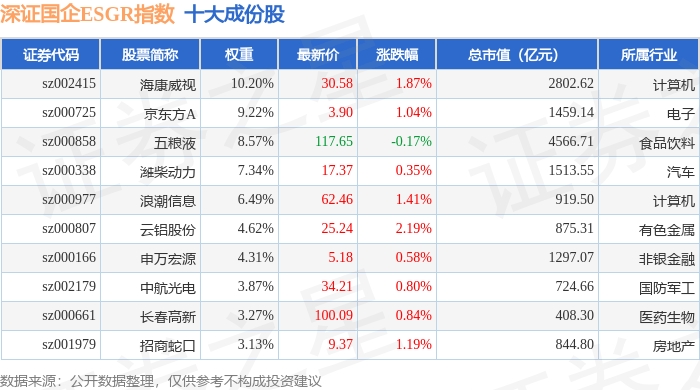
Core Viewpoint - The Shenzhen State-Owned Enterprises ESGR Index (470055) closed at 1569.4 points on December 1, with a gain of 0.83% and a trading volume of 25.363 billion yuan, indicating a positive market sentiment for state-owned enterprises [1] Group 1: Index Performance - The ESGR Index had 32 stocks rising and 16 stocks falling on the reporting day, with the top gainer being AOC Technology, which rose by 9.89%, while Digital Certification led the declines with a drop of 3.22% [1] - The index's turnover rate was 1.02%, reflecting moderate trading activity among investors [1] Group 2: Major Constituents - The top ten constituents of the ESGR Index include Hikvision (10.20% weight, market cap of 280.262 billion yuan), BOE Technology Group (9.22% weight, market cap of 145.914 billion yuan), and Wuliangye Yibin (8.57% weight, market cap of 456.671 billion yuan) [1] - Other notable constituents include Weichai Power (7.34% weight, market cap of 151.355 billion yuan) and Inspur Information (6.49% weight, market cap of 91.950 billion yuan) [1] Group 3: Capital Flow - On the reporting day, the net inflow of main funds into the ESGR Index constituents totaled 599 million yuan, while retail investors experienced a net outflow of 315 million yuan [1][2] - The main funds showed significant interest in AOC Technology with a net inflow of 410 million yuan, while retail investors had a notable outflow of 228 million yuan from the same stock [2] Group 4: Recent Adjustments - The ESGR Index underwent adjustments, adding 15 new stocks and removing 15 stocks, indicating a dynamic rebalancing of the index [3] - New additions include Yunda Co., Ltd. (market cap of 137.46 billion yuan) and Taisheng Wind Power (market cap of 73.76 billion yuan), while notable removals include Zhongke Sanhuan and BOE Technology Group [3]

每周海内外重要政策跟踪(25、11、28)-20251201
Haitong Securities International· 2025-12-01 09:32
Domestic Macro - The National Cooperative Federation of China held its eighth congress on November 24, emphasizing the need for comprehensive reform and development in cooperative services [1][4] - The People's Bank of China announced a 10,000 billion yuan MLF operation on November 25, with a net injection of 1,000 billion yuan to maintain liquidity in the banking system [1][4] - The State Council launched the 14th National Policy Promotion Week to reduce the burden on enterprises on November 25 [1][4] - The National Data Bureau initiated pilot projects for data resource development in 12 state-owned enterprises, focusing on traditional and emerging sectors [1][4] - The Ministry of Commerce and five other departments issued a plan to enhance the adaptability of supply and demand in consumer goods, aiming for significant improvements by 2027 [1][4] Industry Policies - The Ministry of Housing and Urban-Rural Development announced a focus on urban renewal actions in four key areas on November 21 [2][5] - The Ministry of Industry and Information Technology launched commercial trials for satellite IoT services on November 22, supporting the development of new industries [2][5] - The Ministry of Industry and Information Technology initiated the creation of national emerging industry development demonstration bases, aiming to establish around 100 parks and 1,000 enterprises by 2035 [2][5] - The National Space Administration released an action plan to promote high-quality development in commercial aerospace on November 25 [2][5] Local Policies - The Shanghai Municipal Government issued measures to deepen the reform of drug and medical device regulation to promote high-quality development in the pharmaceutical industry on November 24 [6][18] - The Guizhou Provincial Development and Reform Commission held a meeting to address price competition issues on November 25 [6][18] - Guangdong Province introduced a financial support plan for enterprises to conduct industry chain integration and mergers on November 26 [6][18] Overseas Dynamics - The Chinese Foreign Ministry urged Japan to fulfill its commitments to China in practical actions on November 21 [7][20] - The G20 leaders' summit concluded on November 23, emphasizing multilateral cooperation and common development [7][20] - The European Parliament approved the "European Defense Industrial Plan" on November 25, aimed at strengthening the EU's defense capabilities [7][20] - The New Zealand Reserve Bank lowered its benchmark interest rate by 25 basis points to 2.25% on November 26, indicating potential further easing [7][20]




计算机2025年12月研究观点:中美产业布局太空算力,AI科技应用加速突破-20251201
Haitong Securities International· 2025-12-01 06:45
Investment Rating - Investment advice: The report suggests a focus on the accelerating US-China space computing competition, highlighting key companies to watch [3][9]. Core Insights - The US-China space computing race is intensifying, with Musk proposing a space AI satellite plan and Beijing initiating the construction of a gigawatt-level space data center [3][9]. - The US "Genesis Plan" aims to integrate resources from 17 national laboratories to accelerate foundational research in key areas such as nuclear fusion and biotechnology [3][9]. - Chinese companies are demonstrating full-stack AI capabilities, with Alibaba's Qwen app achieving over 10 million downloads and DeepSeek's math model reaching international gold standards [3][9]. Summary by Sections Space Computing Developments - Musk envisions deploying AI computing centers in space within 4-5 years, with plans for 100 gigawatts of solar AI satellites annually, which is equivalent to a quarter of US power [3][9]. - Beijing's plan includes a three-phase approach for the gigawatt-level space data center, focusing on key technology breakthroughs, cost-reducing assembly, and mass production from 2025 to 2035 [3][9]. US Research Initiatives - The "Genesis Plan" was initiated by an executive order in November 2025, aiming to identify 20 national challenges within 60 days and showcase initial results within 270 days [3][9]. - Collaboration with private sector companies like NVIDIA and AMD is part of the plan to enhance computational resources for scientific research [3][9]. Chinese AI Innovations - Alibaba's Qwen app, based on the Qwen3 model, has become one of the fastest-growing AI applications globally, indicating a significant breakthrough in the AI to consumer market [3][9]. - DeepSeek's math model, DeepSeekMath-V2, has introduced a self-verification mechanism, achieving gold-level performance in international competitions [3][9].
AI人工智能ETF(512930)涨超2%,豆包手机助手技术预览版发布
Xin Lang Cai Jing· 2025-12-01 06:02
Core Viewpoint - The AI sector is experiencing significant growth, as evidenced by the strong performance of the Zhongzheng AI Theme Index and related ETFs, driven by advancements in AI technology and infrastructure [1][2]. Group 1: Market Performance - As of December 1, 2025, the Zhongzheng AI Theme Index (930713) rose by 2.05%, with notable gains from constituent stocks such as Beijing Junzheng (300223) up 14.95%, Lexin Technology (688018) up 6.98%, and Runze Technology (300442) up 5.93% [1]. - The AI Artificial Intelligence ETF (512930) also increased by 2.00%, with the latest price reported at 2.09 yuan [1]. Group 2: Technological Developments - On December 1, ByteDance's Doubao team released a technical preview of the Doubao Phone Assistant, an AI assistant software developed in collaboration with smartphone manufacturers, indicating a focus on ecosystem cooperation rather than self-developed phones [1]. - The current phase allows developers and tech enthusiasts to experience the Doubao Phone Assistant on a prototype device in collaboration with ZTE [1]. Group 3: Industry Insights - According to CITIC Securities, the evolution of AI large models towards trillion-parameter, multi-modal, and intelligent agents is pushing traditional architectures to their limits, necessitating a shift to "super-node" architectures [2]. - The NVL72 solution exemplifies this shift, significantly enhancing training efficiency and inference throughput through high bandwidth and low latency interconnections [2]. - The demand for interconnection components such as switching chips, optical modules, and high-speed line modules is expected to shift from linear growth to exponential growth due to this architectural transformation [2]. - There remains substantial room for improvement in domestic AI computing investments compared to overseas, with super-node architecture being essential for catching up in domestic computing infrastructure [2]. Group 4: Index Composition - As of November 28, 2025, the top ten weighted stocks in the Zhongzheng AI Theme Index (930713) accounted for 63.92% of the index, including companies like Zhongji Xuchuang (300308) and Hikvision (002415) [3]. - The AI Artificial Intelligence ETF (512930) closely tracks the Zhongzheng AI Theme Index, which includes 50 listed companies involved in providing foundational resources, technology, and application support for AI [2].