
LG

Search documents
禾盛新材:推动业务向高附加值领域延伸
Zheng Quan Ri Bao· 2025-04-10 16:13
Core Viewpoint - He Sheng New Materials Co., Ltd. has shown strong performance in 2023, with a revenue of 2.526 billion yuan and a net profit of approximately 97.91 million yuan, indicating a year-on-year growth of 7.93% and 18.29% respectively, while focusing on intelligent manufacturing and AI collaboration for future growth [1][5]. Group 1: Financial Performance - In 2023, He Sheng New Materials achieved a revenue of 2.526 billion yuan, representing a year-on-year increase of 7.93% [1]. - The net profit attributable to shareholders was approximately 97.91 million yuan, reflecting an 18.29% increase compared to the previous year [1]. - The company expects a net profit of 48 to 53 million yuan for Q1 2025, indicating a projected growth of 72.14% to 90.07% [5]. Group 2: Business Segments - The composite materials for home appliances generated 2.482 billion yuan in revenue, accounting for 98.25% of total revenue, supported by capacity expansion [2]. - The company has established long-term supply relationships with over 120 well-known domestic and international home appliance brands, including Samsung and Midea [2]. - The production capacity is expected to grow by over 10% in 2024 due to the successful launch of a high-end intelligent composite materials production line [2]. Group 3: Research and Development - R&D expenses reached approximately 85.51 million yuan in 2023, marking a 7.49% increase, which supports product innovation and competitiveness [3]. - The company is focusing on high-performance, green, and intelligent product lines to meet diverse customer needs [3]. Group 4: AI Business Development - He Sheng New Materials is developing AI capabilities through its subsidiary, focusing on hardware and software design, and has initiated collaborations in various sectors including government, finance, and healthcare [4]. - The AI business is in the R&D phase, with products aimed at intelligent computing centers and AI integrated machines [4]. Group 5: Market Environment - The macroeconomic environment in China is improving, with favorable policies for real estate and consumer spending, which is expected to benefit the home appliance materials industry [5]. - The company is facing challenges such as intensified competition and raw material price fluctuations, necessitating ongoing optimization of its business structure and increased investment in technological innovation [5][6].

特斯拉、LG开启磷酸铁锂技术追赶
高工锂电· 2025-04-08 10:35
Core Viewpoint - The importance of lithium iron phosphate (LFP) battery technology is increasingly recognized globally, prompting overseas battery companies to address their shortcomings in this area [1][2]. Group 1: Tesla's Advancements - Tesla's Texas factory has reportedly become the lowest-cost producer among its battery suppliers, likely due to breakthroughs in LFP battery technology [2][5]. - The Texas factory is central to Tesla's strategy for the 4680 battery, with plans for mass production of a dual dry-process version by Q4 2024, which may include LFP variants [5][6]. - Tesla's recent patent for LFP production outlines a more cost-effective method that could produce LFP batteries cheaper than those from China, even without considering tariffs [6][7]. Group 2: LG's Strategic Moves - LG has made significant strides in LFP technology by hiring a core team from a former competitor, aiming to strengthen its capabilities in this field [2][8]. - LG has signed a long-term supply agreement with Changzhou Lithium Source for 160,000 tons of LFP materials from 2024 to 2028, with plans to increase this to 260,000 tons [8]. - LG is also developing a new type of LFP material that reduces costs and environmental impact while improving stability in low temperatures [7][8]. Group 3: Industry Trends and Challenges - Major international automakers, including Stellantis, General Motors, Hyundai, and Volkswagen, are showing strong interest in integrating LFP batteries into their entry-level models [9]. - The geopolitical landscape poses risks to the export of LFP technology, as recent adjustments to China's export control regulations include restrictions on battery cathode material preparation technologies [9].


全固态电池技术路线之争
起点锂电· 2025-04-05 06:30
与车企不同,头部电池企业则针对固态电池态度一般,无论是国内的宁德时代还是国外的LG和松下,均没有贸然说出固态电池前景无限之类 的言论,包括研发过程也是被市场逼问"被迫透露"。 因为汽车企业普遍没有制造电池的经验,电池业内专家也指出想要让固态电池产业化、规模化绝非一朝一夕之事。 因此起点锂电认为欧阳明高院士言论正确:"未来相当一段时间内,液态电池和固态电池是共存关系。" 不过即使固态电池未来不会同大家所想那样拥有三头六臂的六边形战士属性,但产业化依旧在推进,并会在2025年实现技术和产能的新进步, 下面起点锂电将从4个方面来阐述一下固态电池产业化最新进展。 固态电池在实验室中展现出的能量密度和安全性,让新能源汽车和储能企业看到了未来曙光,这正是这些曙光,让当前处于调整期的锂电池产 业链纷纷押注,2025年各企业纷纷摩拳擦掌,力求加快推进产业化进程,向着2027年前目标前进。 作为最关注固态电池进展的车企,也纷纷以身试水,丰田/日产/本田/现代/奔驰/宝马等一众老牌车企先后建立实验室和中试线,国内车厂一汽/ 上汽/广汽/比亚迪也纷纷展开布局。 一汽王德平在公开场合表示,将于2027年实现固态电池小批量应用;比亚迪 ...


美的集团2024风险透视:4091亿营收背后地缘政治风险、智能家居领域红海厮杀、内部管理效率黑洞
Xin Lang Zheng Quan· 2025-04-03 06:37
Core Viewpoint - Midea Group leads the global home appliance market with a revenue of 409.1 billion yuan and a year-on-year growth rate of 9.47%, but faces challenges from geopolitical risks, intense competition in the smart home sector, and internal management inefficiencies [1] Global Expansion - Midea's overseas revenue accounts for 41.92%, but global expansion is fraught with challenges, including competition in Southeast Asia from LG and Samsung, localization challenges in North America, and profit erosion due to exchange rate fluctuations [2] - A sudden change in tariff policies in a specific international market led to a 2.3 percentage point decline in profit margins, while exchange rate changes resulted in a profit loss of approximately 380 million yuan for Midea's overseas business [2] Intensifying Competition - The smart home sector, which contributes 66.2% of Midea's smart home revenue, is highly competitive, with rivals including Huawei, Xiaomi, Haier, and Gree [3] - Midea aims to build a differentiated advantage through a comprehensive smart home solution, but rapid technological changes and evolving user demands pose significant risks [3] - In the B2B market, Midea faces direct competition from international giants like ABB and Fanuc, highlighting gaps in technology reserves, service capabilities, and brand influence [3] Internal Management - Midea's extensive business operations reveal issues such as organizational inefficiencies, resource diversion from non-core businesses, and innovation limitations [4] - The company's main business costs increased by 8.38% year-on-year, which, although lower than the 9.44% increase in main business revenue, still raises concerns [4] - Internal data indicates that decision-making efficiency is severely impacted by lengthy approval processes, with some departments having as many as 12 approval steps [4] Strategic Solutions - To navigate these challenges, Midea is implementing three key strategies: localized deepening of its global strategy, differentiated upgrades in competition, and streamlining internal management [5] - The localization strategy involves integrating R&D, manufacturing, supply chain, sales, logistics, and after-sales service to embed the Midea brand into local markets [5] - The competitive strategy focuses on enhancing scenario-based solutions and creating technological barriers in the smart home sector and B2B business [5] - The internal management strategy aims to break down information silos through a digital transformation initiative and to concentrate resources on core business areas by divesting non-core operations [5] Future Outlook - Midea Group is positioned to navigate the turbulent waters of the global home appliance market by leveraging its strategies of localized deepening, differentiated upgrades, and streamlined focus [6] - The company must remain vigilant, continuously innovate, and prioritize user-centric approaches, technology-driven solutions, and efficiency to thrive in a competitive landscape [6]

最新报告 | 2025年LED市场产值有望增长至130.03亿美元
TrendForce集邦· 2025-03-20 08:17
Core Viewpoint - The global LED market is expected to reach a value of $13.003 billion by 2025, despite rising costs due to tariffs and suppressed consumer demand, with growth in specific sectors like Micro/Mini LED, automotive LED, agricultural lighting, and UV/IR LED [1]. Micro LED Applications - The rapid iteration of AI is driving manufacturers to focus resources on AR devices, with Micro LED monochrome light engines contributing to short-term revenue in head-mounted displays. However, the growth rate is slowing due to a lack of differentiation in monochrome products. Long-term, AI glasses have the potential to expand application scenarios, laying the groundwork for the Micro LED full-color display market [3][4]. Mini LED Displays - The demand for Mini LED (COB) displays is projected to grow rapidly in 2024, with major manufacturers including Samsung, LG, and BOE. Technological advancements have led to a reduction in chip sizes, and the demand for Mini LED wafers is expected to continue its high growth trajectory [6]. Automotive Lighting and Displays - Automotive manufacturers are actively marketing advanced technologies such as adaptive headlights, Mini LED tail lights, and ambient lighting as high-value products. The automotive LED market is expected to grow to $3.509 billion by 2025, despite potential price pressures due to competition and economic uncertainty. However, strong order performance and the introduction of advanced technologies in 2026 are expected to support market recovery [8]. UV LED - UV LEDs offer longer product lifespans and simpler optical designs compared to UV lamps. Companies like Nichia and Seoul Viosys are launching comprehensive UV-A/B/C LED product lines to meet customer needs. The UV LED market is expected to grow due to stable demand in the curing market and advancements in UV-C LED technology for air purification and water sterilization projects [10][11]. Agricultural Lighting - The demand for agricultural lighting LEDs is expected to grow steadily in 2025, driven by the recovery of terminal demand for plant lighting and the application of new technology solutions. Factors such as localized supply of fruits and vegetables, health trends, and government subsidies will support the construction of multifunctional agricultural facilities [13].
Novacium's Silicon-Anode Batteries Exceed 1,000 Cycles, Outperforming Commercial 18650 Cells
Globenewswire· 2025-03-19 11:30
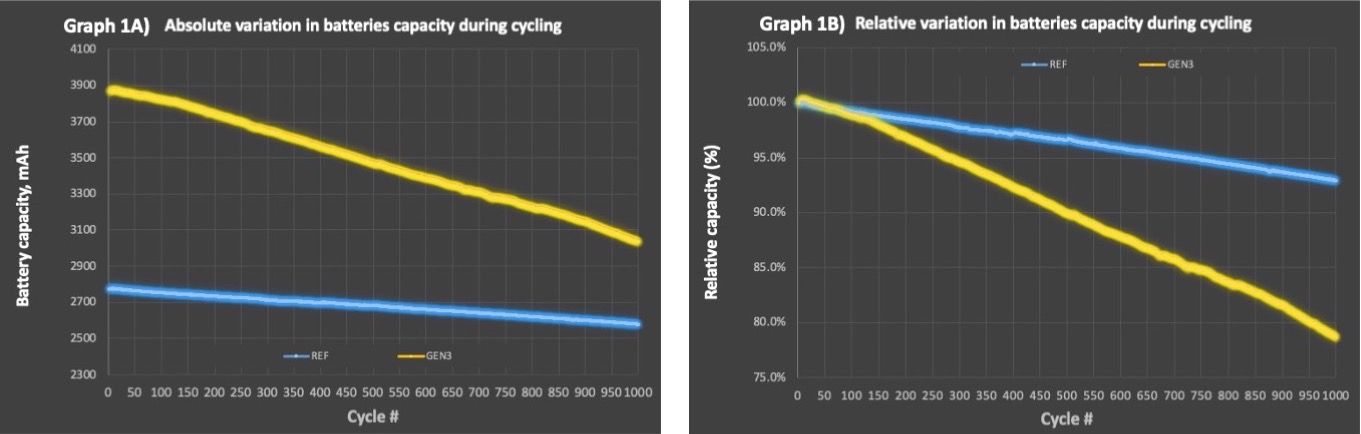
Core Insights - HPQ Silicon Inc. and its affiliate NOVACIUM SAS have achieved significant advancements in battery technology, particularly with the GEN3 silicon-based anode batteries, which maintain over 3,000 mAh capacity after 1,000 cycles, retaining approximately 80% of their original capacity, and outperforming traditional graphite batteries by 18% in capacity [2][7][10]. Battery Performance - The GEN3 batteries exhibit a slow and linear capacity decrease over their lifespan, contrasting with typical batteries that experience rapid capacity loss initially, allowing for better lifetime performance predictions and enhanced overall battery efficiency [3][4]. - At the 1,000-cycle mark, GEN3 batteries deliver around 3,500 Ampere-hours (Ah) compared to approximately 2,700 Ah from graphite-based batteries, indicating over a 30% increase in total energy output [8][9]. Market Position and Growth Potential - The global graphite market is projected to grow from approximately 5.7 million tonnes in 2025 to 11.1 million tonnes by 2030, creating an addressable market for silicon-based materials valued between US$27.5 billion and US$55.0 billion [13]. - HPQ and NOVACIUM's silicon-based materials can replace up to 10% of graphite in existing manufacturing processes without requiring costly retooling, positioning the company to capture 5% to 10% of the total graphite market [12]. Strategic Developments - The company has acquired full ownership of a provisional patent for a one-step manufacturing process for fumed alumina and fumed titanium, essential for next-generation lithium-ion battery cathodes, enhancing its technological capabilities [16][21]. - HPQ's strategy focuses on producing silicon-based materials for the rapidly growing 3C markets (Computer, Consumer, and Communication), projected to grow from a US$12 billion market today to US$38.3 billion by 2030 [15].

三花智控(002050)首次覆盖报告:汽车热管理、机器人,制冷配件龙头不断成长
Guotai Junan Securities· 2025-03-19 11:08
Investment Rating - The report gives an "Accumulate" rating for the company with a target price of 36.29 CNY [2][11]. Core Insights - The company is positioned as a leader in automotive thermal management and a core supplier of components for robotics, continuously expanding its business boundaries and achieving sustained high growth [3][11]. - The report highlights the significant growth potential driven by the electric vehicle market, which is reshaping the supply chain and increasing the value of thermal management components [11][16]. Financial Summary - The company’s revenue is projected to grow from 24.56 billion CNY in 2023 to 34.80 billion CNY in 2026, with a compound annual growth rate (CAGR) of approximately 11.7% [8][18]. - Net profit attributable to the parent company is expected to increase from 2.92 billion CNY in 2023 to 4.31 billion CNY in 2026, reflecting a CAGR of about 14.6% [8][18]. - Earnings per share (EPS) are forecasted to rise from 0.78 CNY in 2023 to 1.16 CNY in 2026 [8][18]. Business Overview - The company has a strong foothold in the refrigeration market, with leading global market shares in key components such as electronic expansion valves and four-way valves [11][25]. - The automotive parts segment is benefiting from the electrification of vehicles, with the value of thermal management components in electric vehicles being approximately three times higher than that in traditional vehicles [11][50]. - The company is also expanding into emerging markets such as energy storage and robotics, which are expected to provide new growth avenues [11][19]. Market Position - The company serves a diverse range of high-profile clients in both the refrigeration and automotive sectors, including major brands like Panasonic, Mitsubishi, and BMW [11][35]. - The report emphasizes the company's commitment to innovation and quality, which has established it as a trusted partner in the global thermal management industry [11][25].

消费提振预期下如何看家电?
2025-03-18 01:38
Summary of Key Points from the Conference Call on the Home Appliance Industry Industry Overview - The conference call focuses on the home appliance industry in China, discussing market trends, retail performance, and investment opportunities in the sector [2][3][4]. Core Insights and Arguments - **Market Style Shift**: There is a notable shift in market style from technology sectors like AI to consumer sectors, driven by consumption-boosting policies [2]. - **Retail Performance**: Home appliance retail is expected to progress in a wave-like manner rather than experiencing sharp declines. The first two months of 2025 are influenced by a short-term pull-forward effect from December, but the overall impact on annual performance is minimal [3][4]. - **Sales Growth Expectations**: Air conditioning shipments are projected to achieve double-digit growth from March to August 2025, supported by promotional seasons and national subsidy policies [3][4]. - **Tariff Concerns**: Concerns regarding tariffs are diminishing, with companies having low exposure to U.S. revenues being less affected. This alleviates valuation pressures on the sector [3][5]. - **Valuation Levels**: White appliance companies are currently valued at historical lows, with Gree at less than 7 times earnings, Midea at about 23 times, and Haier and Hisense around 10 to 11 times [3][6]. - **High-End Brands**: Haier is benefiting from domestic sales transformations and its high-end brand, Casarte, showing strong performance with a 15% year-on-year growth in air conditioning installations in January-February 2025 [3][8]. Additional Important Insights - **Black and Kitchen Appliances**: The black appliance sector is benefiting from trends like larger screens and increased Mini LED penetration, while kitchen appliances are seeing growth due to the release of second-hand homes in first-tier cities [3][9]. - **Export Performance**: In 2024, China's home appliance exports exceeded $100 billion, marking a 14% year-on-year increase. The first two months of 2025 also show a 6% increase in export value [3][20]. - **Competitive Landscape**: The competitive landscape in the home appliance market remains robust, with retail subsidies expected to reach 80-100 billion yuan, driving growth in the sector [10][21]. - **Investment Recommendations**: Recommended investment targets include low-valuation, high-dividend white appliance companies like Gree, Haier, Hisense, and Midea, which are expected to benefit from domestic sales recovery and consumption-boosting policies [7][21]. Conclusion - The home appliance industry in China is poised for growth, supported by favorable market conditions, improving retail performance, and strategic investment opportunities. The focus on consumer spending and government support is expected to drive positive trends in both domestic and export markets [2][20][21].
未来5年,中国将至少需要数万名出海领航者
吴晓波频道· 2025-03-18 00:31
Core Viewpoint - The article emphasizes the accelerating globalization of Chinese enterprises, highlighting their growing influence in the global market and the challenges they face in international expansion [3][6]. Group 1: Global Expansion of Chinese Enterprises - Chinese companies are increasingly becoming significant players in global business, with examples such as Mixue Ice City surpassing McDonald's and Starbucks to become the largest chain restaurant globally [4] - BYD has overtaken Tesla to become the world's largest manufacturer of pure electric vehicles [5] - Miniso's flagship store in New York achieved over one million in daily sales, showcasing the potential of Chinese brands abroad [6] Group 2: Challenges Faced by Chinese Companies - The article discusses various challenges encountered by Chinese companies during their international ventures, including hidden costs in local land policies and cultural conflicts leading to high turnover of overseas executives [6] - New regulations, such as the EU's carbon emission laws, pose risks that could jeopardize years of overseas planning [6] Group 3: Importance of Leadership in Globalization - Successful international expansion requires experienced leaders, referred to as "navigators," who can guide companies through the complexities of foreign markets [7] - The article outlines the need for a significant number of skilled leaders and managers to support the globalization of Chinese enterprises, including hundreds of leaders for Fortune 500 companies and millions of mid-level and grassroots managers [9] Group 4: Training and Development for Global Leaders - To support Chinese companies in their international endeavors, a "Navigator Training Program" has been established to cultivate leaders with global perspectives and practical skills [12] - The program focuses on a comprehensive curriculum covering all aspects of international business, from strategy formulation to operational execution, aiming to reduce risks and enhance decision-making capabilities [12][16] - The training includes real-world case studies and practical exercises to ensure that participants can apply their learning effectively [12][13] Group 5: Course Details and Structure - The Navigator Training Program spans four months, with a focus on intensive learning and practical application, including a field trip to Southeast Asia [19] - The program is designed for company founders, executives, and managers involved in international operations, with limited enrollment to ensure personalized attention [19]
天山电子分析师会议-2025-03-18
Dong Jian Yan Bao· 2025-03-17 23:30
Investment Rating - The report does not explicitly state an investment rating for the optical optoelectronics industry or the specific company involved [1]. Core Insights - The company, Tianshan Electronics, is focusing on the automotive electronics sector, developing products such as VA modules and TFT modules, which have superior viewing angles and response times compared to traditional displays. These products are already being used by well-known automotive brands like BYD and Dongfeng [17][18]. - The "Lingshan Base" is expected to significantly contribute to the company's performance through the production of monochrome and color LCD modules, as well as touch screens. The base is currently in the capacity ramp-up phase and aims to complete its construction by the end of 2025 [18][19]. - The company has implemented a dual mechanism of "incentives + repurchase" to enhance its long-term incentive structure, which includes a restricted stock incentive plan approved in 2024 [19]. - The liquid crystal display industry is evolving towards high resolution, low power consumption, and ultra-narrow bezels, driven by advancements in 5G, IoT, and smart wearable technologies. The company aims to position itself in high-growth segments such as smart home interaction screens and automotive electronics [20]. Summary by Sections 1. Basic Research Information - The research was conducted on Tianshan Electronics in the optical optoelectronics industry on March 17, 2025, with participation from various financial institutions [13]. 2. Detailed Research Institutions - The research involved multiple institutions including Western Securities, E Fund, and others, with representatives from each participating [14]. 3. Research Institution Proportions - The report does not provide specific data on the proportions of research institutions involved [15]. 4. Main Content Information - The company is focusing on strategic development in the automotive electronics sector and has established a strong product matrix at its "Lingshan Base" to meet growing market demands in various fields [17][18]. - The company has formed long-term partnerships with major players in the industry, enhancing its competitive edge and customer loyalty through customized solutions [20]. - The establishment of an industry fund aims to promote technological upgrades and strengthen resource collaboration within the electronic information industry [21][22].