
奇瑞汽车

Search documents
具身智能“不客气”!下一个10万亿赛道,奇瑞靠什么已领跑?
梧桐树下V· 2025-12-16 11:28
Core Viewpoint - The humanoid and intelligent service robot sector is recognized as a potential $10 trillion market, with Chery Automobile positioning itself as a leader by achieving mass production and delivery of robots, marking a significant technological and strategic advancement in the industry [1][18]. Group 1: Chery's Strategic Positioning - Chery has successfully completed the mass production of 220 Mornine humanoid robots by April 2025, becoming the first automotive company globally to achieve this milestone [1]. - The company has also delivered over 1,000 units of its Argos robotic dog, indicating a new phase of large-scale application [1]. - Chery's strategic focus on technology-driven growth has allowed it to ignite a second growth engine beyond its core automotive business [1][6]. Group 2: Technological Advancements - The Mornine robot has transitioned from a promotional virtual image to a functional intelligent assistant capable of executing tasks in real environments, achieving a technological leap from L2 to L3 capabilities [3]. - Chery's "Intelligent Construction of the Whole Domain" technology system supports the Mornine robot's advanced features, including multi-modal perception and independent task execution [3][9]. - The integration of automotive and robotic technologies allows for significant cost reductions in research and manufacturing, leveraging shared resources and expertise [8][9]. Group 3: Market Expansion Strategy - Chery has outlined a three-step strategy for expanding the Mornine robot's application: deepening automotive scenarios, expanding into public services, and ultimately entering household services [4]. - The company aims to sell over 40,000 robots and 90,000 robotic dogs by 2030, targeting a significant scale-up in production and market presence [4]. - Chery's robots have already been deployed in over 30 countries, including Malaysia, Indonesia, and the UAE, showcasing their global reach [13]. Group 4: Globalization and Market Penetration - Chery's established global channels and strong export performance, with 136,700 vehicles exported in November 2025 alone, provide a solid foundation for its robot business [12]. - The company has built a robust global operational system, with over 18.28 million users worldwide, facilitating the rapid entry of its robots into international markets [12]. - Chery's robots have received essential certifications for entry into the European market, further enhancing their global competitiveness [13]. Group 5: Financial Performance and Market Recognition - Chery's automotive sales reached 2.5615 million units in the first eleven months of 2025, with a notable 69.4% increase in electric vehicle sales [14]. - The company's diverse brand matrix supports its financial strength, providing resources for the development and market expansion of its robotic business [17]. - Analysts have recognized Chery's strategic positioning and growth potential, with positive ratings reflecting confidence in its long-term value [14].


创建可持续品牌,9家中国领军企业走进联合国
2 1 Shi Ji Jing Ji Bao Dao· 2025-12-16 11:08
Group 1 - The "Creating Sustainable Brands" vision initiative was officially launched by nine leading Chinese companies at the UNEP headquarters in Nairobi, showcasing China's commitment to sustainable transformation on an international platform [1][5] - This initiative, also known as the "Geneva Vision Initiative," was co-launched by the Sustainable Business Leaders Forum (SBLF) and the China Standardization Association's Sustainable Business and Brand Committee (SBBC) [2] - The initiative aims to find representative cases that deeply integrate sustainable development with brand value creation, providing actionable methods for the global sustainable business ecosystem [5][7] Group 2 - The initiative outlines a systematic approach for companies to incorporate sustainable development into their business and brand value creation, advocating actions in five main areas: integrating sustainability into corporate strategy, establishing responsible business operations, leveraging technological innovation, enhancing product and service sustainability, and incorporating sustainability into brand building [7][8] - This five-dimensional framework addresses common challenges faced by companies in their sustainable exploration efforts [8]






加速头部主动降噪品牌BRISONUS规模化,苏州国芯加码华研慧声
半导体芯闻· 2025-12-16 10:57
Core Viewpoint - Huayan Huisheng (Suzhou) Electronics Technology Co., Ltd. has received a new round of strategic investment from Suzhou Guoxin Technology Co., Ltd. (688262.SH) to accelerate the implementation of in-vehicle active noise cancellation solutions and advance the research and development of AI acoustic algorithms and applications [1] Group 1 - The funding will focus on building an AI intelligent acoustic system centered around "acoustic scenarios," achieving a full-link upgrade from algorithm models to hardware systems [1] - Huayan Huisheng has established itself as a leading provider of system-level in-vehicle acoustic solutions, continuously innovating in automotive cabin space acoustic active control technology [1] - The company has developed a "3D active noise cancellation" and "spatial immersive audio" strategy, leveraging "massive data + customized algorithms" to create the "boundaryless sound" acoustic brand, gradually building a commercial moat [1] Group 2 - Over the past three years, Huayan Huisheng has provided dozens of model developments for major OEMs, including SAIC, Chery, Geely, FAW Group, Xiaopeng Motors, Ford, and Volkswagen [2] - The company launched its RNC road noise active cancellation technology in June 2024, achieving a peak noise reduction of over 10 decibels and marking a local breakthrough in the field [2] - By October 2025, Huayan Huisheng had delivered over 150,000 RNC systems, leading the market share in China and ranking among the top three globally [2] Group 3 - In March 2025, the domestic high-performance audio DSP chip CCD5001 developed by Suzhou Guoxin was successfully mass-produced, designed specifically for in-vehicle acoustic control scenarios [3] - The CCD5001 chip features a 12nm process and HIFI5 core, with a single-core computing power of 6.4 GFLOPS, filling a market gap in domestic high-performance DSP chips for vehicles [3] - The renewed investment from Guoxin Technology reflects strong confidence in the future strategic direction focused on intelligent acoustics [3]


航天智造(300446) - 投资者关系活动记录表
2025-12-16 08:14
Group 1: Automotive Parts Business Performance - The company's automotive parts sales revenue increased by 25% year-on-year in the first nine months of 2025, surpassing the passenger car sales growth rate of 13.7% [2][3] - Key advantages contributing to this growth include strong customer resources and brand partnerships with major manufacturers like Geely, Changan, and BYD [2][3] - The company has established a comprehensive industrial layout with over 20 production bases, ensuring rapid response to customer demands [3] Group 2: Military Products and Future Projections - Military product revenue reached 673.38 million yuan in the first half of 2025, reflecting a growth of 6.96% compared to the previous year [4] - An upgraded automation project for military explosive materials is expected to be operational by September 30, 2026, with projected annual revenue of 15 million yuan [4] Group 3: New Materials and High-Performance Functional Materials - The company’s weather-resistant functional materials, primarily used in high-end applications, generated sales revenue of 39.52 million yuan in the first half of 2025 [5] - High-performance functional materials sales reached 105 million yuan in the same period, focusing on domestic substitution and innovative product development [5] Group 4: Strategic Development Plans - The company has proposed a "1334" development strategy aimed at becoming a world-class aerospace intelligent equipment manufacturer [5] - Plans for capital operations and industrial development are in place to enhance the company's growth and market position [5]

中国车企,“巴”握未来
Zhong Guo Qi Che Bao Wang· 2025-12-16 07:01
Core Insights - Chinese automotive companies are making significant strides in the Brazilian market, showcasing a strong commitment to local production and market penetration [1][5][10] Group 1: Company Developments - GAC International made its debut at the São Paulo International Motor Show, presenting its full range of models, while BYD's Tengshi brand launched its flagship models Z9GT and D9 in Brazil [1][3] - Geely and Renault announced plans to double their local production in Brazil through a joint venture, investing 38 billion Brazilian Reais (approximately 10.5 billion RMB) to enhance their electric vehicle offerings [3][9] - Avita officially entered the Latin American market with the launch of Avita 11, partnering with CAOA Group for comprehensive market support [4] Group 2: Market Potential - Brazil, as the sixth-largest automotive market globally, is experiencing growth driven by a population of over 200 million and an expanding middle class, making it a key target for global automotive companies [5][10] - The Brazilian automotive market is projected to see a 5% increase in sales by 2025, reaching 2.765 million vehicles, with a 7.8% rise in production [5][6] Group 3: Electric Vehicle Growth - The electric vehicle segment in Brazil is rapidly expanding, with a projected 90% increase in sales for electric vehicles in 2024, reaching 177,000 units [6][7] - Chinese companies dominate the electric vehicle market in Brazil, holding a 76% market share as of October 2025, with BYD leading in monthly sales [6][7] Group 4: Policy and Regulatory Environment - Brazilian government policies are catalyzing the shift towards electric vehicles, with incentives and tax benefits aimed at increasing the share of electric vehicles to 30% of total sales by 2030 [7][8] - The government is also implementing import tariffs on electric vehicles to encourage local production, effective from January 2024 [7] Group 5: Strategic Approaches - Chinese automotive companies are adopting differentiated strategies in Brazil, with some focusing on full localization of production, while others, like Geely and Renault, are leveraging partnerships for quicker market entry [8][9] - The establishment of local production facilities is expected to enhance the supply chain for electric vehicle components, further solidifying Brazil's role as a hub for Chinese automotive companies in Latin America [10]




传统车企孵化智驾企业缘何走到尽头
Zhong Guo Qi Che Bao Wang· 2025-12-16 06:50
Core Viewpoint - The decline of independent intelligent driving companies incubated by traditional automakers, such as Haomo Zhixing, highlights the challenges and inefficiencies in the current market, leading to a shift towards more collaborative and cost-effective solutions [1][10][13]. Group 1: Haomo Zhixing's Decline - Haomo Zhixing announced a complete work stoppage starting November 24, 2024, due to its operational status, with indications of significant layoffs and management departures since 2024 [3][4]. - The company, which originated from Great Wall Motors in 2019, had once been a leading player in the intelligent driving sector, achieving a valuation exceeding $1 billion and planning an IPO in 2025 [4][5]. - Despite initial successes, Haomo Zhixing's actual deployment of its NOH system was limited to only three cities by the end of 2023, falling behind competitors [5][6]. Group 2: Industry Trends and Challenges - The trend of traditional automakers dissolving or integrating their independent intelligent driving subsidiaries, such as the dissolution of Dazhuo Intelligent and the integration of Zero束 Technology into SAIC, reflects a broader industry shift towards consolidation and collaboration [7][8]. - The low return on investment for these independent companies has led automakers to reconsider their support, especially in light of more cost-effective third-party solutions [10][11]. - The competitive landscape has evolved, with over 80% of domestic automakers opting for partnerships with established tech firms like Huawei, indicating a preference for collaborative models over independent development [14][15]. Group 3: Future Directions - The industry is moving towards a hybrid model of "self-research + cooperation," allowing traditional automakers to leverage their manufacturing strengths while addressing technological gaps through partnerships [15]. - The market is increasingly favoring third-party intelligent driving solutions, as evidenced by the dominance of companies like Momenta and Huawei in the NOA market, which has shifted the focus back to core automotive manufacturing [14][15].

“俄版谷歌”,正帮中国商人大赚
Di Yi Cai Jing Zi Xun· 2025-12-16 05:27
Group 1 - The rise of trade between China and Central Asian countries has created opportunities for Russian companies, particularly Yandex, to assist Chinese businesses in penetrating these markets [2][9] - Yandex, often referred to as the "Russian Google," is leveraging its strong position in the Central Asian Russian-speaking market to attract more Chinese clients [2][8] - The demand for Chinese products and services in Central Asia is increasing, with many Chinese companies exploring opportunities in countries like Kazakhstan and Uzbekistan [5][6] Group 2 - Kazakhstan serves as a strategic hub for Chinese companies under the Belt and Road Initiative, with a noticeable increase in Chinese advertisements and businesses in cities like Almaty [3][5] - The retail e-commerce market in Kazakhstan is experiencing significant growth, with a projected transaction volume of 1.45 trillion tenge in the first half of 2024, reflecting a 61% year-on-year increase [10] - Yandex Ads is actively targeting Chinese advertisers, with a reported 76% increase in the number of ads and a 192% increase in advertising spending in Kazakhstan by 2025 [10][11] Group 3 - The transition of traditional energy economies in Russia and Central Asia towards digital and renewable technologies presents new opportunities for Chinese companies, especially in the automotive sector [12][14] - Chinese automotive brands are gaining traction in Russia, with a 48% year-on-year increase in total vehicle sales expected in 2024, highlighting the growing acceptance of Chinese vehicles among Russian consumers [15] - Yandex is collaborating with Chinese automotive manufacturers to integrate its software into vehicles, enhancing their appeal in the Russian and Central Asian markets [15]

11月乘用车市场销量分析:新能源逆势增长 头部品牌领跑赛道
Zhong Guo Zhi Liang Xin Wen Wang· 2025-12-16 05:09
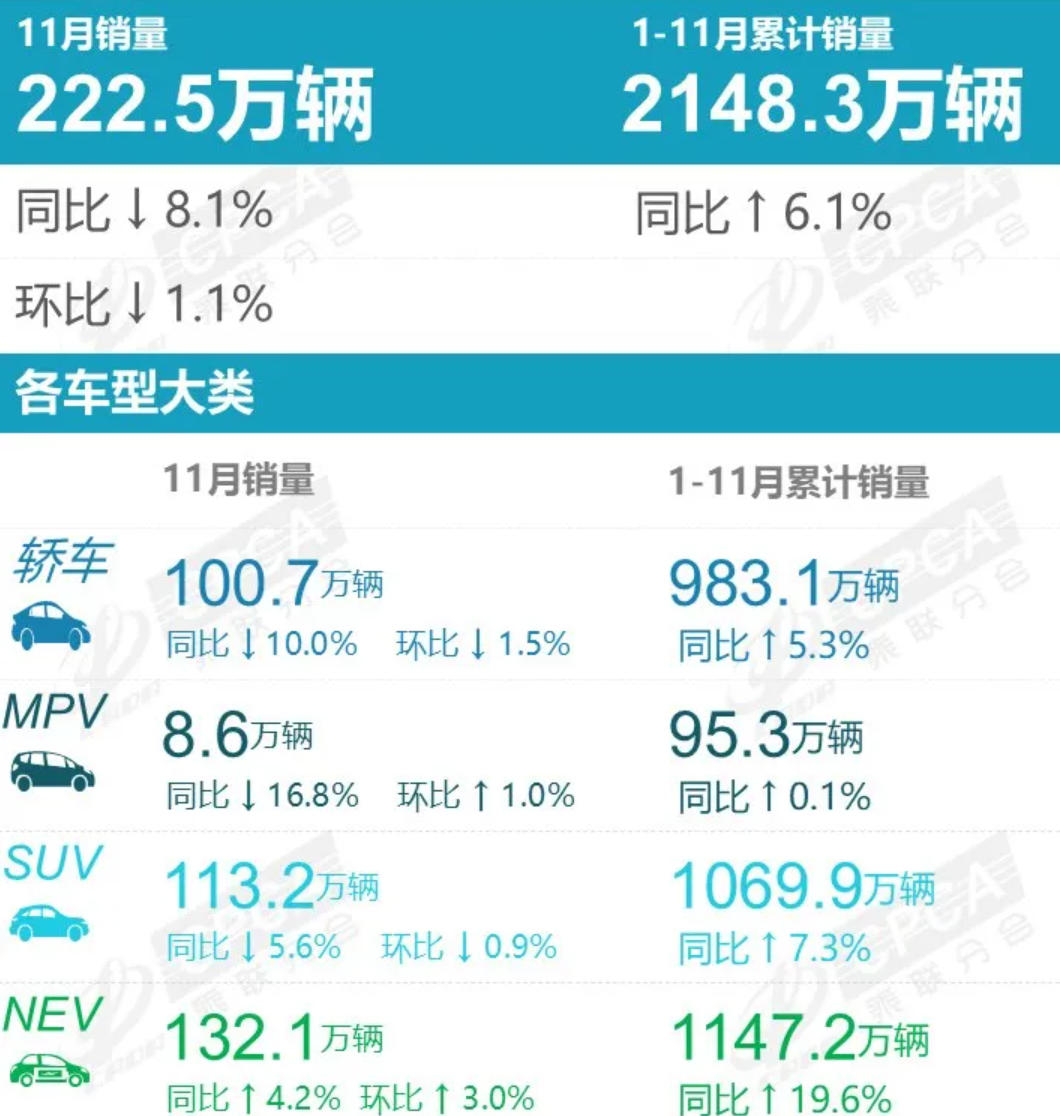
Group 1: Overall Market Performance - In November, the domestic passenger car market faced pressure, with retail sales reaching 2.225 million units, a year-on-year decline of 8.1% and a month-on-month decline of 1.1% [1] - The new energy vehicle (NEV) market, however, showed resilience with sales of 1.321 million units, a year-on-year increase of 4.2% and a month-on-month increase of 3.0%, achieving a penetration rate of over 59% [1] Group 2: Segment Performance - The sedan market saw retail sales of 1.007 million units, down 10.0% year-on-year and slightly down 1.5% month-on-month, with NEV sedans becoming a key growth point [4] - The MPV market was the weakest segment, with retail sales of 86,000 units, a year-on-year decline of 16.8% and a slight month-on-month increase of 1.0% [4] - The SUV market, while also facing year-on-year declines, performed better than sedans and MPVs, with retail sales of 1.132 million units, down 5.6% year-on-year and down 0.9% month-on-month; NEV SUVs sold 683,000 units, up 12.5% year-on-year [4] Group 3: Brand Performance - Among the top ten manufacturers, five were domestic brands, capturing 61% of the total market sales; domestic brands sold 1.49 million units, down 4% year-on-year, while joint venture brands sold 490,000 units, down 19% [4] - BYD led the sales with 306,561 units, although it experienced a year-on-year decline of 26.5% [7] - Geely ranked second with sales of 268,337 units, showing a year-on-year increase of 23.5%, becoming the fastest-growing company among the top brands [9] Group 4: Competitive Landscape - The German brands, particularly FAW-Volkswagen, maintained a stable performance in the shrinking joint venture market, with retail sales of 137,500 units [5] - SAIC Volkswagen's sales were 86,857 units, down 29.3% year-on-year, but it still retained a solid base in the fuel vehicle market [6] - New entrants like Hongmeng Zhixing and Xiaomi Auto showed significant growth, with Hongmeng Zhixing achieving a year-on-year increase of 95.2% [11][18] Group 5: Future Outlook - The market is expected to enter a phase of aggressive sales push in December, with domestic brands likely to maintain their lead in the NEV sector [18] - The competition is shifting from traditional product competition to a focus on technological strength and product quality, indicating a trend towards high-quality development in the automotive industry [18]
AI技术爆发 汽车业迎智能化革命
Zhong Guo Qi Che Bao Wang· 2025-12-16 02:25
Core Insights - The automotive industry is entering an era of universal intelligent driving by 2025, with AI technology deeply integrated into smart cockpits and autonomous driving, marking a significant transformation in the sector [2][3] Group 1: Intelligent Driving and AI Integration - "Intelligent driving equity" has emerged as a key theme, with traditional automakers and new players racing to adopt advanced driving systems, leading to the prediction of 2025 as the "year of universal intelligent driving" [3] - BYD has launched its self-developed "Tianshen Eye" advanced driving system, enhancing the driving experience across its entire model range and supporting sales growth [3] - The overall cost of intelligent driving has significantly decreased due to technological advancements, enabling systems to be integrated into vehicles priced around 100,000 yuan or lower [3][6] Group 2: VLA Model and Its Advantages - The introduction of VLA (Visual Language Action) models by various automakers signifies a trend in intelligent driving, addressing the unpredictability of traditional end-to-end models [4][5] - VLA models enhance the ability to handle complex scenarios and provide interpretability in decision-making, mimicking human driving logic [5] - Companies like Li Auto have upgraded their systems to VLA architecture, improving spatial understanding and communication capabilities [5] Group 3: Robotaxi Commercialization - The commercial application of L4-level autonomous taxis (Robotaxi) is accelerating, with cities like Shanghai seeing the deployment of driverless vehicles [7] - The Robotaxi market in China is projected to grow from $54 million in 2025 to $47 billion by 2035, with over 50,000 Robotaxis expected to operate in more than 10 cities by 2030 [8] - Companies like Xiaoma Zhixing and Wenyan Zhixing reported significant revenue growth in their Robotaxi businesses, indicating a rapid commercialization trend [9][10] Group 4: Emerging Technologies and Opportunities - The automotive industry is also focusing on embodied intelligence, flying cars, and humanoid robots as new opportunities for growth by 2025 [11][12] - The development of flying cars is seen as a transformative innovation in transportation, with companies targeting 2026 for mass production [12] - The integration of industrial internet technologies in automotive manufacturing is redefining production processes and driving the shift towards intelligent manufacturing [12][13]
AI技术爆发,汽车业迎智能化革命
Zhong Guo Qi Che Bao Wang· 2025-12-16 01:41
Core Insights - The automotive industry is entering an era of universal intelligent driving by 2025, with AI technology deeply integrated into smart cockpits and autonomous driving, marking a significant transformation in the industry [2][3] - "Intelligent driving equity" has emerged as a key theme, with traditional automakers and new players racing to adopt advanced driving systems, indicating a shift towards a more accessible intelligent driving experience for consumers [3][4] Industry Trends - The introduction of advanced driving systems like BYD's "Tian Shen Zhi Yan" and XPeng's XNGP system is enhancing the driving experience and supporting sales growth [3] - The overall cost of intelligent driving technology is decreasing, enabling its adoption in more affordable vehicles, thus broadening consumer access [3][4] - The VLA (Visual Language Action) model is becoming a highlight in automotive intelligence, offering better handling of complex scenarios and improving the interpretability of driving decisions [4][5] Market Dynamics - The Robotaxi market is accelerating, with companies like Pony.ai and Baidu obtaining operational licenses in major cities, indicating a rapid commercialization of autonomous taxi services [6][7] - The Chinese Robotaxi market is projected to grow from $54 million in 2025 to $47 billion by 2035, with over 50,000 Robotaxis expected to operate in more than 10 cities by 2030 [7][8] Financial Performance - Companies like Pony.ai and WeRide are reporting significant revenue growth, with Pony.ai's Robotaxi business revenue increasing by 89.5% year-over-year, reflecting the rapid commercialization of autonomous driving [8][9] Technological Innovations - The emergence of embodied intelligence, flying cars, and humanoid robots is becoming a focus for automotive companies, with significant advancements in these areas expected by 2025 [9][10] - The integration of industrial internet technologies is redefining automotive manufacturing, enhancing efficiency and quality while reducing costs [10][11] Policy and Regulation - The Chinese government is actively promoting the development of intelligent connected vehicles through various policies, which are expected to guide the industry's growth and ensure compliance with safety standards [12][13] - Recent policies emphasize the importance of a structured approach to the commercialization of intelligent driving technologies, aiming to prevent over-marketing and ensure reliability [13][14]


