上海家化

Search documents
2025年中国烟酰胺行业生产方法、产业链、市场规模、竞争格局及未来前景:随着食品、医药和化妆品等下游需求持续增长,行业将迎来更广阔的发展空间[图]
Chan Ye Xin Xi Wang· 2025-07-11 01:26
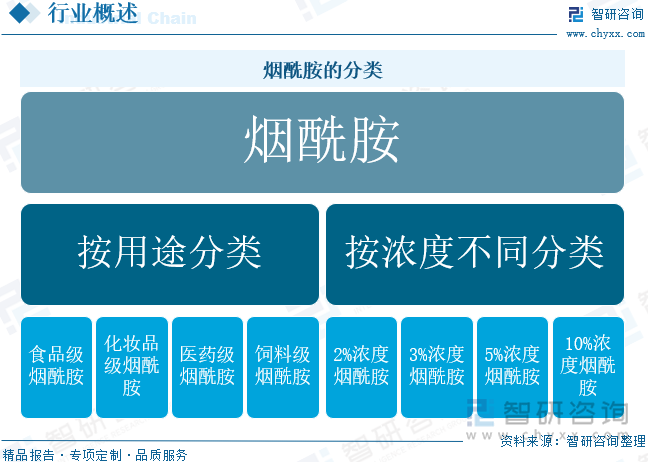
Core Insights - Nicotinamide, an important member of the B-vitamin family, has diversified applications in the food, pharmaceutical, and cosmetic industries, driven by its nutritional enhancement and functional characteristics [1][15] - The market size of the nicotinamide industry in China is projected to reach approximately 2.535 billion yuan in 2024, with a year-on-year growth of 17.26% [1][15] - The industry is expected to benefit from the ongoing "Healthy China" strategy and the increasing consumer demand for functional products, indicating a broader development space in the future [1][15] Industry Overview - Nicotinamide, also known as niacinamide, is a white crystalline powder with a molecular weight of 122.125, primarily used in clinical settings for the prevention and treatment of various health issues [3] - The industry can be segmented into food-grade, cosmetic-grade, pharmaceutical-grade, and feed-grade nicotinamide, with varying concentrations available [3] Production Methods - Three main production methods for nicotinamide include oxidation of β-methylpyridine to niacin, dehydration of niacin with ammonium hydroxide, and a reaction involving niacin, boric acid, and ammonia [5][11] Applications and Benefits - Nicotinamide is recognized for its anti-acne, anti-inflammatory, whitening, and anti-aging properties, making it a popular ingredient in skincare products [7][8] - In the pharmaceutical sector, it is crucial for treating conditions related to niacin deficiency, while in cosmetics, it enhances skin barrier function and moisture retention [9][12] Industry Chain - The nicotinamide industry chain includes upstream raw material supply, midstream production and processing, and downstream applications in pharmaceuticals, cosmetics, and food [9] - Key raw materials include 3-cyanopyridine, niacin, ammonia, and solvents, with production methods involving chemical synthesis or fermentation [9] Market Dynamics - The global nicotinamide industry exhibits a tiered competitive landscape, with leading companies like Lonza, Vantiv, and Brother Technology dominating the market [17][19] - Brother Technology is identified as a leading domestic player, focusing on the production and sales of nicotinamide and niacin products across various sectors [19][21] Future Trends - The industry is shifting towards high-value products, with a focus on technological innovation and product upgrades to enhance purity and bioavailability [26][28] - The application of nicotinamide is expanding into new areas such as oral beauty products and functional foods, driven by consumer trends and interdisciplinary research [27][28]


A500ETF嘉实(159351)红盘蓄势,机构:降准降息仍有空间,A股稳中向上趋势不变
Xin Lang Cai Jing· 2025-07-09 03:15
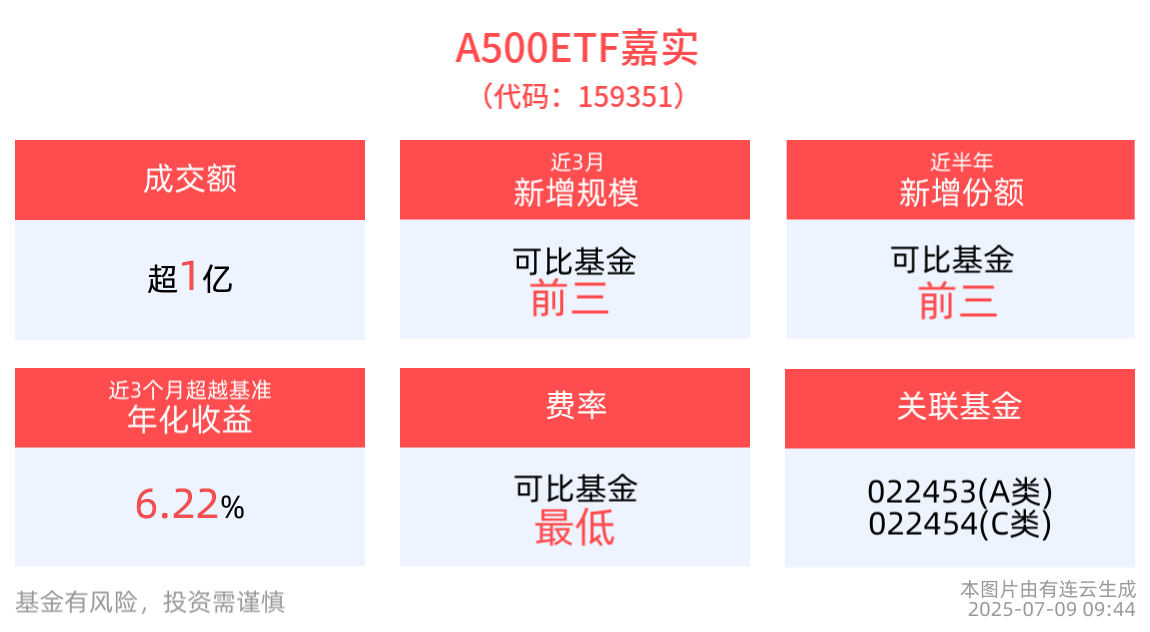
Group 1 - A500ETF Jia Shi has a turnover rate of 1.12% and a transaction volume of 165 million yuan, with an average daily transaction of 3.062 billion yuan over the past month as of July 8 [3] - The scale of A500ETF Jia Shi has increased by 272 million yuan over the past three months, and the number of shares has grown by 1.26 billion shares over the past six months [3] - As of July 8, A500ETF Jia Shi's net value has risen by 7.05% over the past six months, with the highest monthly return since inception being 3.55% and an average monthly return of 2.05% [3] Group 2 - The top ten weighted stocks in the CSI A500 Index as of June 30 include Kweichow Moutai, CATL, Ping An Insurance, and others, accounting for a total of 20.67% [3] - The market is expected to provide structural opportunities despite the index nearing new highs, with July historically being a strong month for market performance [4] - The central bank is anticipated to have room for rate cuts in the second half of the year, supporting a stable upward trend in A-shares [4] Group 3 - Investors without stock accounts can access the A500ETF Jia Shi linked fund (022454) for exposure to the top 500 A-share companies [7]





上海家化: 上海家化2025年员工持股计划第一次持有人会议决议公告
Zheng Quan Zhi Xing· 2025-07-04 16:12
Core Points - The company held the first meeting of the 2025 Employee Stock Ownership Plan (ESOP) on July 4, 2025, with 44 participants representing 72,505,293 shares, accounting for 100% of the total subscription and 99.58% of the initial grant [1][2] - The meeting approved the establishment of a management committee for the 2025 ESOP to ensure smooth operation and protect the rights of the holders [1] - The committee consists of three members, with a term aligned with the duration of the ESOP, and the first meeting elected Dong Xiaoyou as the committee chair [2] - The management committee is authorized to handle various matters related to the ESOP, including convening meetings, managing accounts, exercising shareholder rights, and overseeing asset management [2][3]

上海家化(600315) - 上海家化2025年员工持股计划第一次持有人会议决议公告
2025-07-04 09:30
本公司董事会及全体董事保证本公告内容不存在任何虚假记载、误导性陈述或者重大 遗漏,并对其内容的真实性、准确性和完整性承担法律责任。 上海家化联合股份有限公司(以下简称"公司")2025 年员工持股计划第一 次持有人会议于 2025 年 7 月 4 日以现场结合通讯表决的方式召开。会议由公司 首席财务官兼董事会秘书罗永涛先生召集和主持,出席本次会议的持有人 44 人, 代表 2025 年员工持股计划份额 72,505,293 份,占公司 2025 年员工持股计划首次 认购总份额的 100.00%,占公司 2025 年员工持股计划首次授予份额的 99.58%。 会议的召集、召开和表决程序符合公司 2025 年员工持股计划的有关规定。会议 以记名投票表决方式,审议通过了以下议案: (一) 审议通过《关于设立公司 2025 年员工持股计划管理委员会的议案》 证券代码:600315 证券简称:上海家化 公告编号:临 2025-041 上海家化联合股份有限公司 2025 年员工持股计划第一次持有人会议决议公告 表决结果:同意 72,505,293 份,占出席持有人会议的持有人所持份额总数的 100.00%;反对 0 份, ...
复兴上海家化,林小海行不行?
Sou Hu Cai Jing· 2025-07-03 08:34
Core Viewpoint - Shanghai Jahwa's new CEO Lin Xiaohai is implementing significant reforms to revitalize the company amidst declining performance and increasing competition from international brands and emerging domestic products [1][8]. Group 1: Leadership and Strategy - Lin Xiaohai, with over 25 years of experience at Procter & Gamble, is focusing on brand consolidation and high-end product development [3][4]. - The company is eliminating underperforming sub-brands to concentrate resources on key brands like Six Gods, Baicaoji, and Yuze [4]. - A high-end product line, "Taiji Dan," is being launched under Baicaoji to compete with international brands [4]. Group 2: Operational Changes - The company is optimizing its distribution channels by closing inefficient stores and enhancing online sales, aiming for online revenue to exceed 50% by 2025 [4][10]. - A membership system is being established to improve customer retention and repurchase rates [5]. - The introduction of Procter & Gamble alumni into the management team is expected to enhance operational efficiency [6]. Group 3: Financial Performance - In 2024, Shanghai Jahwa reported a total revenue of 5.679 billion yuan, a year-on-year decline of 13.93%, and a loss of 833 million yuan, a significant drop of 266.60% [8]. - The Q1 2025 report shows a revenue decline of 10% to 1.704 billion yuan, but a profit turnaround to 217 million yuan, indicating a recovery compared to the previous year [10]. Group 4: Future Outlook - The company aims for a revenue target of over 9.5 billion yuan in 2025, with a net profit margin of 8% [15]. - Key brand revenue targets include 2.5 billion yuan for Yuze, 1.8 billion yuan for Baicaoji, and maintaining 3 billion yuan for Six Gods [15]. - The company plans to innovate in both offline and online channels, including the introduction of "smart beauty stores" and doubling GMV on Douyin to 2 billion yuan [15]. Group 5: Market Trends and Challenges - The market for functional skincare is expected to exceed 100 billion yuan by 2026, with "medical research collaboration" becoming a standard in the industry [13]. - International brands maintain a competitive edge in the high-end market, and domestic brands need to establish "technology + culture" barriers [13]. - Rising raw material costs and increasing online customer acquisition costs are significant challenges [13].
化妆品医美行业25Q2业绩前瞻:新消费长坡厚雪,美护板块强者恒强
Shenwan Hongyuan Securities· 2025-07-01 14:55
Investment Rating - The report rates the cosmetics and medical beauty industry as "Positive" [2][3] Core Viewpoints - The cosmetics retail sales growth for January to May 2025 is 4.1%, an increase of 2 percentage points compared to the same period last year, indicating a steady recovery in demand [3] - The performance of leading brands remains strong, with double-digit growth, supported by the theme of self-care in new consumption trends, leading to a positive outlook for the first half of 2025 [3] - The 618 shopping festival saw strong performances from domestic brands, with notable rankings on platforms like Tmall and Douyin [3] Summary by Sections Cosmetics Industry Outlook - The report anticipates significant revenue and net profit growth for major companies in Q2 and H1 2025, with specific forecasts: - Up Beauty Co. is expected to see a revenue increase of 16% and a net profit increase of 25% [3] - Marubi is projected to grow revenue by 22% and net profit by 28% in Q2 2025 [3] - Proya is expected to achieve a revenue growth of 10% and net profit growth of 15% in Q2 2025 [3] Key Companies Performance - Notable companies and their expected performance include: - Mao Geping is projected to have a revenue increase of 38% and net profit increase of 35% in H1 2025 [3] - Ruibin is expected to see a revenue increase of 15% and net profit increase of 15% in Q2 2025 [3] - Huaxi Biological is expected to maintain stable performance with a 0% revenue growth and a 10% net profit increase in Q2 2025 [3] Investment Recommendations - The report recommends focusing on companies with strong brand matrices and comprehensive product layouts, such as Up Beauty Co., Marubi, and Proya, which are expected to benefit from the live e-commerce traffic [3] - It also highlights the importance of niche market players like Ruibin and Mao Geping, who are positioned to capitalize on the rise of personal care and domestic beauty trends [3] - For the medical beauty sector, the report suggests focusing on companies with high R&D barriers and strong profitability, recommending companies like Aimeike and Langzi [3] E-commerce and Other Segments - The report suggests monitoring e-commerce companies like Ruibin, which is expected to see significant growth in revenue and net profit [3] - In the maternal and infant sector, Kid King is projected to exceed market expectations with a revenue increase of 10% and a net profit increase of 70% in Q2 2025 [3]



开源证券晨会纪要-20250701
KAIYUAN SECURITIES· 2025-07-01 14:45
| 昨日涨跌幅后五行业 | | --- | 2025 年 07 月 02 日 他 研 究 开源晨会 0702 ——晨会纪要 沪深300 及创业板指数近1年走势 数据来源:聚源 -16% 0% 16% 32% 48% 64% 2024-07 2024-11 2025-03 沪深300 创业板指 昨日涨跌幅前五行业 | 行业名称 | 涨跌幅(%) | | --- | --- | | 综合 | 2.601 | | 医药生物 | 1.804 | | 银行 | 1.535 | | 有色金属 | 1.489 | | 公用事业 | 1.046 | | 数据来源:聚源 | | | 行业名称 | 涨跌幅(%) | | --- | --- | | 计算机 | -1.182 | | 商贸零售 | -0.788 | | 通信 | -0.452 | | 传媒 | -0.376 | | 电力设备 | -0.373 | 数据来源:聚源 吴梦迪(分析师) wumengdi@kysec.cn 证书编号:S0790521070001 观点精粹 总量视角 【宏观经济】"两重"接力支撑 PMI,预计 Q2 GDP 约 5.2%——兼评 6 月 PM ...

林清轩股东扎堆出逃 高端国货美妆的资本对赌局【IPO观察】
Jin Rong Jie· 2025-07-01 10:26
Core Viewpoint - Lin Qingxuan, a high-end domestic beauty brand, faces challenges in its IPO journey due to regulatory issues regarding its product claims and high sales expenses despite a high gross margin of 82.5% from its Camellia Oil product [1][2][5]. Group 1: Financial Performance - Lin Qingxuan's Camellia Oil, priced over 500 RMB, contributed 4.48 billion RMB in revenue in 2024, accounting for 37% of total revenue, with a gross margin of 82.5%, significantly higher than competitors like Proya (64.5%) and Pechoin (75.8%) [2][4]. - The company's sales expenses were 5.09 billion RMB, 4.87 billion RMB, and 6.88 billion RMB from 2022 to 2024, representing 73.66%, 60.37%, and 56.86% of revenue, respectively, which remains high compared to Proya's 47.88% and Shanghai Jahwa's 46.69% [2][3]. - Lin Qingxuan's net profit margin was only 15.4% in 2024, indicating profitability challenges despite high gross margins [2]. Group 2: Market Position and Expansion - Lin Qingxuan's store count increased from 366 to 506 between 2022 and 2024, with significant growth in new first-tier and second-tier cities, while online sales grew from 45.2% to 59.1% of total revenue [3][4]. - The brand holds a 1.4% market share in the high-end skincare segment, ranking 13th among top brands, and a 2.2% share in the anti-wrinkle market, placing it in the top ten [4][6]. Group 3: Regulatory and Competitive Challenges - The company faced regulatory scrutiny, receiving fines for false advertising regarding its anti-aging claims, with a total of over 200 complaints related to product efficacy and refund issues [1][4][6]. - Lin Qingxuan's pricing strategy is challenged by competitors like Proya and Winona, which offer lower-priced products, and the brand's online sales face increasing costs and lower margins compared to offline sales [4][6]. Group 4: Investment and Valuation - Lin Qingxuan's valuation dropped from 31.75 billion RMB in 2021 to 15.59 billion RMB in 2024, reflecting broader market trends and internal issues, with significant share reductions by early investors [5][6]. - The company has multiple agreements that could pressure its management to buy back shares if it fails to go public by the end of 2026, indicating potential financial strain [6][7].
医美化妆品5月月报:美丽田园股东CPE退出主要股东,618强品牌美妆龙头和新锐功效品牌脱颖而出-20250701
KAIYUAN SECURITIES· 2025-07-01 09:02
Investment Rating - The investment rating for the retail industry is "Positive" (maintained) [1] Core Views - The report highlights the strong performance of high-end brands and emerging effective brands in the beauty and medical aesthetics sectors, particularly during the 618 shopping festival, which saw a total e-commerce sales of 8,556 billion yuan, a year-on-year increase of 15.2% [8][36] - The medical aesthetics market is expected to grow significantly with the approval of new products, such as the first compliant lipolytic injection in China, which is projected to expand the market from 135 million yuan in 2023 to 805 million yuan by 2025 [31][32] Summary by Sections Market Review - The beauty care index rose by 2.55% in May 2025, ranking 14th among all primary industries, underperforming the overall market [16] - In May, the top performers in the medical aesthetics sector included Kedi-B (+61.3%), Sihuan Pharmaceutical (+36.1%), and East China Pharmaceutical (+15.1%) [21][26] - In the cosmetics sector, the leading companies were Lafang Jiahua (+28.0%), Shuiyang Co. (+24.5%), and Babi Co. (+19.1%) [27][29] Medical Aesthetics - The approval of Mai Nuo Wei's "Xian Su" injection marks a significant breakthrough in the domestic lipolytic market, with a projected market size increase to 8.05 billion yuan by 2025 [31][32] - The exit of CPE as a major shareholder in Meili Tianyuan is expected to optimize the company's governance structure and enhance its market position [32] Cosmetics - The 618 shopping festival saw a total GMV of 659.09 billion yuan in the beauty category, with international high-end brands showing resilience and growth due to strong brand effects [8][41] - Domestic brands like Pechoin and Han Shu led the sales on platforms like Tmall and Douyin, with significant growth rates for new brands [44] Investment Recommendations - The report recommends focusing on strong domestic beauty brands and those benefiting from high-growth segments, highlighting companies like Shangmei Co., Maogeping, and Pechoin as key investment opportunities [47][48] - In the medical aesthetics sector, companies like Aimeike and Kedi-B are recommended for their potential growth driven by new product launches and market expansion [47][48] Market Trends - The report notes a shift towards "emotional consumption" in the beauty sector, with consumers increasingly seeking products that offer aesthetic and therapeutic benefits [48] - The overall market is expected to continue evolving with new product introductions and innovative marketing strategies as the industry enters a seasonal transition [49]
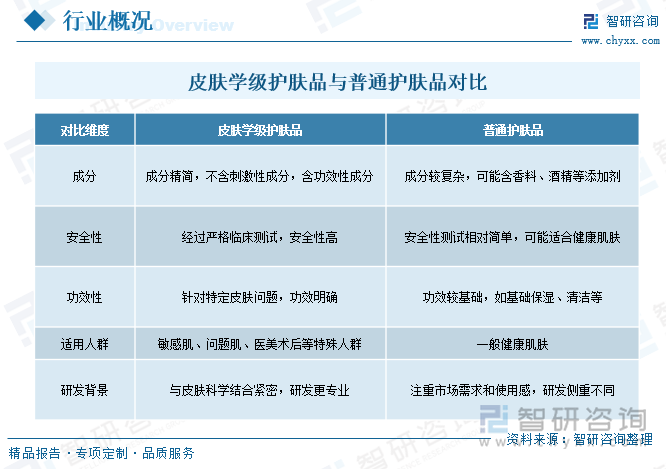
研判2025!中国皮肤学级护肤品行业市场政策、产业链图谱、发展现状及发展趋势分析:18-35岁的年轻女性为核心消费人群[图]
Chan Ye Xin Xi Wang· 2025-07-01 01:23
Core Viewpoint - The demand for dermatological skincare products in China is rapidly increasing due to rising consumer health awareness and income levels, with the market expected to reach 22.528 billion yuan in 2024, reflecting a year-on-year growth of 21.13% [1][12]. Overview - Dermatological skincare products are developed based on dermatology and skin structure, aimed at addressing specific skin issues. They are characterized by simplified ingredients, higher safety, and clearer efficacy compared to regular skincare products [2][3]. Market Policy - The Chinese government has implemented a series of regulations to enhance the development of the cosmetics industry, including dermatological skincare products, promoting standardization and high-quality growth [5][6]. Industry Chain - The upstream of the dermatological skincare industry includes suppliers of active ingredients, moisturizers, oils, plant extracts, and production equipment. The downstream consists of hospitals, pharmacies, supermarkets, beauty salons, brand counters, and e-commerce platforms [7][10]. Development Status - The market for dermatological skincare products is experiencing exponential growth, driven by increasing skin issues among consumers and a shift towards scientific skincare. Despite rapid development, the market penetration in China remains low compared to mature overseas markets, indicating significant future growth potential [1][12]. Competitive Landscape - The dermatological skincare market in China is becoming increasingly competitive, with numerous companies entering the space. Key players include Peirfaer (Shanghai) Cosmetics Trading Co., L'Oréal (China) Co., Shenzhen Haichuang Biotechnology Co., and others [14][16]. Representative Company Analysis - Yunnan Betaini Biotechnology Group Co., established in 2010, focuses on skin health and has gained recognition for its "Winona" brand, achieving a revenue of 5.736 billion yuan in 2024, with skincare products accounting for 83.70% of total revenue [16]. - Beijing Andeputai Medical Technology Co., founded in 2010, specializes in solutions for problematic skin and integrates global resources for medical research and product development [18]. Development Trends - The trend of "minimalist skincare" is emerging, with consumers favoring simplified formulations. Additionally, domestic brands are leveraging cross-border e-commerce to expand internationally, supported by capital mergers to enhance global competitiveness [21].