
东风股份

Search documents
东风股份与九识智能携手打造自动驾驶汽车产品
Yang Shi Wang· 2025-12-18 07:42
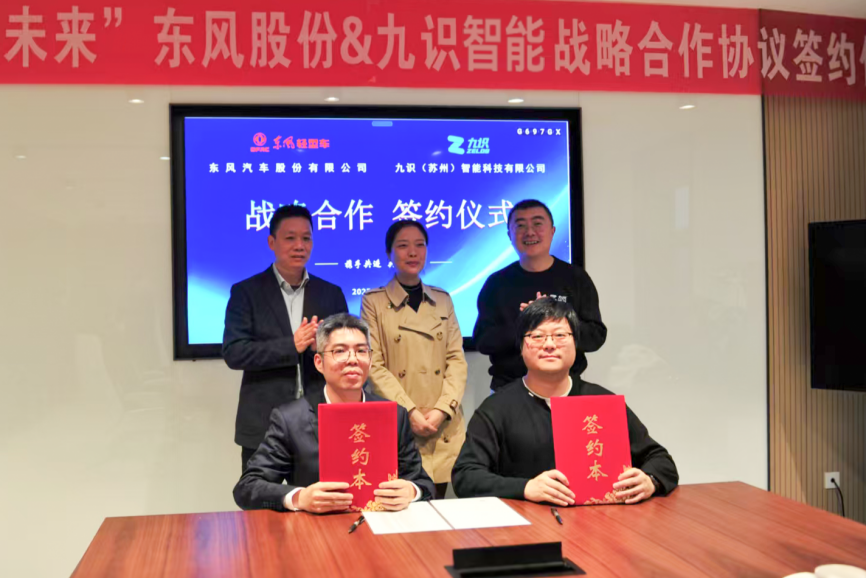
近日,东风汽车股份有限公司(简称东风股份)与九识(苏州)智能科技有限公司(简称九识智能)在襄阳举行战略 合作协议签约仪式,双方将围绕自动驾驶车辆的开发展开深度合作,共同推动自动驾驶技术在商用车领域的规模化落地。 九识智能CEO孔旗 九识智能CEO孔旗表示,将充分发挥九识在自动驾驶全栈技术、智能运营平台与多场景落地方面的优势,结合东风在 整车研发、精益制造、市场渠道与品牌影响力方面的深厚积淀,打造"整车+智驾+运营"模式,联合开发多类车型,携手推 动城配物流、园区物流等领域的规模化与商业化落地。 此次东风股份与九识智能的战略合作,不仅是自动驾驶科技与传统汽车产业的深度融合,还将是推动中国汽车产业智 能化转型与高质量发展的全新实践。 根据协议,双方将建立全面战略合作伙伴关系,联合打造具备创新力与市场竞争力的自动驾驶汽车产品,合作车型涵 盖载货车、环卫车、VAN车、客车等多个类别。 东风股份总经理段仁民表示,此次合作是东风股份深化"五化"布局、向"卓越科技企业"转型的重要举措。未来,企业 将以开放务实的态度与九识智能紧密协作,推动合作项目高效落地,早日让双方联合打造的无人驾驶车辆在智慧物流园 区、城市公交线路等场景 ...


解放/重汽份额扩大 东风涨80% 北汽暴涨301%!11月燃气重卡增71% | 头条
第一商用车网· 2025-12-18 07:01
Core Viewpoint - The natural gas heavy truck market in China has shown significant growth in September and October 2025, with year-on-year increases of 149% and 138% respectively, indicating a strong performance during the peak season. However, questions remain about whether this momentum will continue into December and what changes may occur in the industry landscape as the year concludes [1]. Sales Performance - In November 2025, the actual sales of natural gas heavy trucks reached 19,400 units, representing a month-on-month decrease of 8% but a year-on-year increase of 71%. This marks the fourth consecutive month of year-on-year growth [3][15]. - The overall heavy truck market saw total sales of 76,700 units in November, with natural gas heavy trucks outperforming the overall market growth for the fifth time this year, achieving a 71% year-on-year increase [7]. Monthly Trends - The monthly sales data for natural gas heavy trucks over the past five years shows that January and February 2025 had the highest sales figures compared to previous years. However, from March to July, sales were the second highest in five years, and November recorded the highest sales for the year [5]. Market Share and Competition - In November, natural gas heavy trucks accounted for 25.26% of total heavy truck sales, a decrease from 30.09% in October. The cumulative market share for January to November 2025 was 26.00%, lower than the previous year's 31.64% [7][21]. - Five companies sold over 1,000 units in November, with Jiefang leading at 5,449 units, followed by China National Heavy Duty Truck at 4,494 units. Other notable competitors included Dongfeng, Foton, and Shaanxi Automobile, all exceeding 2,500 units [17][18]. Price Influence - Natural gas prices fluctuated throughout 2025, with average prices around 4,400 RMB/ton in January and February, peaking near 4,600 RMB/ton in March and April, and then declining to below 4,200 RMB/ton by August. In November, prices rose above 4,350 RMB/ton, but this had little stimulating effect on sales [11]. Regional Sales Distribution - Sales of natural gas heavy trucks were distributed unevenly across regions, with Hebei, Shandong, Henan, and Shanxi being the top four provinces in terms of sales volume. Hebei alone accounted for 14.7% of total sales from January to November 2025 [11][13]. Year-to-Date Performance - Cumulatively, from January to November 2025, natural gas heavy truck sales reached 186,100 units, reflecting a year-on-year growth of 10%. This growth is attributed to several provinces experiencing increased sales, while others saw declines [23][26]. Conclusion - The natural gas heavy truck market has rebounded after a period of decline, with a strong performance in the latter part of 2025. The potential for total sales to exceed 200,000 units this year remains high, indicating a promising outlook for the market [28].




科技跃迁 赋能未来 东风汽车加速提质向“新”
Xin Hua Wang· 2025-12-18 02:47
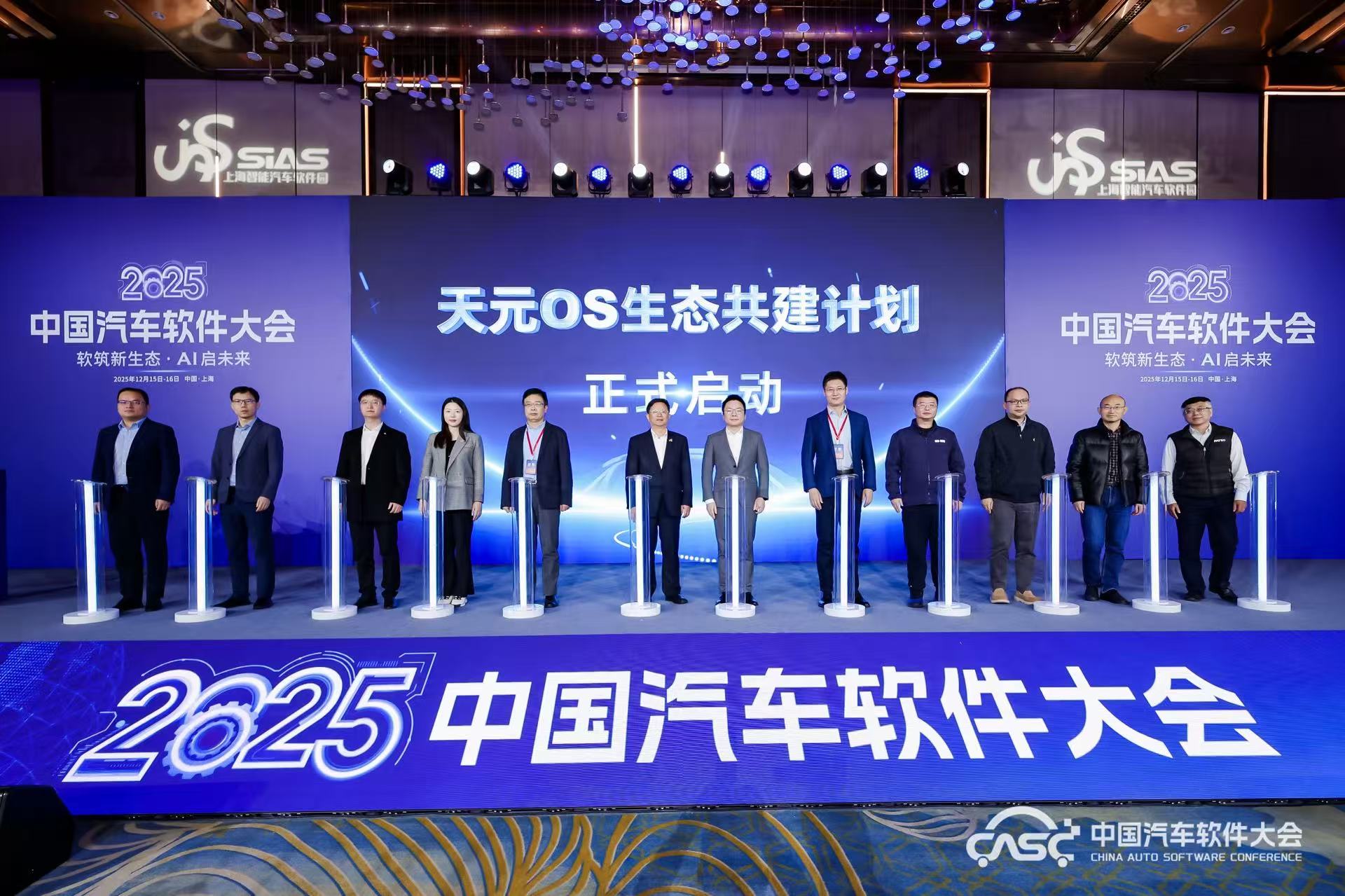
Core Insights - Dongfeng Motor has officially launched the "Tianyuan OS," the industry's first open-source cross-domain middleware product covering AP standard middleware, marking a significant step in middleware technology application in smart vehicles [1][3] - The company aims to drive high-quality development in the Chinese automotive industry through technological self-reliance and innovation, aligning with the strategic goals set for the 14th Five-Year Plan [3][4] Group 1: Technological Innovation and Development - Dongfeng Motor has transitioned from a traditional automotive manufacturer to a technology-driven enterprise, emphasizing systematic support for new quality productivity [4][5] - Since the 14th Five-Year Plan, the company has maintained a research and development investment intensity of over 8%, with 100% of new technology innovation investments for its main passenger vehicle brands directed towards new energy [10] - The company has established a "1+n" efficient collaborative R&D system, integrating basic research, common technologies, and cutting-edge technologies to enhance innovation capabilities [5][10] Group 2: Patent and Standardization Achievements - As of October 2025, Dongfeng Motor holds a total of 27,529 valid patents, including 12,889 invention patents, with 6,617 patents in the fields of new energy and intelligent networking, maintaining a leading position among domestic manufacturers [12] - The company has led or participated in the formulation of 68 national and industry standards, ranking first among automotive enterprises, and has achieved a historic breakthrough in international standardization [12] Group 3: Core Technology Development - Dongfeng Motor has developed a new 1.5T hybrid engine with a thermal efficiency exceeding 48%, and a new generation of high-energy solid-state batteries with an energy density of 350Wh/kg, enabling vehicles to achieve over 1,000 km of range [15][21] - The company has also achieved the highest powertrain efficiency in the industry at 51.08% with its Dragon Engine 3.0, continuously creating significant value for customers [15] Group 4: Product and Market Expansion - Dongfeng Motor has launched 14 new energy vehicle models since the 14th Five-Year Plan, covering luxury, high-end, and mainstream markets, with notable sales success for models like the Mengshi 917 and the Lantu brand [25] - The company is actively building a cross-industry innovation ecosystem, collaborating with various partners to address supply chain challenges and enhance technological capabilities [28][30] Group 5: Future Outlook and Strategic Goals - Dongfeng Motor aims to continue its technological transformation and high-quality development, focusing on creating a greener, smarter, and more open automotive landscape [30] - The company is committed to leveraging strategic determination to navigate industry changes and foster new quality productivity in the upcoming 15th Five-Year Plan [30]
宁德时代、岚图汽车,大动作!
Mei Ri Jing Ji Xin Wen· 2025-12-18 02:47
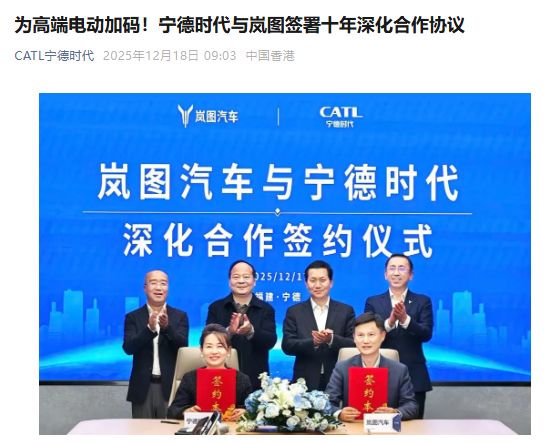
Core Viewpoint - CATL and Lantu Motors signed a 10-year deep cooperation agreement to enhance collaboration in technology application, product supply, brand co-construction, and global market synergy, aiming to accelerate the high-end, intelligent, and global development of the new energy vehicle industry [1][6]. Group 1: Technology Collaboration - CATL will prioritize providing advanced battery technologies to Lantu, including the large-scale application of its Kirin, Xiaoyao, and Shenxing battery brands in Lantu vehicles [5]. - Both companies will collaborate on new ecological technologies such as battery swapping, integrated intelligent chassis, and V2G, while deepening battery big data collaboration to create a comprehensive management loop covering R&D, manufacturing, and operations [5]. Group 2: Supply Chain Strategy - The partnership will focus on localized production capacity and collaborative layout to enhance supply chain agility and security, effectively addressing external volatility risks and ensuring stable and reliable battery supply for Lantu's rapid product scaling and market competitiveness [5]. Group 3: Market Expansion - CATL and Lantu will work together to innovate their brands and expand into overseas markets, aiming to enhance their brand influence and competitiveness in the global high-end new energy vehicle market [6]. - Since the delivery of Lantu's first mass-produced vehicle in 2021, CATL has become the core battery supplier for all Lantu models, marking a significant advancement in their strategic partnership [6]. Group 4: Other Collaborations - In addition to Lantu, CATL has signed strategic cooperation agreements with Shouqi Group and Dongfeng Commercial Vehicle, focusing on electric vehicle transformation, after-sales service, battery recycling, and charging infrastructure [8]. - The collaboration with Dongfeng Commercial Vehicle aims to leverage past successful experiences to establish a new five-year strategic partnership in the commercial vehicle electrification sector [9].

AI加速“上车” 智能汽车操作系统迈向千亿级市场
Xin Hua Cai Jing· 2025-12-18 01:09
Core Insights - Major automotive companies are increasingly adopting AI as a core strategy for future development, with significant investments in AI technologies and models [1] - The automotive software industry is undergoing structural changes, shifting the value focus from traditional hardware manufacturing to software and services, with projections indicating a rise in software profit share from 6% in 2020 to 25% by 2030 [2][3] - The integration of software is fostering a new ecosystem that bridges various sectors, enhancing collaboration and resource efficiency across the automotive industry [3][4] Group 1: Industry Trends - The automotive software industry's value is transitioning from a "one-time sale" model to a "full-cycle service" model, with hardware profit share decreasing from 79% in 2020 to an expected 59% by 2030 [2] - The commercial value of in-vehicle operating systems is becoming increasingly significant, with the market projected to reach approximately 600 billion yuan by 2025 and exceed 1 trillion yuan by 2030 [3] - The future of automotive software development is expected to focus on integration, moving towards highly adaptive intelligent operating systems that support comprehensive resource management [4] Group 2: Challenges and Solutions - The automotive industry faces challenges in establishing a unified and open software and hardware ecosystem, with varying levels of openness and interface standards among chip manufacturers [7] - Collaboration between companies remains inefficient, often requiring extensive customization and debugging, which hampers the overall efficiency of solutions [7] - The industry is encouraged to adopt open-source models to build a unified technical foundation, reducing costs and fostering innovation through community collaboration [5][9] Group 3: Future Directions - The integration of advanced safety features and the expansion of collaborative boundaries are essential for building sustainable competitive advantages in the automotive sector [11] - The industry is exploring the incorporation of satellite technology into existing vehicle-road-cloud systems to enhance data and computational networks [12] - The relationship between AI and the automotive industry is expected to evolve, with AI becoming a critical component in the development of intelligent vehicles and applications [12]



实践与思考丨坚持问题导向深化以案促改促治
Zhong Yang Ji Wei Guo Jia Jian Wei Wang Zhan· 2025-12-18 00:06
Core Viewpoint - The article emphasizes the importance of enhancing the effectiveness of case-based reforms and supervision mechanisms within state-owned enterprises, particularly focusing on the East Wind Automotive Group, to eliminate corruption and ensure high-quality development [2][3]. Group 1: Case Handling and Problem Identification - The East Wind Company’s disciplinary inspection team focuses on identifying key issues that hinder enterprise development through case handling, analyzing root causes, and providing targeted suggestions for reform [3]. - Since the 20th National Congress, over 400 cases have been filed, resulting in more than 400 disciplinary actions, including the detention of over 60 public officials and the investigation of over 50 top executives [3]. Group 2: Root Cause Analysis - The inspection team conducts in-depth analyses of the subjective and objective reasons behind individual cases, guiding involved parties to reflect on the harm caused by violations and suggesting management improvements [4]. - Specific issues in procurement and other key areas have been identified, leading to comprehensive discussions with the company’s leadership to address systemic weaknesses and prevent recurrence [4]. Group 3: Utilization of Inspection Suggestions - The team emphasizes systematic analysis and communication with relevant units to propose precise inspection suggestions aimed at addressing specific reform challenges [5]. - A mechanism for tracking and verifying the implementation of corrective actions has been established, ensuring that issues are addressed effectively and preventing superficial compliance [5]. Group 4: Accountability and Responsibility - The inspection team enforces a "three-in-one" responsibility system, ensuring that the company’s leadership, inspection bodies, and involved units share accountability for problem resolution [6]. - Regular discussions and educational sessions are conducted to reinforce the importance of accountability and to address issues identified during case investigations [6][8]. Group 5: Integration of Reform Efforts - The inspection team promotes a comprehensive approach to reform, integrating case handling, corrective actions, and governance improvements to enhance overall corporate governance effectiveness [9]. - The focus is on strengthening the governance framework by ensuring that the party's leadership is embedded within the corporate governance structure [9]. Group 6: Mechanism Improvement and Risk Management - The team encourages relevant departments to address systemic shortcomings and optimize internal control processes, particularly in procurement and bidding areas [10][11]. - A robust disciplinary education system is being developed to foster a culture of compliance and integrity within the organization, utilizing past cases as educational tools [11].
【重卡11月月报】内销与出口共振,景气度持续向好
东吴汽车黄细里团队· 2025-12-17 14:11
Investment Highlights - November sales: Domestic sales met expectations, while wholesale and export exceeded expectations. November heavy truck production reached 114,000 units, with year-on-year and month-on-month growth of +84.4% and +9.8% respectively. Wholesale sales were 113,000 units, with year-on-year and month-on-month growth of +65.4% and +6.6%. Terminal sales were 77,000 units, with year-on-year and month-on-month growth of +34.3% and +9.6%. Exports reached 33,000 units, with year-on-year and month-on-month growth of +44.0% and +0.7%. Overall industry inventory increased by 420 units, with a total inventory coefficient of 1.8, indicating a reasonable level [2][14][17]. Industry Structure - In November, the performance of engineering vehicles outperformed logistics vehicles. Terminal sales of engineering vehicles were 8,500 units, with year-on-year and month-on-month growth of +41.2% and +13.1%. Logistics vehicle sales were 68,200 units, with year-on-year and month-on-month growth of +33.5% and +8.9%. The market share of engineering vehicles and logistics vehicles was 11.1% and 88.9% respectively, with engineering vehicle share increasing by 0.5 and 0.3 percentage points, while logistics vehicle share decreased by 0.5 and 0.6 percentage points [3][36]. Market Share Dynamics - In November, Foton's domestic sales share increased year-on-year, while the export shares of Jiefang and Foton rose month-on-month. The terminal sales market shares for November were 21.1% for Jiefang, 18.0% for Dongfeng, 16.9% for Heavy Truck, 11.0% for Shaanxi Heavy Truck, and 12.4% for Foton, showing changes compared to the full year of 2024 [4][16][53]. Engine Market - Weichai maintained the top market share in the engine sector. In November, the market shares for Weichai, Cummins, Xichai, Heavy Truck, and Yuchai were 17.4%, 15.6%, 14.6%, 9.2%, and 11.1% respectively. Weichai's terminal matching volume was 13,000 units, with year-on-year growth of +11.8% but a month-on-month decline of -7.1% [5][19][70]. Investment Recommendations - The company is optimistic about the market performance driven by the National IV policy. Recommendations include investing in China National Heavy Duty Truck and Weichai Power, while also paying attention to the performance improvement potential of FAW Jiefang and Foton [7][18].
11月新能源销量放榜,奇瑞首次进入前三,跨界具身智能寻求新增长极
Jin Rong Jie· 2025-12-17 10:11
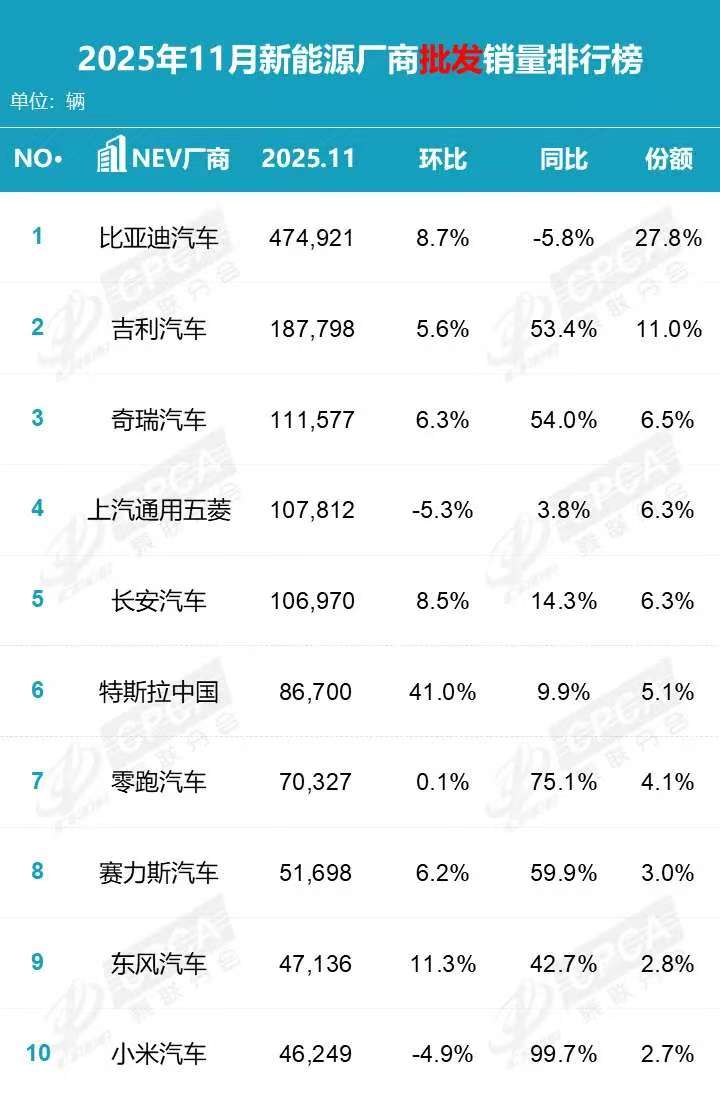
Core Viewpoint - Chery's new energy vehicle (NEV) sales reached a record high in November, marking significant growth and positioning the company among the top three in the industry for the first time [1][3]. Group 1: Sales Performance - In November, Chery's NEV wholesale sales reached 111,577 units, a year-on-year increase of 54% and a month-on-month increase of 6.3% [1][2]. - Chery Group's total NEV sales for November were 116,794 units, reflecting a 50.1% year-on-year growth, contributing to a cumulative total of 814,685 units sold from January to November, which is a 69.4% increase year-on-year [3][6]. Group 2: Market Position - Chery's market share in the NEV sector reached 6.5% in November, placing it third behind BYD and Geely, which had shares of 27.8% and 11.0% respectively [2]. - The company has achieved four consecutive months of sales growth in the NEV segment, indicating a strong upward trend [5]. Group 3: Technological Advancements - Chery's growth in the NEV market is supported by its robust R&D capabilities, including the development of the Kunpeng Tianqing hybrid engine with a thermal efficiency of over 48% and the Rhino solid-state battery with an energy density of 600 Wh/kg [7][10]. - The company has introduced several successful models, such as the A9L and T11, which have significantly contributed to its market presence [8]. Group 4: International Expansion - Chery's NEV products have gained recognition in international markets, with accolades such as the "Car of the Year" in the UK for the Tiggo 8 and multiple five-star safety ratings from European NCAP [11][19]. - The company is actively expanding its global footprint, with plans to establish 26 new overseas R&D centers to enhance local development capabilities [19]. Group 5: Financial Performance - Chery reported a revenue of 214.83 billion yuan for the first three quarters of 2025, a 17.9% increase from the previous year, with a net profit of 14.37 billion yuan, up 28% year-on-year [22].
东风汽车零部件业务主体跃创科技总部落户武汉经开区
Xin Lang Cai Jing· 2025-12-17 09:44
据武汉经开区消息,12月16日,武汉经开区与跃创科技有限公司(简称"跃创科技")全面合作签约活动 举行,跃创科技总部等7个重大项目落户车谷。现场,武汉经开区与跃创科技签订合作协议。根据协 议,跃创科技总部落户武汉经开区。同时,武汉经开区与科新动力、启新热系统、南斗六星、东风汽车 用品、武汉燎原、东风模冲分别签订合作协议,涵盖动力总成、能源生态、热管理系统、智能驾驶、汽 车后市场服务等领域。跃创科技是东风汽车零部件业务的主体和管理主体,整合东风汽车零部件事业 部、东风鸿泰现有职能,管理智新科技、南斗六星等原零部件事业部管辖企业。 ...
汽车视点 | AI加速“上车” 智能汽车操作系统迈向千亿级市场
Xin Hua Cai Jing· 2025-12-17 08:16
Group 1 - Major automotive companies are increasingly adopting AI as a core strategy, with significant investments in AI technologies, such as Xiaopeng's annual investment of 4.5 billion yuan in AI [1] - The 2025 China Automotive Software Conference highlighted the irreversible trend of software-defined vehicles and AI-driven design, marking the transition to the AIDV (AI Defined Vehicle) era [1] Group 2 - The automotive software industry is experiencing structural changes, with the value focus shifting from hardware manufacturing to software and services, and profit structures evolving from "one-time delivery" to "full-cycle services" [2] - In 2020, hardware accounted for 79% of automotive profits, while software only represented 6%. By 2025, hardware's share is expected to drop to 69%, with software rising to 17%, and by 2030, hardware is projected to be 59% and software 25% [2] Group 3 - Software is becoming a bridge for industry integration, connecting various stakeholders such as automakers, chip manufacturers, and research institutions, facilitating resource optimization [3] - The commercial value of in-vehicle operating systems is increasing, with the market expected to reach approximately 60 billion yuan by 2025 and exceed 100 billion yuan by 2030 [3] Group 4 - The future trend of automotive software development is expected to be integration, moving towards highly adaptive intelligent operating systems that support resource scheduling and sharing across vehicles, roads, clouds, and edge [4] - AI capabilities are anticipated to be deeply integrated into operating systems, evolving from simple application-level integration to native AI fusion that understands user intent [4] Group 5 - Open-source development is recognized as a vital technical pathway, with companies like Li Auto and Dongfeng actively participating in open-source projects to address cross-enterprise collaboration challenges [5] Group 6 - The market for software-based autonomous driving solutions in China is projected to grow from 350 million yuan in 2024 to over 1.9 billion yuan in 2025, and surpass 6 billion yuan by 2030 [6] - Challenges related to AI systems, such as their "black box" nature and difficulties in safety verification, need to be addressed for effective development [7] Group 7 - The automotive software ecosystem faces challenges, including the lack of a unified, open hardware-software platform, which complicates collaboration and development processes [7] - Cross-enterprise collaboration mechanisms are often inefficient, leading to difficulties in achieving consensus on costs, timelines, and technical directions [7] Group 8 - The establishment of a unified standard and interface is crucial for accelerating technology implementation and shortening development cycles, with a focus on defining standards for chips, operating systems, and middleware [10] - The integration of forward-looking safety features into the ecosystem is essential for building sustainable competitive advantages [11] Group 9 - The industry is encouraged to explore the integration of satellite technology into the existing vehicle-road-cloud system to enhance data and computing networks, expanding application scenarios [12] - The automotive industry is seen as a significant platform for AI applications, with the potential for AI to evolve through interaction with the physical world [12]