长江存储

Search documents
巧了吗这不是!七家亏损企业IPO,都是半导体公司
Sou Hu Cai Jing· 2025-07-03 01:53
Group 1 - In the first half of 2025, 7 semiconductor companies that are still in the red managed to go public, which is a significant shift from the traditional capital market preference for profitable companies [1][2] - The introduction of the Sci-Tech Innovation Board in 2019 broke the previous profit requirement for IPOs, allowing companies with strong technology and promising sectors to list even without profits [2][3] - On February 17, 2023, the China Securities Regulatory Commission approved a third set of listing standards for the ChiNext board, enabling unprofitable companies with a projected market value of at least 5 billion yuan and recent revenue of at least 300 million yuan to go public [2] Group 2 - The 7 unprofitable companies are engaged in various high-tech fields, each facing significant financial challenges while pursuing innovation [5] - Moer Thread and Muxi Co. are focused on the GPU sector, requiring substantial investment for architecture innovation to compete with established players like NVIDIA [6] - Dapu Microelectronics specializes in storage control chips, aiming to support the domestic storage chip market amid rapid technological changes [7] - Shiya Technology is developing silicon-based OLED display chips for AR/VR devices, facing high costs in R&D and production [8] - Zhaoxin Integrated is tackling the CPU market, aiming to create a complete domestic computing platform despite significant challenges [9] - Shanghai Super Silicon is producing high-purity silicon wafers, a critical component in chip manufacturing, requiring extensive investment [10] - Angrui Micro focuses on RF front-end chips for 5G communication, needing innovation to compete in a complex market [11] Group 3 - The ability of these 7 companies to go public indicates government support for the semiconductor industry, highlighting the need for capital market involvement in achieving self-sufficiency in high-end chips and critical materials [12]

巧了吗这不是!七家亏损企业IPO,都是半导体公司
是说芯语· 2025-07-03 00:55
Core Viewpoint - In the first half of 2025, 7 semiconductor companies that are still in the red managed to go public, indicating a shift in the capital market's attitude towards unprofitable firms, particularly in the semiconductor sector [1]. Group 1: Changes in IPO Regulations - The traditional A-share IPO process required companies to meet profit thresholds, but the introduction of the Sci-Tech Innovation Board in 2019 allowed unprofitable companies with strong technology to list [3]. - On February 17, 2023, the China Securities Regulatory Commission (CSRC) approved a third set of financial standards for the ChiNext board, allowing unprofitable companies with a market value of at least 5 billion yuan and revenue of at least 300 million yuan to go public [3]. - The first unprofitable company to be accepted for listing on the ChiNext was Dapu Microelectronics on June 27, 2025, marking the implementation of the new standards [3]. Group 2: Overview of the 7 Unprofitable Companies - The 7 companies, despite their losses, are engaged in critical sectors within the semiconductor industry [4]. - **Mole Thread and Muxi Co., Ltd.** are focused on the GPU market, facing high costs in architecture innovation to compete with dominant players like NVIDIA [5]. - **Dapu Microelectronics** specializes in storage control chips, essential for the smart storage systems, and aims to secure funding through its IPO to support ongoing high R&D costs [6]. - **Shiyatech** is developing silicon-based OLED display chips for AR/VR devices, requiring significant investment in R&D and production capabilities [7]. - **Zhaoxin Integrated** is tackling the CPU market, aiming to create a complete domestic computing platform despite facing significant challenges in ecosystem adaptation and performance optimization [8]. - **Shanghai Super Silicon** focuses on producing high-purity silicon wafers, a foundational element in chip manufacturing, requiring substantial upfront investment [10]. - **Angrui Micro** is dedicated to RF front-end chips critical for mobile signal quality, needing to innovate to compete in the 5G market [11]. Group 3: Policy Support for Semiconductor Industry - The ability of these 7 companies to go public reflects government support for the semiconductor industry, which is crucial for achieving self-sufficiency in high-end chips and key materials amid global competition [12].
英杰电气20250702
2025-07-02 15:49
Summary of the Conference Call for Yingjie Electric Industry and Company Overview - **Company**: Yingjie Electric - **Industry**: Nuclear Fusion Power, Semiconductor, Charging Piles, Energy Storage, Photovoltaics Key Points and Arguments 1. **Nuclear Fusion Market Potential**: Yingjie Electric has been deeply involved in the nuclear fusion power sector for 20 years, collaborating with research institutions like the Southwest Institute of Physics and the Chinese Academy of Sciences. The company expects to achieve over 100 million in revenue in 2024 from this sector, indicating significant market potential [2][6][10]. 2. **Technological Advantages**: The company has a strong technological edge in heating power and magnetic field power control, with current fluctuation rates controlled within 1/10,000. They have achieved long pulse continuous waves lasting 1,066 seconds, showcasing their technical capabilities [2][19][31]. 3. **Competition**: Yingjie Electric faces competition from companies like Anshan Tongchuang and Tianjin Mingwei, but its IGBT technology and flexible production capabilities position it well to capture market opportunities in nuclear fusion projects, which are expected to attract hundreds of billions in investment [2][7][10]. 4. **Impact of Photovoltaic Industry Decline**: The downturn in the photovoltaic industry has significantly affected Yingjie Electric, with domestic orders dropping sharply. The company has proactively expanded into semiconductors, charging piles, and energy storage, with semiconductor revenue expected to exceed 400 million this year, marking a growth of over 30% [2][22][34]. 5. **Response to Bad Debt Risks**: The company has taken measures to address bad debt risks in its photovoltaic business, including a provision of over 50 million for losses and strategies to recover customized power products through legal means [2][27]. 6. **Revenue Goals**: Yingjie Electric aims to achieve 5 billion in revenue within three to four years, leveraging growth in semiconductor, charging pile, energy storage, and overseas markets [4][42]. 7. **Nuclear Fusion Project Clients**: The company is involved in several domestic nuclear fusion projects, including those at the Southwest Institute of Physics and the Chinese Academy of Sciences, indicating a strong client base in the sector [4][5]. 8. **Market Share in Magnetic Field Power**: Yingjie Electric holds a market share of over 50% in the magnetic field power and cyclotron power sectors, reflecting its strong position in the industry [29]. 9. **Future Development Directions**: The company plans to focus on semiconductor, charging pile, energy storage, and photovoltaic sectors, with significant potential for growth in these areas [38][40]. 10. **International Market Challenges**: Yingjie Electric faces challenges in expanding into international markets due to geopolitical uncertainties and tariffs but continues to seek solutions and opportunities for growth [39]. Other Important but Possibly Overlooked Content - **Production Flexibility**: The company has strong flexible production capabilities, allowing it to quickly adapt to new industry demands despite current low photovoltaic orders [9][16]. - **R&D in Nuclear Fusion**: Yingjie Electric does not anticipate the need for new product development for nuclear fusion projects, as existing technologies can meet most requirements [12][31]. - **Sales Performance**: The company has signed contracts worth several million in 2025, indicating a positive trend in securing new orders despite challenges in the photovoltaic sector [21][24]. - **Long-term Outlook**: The company expresses confidence in a gradual recovery of the photovoltaic market and anticipates significant contributions from nuclear fusion projects in the coming years [43].
2025年中期电子行业投资策略报告:芯声澎湃,精彩纷呈-20250702
Wanlian Securities· 2025-07-02 13:10
Core Insights - The report indicates that the SW electronics industry has outperformed the CSI 300 index since the beginning of 2025, with a slight increase in valuation compared to recent years [1] - The performance in Q1 2025 shows record highs in revenue and net profit for the SW electronics sector, suggesting a positive outlook for the second half of 2025, particularly in semiconductor self-sufficiency, AI computing power construction, and terminal innovation [1][2] Semiconductor Self-Sufficiency - The intensifying US-China tech friction is accelerating the domestic substitution process in semiconductors, with China being the largest semiconductor equipment market globally [2] - The report highlights that the domestic market still has significant room for improvement in the localization of advanced process equipment, components, and materials, particularly in areas like photolithography machines and high-end photoresists [2][40] - The expansion of wafer fabs is expected to boost demand for semiconductor equipment, indicating a strong growth momentum in advanced processes [2] AI Computing Power Construction - The report notes that AI computing power construction has entered a competitive phase, with key segments including AI chips, advanced packaging, storage chips, and PCBs being critical to the computing power foundation [3] - Domestic internet companies are increasing their AI spending, supported by favorable policies for domestic AI innovation, leading to a gradual increase in the market share of domestic AI chips [3][39] - The storage chip market is expected to benefit from price increases due to adjustments in production plans by overseas manufacturers, with domestic storage companies likely to gain from this trend [3] Terminal Innovation - The report emphasizes that the combination of national subsidies and the AI innovation wave is driving growth in consumer terminals, with AI smartphones and AIPC expected to penetrate the market rapidly [4] - AI smartphones are projected to exceed a penetration rate of 30% in the smartphone market by 2025, with major brands like Apple, Huawei, and Xiaomi actively innovating in AI terminal products [4][39] - The report also mentions that the user base for AI applications is accelerating, with the potential for several billion-level AI application opportunities in the future [4][8] Investment Recommendations - The report suggests focusing on investment opportunities in semiconductor self-sufficiency, AI computing power construction, and terminal innovation [9] - Specific recommendations include investing in advanced process semiconductor industry chains, domestic AI chip leaders, and companies involved in advanced packaging and storage chips [9] - The report also highlights the importance of monitoring leading companies in the PCB sector and those involved in AI smartphone and AIPC developments [9]
研判2025!中国电子大宗气体行业分类综述、成本结构、市场现状及发展趋势分析:行业市场规模持续扩张,国产替代进程加速[图]
Chan Ye Xin Xi Wang· 2025-07-02 01:26
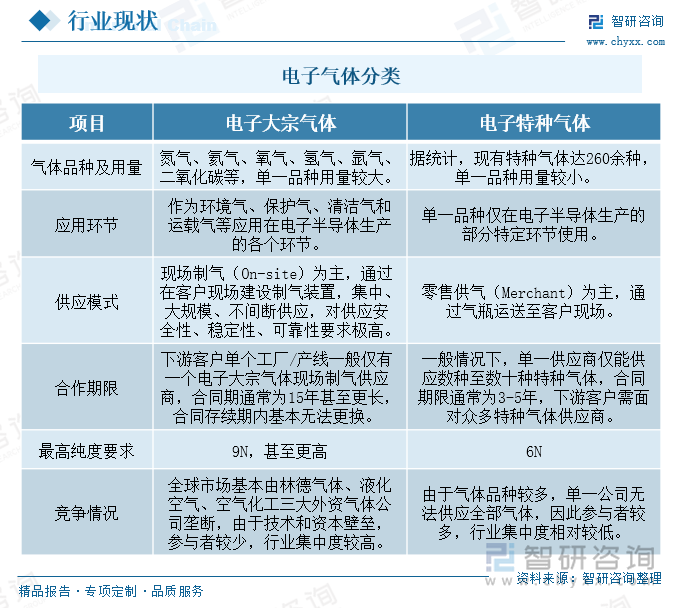
Core Viewpoint - The Chinese electronic bulk gas industry is undergoing a critical transformation from technology catch-up to localized breakthroughs, with a continuously expanding market size and accelerated domestic substitution process. The market size of China's electronic bulk gas is expected to reach approximately 11.2 billion yuan in 2024, representing a year-on-year growth of 8.74% [1][16]. Industry Overview - The term "electronic gas" broadly refers to gases used in electronic industrial production, divided into electronic bulk gases and electronic specialty gases, which are crucial raw materials in semiconductor manufacturing [2]. - Electronic bulk gases include nitrogen, helium, oxygen, hydrogen, and carbon dioxide, with significant usage in semiconductor production processes [4][6]. Industry Development History - The development of China's electronic bulk gas industry has gone through four stages: 1. The budding stage (1950-1980) where reliance on imported equipment limited domestic production capabilities. 2. The initiation stage (1981-1999) marked by the entry of international gas giants bringing advanced technology. 3. The development stage (2000-2015) where domestic companies began to reduce reliance on imports and the demand for electronic bulk gases surged due to the growth of the semiconductor and photovoltaic industries. 4. The maturity stage (2016-present) where domestic companies have mastered ultra-pure gas purification technologies, meeting advanced process requirements [7][8]. Market Size - The electronic gas market in China is projected to reach approximately 20.3 billion yuan in 2024, with a year-on-year growth of 7.98%. The rapid expansion of the domestic semiconductor industry and continuous growth in photovoltaic installations are driving this demand [14][16]. Key Companies - **Guangzhou Guanggang Gas**: A leading domestic electronic bulk gas service provider, known for its "Super-N" series ultra-pure nitrogen production technology, achieving ppb-level purity [21]. - **Jinhong Gas**: Engaged in gas research, production, and sales, recognized as a national high-tech enterprise, with a focus on ultra-pure gases [23]. - **Linde Gas, Air Liquide, and Air Products**: Global industrial gas giants dominating over 70% of the high-end market share, leveraging technology barriers and long-term customer contracts [18][19]. Industry Development Trends 1. **Technological Innovation and Domestic Substitution**: The industry is experiencing dual drivers of technological innovation and domestic substitution, with companies increasing R&D investments to meet high purity and stability requirements [25]. 2. **Industry Chain Integration and Model Innovation**: Companies are integrating vertically and innovating business models, exploring on-site gas production and digital gas management systems to enhance competitiveness [26]. 3. **Diversified Market Demand and Global Layout**: The industry faces opportunities from diversified market demands and accelerated globalization, with companies expanding internationally to meet both domestic and foreign needs [27].


何小鹏催雷军早点交付YU7丨新鲜早科技
2 1 Shi Ji Jing Ji Bao Dao· 2025-07-01 02:33
Group 1: Technology Developments - Nvidia's CEO Jensen Huang personally recruited two Chinese AI experts, Banghua Zhu and Jiantao Jiao, to focus on model post-training, performance evaluation, agent development, and AI infrastructure [2] - Google announced a commercial power purchase agreement with Commonwealth Fusion Systems for 200 MW from its fusion power project in Virginia, marking the first commercial application of fusion energy [2] - Baidu officially open-sourced its Wenxin large model 4.5 series, which includes 10 models with varying parameters, available for deployment on platforms like PaddlePaddle and Hugging Face [5] Group 2: Automotive Industry Updates - Xiaomi's automotive division plans to roll out the 10 million Clips version of its assisted driving feature for models SU7 Pro, Max, and SU7 Ultra by late July [6] - Hongmeng Zhixing reported that its flagship car, the Zun Jie S800, achieved over 6,500 pre-orders in its first month, positioning it against luxury competitors like BMW 7 Series and Audi A8 [7][8] - Tesla launched its next-generation V4 supercharging stations in China, which are also available for non-Tesla electric vehicles, enhancing user charging experience and efficiency [9] Group 3: Financial and Market Movements - Hongxin Electronics announced that its subsidiaries signed contracts totaling approximately 373 million RMB for AI-related services [10] - Hikvision stated that its Canadian market revenue will account for less than 0.3% of its total revenue in 2024, amidst ongoing political pressures [11] - The National Integrated Circuit Industry Investment Fund reduced its stake in Tongfu Microelectronics by 1%, bringing its holding down to 7.77% [16] Group 4: Semiconductor and Chip Industry - AMD announced that its upcoming AI semiconductor "MI400" series will support a new interconnect standard called "Ultra Accelerate Link" to compete with Nvidia's NVLink [12] - Wolfspeed filed for Chapter 11 bankruptcy protection, expecting to reduce its overall debt by approximately 70%, equivalent to about 4.6 billion USD [13] - Jiangbo Long anticipates a 5% to 10% increase in eSSD prices in Q3 due to production cuts and rising demand from downstream customers [18] Group 5: IPO and Market Entries - The Shanghai Stock Exchange accepted the IPO application of Muxi Integrated Circuit, aiming to raise 3.904 billion RMB for high-performance GPU development [19] - The IPO application of Moer Thread was also accepted, with plans to raise 8 billion RMB for various AI and graphics chip projects [20] - Jiadu Technology announced plans to issue H-shares and list on the Hong Kong Stock Exchange [21]
84元/股!今日一只高价新股申购……盘前重要消息还有这些
证券时报· 2025-07-01 00:00
Key Points - The article discusses various important news and updates related to the investment landscape, including new stock offerings, government policies, and economic indicators [2][4][5]. Group 1: New Stock Offerings - The new stock offering for Tongyu New Materials has an issuance price of 84.00 CNY per share, with a subscription limit of 10,000 shares [2]. Group 2: Government Policies and Economic Indicators - The Ministry of Finance, State Administration of Taxation, and Ministry of Commerce announced a tax credit policy for foreign investors, allowing a 10% tax credit on direct investments made from distributed profits between January 1, 2025, and December 31, 2028 [4]. - The National Bureau of Statistics reported an increase in the Manufacturing Purchasing Managers' Index (PMI) to 49.7%, the Non-Manufacturing Business Activity Index to 50.5%, and the Composite PMI Output Index to 50.7% in June, indicating overall economic expansion [5]. - The State Administration of Foreign Exchange issued a total of 3.08 billion USD in investment quotas to qualified domestic institutional investors (QDII) to facilitate cross-border investment [4]. Group 3: Company News - JD.com issued a statement warning the public about misleading information regarding its collaboration with a cryptocurrency project, emphasizing that it has not issued any stablecoins [9]. - DJI clarified that new regulations from the Civil Aviation Administration regarding power banks do not affect the battery security requirements for its drones [10]. - A series of companies, including Aorui De and Changcheng Military Industry, reported significant uncertainties and risks in their respective business operations [11][12].
以项目之进 看发展之势
He Nan Ri Bao· 2025-06-28 23:21
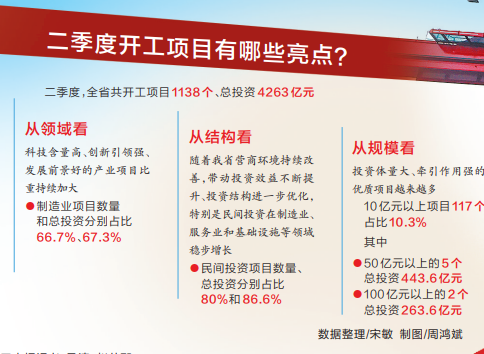
Core Viewpoint - The article emphasizes the importance of large projects as a driving force for economic growth and development, highlighting the need for high-quality projects that contribute significantly to the economy and employment [2][5][6]. Group 1: Project Significance - Large projects serve as new growth points and can create new economic zones, as demonstrated by the development of the Zhengzhou Airport Economic Zone with BYD as a leading enterprise [3]. - The construction of major projects is crucial for stabilizing growth, adjusting structure, and increasing momentum in the economy [4]. Group 2: Quality of Projects - High-quality projects are essential for economic development, focusing on projects with high gold content, innovation, and environmental sustainability [5][6]. - Specific projects mentioned include the China Coal Yongcheng New Energy Development project with an investment of approximately 16 billion yuan and the intelligent power equipment industrial park, which is expected to create 25,000 jobs [6]. Group 3: Effective Project Implementation - Successful project implementation requires coordinated efforts in resource allocation, precise services, and strict supervision [7]. - Establishing a management loop for project planning, construction, production, and evaluation is critical to ensure timely and effective project execution [7].
屹唐半导体:多产品线平台化半导体设备龙头,核心产品打入5nm逻辑量产生产线
梧桐树下V· 2025-06-27 08:56
Core Viewpoint - The semiconductor equipment industry is the foundation of semiconductor manufacturing and the entire electronic information industry, with equipment investment accounting for approximately 75-80% of total investment in a semiconductor production line, driven by the rising demand in consumer electronics and PCs [1] Group 1: Industry Overview - The semiconductor equipment market is experiencing growth, with China's market share expected to reach 42.3% by 2024, despite a currently low overall domestic equipment localization rate [1][12] - The domestic equipment manufacturers have made significant progress, particularly in the photoresist removal equipment sector, achieving a localization rate of over 90% [1][12] Group 2: Company Profile - Yitang Semiconductor, established in 2015, specializes in the research, production, and sales of wafer processing equipment for integrated circuit manufacturing, and ranks second globally in the market share of dry photoresist removal and rapid thermal processing equipment [2][4] - The company serves major global chip manufacturers, including TSMC, Samsung, and SMIC, and has a cumulative installed base of over 4,800 units by the end of 2024 [4][3] Group 3: R&D and Technological Advancements - Yitang Semiconductor has a strong R&D focus, with 29.28% of its workforce dedicated to research, and has invested significantly in R&D, with expenses rising from approximately 52.99 million yuan in 2022 to 71.69 million yuan in 2024 [6][5] - The company holds 445 invention patents and has developed core technologies that enhance its competitive edge in the market [6][7] Group 4: Financial Performance - The company has seen steady revenue growth, with total revenues of approximately 476.26 million yuan in 2022, 393.14 million yuan in 2023, and 463.30 million yuan in 2024, with core technology products contributing significantly to these figures [7][8] - Gross profit has also increased, with a compound annual growth rate of 12.93% from 2022 to 2024, indicating improved profitability [7][8] Group 5: Market Trends and Future Outlook - The integrated circuit market in China is projected to grow from 0.88 trillion yuan in 2020 to 1.45 trillion yuan in 2024, with a compound annual growth rate of 13.3%, indicating a robust demand for semiconductor equipment [9] - The global semiconductor equipment sales are expected to reach 117.1 billion USD in 2024, driven by increased investments from leading foundries to expand capacity [10] Group 6: Strategic Initiatives - Yitang Semiconductor plans to raise 2.5 billion yuan through its IPO to enhance its R&D and manufacturing capabilities, addressing capacity constraints and expanding its product offerings [14][13] - The company aims to leverage its technological advancements to develop next-generation equipment and enhance its position in the global semiconductor equipment market [14]
最高2.6万亿元!2025全球独角兽榜单出炉!
证券时报· 2025-06-26 08:27
6月26日,胡润研究院发布《2025全球独角兽榜》,列出了全球成立于2000年之后、价值10亿美元 以上的非上市公司。 数据显示,全球独角兽企业数量达到1523家,创世界新纪录,比去年增加了70家,增幅接近5%。其中, 美国以758家独角兽企业领先,占世界总数的49.77%;中国以343家独角兽企业位居第二,占世界总数 的22.52%;印度、英国等国家的独角兽企业超过60家。 全球独角兽企业超1500家 胡润研究院在全球范围内共发现了1523家独角兽企业,它们分布在52个国家的307个城市。其中,359 家独角兽的估值比去年有所上升,包括203家新独角兽。与此同时,143家公司的估值出现下降,其中52 家因估值低于10亿美元而"降级"退出独角兽行列。此外,64家去年的独角兽因"升级"退出榜单,其中34 家成功上市,30家被收购。还有1073家独角兽的估值保持稳定。这些独角兽企业的总价值达到5.6万亿美 元。 从行业领域细分来看,全球独角兽正在重塑金融服务、企业管理解决方案和医疗健康行业。77%的独角兽 公司销售软件和服务,以金融科技、软件服务和AI领域为主,而23%的独角兽公司销售实体产品,主要集 中在半导体 ...