华润微

Search documents
2025年中国集成电路产量为4842.8亿块 累计增长10.9%
Chan Ye Xin Xi Wang· 2026-01-30 03:45
2020-2025年中国集成电路产量统计图 上市企业:纳思达(002180),韦尔股份(603501),江波龙(301308),士兰微(600460),华润微 (688396),佰维存储(688525),兆易创新(603986),航锦科技(000818),海光信息(688041),晶晨 股份(688099) 相关报告:智研咨询发布的《2026-2032年中国半导体集成电路产业竞争现状及发展前景规划报告》 根据国家统计局数据显示:2025年12月中国集成电路产量为481亿块,同比增长12.9%;2025年1-12月中 国集成电路累计产量为4842.8亿块,累计增长10.9%。 数据来源:国家统计局,智研咨询整理 知前沿,问智研。智研咨询是中国一流产业咨询机构,十数年持续深耕产业研究领域,提供深度产业研 究报告、商业计划书、可行性研究报告及定制服务等一站式产业咨询服务。专业的角度、品质化的服 务、敏锐的市场洞察力,专注于提供完善的产业解决方案,为您的投资决策赋能。 ...


电子元器件,涨声一片!
是说芯语· 2026-01-29 06:47
Price Increases in Semiconductor and Electronic Components Industry - Resonac announced a price increase of 30% for copper-clad laminates and adhesive films starting March 1, 2026, due to tight supply and rising costs of raw materials and labor [3] - Nanya Plastics will raise prices for all CCL products and PP by 8% starting November 20, 2025, citing increases in international copper prices and raw material costs [7] - TrendForce predicts that the average capacity utilization rate of global 8-inch wafer foundries will rise to 85%-90% in 2026, leading to price increases of 5%-20% for wafer foundry services across the board [8] - TSMC plans to increase prices for advanced technology nodes (5nm, 4nm, 3nm, 2nm) by 8%-10%, with a 50% increase for 2nm wafers starting in 2026 [10] - SMIC has implemented a price increase of approximately 10% for certain capacities [11] - Several packaging and testing companies have begun raising prices, with increases nearing 30% due to high demand and full capacity utilization [13] Memory Chip Price Increases - Samsung has raised NAND flash prices by over 100% and plans to increase server DRAM prices by 60%-70% in Q1 2026 [15] - SK Hynix is also raising server DRAM prices by 60%-70% and has negotiated significant price increases for LPDDR memory used in iPhones, approaching 100% [16] - Micron has announced a general price increase of approximately 20% across its product lines [17] - NAND flash wafer prices increased by over 10% in December 2025, with SSD prices rising by 15%-20% [24] Passive Components Price Adjustments - Various passive component manufacturers, including Yageo and Panasonic, have announced price increases for capacitors and resistors ranging from 8% to 30% [26][31] - ROHM Semiconductor has raised prices for thick film resistors by 8%-20% [38] - Multiple manufacturers are adjusting prices due to rising raw material costs and supply chain pressures [47] Power Devices and Other Electronics - Huazhong Microelectronics confirmed price increases for certain IGBT products due to rising copper and raw material costs [48] - Several semiconductor companies, including Jiangxi Tianyi and Wuxi Zongxiang Technology, have raised prices for specific products by 10%-20% [82][83] CPU and GPU Price Trends - AMD and Intel are planning to increase server CPU prices by up to 15% due to high demand from large enterprises [62] - NVIDIA and AMD are expected to raise GPU prices in early 2026, with multiple price adjustments anticipated throughout the year [79]


众赢财富通:境内首只500亿芯片ETF诞生 产业配置升温
Cai Fu Zai Xian· 2026-01-29 01:58
Core Insights - The launch of the first domestic chip ETF exceeding 50 billion yuan signifies strong market recognition of the investment value in the semiconductor sector, reflecting ongoing enthusiasm for core technology assets amid supportive policies and accelerated domestic substitution [1][3] Group 1: ETF Performance and Market Dynamics - The Jiashi Fund's Sci-Tech Chip ETF (588200) has reached a scale of 50.343 billion yuan, marking a new high since its listing and becoming the first chip ETF in China to surpass the 50 billion yuan threshold [1] - The ETF tracks the Shanghai Stock Exchange Sci-Tech Board Chip Index, covering high-quality companies across the semiconductor industry chain, including leaders like Zhongwei Company and Tuojing Technology, which helps capture overall industry growth while mitigating individual stock volatility [3] - Other chip ETFs, such as E Fund's Sci-Tech Chip ETF (589130) and Guolian An's Sci-Tech Chip Design ETF (588780), have also seen significant inflows, indicating a consensus on the long-term value of the chip industry [3] Group 2: Policy Support and Industry Growth - Continuous policy support is identified as a key driver for the explosive growth of chip ETFs, with the semiconductor industry policy support intensifying since the beginning of 2026, including the establishment of the third phase of the semiconductor fund with a total scale exceeding 350 billion yuan [4] - The Ministry of Industry and Information Technology has introduced special subsidy policies, allowing domestic wafer fabs to receive up to 15% subsidies for purchasing domestic semiconductor equipment, thereby accelerating the domestic substitution process [4] - Major domestic wafer fabs are actively expanding production, with significant investments announced, such as 7.6 billion USD by SMIC and 6.7 billion USD by Huahong Wuxi, which are expected to drive performance expectations for industry chain companies [4] Group 3: Domestic Substitution and Market Recovery - The acceleration of domestic substitution in the semiconductor industry and signs of cyclical recovery provide solid fundamental support for ETF growth, with the domestic semiconductor equipment localization rate rising from 25% in 2025 to 35% by early 2026 [5] - Key equipment replacement rates have exceeded 40%, and the proportion of domestic equipment in new wafer production lines has reached 55%, surpassing market expectations [5] - The semiconductor industry is showing clear signs of recovery, with DRAM contract prices increasing by over 50% and flash memory prices rising by over 30%, further driving equipment procurement by domestic manufacturers [5]
未知机构:1用玉米大豆模型把AI需求如何外溢到非AI芯片讲清楚-20260128
未知机构· 2026-01-28 02:00
Summary of Conference Call Transcript Industry Overview - The discussion revolves around the semiconductor industry, particularly the impact of AI demand on traditional chip production and supply dynamics [1][3]. Core Insights and Arguments 1. **Agricultural Analogy**: The author uses a "corn-soybean" model to explain how AI demand diverts resources from traditional chips (corn) to advanced chips (soybeans) like HBM and 3/4 nm processes [1][3]. 2. **Supply Shortage Evidence**: By 2026, three key indicators suggest a shortage of traditional chips: - **NAND**: Companies like Kioxia and SK Hynix report that their 2026 production capacity was sold out by January, with SSD spot prices increasing by 15-20% [2][6]. - **CPU**: Intel prioritizes 14/10 nm capacity for server CPUs, leading to a widening supply gap for PC CPUs, with Raptor Lake prices rising by 8-12% in January [2][6]. - **Packaging**: Major players like ASE and Tongfu report a 5-8% increase in lead frame and substrate prices due to rising costs of copper, gold, and BT resin, alongside tight 8-inch capacity [2][6]. 3. **Comparison of 2021 and 2026**: - **2021**: Supply constraints due to events like the Renesas fire and Texas freeze, with 8-inch utilization dropping to 75%. Demand surged due to pandemic-driven PC and electric vehicle sales [6]. - **2026**: Supply constraints persist, with AI demand causing negative capital expenditure for 8-inch lines for three consecutive years, and global capacity down 7% from 2021 levels. Demand remains weak, with mobile shipments expected to grow only 3% and automotive chip inventories at 2.2 months [6]. 4. **Potential Catalysts for Demand Recovery**: - **Macro Factors**: A global inventory replenishment cycle in the second half of 2026 could boost utilization rates from 85% to 95% [6]. - **Events**: A significant disruption at a major 8-inch wafer or packaging facility could lead to rapid price increases [6]. - **Policy Initiatives**: New government policies promoting domestic MCU and analog IC demand could significantly impact the market [6]. Additional Important Insights 1. **MCU Price Trends**: In January, 32-bit MCU prices showed a 5% increase for STMicroelectronics and a 7% increase for GigaDevice, indicating early signs of price recovery, although actual demand remains subdued [7]. 2. **Risk Factors**: If demand does not improve by Q2 2026, channel inventories may flood the market again, potentially driving prices back to 2022 lows [7]. 3. **Investment Strategy**: Recommended stocks include leading packaging firms (Changdian, Tongfu, Huada), specialized 8-inch wafer manufacturers (Huahong, China Resources Micro), and domestic MCU/analog design companies (GigaDevice, Silead, Systech) as a balanced investment approach [7].
华润微股价连续3天上涨累计涨幅6.5%,华夏基金旗下1只基金持1873.55万股,浮盈赚取7793.99万元
Xin Lang Cai Jing· 2026-01-27 07:12
Core Viewpoint - Huazhu Microelectronics has seen a stock price increase of 6.5% over the past three days, with a current price of 68.19 yuan per share and a market capitalization of 90.524 billion yuan [1] Group 1: Company Overview - Huazhu Microelectronics Co., Ltd. was established on January 28, 2003, and went public on February 27, 2020 [1] - The company is located in Wuxi, Jiangsu Province, and Shanghai, and specializes in the design, production, and sales of power semiconductors, smart sensors, and smart control products [1] - The revenue composition of the company is as follows: 54.34% from products and solutions, 42.92% from manufacturing and services, and 2.74% from other sources [1] Group 2: Shareholder Information - Huazhu Microelectronics' major circulating shareholder is Huaxia Fund, which reduced its holdings in the Huaxia SSE STAR 50 ETF (588000) by 10.5723 million shares, now holding 18.7355 million shares, representing 1.41% of circulating shares [2] - The ETF has generated a floating profit of approximately 26.23 million yuan today and 77.9399 million yuan during the three-day stock price increase [2] - The Huaxia SSE STAR 50 ETF was established on September 28, 2020, with a current scale of 76.022 billion yuan and a year-to-date return of 14% [2] Group 3: Fund Performance - The Huaxia SSE STAR 50 ETF has a one-year return of 56.83%, ranking 878 out of 4285 in its category [2] - The fund manager of the Huaxia SSE STAR 50 ETF is Rong Ying, who has been in the position for 10 years and 86 days, with a total asset scale of 143.279 billion yuan [3] - During Rong Ying's tenure, the best fund return was 183.41%, while the worst was -7.58% [3] Group 4: Fund Holdings - The Huaxia SSE Smart Selection STAR 50 Strategy ETF (589550) has also reduced its holdings in Huazhu Microelectronics, now holding 20,300 shares, which accounts for 2.59% of the fund's net value [4] - The ETF has generated a floating profit of approximately 2835.28 yuan today and 84,200 yuan during the three-day stock price increase [4] - The Huaxia SSE Smart Selection STAR 50 Strategy ETF was established on July 16, 2025, with a current scale of 413.775 million yuan and a year-to-date return of 13.72% [4]

广东培育形成8个千亿级、17个百亿级现代农业产业集群
Zhong Guo Xin Wen Wang· 2026-01-26 10:49
Core Insights - Guangdong has developed 8 trillion-level and 17 hundred-billion-level modern agricultural industry clusters, leading the nation in total aquatic product output, marine fish farming output, and marine fish seedling output [1] - During the 14th Five-Year Plan period, Guangdong is advancing the construction of a modern industrial system, achieving breakthroughs in traditional, emerging, and future industries [1] - Major industrial projects such as BASF's core facility, ExxonMobil's first phase, and China Resources Microelectronics' 12-inch production line have been completed, with industries like electronic information, new energy vehicles, and low-altitude economy flourishing [1] Industry Development - Guangdong aims to elevate traditional industries such as electronics, machinery, chemicals, light industry, building materials, textiles, metallurgy, mining, and shipbuilding to mid-to-high-end levels, while strengthening brands in home appliances, food, clothing, furniture, jewelry, toys, and footwear [2] - The province will promote innovation infrastructure, technology R&D, and product upgrades, focusing on emerging industries like new energy, new materials, smart connected vehicles, robotics, pharmaceuticals, aerospace, integrated circuits, low-altitude economy, and biomanufacturing [2] - Guangdong will establish a long-term mechanism for rapid identification and precise policy implementation for new industry tracks, supported by a multi-level, systematic pilot service network and venture capital funds [2]
半导体板块1月26日跌2.38%,国科微领跌,主力资金净流出133.18亿元
Zheng Xing Xing Ye Ri Bao· 2026-01-26 09:37
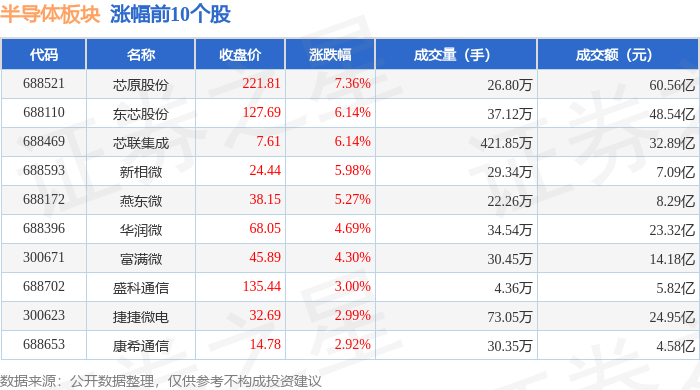
证券之星消息,1月26日半导体板块较上一交易日下跌2.38%,国科微领跌。当日上证指数报收于4132.61,下跌0.09%。深证成指报收于 14316.64,下跌0.85%。半导体板块个股涨跌见下表: | 代码 | 名称 | 收盘价 | 涨跌幅 | 成交量(手) | 成交额(元) | | | --- | --- | --- | --- | --- | --- | --- | | 688521 | 芯原股份 | 221.81 | 7.36% | 26.80万 | | 60.56 Z | | 688110 | 东芯股份 | 127.69 | 6.14% | 37.12万 | | 48.54亿 | | 688469 | 芯联集成 | 7.61 | 6.14% | 421.85万 | | 32.89亿 | | 6888889 | 新相微 | 24.44 | 5.98% | 29.34万 | | 7.09亿 | | 688172 | 症矢微 | 38.15 | 5.27% | 22.26万 | | 8.29亿 | | 688396 | 华润微 | 68.05 | 4.69% | 34.54万 | | 23.32亿 | ...

华润微股价涨5.12%,华夏基金旗下1只基金位居十大流通股东,持有1873.55万股浮盈赚取6238.94万元
Xin Lang Cai Jing· 2026-01-26 05:33
Core Viewpoint - Huazhu Microelectronics has seen a stock price increase of 5.12%, reaching 68.33 yuan per share, with a total market capitalization of 90.71 billion yuan as of January 26 [1] Company Overview - Huazhu Microelectronics Co., Ltd. is located in Wuxi, Jiangsu Province, and was established on January 28, 2003, with its listing date on February 27, 2020 [1] - The company specializes in the design, production, and sales of power semiconductors, smart sensors, and smart control products, as well as providing open wafer manufacturing and packaging testing services [1] - The revenue composition of the company is as follows: products and solutions account for 54.34%, manufacturing and services for 42.92%, and others for 2.74% [1] Shareholder Information - Huazhu Microelectronics' top circulating shareholder is a fund under Huaxia Fund, specifically the Huaxia SSE STAR 50 ETF (588000), which reduced its holdings by 10.57 million shares to hold 18.74 million shares, representing 1.41% of circulating shares [2] - The fund has achieved a floating profit of approximately 62.39 million yuan today [2] - The Huaxia SSE STAR 50 ETF was established on September 28, 2020, with a current scale of 76.02 billion yuan, yielding a return of 15.54% this year, ranking 557 out of 5,580 in its category [2] Fund Performance - The fund manager of the Huaxia SSE STAR 50 ETF is Rong Ying, who has a tenure of 10 years and 85 days, with a total asset scale of 143.28 billion yuan [3] - During the manager's tenure, the best fund return was 169.4%, while the worst was -7.58% [3] Fund Holdings - The Huaxia SSE Smart Selection STAR 50 Value Strategy ETF (589550) also holds Huazhu Microelectronics as a significant position, having reduced its holdings by 4,640 shares to 20,300 shares, which constitutes 2.59% of the fund's net value [4] - The fund has a floating profit of approximately 67,400 yuan today [4] - The Huaxia SSE Smart Selection STAR 50 Value Strategy ETF was established on July 16, 2025, with a current scale of 41.38 million yuan, yielding a return of 14.78% this year, ranking 730 out of 5,580 in its category [4] Fund Manager Information - The fund manager of the Huaxia SSE Smart Selection STAR 50 Value Strategy ETF is Yang Siqi, who has a tenure of 1 year and 230 days, with a total asset scale of 25.97 billion yuan [5] - The best fund return during Yang's tenure was 88.59%, while the worst was -3.79% [5]
央企科创成果发布,多家上市公司产品在列
Shang Hai Zheng Quan Bao· 2026-01-25 16:01
近日,国务院国资委发布2024年版央企科创成果手册,收录67家央企208项成果,涵盖电子元器件、零 部件、新材料、仪器仪表、软件产品、高端装备、制造工艺等7个领域。 据了解,成果目录收录了16项电子元器件成果以及23项软件产品成果。电子元器件成果覆盖GPU、 CPU、DPU、RISC-V等品类,软件产品包括智能体、智算平台、工业软件等。值得一提的是,多家央 企控股上市公司的产品入选了成果目录。 GPU、CPU、DPU等电子元器件入选 多款智能体、智算平台、工业软件等 品类成果亮相 软件产品方面,包括全栈电力系统智能体、天翼云智算平台、"C大脑"工业智能操作系统等多款产品入 选。 全栈电力系统智能体由南方电网人工智能科技有限公司开发,是异构算力统一调度管理的电力人工智能 基础设施。平台提供一站式服务,涵盖全类型数据管理、多场景标注、统一算力中心、模型共享、专业 及低代码建模、大模型训练、智能体搭建等工具,具备AI能力可视化、模型高效测评与快速迭代等功 能,构建了全国规模最大的电力样本库,适用于输配电、市场营销、电力调度、电网规划、安监、供应 链、产业金融等领域。 天翼云智算平台是由中国电信旗下天翼云科技有限公司 ...
中国又一超级王牌,比稀土稀缺100倍!或将领导新一轮半导体革命
Sou Hu Cai Jing· 2026-01-24 14:12
Core Insights - The article discusses the significance of antimony, gallium, and germanium, which are less abundant than rare earth elements but are crucial for various high-tech applications. China produces over 70% of the global supply of these metals, primarily extracted from industrial waste rather than mined directly [1][3][4]. Group 1: Metal Abundance and Importance - Gallium and germanium are extremely rare, with gallium's abundance in the earth's crust at 0.0015% and germanium at 0.00015%, making them significantly less common than iron and aluminum [3][4]. - Antimony, while having independent deposits mainly in China and Russia, is also scarce, with a crustal abundance of only 0.0001% [3][4]. - These metals are essential for various applications, including semiconductors, military technology, and advanced materials [6][7]. Group 2: China's Industrial Advantage - China has developed a robust aluminum and zinc smelting industry, which allows for the recovery of gallium and germanium from waste products [9][10]. - The country has made significant advancements in refining techniques, achieving a high purity level of gallium (99.9999%) necessary for semiconductor applications [12][13]. - By 2020, China's high-purity gallium production accounted for over 90% of the global supply, showcasing its industrial capabilities [13]. Group 3: Technological Developments and Market Dynamics - The third-generation semiconductor materials, such as silicon carbide and gallium nitride, are becoming increasingly important, with gallium being a critical component [24][25]. - In 2023, the domestic market for power electronics using these materials surpassed 7 billion yuan, growing at an annual rate of over 20% [27]. - Chinese companies are achieving breakthroughs in core technologies, enhancing production efficiency and quality in semiconductor materials [28][30]. Group 4: Export Controls and Market Impact - In 2023, China implemented export controls on gallium, germanium, and antimony, requiring licenses for exports, which has significantly reduced export volumes [31][33]. - The price of antimony surged from around $10,000 per ton at the beginning of the year to $25,000 by the end, reflecting the impact of these controls on global markets [34]. - The U.S. Treasury Secretary expressed concerns about China's control over rare metals, indicating a potential shift in the global supply chain dynamics [34][36]. Group 5: Future Outlook - The article suggests that rebuilding a rare metal supply chain in the West will be a long and challenging process, requiring significant industrial infrastructure and expertise [36][39]. - China's strategy appears to focus on moving up the value chain from raw materials to high-end products, aiming for greater control and profitability in the global market [40].