
君实生物

Search documents
港股异动 | 医药股多数走高 歌礼制药-B(01672)涨超6% 康方生物(09926)涨超5%
智通财经网· 2026-02-20 07:08
Group 1 - The pharmaceutical stocks have shown a general upward trend, with notable increases in companies such as Genscript Biotech (up 6.33%), Kintor Pharmaceutical (up 5.23%), and Junshi Biosciences (up 4.39%) [1] - The Chinese innovative drug licensing market has continued its strong growth into 2026, with total transaction amounts exceeding $33.28 billion in the first quarter, surpassing the highest quarterly upfront payment levels of 2025 [1] - According to Open Source Securities, the innovative drug sector has experienced a correction over the past two quarters, but long-term prospects for quality stocks are favorable, suggesting an increase in sector allocation focusing on companies with established overseas opportunities and high clinical data performance [1] Group 2 - Donghai Securities previously indicated that the innovative drug sector is entering a phase of accelerated profit realization by 2025, with companies like Innovent Biologics and Rongchang Biopharmaceutical achieving profitability, while others like 3SBio and Shanghai Yizhong are expected to see significant performance increases [2] - The strong performance of the innovative drug sector validates the effectiveness of the domestic innovative drug business model, with core product volume growth supported by medical insurance becoming the foundation for performance growth, while external collaborations such as BD are crucial for enhancing earnings [2]

“东北霸总”给员工发40亿年终奖,自己成了“辽宁首富”
Sou Hu Cai Jing· 2026-02-17 03:16
Core Viewpoint - The article discusses the contrasting approaches of companies in distributing year-end bonuses, highlighting the extravagant cash bonuses given by Fangda Group and the innovative reward strategies employed by other firms in 2026 [2][3][17]. Group 1: Fangda Group's Year-End Bonus Strategy - Fangda Group has distributed nearly 4 billion yuan in cash bonuses to approximately 130,000 employees over the past decade, showcasing a unique and impactful incentive strategy [3][6]. - The company's founder, Fang Wei, has seen his wealth increase significantly, reaching 52.5 billion yuan in 2025, reflecting the success of his business model [5]. - The "cash wall" phenomenon, where employees receive large sums of cash in a dramatic fashion, has become a viral sensation on social media, reinforcing Fangda Group's image as a "fairy-tale company" [3][6]. Group 2: Other Companies' Bonus Strategies in 2026 - JD.com has adopted a performance-based bonus system, with top-performing employees potentially receiving up to 24 months' salary as bonuses, and overall bonus spending increasing by over 70% [17]. - Chasing Technology has introduced a unique "golden bonus" where each employee received a custom gold banknote, totaling an investment of approximately 26 to 28 million yuan [17]. - Insta360 and Junshi Biosciences have also implemented substantial rewards, including luxury cars and significant cash prizes, indicating a trend among companies to enhance employee motivation through tangible rewards [19][17].


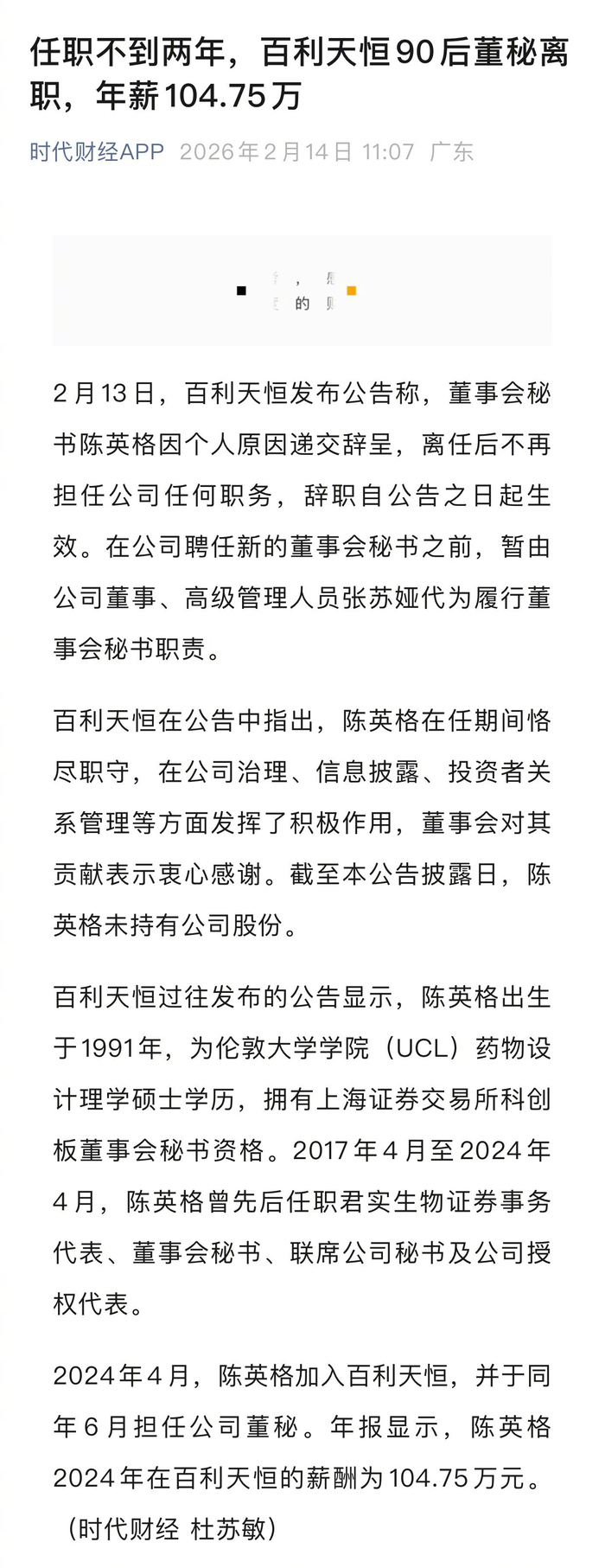
百利天恒90后董秘陈英格离职,年薪104万任职不到两年
Cai Jing Wang· 2026-02-14 06:05
Core Viewpoint - The resignation of Chen Yingge, the Secretary of the Board of Baili Tianheng, is attributed to personal reasons, effective immediately upon the announcement, with Zhang Suya temporarily assuming the role until a new secretary is appointed [1][3]. Group 1: Resignation Details - Chen Yingge submitted his resignation and will no longer hold any position within the company [1]. - The company expressed gratitude for Chen's contributions in governance, information disclosure, and investor relations during his tenure [3]. Group 2: Background Information - Chen Yingge, born in 1991, holds a Master's degree in Drug Design from University College London (UCL) and is qualified as a Secretary of the Board for the Sci-Tech Innovation Board of the Shanghai Stock Exchange [3]. - Prior to joining Baili Tianheng in April 2024, Chen held various positions at Junshi Biosciences from April 2017 to April 2024, including Secretary of the Board and authorized representative [3]. - In 2024, Chen's salary at Baili Tianheng was reported to be 1.0475 million yuan [3].
创新驱动自免市场扩容,三生国健迈入价值兑现期
Guo Ji Jin Rong Bao· 2026-02-14 04:14
Core Viewpoint - The approval of the anti-IL-17A monoclonal antibody, Anmucita, by Sanofi is a significant milestone for the domestic innovative drug industry, enhancing the competitive landscape in the treatment of autoimmune diseases like psoriasis [1] Group 1: Market Trends and Competitive Landscape - The market position of anti-IL-17 treatments is gradually increasing, with Novartis's Cosentyx projected to achieve sales of $6.668 billion by 2025, reflecting a 9% year-on-year growth [1] - As imported products approach patent expiration, sales growth is slowing, leading to increased focus on domestic players, including Sanofi's Anmucita, Hengrui's innovative drug, and others [1] - The domestic autoimmune drug market is expected to reach $4.6 billion by 2024, with a compound annual growth rate (CAGR) of 15.9% from 2020 to 2024, and projected to grow to $35.2 billion by 2034 [7] Group 2: Clinical Advantages of Anmucita - Anmucita demonstrates a significantly lower immunogenicity rate of only 0.7%, with no patients developing neutralizing antibodies, which enhances its clinical efficacy [4] - The drug shows rapid onset of action, with symptom relief occurring within two weeks of the first dose, and maintains high response rates (over 92%) for PASI75 and PASI90 at 52 weeks [4] - Anmucita offers a long dosing interval of Q8W (every 8 weeks), improving patient compliance while maintaining stable efficacy [4] Group 3: Company Strengths and Innovation - Sanofi's confidence stems from over 20 years of experience in target discovery, early development, and a comprehensive innovation system, positioning it ahead of many local biotech firms [5] - The company has established a robust antibody drug development platform and talent pool, enabling it to efficiently navigate the drug approval process and commercialize products [8] - Sanofi's extensive experience in the autoimmune sector allows it to leverage its commercial capabilities and channel coverage for seamless product launch and market penetration [8]

瑞银深度调研报告:2026年中国两大产业主线:自主可控与海外扩张
Zhi Tong Cai Jing· 2026-02-13 13:31
Group 1: Core Insights - UBS's in-depth research in China identifies two main industry themes for 2026: self-sufficiency and overseas expansion [1] - The research covered various sectors including technology, industrial, healthcare, consumer, and utilities, visiting over 100 companies and industry experts [1] - The report highlights a shift in investor interest, with capital goods, media entertainment, and real estate development seeing increased research focus, while semiconductor and automotive parts sectors experienced a decline [1] Group 2: Technology Sector Insights - The technology sector is a key focus, with advancements in self-sufficiency moving from isolated breakthroughs to industry-wide collaboration [2] - AI capital expenditure is expected to grow steadily in 2026, driven by strong demand for AI applications and local semiconductor production [3] - Despite uncertainties regarding H200 GPU imports, domestic supply chains are adapting through technology substitution and demand upgrades [3] Group 3: Semiconductor Developments - The localization of China's semiconductor industry is accelerating, with significant progress in advanced etching/ deposition equipment, advanced packaging, and high-end analog chips [4] - Capital expenditure for wafer fabrication equipment (WFE) is projected to grow by 10-15% annually, driven by capacity expansion in advanced logic and memory wafer fabs [4] - Domestic manufacturers anticipate a substantial increase in storage capital expenditure in 2026, aligning with a global upcycle in the storage industry [4] Group 4: Overseas Expansion Trends - Multiple industries, including industrial, biopharmaceuticals, and consumer goods, are focusing on overseas expansion as a key growth strategy [6] - In the industrial sector, overseas orders for AIDC and renewable energy storage equipment are increasing significantly [7] - The healthcare sector is also prioritizing global expansion, with biopharmaceutical companies actively pursuing international collaborations and local sales team development [9] Group 5: Key Recommendations - UBS recommends several core stocks in the technology and semiconductor sectors, including Northern Huachuang (advanced etching/ deposition), Changdian Technology (advanced packaging), and Horizon Robotics (edge AI) [5][12] - In the healthcare sector, companies like WuXi AppTec (CRO/CDMO) and 3SBio (biopharmaceuticals) are highlighted as key beneficiaries of global expansion [12] - The consumer sector sees recommendations for Jason Furniture (overseas expansion) and Leap Motor (new energy vehicles), while Gree Electric Appliances is advised to sell due to margin pressures [12] Group 6: Overall Industry Outlook - The report concludes that China's industrial development in 2026 will be characterized by a dual focus on self-sufficiency in technology and overseas expansion in various sectors [13] - The integration of these two themes is expected to enhance China's economic globalization, with technology supporting overseas expansion and vice versa [13] - Investment opportunities are identified in sectors with low crowding and improving fundamentals, as well as in high-growth areas like AI and semiconductors [13]


君实生物总经理邹建军:向打造本土跨国药企进阶
Jing Ji Guan Cha Wang· 2026-02-13 05:08
Core Insights - The Chinese innovative drug industry has entered a critical stage of high-quality development, focusing on quality and core value rather than rapid scale expansion [1] - By 2026, the industry will emphasize core strengths and practical outcomes, with a focus on producing valuable innovative results and achieving efficient transformation [1] Group 1 - The industry has transitioned from "barbaric growth" to "rational maturity," with a clearer development direction [1] - Chinese innovative drug companies are increasingly engaging in license-out collaborations with multinational corporations (MNCs), reflecting global recognition of their R&D capabilities [1][2] - There is a need for companies to move beyond short-term gains from selling pipelines and focus on independent commercialization to build a sustainable local MNC [1] Group 2 - Companies should maintain their original intent by focusing on unmet clinical needs rather than merely catering to business development transactions [1] - Junshi Bioscience aims to deepen its research in cutting-edge fields like tumor immunotherapy and advance high-potential pipelines such as JS207 and JS212 to create globally competitive innovative products [1][2] - Companies must strengthen their global capabilities by establishing a comprehensive self-operated system for R&D, production, commercialization, and regulatory compliance [2] Group 3 - The integration of medical insurance and commercial insurance is essential to boost confidence in sustained investment in true innovation [2] - The new medical insurance directory and the first commercial insurance innovative drug directory are expected to improve accessibility to high-priced drugs and stabilize market expectations [2] - Embracing digitalization and AI can help companies overcome innovation bottlenecks, enhancing efficiency and reducing costs across various stages of drug development [2] Group 4 - By 2026, the innovative drug industry will face both opportunities and challenges, with an increasing concentration of the market favoring leading companies and niche leaders [3] - Junshi Bioscience is committed to a patient-centered approach, aligning with innovation trends, ensuring compliance, and expanding its collaborative landscape [3] - The company believes that collective efforts will drive the high-quality development of China's innovative drugs, benefiting patients globally [3]

君实生物总经理邹建军:向打造本土跨国药企进阶|2026商业新愿景
Jing Ji Guan Cha Wang· 2026-02-13 05:01
Group 1 - The Chinese innovative drug industry has entered a critical stage of high-quality development, focusing on quality and core value rather than rapid scale expansion, moving from "barbaric growth" to "rational maturity" [2] - By 2026, the industry will emphasize core strengths and practical results, with a focus on producing valuable innovative outcomes and achieving efficient transformation [2] - Currently, the internationalization of Chinese innovative drugs is still in its early stages, with more early-stage pipelines engaging in license-out collaborations with multinational corporations (MNCs), reflecting global recognition of China's R&D capabilities [2] Group 2 - Innovative drug companies must adhere to their original intentions, focusing on unmet clinical needs rather than merely catering to business development transactions, with a goal to achieve FIC/BIC innovations to build core competitiveness [3] - Companies venturing abroad need to solidify their global capabilities by establishing a comprehensive self-operated system across R&D, production, commercialization, and regulatory compliance [3] - The new medical insurance directory and the first commercial insurance innovative drug directory are expected to enhance the accessibility of high-priced drugs and stabilize market expectations for companies [3] Group 3 - There is an opportunity for deep integration of digitalization and innovative drugs, with AI becoming a crucial tool for overcoming innovation bottlenecks and improving efficiency while reducing costs across various stages [4] - By 2026, the innovative drug industry will face both opportunities and challenges, with increasing industry concentration and a landscape where leading companies and niche leaders emerge [4] - The company aims to participate in the construction of the industry ecosystem by focusing on patient-centered approaches, aligning with innovation trends, ensuring compliance, and expanding collaboratively [4]

君实生物2月12日获融资买入2105.68万元,融资余额14.12亿元
Xin Lang Cai Jing· 2026-02-13 05:00
Group 1 - The core viewpoint of the news is that Junshi Biosciences experienced a decline in stock price and significant trading activity, indicating potential investor concerns and market volatility [1] - On February 12, Junshi Biosciences' stock fell by 1.23%, with a trading volume of 243 million yuan, and a net financing outflow of approximately 14.89 million yuan [1] - As of February 12, the total margin balance for Junshi Biosciences was 1.423 billion yuan, with a financing balance of 1.412 billion yuan, representing 5.33% of the circulating market value, which is above the 90th percentile of the past year [1] Group 2 - Junshi Biosciences, established on December 27, 2012, focuses on the research and commercialization of monoclonal antibody drugs, with 90.67% of its revenue coming from drug sales [2] - For the period from January to September 2025, Junshi Biosciences reported a revenue of 1.806 billion yuan, a year-on-year increase of 42.06%, while the net profit attributable to shareholders was -596 million yuan, reflecting a 35.72% increase [2] - As of September 30, 2025, the number of shareholders increased by 15.17% to 35,900, while the average circulating shares per person decreased by 12.96% to 21,361 shares [2]
从“十四五”收官到“十五五”奠基,沪市公司2025业绩预告透露哪些新信号?
Zhong Guo Jing Ying Bao· 2026-02-12 15:05
Core Insights - The number of companies in the Shanghai Stock Exchange (SSE) announcing positive earnings forecasts for 2025 is increasing, indicating a recovery in performance and a solid foundation for the "14th Five-Year Plan" period [1][7][9] Group 1: Performance Highlights - As of February 9, 2026, 271 companies on the SSE main board have issued positive earnings forecasts for 2025, with 168 expecting profit increases and 85 companies turning losses into profits [1] - The performance of companies is particularly strong in the non-ferrous metals and electronics sectors, with leading companies maintaining high profit levels [2][8] - In the non-ferrous metals sector, companies are experiencing a "volume-price resonance," with both production increases and rising prices contributing to profit growth [2][8] Group 2: Sector-Specific Insights - Non-ferrous metal companies are benefiting from rising prices and increased production, with Zijin Mining expected to achieve a net profit of 51-52 billion yuan, a year-on-year increase of 59%-62% [2] - The electronics sector is driven by AI demand, with companies like Huaqin Technology forecasting a revenue increase of 54.7%-56.1% and a net profit increase of 36.7%-38.4% [3] - The AIoT market is rapidly growing, with companies like Rockchip expecting significant revenue and profit growth due to increased demand in automotive electronics and AI servers [3] Group 3: Industry Trends - The semiconductor and biopharmaceutical sectors on the STAR Market are showing signs of recovery, with nearly 60% of companies reporting profit growth [5][6] - The integrated circuit industry is benefiting from AI applications, with 87 companies reporting a combined net profit increase of approximately 99.49 billion yuan [5][8] - The biopharmaceutical sector is experiencing a resurgence, with innovative drug companies reporting significant revenue growth and improved profitability [6] Group 4: Future Outlook - The earnings forecasts reflect structural optimization and profitability recovery, indicating a strong foundation for the Chinese economy amid complex challenges [7][9] - The focus on innovation and structural optimization will be crucial for the next five years, with SSE companies playing a key role in driving economic stability [9][10] - The continuous improvement of the capital market environment is expected to attract long-term investment, fostering a positive cycle between technological innovation and capital support [10]
沪市有色“量价齐升”,电子AI“多点开花”
Bei Jing Ri Bao Ke Hu Duan· 2026-02-12 12:24
Group 1: Overall Market Performance - Over 270 companies on the Shanghai Stock Exchange have issued positive performance forecasts for 2025, indicating a robust outlook for the market [1] - Nearly 60% of companies on the Sci-Tech Innovation Board have reported year-on-year profit growth, showcasing the dual dimensions of quality and quantity in the economic trajectory of China [1] Group 2: Nonferrous Metals Industry - The nonferrous metals industry is experiencing a boom driven by resource prices and industrial upgrades, with industrial added value growth of 6.9%, surpassing the national average [2] - The total profit for ten major nonferrous metals reached 528.45 billion yuan, a year-on-year increase of 25.6%, marking a historical peak [2] - Leading companies like Zijin Mining are expected to see significant profit increases, with projected net profits of 51 to 52 billion yuan, reflecting a growth of 59% to 62% [2] Group 3: Electronic Industry - The electronic industry is witnessing growth driven by AI demand, with companies like Huaqin Technology expected to achieve revenues of 170 to 171.5 billion yuan, a year-on-year increase of 54.7% to 56.1% [4] - Shengyi Technology anticipates a net profit increase of 87% to 98%, benefiting from rising sales and improved product structure in the copper-clad laminate sector [4] - Companies are leveraging AI advancements to enhance their product offerings, with firms like Rockchip expected to see revenue growth of 71.97% to 85.42% [5] Group 4: Sci-Tech Innovation Board - The Sci-Tech Innovation Board is showing strong innovation momentum, particularly in the integrated circuit and biopharmaceutical sectors, with a projected net profit increase of approximately 99.49 billion yuan across 87 companies [6] - Companies in the AI chip sector are expected to see revenue growth exceeding 100%, with significant improvements in profitability [6] - The biopharmaceutical industry is transitioning towards commercialization, with notable collaborations and product approvals driving growth [6]




