
小鹏

Search documents
铜价狂飙36%,格力回应空调涨价问题
21世纪经济报道· 2026-01-05 12:52
Core Viewpoint - Gree Electric Appliances has decided not to raise prices for its home air conditioners despite rising copper prices, emphasizing its commitment to consumer rights and maintaining the benefits of national subsidies [1][5]. Group 1: Price Strategy and Market Position - Gree Electric announced that it will not increase the price of its home air conditioners, aiming to ensure that the benefits of national subsidies reach consumers fully [1][5]. - The company highlighted that copper constitutes about 20% of the cost of air conditioners, and the recent surge in copper prices has led to a cost increase of approximately 7.26% per unit [4]. - Gree's market director stated that transferring cost pressures to consumers undermines the effectiveness of national subsidy policies [5]. Group 2: Aluminum vs. Copper Debate - Gree Electric has no current plans to adopt "aluminum instead of copper" technology, citing significant performance and reliability differences between the two materials [4][6]. - The company has been actively researching aluminum technology but insists that it will only switch to aluminum when it meets the same technical standards as copper [6]. - Other companies in the industry, such as Midea and Haier, have signed a self-regulatory agreement to accelerate the adoption of aluminum, while Gree has opted out of this initiative [6][7]. Group 3: Industry Trends and Future Outlook - The air conditioning industry is seeing a push towards aluminum use, with expectations that aluminum replacement rates could reach 60% for heat exchangers and 90% for connecting pipes by 2030 [7]. - Analysts predict that the air conditioning sector, due to its high copper intensity and cost sensitivity, will be a leading area for aluminum adoption, potentially increasing annual aluminum demand by 200,000 to 500,000 tons [7].



德系豪华车新年搞“突袭”?宝马开年官降最高30万
Zhong Guo Jing Ji Wang· 2026-01-05 11:49
Core Viewpoint - BMW has initiated a significant price reduction across 31 key models, with discounts reaching up to 300,000 yuan, marking a departure from its previous stance against price wars in the luxury car market [1][4]. Group 1: Price Reduction Details - The price cuts affect a wide range of models, with reductions generally exceeding 10%, and 24 models seeing cuts over 10%, while 5 models have reductions over 20% [2]. - The model with the largest price drop is the BMW i7 M70L, which saw a reduction from 1.899 million yuan to 1.598 million yuan, a decrease of 301,000 yuan [3][4]. - The entry-level BMW 225L M Sport model's price was reduced from 259,900 yuan to 208,000 yuan, lowering the entry barrier for consumers [2]. Group 2: Market Context and Strategy - BMW's price reduction is framed as a "value upgrade" rather than a price war, indicating a strategic response to market dynamics [4]. - The luxury car market in China is undergoing rapid restructuring, with traditional German brands like BMW, Mercedes-Benz, and Audi facing declining sales, as evidenced by a 14.7% drop in BMW's sales from January to November 2025 [6]. - The rise of Chinese brands, which have seen significant sales growth, poses a challenge to established luxury brands, with companies like Hongmeng Zhixing and Zeekr achieving sales of 589,000 and 575,000 units respectively in 2025 [7][8]. Group 3: Regulatory Environment and Implications - The Chinese government has been actively regulating price wars in the automotive sector, emphasizing compliance with pricing guidelines to promote healthy market development [9]. - BMW's decision to lower prices may attract consumer interest in the short term but could undermine its brand's pricing integrity and consumer perception in the long run [9]. - The competitive landscape may prompt other luxury brands like Mercedes-Benz and Audi to reconsider their pricing strategies in response to BMW's actions, potentially reshaping the market dynamics further [10].
年度策略报告姊妹篇:2026年机械行业风险排雷手册-20260105
ZHESHANG SECURITIES· 2026-01-05 08:45
Core Insights - The report emphasizes a positive outlook for the mechanical industry in 2026, driven by structural transformation and a rebound in external demand [3][4] - The report introduces a "risk排雷" manual to proactively identify potential market misjudgments and challenges within various sectors [3][4] Industry Overview - The mechanical industry is expected to experience a cyclical reversal, with growth in engineering machinery, industrial gases, shipbuilding, photovoltaic equipment, and lithium battery equipment [6][8] - Key assumptions include continued government support for emerging technology industries and a stable macroeconomic recovery [11][16] Engineering Machinery - The engineering machinery sector is witnessing a cyclical upturn, with increased overseas market share and a gradual domestic renewal cycle [17] - Key growth drivers include global market expansion, improved domestic demand due to favorable macro policies, and a stabilizing domestic infrastructure and real estate market [17] Shipbuilding - The shipbuilding industry is on an upward trend, with demand supported by a variety of vessel types and improving profitability for shipyards [19] - The sector is expected to benefit from supply constraints driving up ship prices and a focus on high-end, large-scale, dual-fuel vessels [20] Export Chain - The export chain is optimistic about demand recovery, particularly in the U.S. market, with a focus on strategic exports and emerging markets [22] - Key assumptions include a favorable trade environment and ongoing industrial shifts towards resource-rich countries [22] Industrial Gases - The industrial gases sector is viewed positively, with expectations of volume and price increases leading to improved valuations [27] - The report highlights the importance of leading companies in the sector and recommends focusing on those with operational highlights in niche markets [30] Lithium Battery Equipment - The lithium battery equipment sector is expected to emerge from a downturn, with solid-state battery technology creating significant market opportunities [51] - The report anticipates a substantial increase in market size, projecting a growth from 2.06 billion in 2025 to 33.62 billion by 2030 [51] Wind Power Equipment - The wind power industry is projected to maintain high growth, particularly in offshore wind projects, with significant investments expected [63] - The report recommends focusing on leading manufacturers and components that support the offshore wind market [64] Testing and Inspection - The testing and inspection sector is expected to see upward momentum, driven by increasing demand and a trend towards consolidation among leading firms [71] - The report emphasizes the importance of focusing on emerging fields and the long-term growth potential of comprehensive testing companies [71] Rail Transit Equipment - The rail transit equipment sector is expected to benefit from steady investment in fixed assets and high demand for passenger and freight transport [75] - The report highlights the potential for continued growth in the high-speed train sector and recommends key players in the industry [76] Oil Service Equipment - The oil service equipment sector is anticipated to thrive due to sustained demand driven by oil prices and energy security concerns [79] - The report suggests focusing on companies with strong technical barriers and those benefiting from domestic and international market opportunities [80]





苏奥传感:小鹏为公司的重要客户之一
Mei Ri Jing Ji Xin Wen· 2026-01-05 08:09
苏奥传感(300507.SZ)1月5日在投资者互动平台表示,投资者您好,小鹏为公司的重要客户之一。感 谢关注! (记者 曾健辉) 每经AI快讯,有投资者在投资者互动平台提问:公司有小鹏有哪些业务往来? ...

申万宏源证券晨会报告-20260105
Shenwan Hongyuan Securities· 2026-01-05 05:26
Core Insights - The report highlights Nanshan Aluminum (600219) as a rare growth target in the electrolytic aluminum sector, emphasizing its dividend and buyback strategies as indicators of confidence in future performance [2][9][11] - The report also covers Hanhigh Group (001221), which is positioned as a high-growth company focusing on cost reduction and brand strength to create high-end cost-performance products [10][12] Nanshan Aluminum (600219) Summary - Expected net profit for 2025, 2026, and 2027 is projected at 5.0 billion, 5.46 billion, and 5.84 billion yuan respectively, with corresponding P/E ratios of 12, 11, and 10 times [3][11] - The company is anticipated to benefit from the expansion of alumina production in Indonesia, which will enhance its performance due to cost advantages [11] - The report assigns a target P/E of 13 times for 2026, indicating a potential upside of 15% from the current price [3][11] - The company has a production capacity of 680,000 tons of electrolytic aluminum, with expectations for aluminum prices to rise in 2026 due to a slowdown in global supply growth [11] Hanhigh Group (001221) Summary - Revenue projections for Hanhigh Group are set at 3.595 billion, 4.525 billion, and 5.653 billion yuan for 2025, 2026, and 2027, with net profits of 706 million, 942 million, and 1.237 billion yuan respectively [10][14] - The company is expected to maintain a lower valuation compared to its peers, with P/E ratios of 33, 24, and 19 times for the respective years [10][14] - Hanhigh Group's growth is driven by cost reduction strategies and a focus on high-quality, high-performance products, which have gained market recognition [12][14] Investment Recommendations - Both Nanshan Aluminum and Hanhigh Group are given "Outperform" ratings, indicating a positive outlook for their stock performance relative to the market [3][10] - The report suggests that Nanshan Aluminum's unique position in the electrolytic aluminum market and Hanhigh Group's strong growth trajectory make them attractive investment opportunities [2][10]
申万宏源研究晨会报告-20260105
Shenwan Hongyuan Securities· 2026-01-05 01:24
Group 1: Nanshan Aluminum (南山铝业) - Nanshan Aluminum is positioned as a rare growth target in the electrolytic aluminum sector, with a focus on dividends and share buybacks, reflecting confidence in its growth potential [4][12] - The company is expected to achieve net profits of CNY 5.0 billion, CNY 5.46 billion, and CNY 5.84 billion for the years 2025, 2026, and 2027, respectively, corresponding to P/E ratios of 12x, 11x, and 10x [4][12] - The report anticipates a 15% upside potential based on a target P/E of 13x for 2026, indicating a favorable valuation compared to peer companies [4][12] - Key assumptions include increased alumina production from Indonesia, with projected sales volumes of 2.76 million tons in 2025, 4.36 million tons in 2026, and 4.56 million tons in 2027 [12] - The report highlights that domestic electrolytic aluminum capacity is nearing its peak, while global supply growth is slowing, suggesting a favorable supply-demand balance for the industry [12] Group 2: Hanhigh Group (悍高集团) - Hanhigh Group is expected to achieve revenues of CNY 3.595 billion, CNY 4.525 billion, and CNY 5.653 billion for 2025, 2026, and 2027, respectively, with net profits of CNY 706 million, CNY 942 million, and CNY 1.237 billion [4][15] - The company is rated as "Buy" based on its current valuation being below the average of comparable companies for 2026 [4][15] - Hanhigh Group's growth is driven by cost reduction and brand strength, with a CAGR of 29% in revenue and 59% in net profit from 2019 to 2024 [12][13] - The company focuses on product innovation and cost efficiency, leveraging its own production capacity to enhance profitability [12][13] Group 3: Market Overview and Investment Strategy - The report identifies a favorable market environment for the spring season, with expectations of continued upward momentum in the stock market due to improved economic indicators and liquidity [22] - The "Top Ten Gold Stocks" for January 2026 include companies like Hualu Hengsheng, Lingyi Zhi Zao, and Alibaba, indicating a diversified investment strategy across sectors [14][22] - The automotive industry is highlighted for its recovery potential, particularly with the introduction of new subsidies and the expected improvement in demand for mid-range vehicles [24]
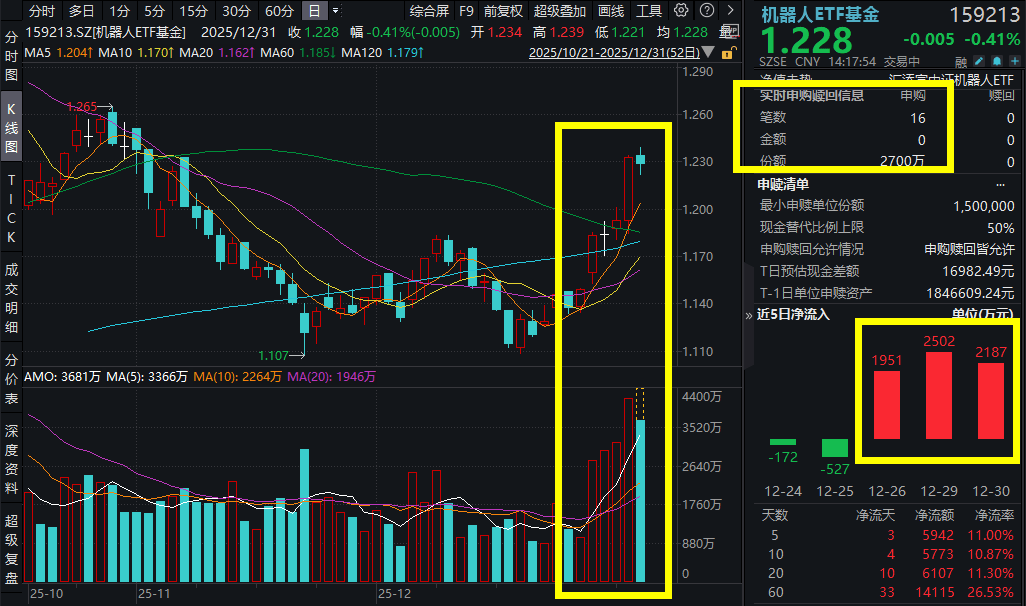
机器人回调,大族激光跌超1%,机器人ETF基金(159213)已经连续4日净流入近1亿元!2025年人形机器人量产元年已过,2026年"飞轮时刻"将启动?
Sou Hu Cai Jing· 2025-12-31 08:53
Core Viewpoint - The A-share market shows a mixed trend with the robotics sector under pressure, yet there is a significant inflow of funds into the robotics ETF fund (159213), indicating investor confidence despite market fluctuations [1][3]. Group 1: Market Performance - As of 14:25, the robotics ETF fund (159213) experienced a decline of 0.41%, marking its first pullback after five consecutive days of gains [1]. - The fund saw a net inflow of over 33 million yuan during the day, contributing to a total net inflow of nearly 100 million yuan over the past four days [1]. Group 2: Component Stocks - The top ten component stocks of the robotics ETF fund show mixed performance, with notable gains from Keda Xunfei (2.70%) and Zhongkong Technology (1.27%), while Huichuan Technology and Dazhu Laser both fell over 1% [2][4]. Group 3: Industry Developments - The robotics sector is experiencing a significant boost, with rumors of an upcoming administrative order on robotics expected in 2026, and suppliers actively engaging in North America [3]. - The year 2025 is highlighted as a pivotal year for robotics, with strong initial growth followed by adjustments and renewed interest due to events like the World Robot Conference [3]. Group 4: Future Outlook - The robotics ETF fund manager indicates substantial advancements in mass production, with companies like UBTECH and ZhiYuan set to achieve significant production milestones by 2025 [6]. - The industry is expected to see a surge in human-like robots, with projections indicating that domestic sales could exceed 10,000 units in 2026, driven by technological advancements and commercial viability [7].



2025年度盘点,重新定义资管模式的华夏基金
Sou Hu Cai Jing· 2025-12-31 01:21
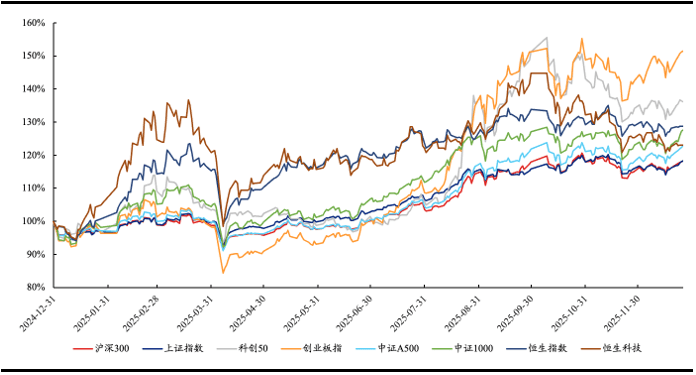
Core Viewpoint - The year 2025 marks a structural bull market, with significant gains in major indices, including an 18.36% increase in the CSI 300 and a 51.47% rise in the ChiNext Index, both representing the largest annual gains since 2020. The total trading volume of A-shares exceeded 400 trillion yuan, setting a historical record [1]. Monthly Key Events - January-February: AI models driven by DeepSeek and humanoid robot performances during the Spring Festival gained attention [4]. - March: Recovery in consumer scenarios boosted retail and catering sectors [4]. - April: U.S. tariffs led to increased interest in gold, agriculture, and undervalued blue-chip stocks [4]. - May: The May Day consumption peak activated the consumption and logistics sectors [4]. - June: Military parades and geopolitical tensions strengthened the military industry, while green building policies positively impacted related sectors [4]. - July: The commercial launch of humanoid robots and surging demand for AI computing power boosted related stocks [4]. - August: Support policies for synthetic biology spurred interest in beauty and pharmaceutical sectors [4]. - September: Accelerated industrialization of solid-state batteries led to valuation recovery in the new energy sector [4]. - October-November: Recovery in storage chip prices initiated an industry cycle reversal, benefiting the semiconductor sector [4]. - December: The official launch of the Hainan Free Trade Port and the issuance of L3 autonomous driving permits led to increased activity in local stocks and related technologies [4]. Industry Performance - The mining, hardware, industrial trade, and comprehensive sectors saw annual gains exceeding 60% [5]. - The top three investment themes in 2025 were innovative drugs, AI, and robotics, with gold also performing exceptionally well due to a weaker dollar [6][9]. Investment Highlights - Innovative drugs experienced a valuation reshaping driven by policy support and industry upgrades, with the Hang Seng Biotechnology Index rising 70.02% [7]. - The AI sector exploded following the introduction of DeepSeek, with significant growth in demand for chips and computing power [8]. - The robotics sector gained momentum with increased policy support and the emergence of domestic giants [9]. Fund Performance - 华夏基金 (China Asset Management) achieved notable success in various fund categories, continuing its strong performance from 2023 [10]. - The 华夏北交所创新中小企业精选两年定开 fund recorded a return of 270.61% over three years, with a 75.28% return in 2025 [11]. - The 华夏数字产业混合 fund saw a 126.46% increase in 2025, benefiting from the structural bull market in the AI sector [9]. ETF Market Growth - The ETF market in China reached 6.03 trillion yuan by the end of 2025, a 60% increase from the beginning of the year, with 1,381 ETFs available [15]. - 华夏基金 played a significant role in the growth of the ETF market through innovative tools and reports aimed at enhancing investor experience [16][17]. Strategic Evolution - 华夏基金 has transitioned from "managing assets" to "defining assets," focusing on a multi-asset approach to meet diverse investor needs in the era of inclusive finance [18][19].
英利汽车:公司的主要客户为国内知名整车制造商
Zheng Quan Ri Bao Wang· 2025-12-30 11:41
Core Viewpoint - Yingli Automotive (601279) has established deep partnerships with well-known domestic automakers and is expanding its business in the emerging new energy vehicle sector through collaborations with leading companies in the industry [1] Group 1: Client Relationships - The company’s main clients include prominent domestic vehicle manufacturers such as FAW-Volkswagen, Beijing Benz, Volvo Asia Pacific, Brilliance BMW, SAIC Volkswagen, SAIC General Motors, Geely, and FAW Hongqi [1] - Yingli Automotive is progressively promoting its new energy vehicle business and has formed partnerships with notable new energy vehicle companies like BYD (002594), Xpeng, NIO, Polestar, and several well-known North American new energy vehicle firms [1] Group 2: Business Development - The client structure of the company is continuously enriching, indicating a strategic focus on diversifying its customer base within the automotive industry [1]

中概指数盘初跌1.3%:阿里跌2.9%,小鹏跌2.7%
Ge Long Hui A P P· 2025-12-29 15:01
Core Viewpoint - The Nasdaq Golden Dragon China Index experienced a decline of over 1.3%, reaching 7576.48 points, indicating a negative trend in the performance of popular Chinese concept stocks [1] Group 1: Stock Performance - Qifu Technology saw a drop of 4.75% [1] - Zai Lab fell by 4% [1] - Alibaba and Miniso both decreased by 2.9% [1] - Global Data and Xpeng declined by 2.7% [1] - Li Auto dropped by 2.1% [1] - Yum China fell by 1.8% [1] - Atour decreased by 1.7% [1] - Century Internet dropped by 1.4% [1] - Daqo New Energy, New Oriental, and Pony.ai also saw declines exceeding 1% [1]