
海澜之家

Search documents
波司登高端化“大败局”:86克的“轻”与2299元的“重”,究竟谁背叛了谁?
3 6 Ke· 2026-01-23 04:04
Core Viewpoint - The article highlights the disparity between the high prices of Bosideng's products and their low filling weights, leading to consumer dissatisfaction and a potential decline in brand trust [1][2][4][22]. Group 1: Product Quality and Consumer Perception - Bosideng's high-priced products, such as a down jacket priced at 2299 yuan with only 86 grams of filling, raise concerns about value for money [1][2]. - The company has been accused of "compliance-based cost-cutting," where it adheres to national standards while still providing subpar products, leading to consumer outrage [2][4]. - Complaints about product quality, including low filling amounts and poor after-sales service, have surged on consumer complaint platforms [4][11]. Group 2: Brand Strategy and Market Position - Bosideng's shift towards high-end branding and pricing has not been matched by improvements in product quality, leading to a disconnect with consumer expectations [10][22]. - The brand's average selling price has increased significantly, from under 1000 yuan in 2017 to over 1800 yuan by 2025, indicating a reliance on price increases rather than product enhancements [9][10]. - The company's past success was attributed to a focused strategy on down jackets, but recent financial reports indicate stagnation in revenue growth, suggesting a need for strategic reevaluation [12][13]. Group 3: Competitive Landscape - Bosideng faces increasing competition from both high-end outdoor brands and budget-friendly alternatives, which offer better value propositions [17][20]. - Brands like Arc'teryx and The North Face are capturing market share in the high-end segment, while budget brands like Yaya and Xuezhongfei are aggressively targeting price-sensitive consumers [17][20]. - The competitive pressure is compounded by the emergence of new players like Gao Fan, which are effectively positioning themselves in the same price range as Bosideng [20]. Group 4: Financial Performance and Future Outlook - Recent financial data shows a mere 1.4% revenue growth, a stark contrast to previous years' growth rates, indicating potential challenges ahead [12][13]. - The company's diversification efforts in other clothing lines have not yielded positive results, with significant declines in revenue from these segments [14][16]. - The market's reaction to Bosideng's recent performance has been negative, with stock prices dropping significantly, reflecting investor concerns about the brand's future viability [21].

申万宏源:25Q4我国纺服终端需求增速放缓 关税谈判结果陆续落定提振出口景气度
智通财经网· 2026-01-22 07:50
Core Viewpoint - The retail sales of clothing, shoes, and textiles in China for the year 2025 reached 1.52 trillion yuan, reflecting a year-on-year increase of 3.2%, with a slowdown in demand observed in Q4 2025 due to warmer winter temperatures affecting winter clothing sales [1][2] Domestic Demand - In 2025, the retail sales of clothing, shoes, and textiles amounted to 1.52 trillion yuan, with monthly growth rates of 6.3%, 3.5%, and 0.6% for October, November, and December respectively, indicating a slowdown in Q4 due to higher winter temperatures [1] - The performance of women's clothing brands is expected to show signs of recovery, with companies like Xinhe and Ge Li Si projected to achieve revenue growth in Q4 2025 [4] External Demand - China's textile and apparel exports totaled $293.8 billion in 2025, down 2.6% year-on-year, with textile exports at $142.6 billion (up 0.4%) and apparel at $151.2 billion (down 5.2%) [2] - Vietnam's textile exports grew by 7.0% to $39.6 billion, indicating a shift in the textile supply chain and highlighting the competitive pressures faced by Chinese exporters [2] Industry Performance - The overall sales in Q4 2025 were impacted by weak winter clothing consumption, but high-end outdoor and niche sports brands are expected to maintain strong growth, with brands like FILA and 361 Degrees projected to see significant revenue increases [3] - The home textile sector is experiencing a mixed performance, with companies like Luolai and Water Mercury showing stable growth, while Fuanna is still in a destocking phase [5] Non-woven Fabric Industry - The non-woven fabric sector is benefiting from quality upgrades and expanding demand, with companies like Wanjia and Nuo Bang expected to see revenue growth of 10% to 20% in Q4 2025 [6] Textile Manufacturing - The performance of the textile manufacturing chain is under pressure due to fluctuations in brand orders, particularly from Nike and Converse, while the Australian wool industry is expected to benefit from rising demand and price increases [7] Investment Insights - Looking ahead to 2026, domestic demand is anticipated to gradually recover, with potential investment opportunities in high-performance outdoor brands and discount retail sectors [9] - The global tariff negotiations are stabilizing, which may not affect the core manufacturing competitiveness of the industry [9]
申万宏源证券晨会报告-20260122
Shenwan Hongyuan Securities· 2026-01-22 02:09
澳毛周期、无纺布制造可期 涨跌 (%) IKA ta 今日重点推荐 2026 年 01 月 22 日 纺织服装行业点评:2025 年报业绩前瞻,品牌服饰表现分化, 行业观点与投资分析意见: 展望 26 年内需有望逐步回暖,挖掘新消费高景气方向:①高性能户外:波 司登、安踏、滔搏、361 度,建议关注伯希和(已递交招股书)、李宁、特 步;②折扣零售:海澜之家(旗下京东奥莱);③个护清洁:诺邦股份、稳 健医疗、洁雅股份;④睡眠经济:罗莱生活、水星家纺。 全球关税博弈变量逐步落定,不改核心制造全球竞争力:①运动制造产业链: 申洲国际、华利集团、裕元集团、伟星股份、百隆东方;②澳毛涨价周期: 新澳股份;③卫材升级产业链:延江股份。 风险提示:消费恢复低于预期;行业竞争加剧;存货减值风险;原材料成 本上涨。 (详见正文) (联系人:王立平/朱本伦) 海外利率上行引发全球震荡,后续推演与影响 -- -- 全球资产配 置风险系列报告之二 上 周 以 美 日 为 代 表 的 发 达 国 家 长 端 利 率 再 度 上 行 (20260101~20260120,30 年日债利率上行 41bp,30 年美债利率上 行 7bp), ...
申万宏源研究晨会报告-20260122
Shenwan Hongyuan Securities· 2026-01-22 00:57
Group 1: Textile and Apparel Industry Insights - The textile and apparel industry is expected to see a gradual recovery in domestic demand in 2026, with a focus on high-growth consumption areas such as high-performance outdoor brands, discount retail, personal care, and sleep economy [9][13] - The retail sales of clothing, shoes, and textiles in China reached 1.52 trillion yuan in 2025, showing a year-on-year increase of 3.2%, with December experiencing a slowdown in growth due to warmer winter temperatures [9] - The export value of China's textile and apparel in 2025 was $293.8 billion, a decrease of 2.6% year-on-year, indicating a shift in supply chain orders towards countries like Vietnam, which saw a 7% increase in textile exports [9] Group 2: Performance of Key Brands - Major outdoor brands such as Anta, Li Ning, and 361 Degrees are expected to perform well, while discount retailers like Hailan Home are also projected to grow [10][13] - The performance of women's apparel brands is showing signs of recovery, with companies like Xinha and Ge Li Si expected to see significant growth in revenue and net profit [10] - The children's clothing segment is anticipated to stabilize, with brands like Semir and Jiama showing slight growth in revenue [10] Group 3: Non-woven Fabric Industry - The non-woven fabric industry is benefiting from quality upgrades and expanding demand, with companies like Sturdy, Yanjiang, and Nobon expected to see revenue growth of 10% to 20% in 2025 [11][12] - The global market for wet and dry wipes is projected to be worth hundreds of billions, with China experiencing faster growth than the global average [11] Group 4: Global Interest Rate Trends and Impacts - Recent increases in long-term interest rates in developed countries have led to global market volatility, with the 30-year Japanese government bond yield rising by 41 basis points and the 30-year U.S. Treasury yield increasing by 7 basis points [14][15] - The geopolitical tensions, particularly involving the U.S. and Europe, have prompted a reallocation of global funds, with potential risks for U.S. Treasury securities [15] Group 5: Banking Sector Performance - Ningbo Bank reported a revenue of 71.97 billion yuan in 2025, with a year-on-year growth of 8%, driven by an increase in net interest income and non-interest income [18][19] - The bank's non-performing loan ratio remained stable at 0.76%, indicating effective risk management [19] - Industrial Bank also showed a slight revenue increase of 0.2% in 2025, with expectations for steady recovery in 2026 [21][23]
——纺织服装行业2025年报业绩前瞻:品牌服饰表现分化,澳毛周期、无纺布制造可期
Shenwan Hongyuan Securities· 2026-01-21 10:45
Investment Rating - The textile and apparel industry is rated as "Neutral" for the upcoming period, indicating that the industry is expected to perform in line with the overall market [9]. Core Insights - The report highlights a divergence in performance within the textile and apparel sector, with high-end outdoor and niche sports brands showing strong potential despite an overall slowdown in demand [3]. - Domestic retail sales for clothing and textiles reached 1.52 trillion yuan in 2025, reflecting a year-on-year growth of 3.2%, with a notable slowdown in December due to warmer winter temperatures [3]. - Export figures for the textile and apparel sector showed a decline, with total exports amounting to 293.8 billion USD, down 2.6% year-on-year, indicating a shift in supply chain dynamics towards countries like Vietnam [3]. Summary by Sections Domestic Demand - Retail sales for clothing and textiles in China reached 1.52 trillion yuan in 2025, with growth rates of 6.3%, 3.5%, and 0.6% in October, November, and December respectively [3]. - The warmer winter led to a slowdown in winter clothing sales, impacting overall performance [3]. International Demand - Textile and apparel exports totaled 293.8 billion USD in 2025, with textiles at 142.6 billion USD (up 0.4%) and apparel at 151.2 billion USD (down 5.2%) [3]. - Vietnam's textile exports grew by 7.0%, indicating a shift in orders due to tariff policies affecting different production regions [3]. Brand Performance - High-end outdoor brands and niche sports brands are expected to maintain strong growth, while traditional brands like Anta and Li Ning are projected to see varied performance, with Anta's revenue expected to decline slightly [3]. - Women's apparel is facing challenges, but companies like Xinha and Ge Li Si are expected to show improvements in profitability due to prior adjustments [3]. Home Textiles - Companies like Luolai and Water Mercury are expected to perform steadily, while Fuanna is still in a destocking phase [3]. Non-woven Fabric Industry - The non-woven fabric sector is anticipated to benefit from quality upgrades and expanding demand, with companies like Nuo Bang and Yan Jiang expected to see significant revenue growth [3]. Textile Manufacturing - The report notes that the performance of the sports manufacturing chain is under pressure due to fluctuations in brand orders, but the Australian wool industry is expected to see a rebound in demand and pricing [3]. Investment Recommendations - The report suggests focusing on high-performance outdoor brands, discount retail, personal care, and sleep economy sectors for potential investment opportunities [3].


纺织服装行业2025年报业绩前瞻:品牌服饰表现分化,澳毛周期、无纺布制造可期
Shenwan Hongyuan Securities· 2026-01-21 09:11
Investment Rating - The textile and apparel industry is rated as "Overweight" indicating an expectation for the industry to outperform the overall market [4][10]. Core Insights - The report highlights a divergence in performance within the brand apparel sector, with expectations for growth in the non-woven fabric manufacturing segment and opportunities in the Australian wool cycle [4]. - Domestic demand for apparel has shown a modest increase, with retail sales of clothing, shoes, and textiles reaching 1.52 trillion yuan in 2025, reflecting a year-on-year growth of 3.2% [4]. - Export figures indicate a decline, with textile and apparel exports totaling $293.8 billion in 2025, down 2.6% year-on-year, while Vietnam's textile exports grew by 7% [4]. Summary by Sections Domestic Demand - Retail sales for clothing, shoes, and textiles in China reached 1.52 trillion yuan in 2025, with monthly growth rates of 6.3%, 3.5%, and 0.6% in October, November, and December respectively [4]. - The warm winter weather has negatively impacted winter apparel sales [4]. Export Demand - Textile and apparel exports amounted to $293.8 billion in 2025, with textiles at $142.6 billion (up 0.4%) and clothing at $151.2 billion (down 5.2%) [4]. - Vietnam's textile exports were $39.6 billion (up 7%) and footwear exports were $24.2 billion (up 5.8%), indicating a shift in the textile supply chain [4]. Brand Performance - High-end outdoor and niche sports brands are expected to maintain strong growth despite overall industry slowdowns [4]. - Anta, FILA, and outdoor brands are projected to see sales declines in Q4 2025, while brands like 361 Degrees are expected to grow by 10% [4]. Children and Women's Apparel - Women's apparel is facing challenges, but companies like Xinha and Ge Li Si are expected to show improvements in revenue and profitability [4]. - Men's apparel, particularly Haian, is projected to grow by 5% in revenue [4]. Home Textiles - Fuanna is still in a destocking phase, while companies like Luolai and Water Mercury are expected to perform steadily [4]. Non-Woven Fabric Industry - The non-woven fabric sector is benefiting from quality upgrades and expanding demand, with companies like Wanjian and Nuo Bang expected to see revenue growth of 10% to 20% [4]. Textile Manufacturing - The report notes that brands like Nike are experiencing performance fluctuations, impacting the manufacturing chain, while the Australian wool industry is expected to see price increases due to reduced supply and rising demand [4]. Investment Recommendations - The report suggests focusing on high-performance outdoor brands, discount retail, personal care, and sleep economy sectors for potential investment opportunities [4]. - Companies like Anta, Li Ning, and Tebu are highlighted as key players to watch [4].

全国多地迎来大范围寒潮 京东秒送保暖相关服饰增长翻倍
Zhong Jin Zai Xian· 2026-01-20 09:25
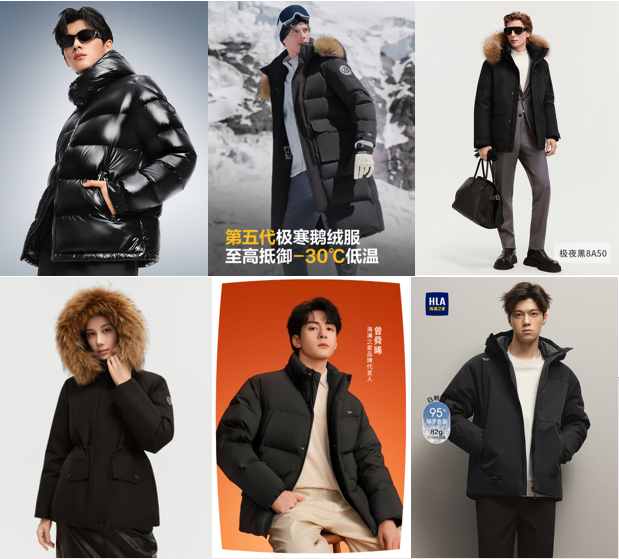
Group 1 - A significant cold wave hit the country, causing temperatures to drop nearly 20°C, leading to a surge in "instant warmth" consumption [1] - From January 17 to 18, JD reported a 100% increase in sales of warm clothing, with accessories like hats and scarves seeing over a 200% increase in sales [1] - The search volume for warm clothing categories such as cashmere sweaters and jackets increased by over 3.5 times during the cold snap [1] Group 2 - High-fill down jackets were the most popular items, with products like Bosideng's short down jacket featuring a fill weight of up to 247g and innovative "cloud-like warmth technology" [1] - The fifth-generation extreme cold down jacket from Bosideng has a fill weight of up to 275g and utilizes aerospace-grade heating materials, capable of withstanding temperatures as low as -30°C [1] - Other popular items include the Hai Lan Zhi Jia short down jacket, which boasts a 95% down content and 800+ fluffiness [1] Group 3 - Children's winter gear is also in high demand, with products like the Yaya Ice Shell series children's long down jacket featuring 90+ large down clusters and 680+ high fluffiness [3] - The Moody Tiger mid-length girls' down jacket uses 750FP high-end white goose down and includes heat-retaining fabric for enhanced warmth [3] - Converse's children's thickened hooded down jacket is designed for temperatures as low as -10°C, available in six vibrant colors [3] Group 4 - Accessories such as hats, scarves, and gloves are essential for maximizing warmth, with products like Johnstons of Elgin cashmere scarves and Canada Goose Arctic hats being highlighted for their quality and uniqueness [5] - Burberry's cashmere blend gloves combine style and warmth with a distinctive black and white design [5] Group 5 - As temperatures continue to drop, consumers are encouraged to use the JD app to quickly update their winter gear for optimal warmth [7]
如何看2025年12月消费数据
2026-01-20 01:50
Summary of Key Points from Conference Call Records Industry Overview - **Consumer Sector Performance**: In December 2025, the overall retail sales growth was 0.9% year-on-year, with a full-year growth of 3.7%. Online retail grew by 5.2% for the year, while offline retail showed slower growth [2][3]. Key Insights and Arguments - **Retail Categories**: - Supermarket retail sales increased by 4.3% year-on-year, while department stores only saw a 0.1% increase [3]. - Essential goods performed well, with grain and oil food growth at 3.9%. In the discretionary category, cosmetics grew by 8.8%, and gold and jewelry increased by 5.9% due to a rise in gold prices [3][4]. - Communication equipment maintained a growth rate of over 20%, while home appliances declined by 19% due to tightening subsidies [3][4]. - **Automotive Sector**: - The total retail sales for automobiles reached 548.2 billion, down 5% year-on-year. Passenger car sales fell by 8.8%, but new energy vehicle wholesale sales grew by 3.3% [11]. - **Textile and Apparel**: - The textile and apparel sector saw a 0.6% year-on-year retail growth in December, but a decline in month-on-month performance due to weather and the delayed Spring Festival [13][14]. - **Alcohol Industry**: - The retail sales of the liquor industry decreased by 2.9% year-on-year in December, with a price index decline of 0.19%. The industry is currently in a phase of active inventory reduction [16][17]. - **Consumer Expectations**: - Due to the late Spring Festival and expectations of rising gold prices, consumer demand is anticipated to recover in January and February 2026 [5]. Additional Important Insights - **Investment Recommendations**: - In the beauty and personal care sector, companies like Shiseido and domestic brands such as Maogeping are recommended. For the gold and jewelry sector, brands with strong store expansion logic are highlighted [6][10]. - In the automotive sector, companies like JAC Motors and Geely are recommended, focusing on high-end and luxury markets [12]. - For the textile and apparel sector, brands like Li Ning and Fuanna are suggested, with a focus on companies that can support their market value through dividends [15]. - **Household Appliances**: - The household appliance sector is experiencing a downturn, with significant declines in sales across various categories. However, leading companies like Midea and Haier are expected to maintain slight growth due to low inventory levels [21][22][24]. - **Light Industry**: - The light industry saw a decline in furniture sales by 2.2% year-on-year, with exports down by 9.8%. However, some companies are expected to see revenue and profit recovery in 2026 [26][27]. Conclusion The consumer sector is facing mixed performance across various categories, with essential goods showing resilience while discretionary spending is under pressure. Investment opportunities exist in specific brands and sectors that are positioned to benefit from changing consumer behaviors and market dynamics.
如何看2025年12月消费数据?
Changjiang Securities· 2026-01-19 14:31
Investment Rating - The report does not explicitly state an investment rating for the industry, but it provides insights into various sectors and companies with potential investment opportunities. Core Insights - In December, the total retail sales of consumer goods reached 45,136 billion yuan, a year-on-year increase of 0.9%. Excluding automobiles, retail sales amounted to 39,654 billion yuan, growing by 1.7%. For 2025, total retail sales are projected to reach 501,202 billion yuan, representing a 3.7% increase from the previous year, with non-automobile retail sales expected to grow by 4.4% to 451,413 billion yuan [4][7]. Retail Sector - The retail sector shows stable growth, with offline sales demonstrating resilience. In December, the retail sales of goods increased by 0.7% year-on-year, while dining revenue grew by 2.2%. Online retail sales of physical goods for the year increased by 5.2%, accounting for 26.1% of total retail sales [17][18]. Food and Beverage Sector - The food and beverage sector faced challenges in December, with dining revenue growing by only 2.2% year-on-year. The report suggests that the sector may see a rebound as previous restrictions on alcohol consumption ease [19][20]. Automotive Sector - The automotive sector experienced a decline in December, with total retail sales of automobiles at 548.2 billion yuan, down 5.0% year-on-year. However, the export of passenger vehicles saw significant growth, with a 50.4% increase in December [24][25]. Apparel and Textile Sector - The apparel and textile sector saw a slowdown in retail growth, with sales increasing by only 0.6% year-on-year in December. The report indicates that the sector is expected to recover in 2026 as inventory levels stabilize [28][29]. Home Appliances Sector - The home appliances sector faced a decline in December, with retail sales down 18.7% year-on-year. The report highlights that the sector's performance is affected by high base effects and the withdrawal of government subsidies [38][39]. Investment Recommendations - The report recommends focusing on companies with strong growth potential in various sectors, including beauty and personal care, gold and jewelry, and consumer electronics. Specific companies highlighted include 毛戈平, 上美股份, and 美的集团 [18][45].
周观点:中国纺织品出口12月再次回落,澳洲羊毛复拍大涨-20260119
INDUSTRIAL SECURITIES· 2026-01-19 09:30
Investment Rating - The industry investment rating is Neutral (maintained) [1] Core Insights - In December 2025, China's textile product exports weakened again, with yarn, fabrics, and products amounting to USD 12.58 billion, down 4.2% year-on-year; clothing and accessories exports were USD 13.41 billion, down 10.2%; and footwear exports were USD 3.91 billion, down 17.4% [2] - The recent stability of the RMB exchange rate has alleviated concerns about rapid appreciation, suggesting a focus on quality OEM companies such as Huali Group, leading auxiliary material supplier Weixing Co., and steadily expanding Kai Run Co. [2] - The report highlights a significant increase in wool auction prices due to strong demand, with the Eastern Market Index (EMI) for Australian wool rising by 107 Australian cents/kg [2] - The report suggests monitoring companies like New Australia Co. and Baolong Oriental, which have high dividend intentions, as well as Taihua New Materials, which may benefit from anti-involution policies in the chemical industry [2] Summary by Sections Section 1: Market Review - The textile and apparel sector underperformed against the CSI 300 index, with the Jiangsu textile index declining by 0.82% compared to a 0.57% drop in the CSI 300, resulting in a 0.25 percentage point underperformance [9] Section 2: Major Raw Material Prices and Industry Tracking (1) Major Raw Material Price Trends - As of January 16, 2026, cotton prices were at CNY 16,002/ton, with a week-on-week increase of 0.09%; polyester POY was CNY 6,700/ton, up 2.29%; and nylon POY remained stable at CNY 11,600/ton [21][23] (2) Export Data Tracking - In December 2025, China's textile exports were USD 12.58 billion, down 4.2% year-on-year; clothing exports were USD 13.41 billion, down 10.2%; and footwear exports were USD 3.91 billion, down 17.4% [29][31] - Vietnam's textile exports in December 2025 reached USD 3.65 billion, up 8.4% year-on-year, while footwear exports were USD 2.20 billion, up 4.3% [35][37] (3) Domestic and Overseas Apparel Consumption Tracking - In November 2025, China's retail sales growth was 1.3%, with apparel and footwear sales growing by 3.5% [39] - In October 2025, U.S. apparel wholesale inventory was USD 28.04 billion, with a stock-to-sales ratio of 2.04 [40]