银轮股份

Search documents
中证智能电动汽车指数上涨1.29%,智能车ETF泰康(159720)近1周涨幅排名可比基金首位
Xin Lang Cai Jing· 2025-08-15 06:01
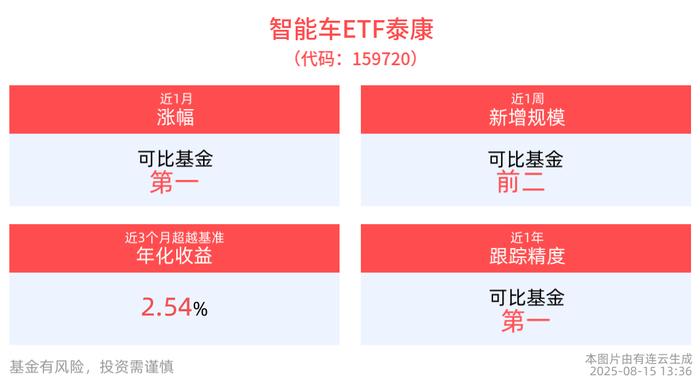
Core Viewpoint - The smart electric vehicle sector is experiencing significant growth, as evidenced by the performance of the Zhongzheng Smart Electric Vehicle Index and the related ETF, indicating strong investor interest and market momentum [2][3]. Performance Summary - As of August 15, 2025, the Zhongzheng Smart Electric Vehicle Index (H11052) rose by 1.29%, with key stocks such as Yinlun Co., Ltd. (002126) increasing by 6.52% and Keda Li (002850) by 6.00% [2]. - The Smart Car ETF Taikang (159720) saw a 0.90% increase, with a recent price of 0.68 yuan. Over the past week, it has accumulated a 2.60% increase, ranking 1/4 among comparable funds [2]. - The trading volume for the Smart Car ETF Taikang was 139.85 million yuan, with a turnover rate of 2.7%. The average daily trading volume over the past year was 156.28 million yuan [2]. Fund Performance Metrics - The net value of the Smart Car ETF Taikang increased by 38.85% over the past year. The highest monthly return since inception was 27.78%, with the longest consecutive monthly gain being 3 months and an average monthly return of 7.95% [3]. - The fund's Sharpe ratio was 1.16 as of August 8, 2025, indicating strong risk-adjusted returns [3]. - The fund's management fee is 0.50%, and the custody fee is 0.10% [3]. Tracking and Composition - The Smart Car ETF Taikang closely tracks the Zhongzheng Smart Electric Vehicle Index, which includes companies involved in various aspects of the smart electric vehicle industry, reflecting the overall performance of listed companies in this sector [3]. - As of July 31, 2025, the top ten weighted stocks in the Zhongzheng Smart Electric Vehicle Index accounted for 60.99% of the index, with companies like CATL (300750) and BYD (002594) being the largest contributors [4]. Top Holdings Performance - The top ten holdings of the Smart Car ETF Taikang and their respective performance include: - CATL (300750): +0.24%, 14.97% weight - BYD (002594): -0.17%, 13.89% weight - Luxshare Precision (002475): +0.05%, 7.13% weight - Huichuan Technology (300124): +1.01%, 4.94% weight - Omnivision Technologies (603501): +1.17%, 4.42% weight - Great Wall Motors (601633): +2.66%, 3.80% weight - iFlytek (002230): +0.66%, 3.15% weight - Changan Automobile (000625): +0.54%, 3.00% weight - Sanhua Intelligent Control (002050): +4.42%, 2.80% weight - EVE Energy (300014): +2.88%, 2.66% weight [6].







“60天账期”承诺部分车企带头“真付快付”,汽车零件ETF(159306)有望受益现金流改善
Xin Lang Cai Jing· 2025-08-15 01:36
Group 1 - The core viewpoint of the articles highlights that 17 domestic automotive companies have committed to paying suppliers within 60 days, which is expected to improve cash flow, supply chain stability, and financial cost optimization for these companies [1] - The implementation of the 60-day payment commitment is supported by the establishment of a comprehensive control system to ensure timely payments to suppliers [1] - The automotive parts ETF closely tracks the CSI Automotive Parts Theme Index, which is anticipated to benefit from the improvement in industry cash flow [1] Group 2 - As of July 31, 2025, the top ten weighted stocks in the CSI Automotive Parts Theme Index account for 40.36% of the index, including companies like Huichuan Technology, Fuyao Glass, and Sanhua Intelligent Control [2] - The automotive parts ETF and its various fund links are mentioned, indicating a structured investment approach in the automotive parts sector [2]
投资策略专题:液冷:下一个光模块、PCB
KAIYUAN SECURITIES· 2025-08-14 09:28
Group 1 - The report emphasizes a positive market outlook driven by technology, highlighting a "dual-driven" market structure that includes strong growth categories under global technological collaboration and cyclical trading under the "anti-involution" trend [3][12][13] - The AI computing chain is identified as a core investment opportunity, with components like optical modules and PCBs being crucial for AI infrastructure, experiencing significant growth in both shipment and value [4][15][17] - Liquid cooling is positioned as a strategic investment opportunity within the AI computing chain, characterized by strong growth, a complete narrative, and favorable odds [4][18][22] Group 2 - The liquid cooling industry chain is segmented into three main parts: upstream components, midstream system integration and manufacturing, and downstream applications, each with distinct technical barriers and competitive landscapes [5][23][24] - Upstream focuses on the technical core of liquid cooling systems, including cooling fluids and key components, which significantly influence system performance and reliability [5][23] - Midstream integrates upstream components to provide complete liquid cooling server solutions, with technical integration capabilities being a core barrier [5][23] - Downstream applications primarily involve high-performance data center operators and industry users, driving the large-scale adoption of liquid cooling [5][23] Group 3 - Liquid cooling is expected to experience a steep growth phase from late 2025 to 2026, driven by technological advancements and increasing power demands from high-end chips [18][19][22] - The transition of liquid cooling from an optional to a necessary solution is supported by stricter energy efficiency standards driven by government policies [19][22] - Compared to optical modules and PCBs, liquid cooling is in an earlier development stage, with lower penetration rates but high growth potential as demand for cooling solutions increases [18][20][22]
两部门就辅助驾驶征求意见,汽车零件ETF(159306)有望受益智驾规范发展
Xin Lang Cai Jing· 2025-08-14 01:27
Group 1 - The core viewpoint of the news is the introduction of a draft notification by the State Administration for Market Regulation and the Ministry of Industry and Information Technology to strengthen the supervision and management of recalls, production consistency, and advertising for intelligent connected new energy vehicles [1] - Companies are prohibited from misleading consumers by suggesting that their driving assistance systems can be considered as autonomous driving systems or possess functionalities that they do not actually have, to prevent misuse by drivers [1] - The State Administration for Market Regulation will enhance supervision over exaggerated advertising and commercial promotion behaviors by companies, and will conduct joint investigations with the Ministry of Industry and Information Technology to rectify and standardize these practices [1] Group 2 - As of July 31, 2025, the top ten weighted stocks in the CSI Automotive Parts Theme Index (931230) include Huichuan Technology, Fuyao Glass, Sanhua Intelligent Control, Top Group, Sailun Tire, Desay SV, Huayu Automotive, Wanfeng Aowei, Yinlun Co., and Shuanghuan Transmission, collectively accounting for 40.36% of the index [2] - The Automotive Parts ETF (159306) is closely tracking the CSI Automotive Parts Theme Index, with several stocks in the intelligent driving industry chain likely to benefit from the industry's standardized development [1][2]
一周一刻钟,大事快评(W119):机器人大会更新,关注摆线针轮减速器,小鹏更新
Shenwan Hongyuan Securities· 2025-08-12 14:44
Investment Rating - The industry investment rating is "Overweight" indicating that the industry is expected to outperform the overall market [18]. Core Insights - The core trend observed at the recent robotics conference is the acceleration of application scenario diversification and significant cost reductions in core sensors and hardware, with conditions for implementation gradually maturing. Similar to the early stages of autonomous driving, humanoid robots exhibit both a general-purpose route and a focus on niche scenarios. In high-tech, long commercialization paths with complex regulatory requirements, companies with stable cash flows and clear application scenarios are more resilient to capital shocks. Humanoid robots require control of at least 10-15 degrees of freedom, with algorithm complexity significantly higher than that of autonomous driving. The market space for robots is vast, but regulatory frameworks need improvement, and there are more ethical challenges, with a short-term maturity timeline of 2-3 years. Investment focus should be on the binding degree between companies and application scenarios, as well as the feasibility of technology, regulation, and costs. Currently, hardware is no longer the main bottleneck; breakthroughs are expected in control algorithms and human-machine interaction experiences, particularly in low-algorithm dependency scenarios like healthcare and exoskeletons, which are likely to see early volume growth [5][6]. Summary by Sections 1. Robotics Conference - The robotics conference highlighted the trend of accelerating diversification in application scenarios and significant cost reductions in core sensors and hardware, leading to maturing implementation conditions. The humanoid robot market is expected to have a larger space and long-tail demand, but it faces regulatory and ethical challenges that need to be addressed [6]. 2. Cycloidal Gear Reducers - The design of robot joints imposes new requirements on reducer structures, with a focus on cycloidal gear reducers. These reducers have a high engagement ratio (up to 70%-80%) and superior impact resistance and load-bearing performance compared to harmonic drives, while being smaller than RV reducers. Despite slightly lower precision and heavier weight, improvements through structural design and material changes are anticipated. Companies with existing layouts in the cycloidal gear reducer field, such as Shuanghuan Transmission and Changban Technology, are recommended for attention [7]. 3. XPeng Motors - XPeng is focusing on the upgrade of the new P7 model and the layout of extended-range products. The new P7 is designed to appeal to mainstream aesthetics, with increased size for rear space and comfort, and features a mid-mounted electric drive layout and dual-chamber air suspension. The intelligent driving system has been upgraded to the Ultra version, supporting L4 level autonomous driving. The pricing strategy will be crucial for its market performance, with the X9 extended-range version expected to launch soon, which is seen as a key driver for future sales growth [8]. 4. Investment Recommendations - Investment recommendations include focusing on domestic leading manufacturers like BYD, Geely, and XPeng, as well as companies with strong performance growth and robotics layouts such as Fuyao Glass and Shuanghuan Transmission. The report emphasizes the importance of technology and regulatory feasibility in investment decisions [5][8].
7月车市淡季不淡,汽车零件ETF(159306)盘中上涨
Xin Lang Cai Jing· 2025-08-12 02:25
Group 1 - In July, the automotive production and sales reached 2.591 million and 2.593 million units respectively, with month-on-month declines of 7.3% and 10.7%, but year-on-year increases of 13.3% and 14.7% [1] - From January to July, automotive production and sales totaled 18.235 million and 18.269 million units, reflecting year-on-year growth of 12.7% and 12%, with production and sales growth rates expanding by 0.2 and 0.6 percentage points compared to the first half of the year [1] - The automotive market in July showed a performance that was not typical of a seasonal downturn [1] Group 2 - Desay SV Automotive reported a 45.8% year-on-year increase in net profit for the first half of the year, leading to significant stock price appreciation [1] - As of August 12, 2025, the CSI Automotive Parts Theme Index (931230) rose by 0.20%, with notable increases in component stocks such as Desay SV (up 8.22%) and Aerospace Science and Technology (up 4.34%) [1] - The CSI Automotive Parts Theme Index includes 100 listed companies involved in automotive systems, interiors, electronics, and tires, with the top ten weighted stocks accounting for 40.36% of the index [2]
机器人行业事件点评报告:人形机器人群智迸发 驱动量产落地提速
Xin Lang Cai Jing· 2025-08-11 12:32
Core Insights - The 2025 World Robot Conference opened on August 8 in Beijing, showcasing significant industry enthusiasm and innovation [1][2] - The event featured over 50 machine enterprises presenting more than 1,500 products, with 100 new products launched, nearly double from the previous year, indicating rapid technological iteration and application expansion [2] - The global humanoid robot market is projected to reach $5.3 billion by 2025, with a compound annual growth rate (CAGR) reflecting high growth potential [3] Industry Trends - The humanoid robot industry is experiencing rapid growth, with the market size expected to increase from $3.4 billion in 2024 to $5.3 billion in 2025, and potentially surpassing $20.6 billion by 2028 [3] - The domestic market in China is also showing strong performance, with projections of reaching 5.3 billion yuan in 2025 and 38.7 billion yuan by 2028, indicating a doubling in size [3] - China is positioned as a leading producer in the humanoid robot sector, benefiting from advancements in the supply chain, technology research, and application exploration [3] Company Developments - Tesla's Optimus Gen3 production is accelerating, with plans to launch a prototype in three months and start mass production early next year, aiming for an annual output of 1 million units within five years [4] - The acceleration of Tesla's production timeline is expected to stimulate the global humanoid robot industry, transitioning from technology development to large-scale production [4] - Key companies in the robot core components sector include Silver Wheel, Junsheng Electronics, and others, which are recommended for investment due to their potential benefits from the industry's growth [4][5]

液冷行业跟踪:预计AI液冷将为产业链公司提供第二增长曲线
Orient Securities· 2025-08-11 09:18
Investment Rating - The industry investment rating is Neutral [8] Core Insights - AI liquid cooling is transitioning from an optional to a necessary solution, with demand expected to drive rapid growth in market space and penetration rates [8] - The acceleration of ASIC layouts and the increase in domestic computing cluster scale will open new growth opportunities for the liquid cooling market [8] - The overseas supply gap in liquid cooling will provide opportunities for domestic suppliers to expand internationally, with expectations of moving from component supply to modular and integrated solutions [8] - The AI liquid cooling sector has high barriers to entry and significant value, suggesting a favorable competitive landscape and profitability in the medium to long term [8] Summary by Sections Liquid Cooling Market Dynamics - The demand for AI computing centers is driving the need for high-density GPU clusters, leading to a shift towards liquid cooling solutions [8] - Major cloud service providers are accelerating the development of customized ASICs and integrating liquid cooling solutions [8] Investment Recommendations - Suggested companies to watch include: - Yinvik (002837, Not Rated) - Yinlun (002126, Buy) - Feilong (002536, Not Rated) - Chuanhuan Technology (300547, Not Rated) - Xiangxin Technology (002965, Not Rated) - Sulian Technology (301397, Not Rated) - Zhongding (000887, Not Rated) [3]



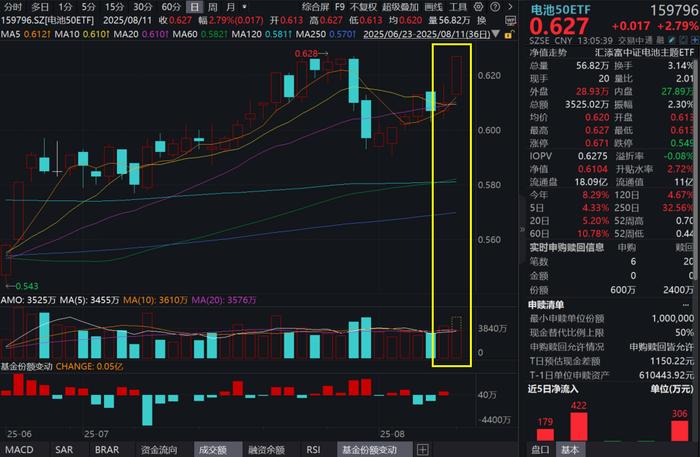
宁德时代H1盈利激增33%!枧下窝锂矿停产,带动锂价飙升,电池50ETF(159796)放量大涨2.79%!
Xin Lang Cai Jing· 2025-08-11 05:34
Group 1 - The lithium mining sector experienced a sudden surge on August 11, with the Battery 50 ETF (159796) rising by 2.79% and attracting over 3 million yuan in inflows [1] - The top ten constituent stocks of the Battery 50 ETF showed significant gains, with New Era Technology rising over 16% and Hunan YN Energy increasing by over 9% [3] - Lithium carbonate futures reached their limit up within the first five minutes of trading, indicating strong market sentiment [1][3] Group 2 - CATL announced that its mining rights for the Jiangxia Wokou area expired on August 9, leading to a suspension of mining operations, which raises supply concerns [4] - Supply disruptions in Jiangxi and Qinghai could impact over 100,000 tons of annual lithium production, potentially tightening the market [5] - The lithium price is currently at a bottom range, with upward elasticity expected as production cuts from Australian mines may occur if prices fall to 70,000-80,000 yuan [6] Group 3 - Demand for lithium is expected to remain strong due to the robust growth in the electric vehicle and energy storage sectors, with a 219.1% year-on-year increase in energy storage demand in the first half of the year [5] - The overall balance of the lithium market is projected to tighten, with potential upward adjustments in equilibrium prices due to supply constraints [5][6]

30+电池冷板重点企业揭秘
DT新材料· 2025-08-08 16:03
Core Viewpoint - The article emphasizes the urgent need for advanced thermal management technologies in the electric vehicle sector, particularly focusing on liquid cooling solutions to address the challenges posed by traditional air cooling methods in battery performance and safety [1]. Group 1: Industry Challenges and Solutions - The traditional air cooling methods are inadequate due to low efficiency and high sensitivity to environmental temperatures, necessitating breakthroughs in thermal management technology [1]. - Liquid cooling technology, particularly through the use of cooling plates, is evolving and becoming the mainstream solution for maintaining battery performance and safety [1]. - Cooling plates are critical components that directly contact heat-generating parts, efficiently absorbing heat and ensuring batteries operate within optimal temperature ranges, thereby enhancing range and lifespan [1]. Group 2: Key Players in Thermal Management - Valeo Group, headquartered in France, is a leading automotive parts supplier involved in thermal management across various segments, including battery cooling plates [5][7]. - Mahle is recognized as a global expert in thermal management, offering innovative solutions such as new bionic structure battery cooling plates that significantly enhance thermodynamic and structural performance [8][10]. - Denso Corporation, a top-tier automotive parts supplier from Japan, provides a wide range of products, including thermal management systems [11][13]. - Modine Manufacturing Co specializes in thermal management systems and components for diverse global markets, including automotive applications [19]. - Boyd is known for developing high-performance thermal management solutions across various industries, including battery cooling plates [21][23]. Group 3: Domestic Companies in Thermal Management - Sanhua Holding Group, established in 1984, focuses on energy-saving thermal management solutions for traditional and electric vehicles [24]. - Shenzhen Feirongda Technology Co., founded in 1993, is a leading provider of electromagnetic shielding and thermal management materials [25][27]. - Nabichuan New Energy Co., established in 1998, specializes in thermal management systems for automotive engines and has developed solutions for electric vehicle battery cooling [28][30]. - Yibin Zongguan Line Technology Co. is recognized as a leader in battery thermal management, with unique direct cooling technology [31]. - Zhejiang Yinlun Machinery Co., a private company, develops various thermal management products for commercial and passenger vehicles [32][34]. Group 4: Market Dynamics and Trends - The current procurement model for liquid cooling plates is primarily determined by technological barriers and value, with a trend towards external procurement among major battery manufacturers [68]. - Companies like CATL utilize multiple suppliers for liquid cooling plates, reflecting a strategy of centralized supply and risk diversification [68]. - The market for liquid cooling plate production is fragmented, with many smaller specialized manufacturers due to the relatively low prices of components [69].