奔驰

Search documents
被割韭菜了!苹果刚将生产线搬过去,印度就翻出1961年旧法,要征收数十亿美元的税!
Sou Hu Cai Jing· 2025-10-29 10:27
Core Viewpoint - Apple has relocated eight iPhone production lines from China to India, expecting to benefit from subsidies and lower costs, but has encountered unexpected tax demands from the Indian government based on a 1961 tax law that requires taxation on global revenue, leading to significant financial implications for the company [1][6][17]. Group 1: Apple's Investment in India - Apple has invested significantly in India, collaborating with Foxconn and Tata Group to establish five iPhone factories with equipment investments amounting to several billion dollars and employing thousands of workers [3][17]. - The Indian government initially offered substantial subsidies, totaling 230 billion rupees, to attract foreign investment [3]. Group 2: Taxation Issues - The Indian tax authorities have invoked a 1961 law that allows them to tax foreign companies based on their global profits if they have a "business connection" in India, which Apple is now facing due to its control over the production equipment in the factories [5][6]. - Apple is being asked to pay taxes based on its global revenue of $383 billion, resulting in a potential tax liability of $4.1 billion [6][17]. Group 3: Government Response and Industry Impact - The Indian government is aware that aggressive tax measures could deter foreign investment, leading to a temporary cooling of the situation after media scrutiny [11][17]. - Other foreign companies, including Xiaomi, Vivo, and Volkswagen, have also faced similar tax issues in India, indicating a pattern of aggressive tax enforcement against foreign firms [14][15]. Group 4: Long-term Implications - The situation highlights India's strategy of attracting foreign investment with initial incentives followed by increased taxation, which may ultimately discourage foreign companies from investing in the country [17][18]. - The ongoing tax disputes may lead Apple to reassess the viability of its manufacturing operations in India, despite its previous investments [17][18].



马斯克称自动驾驶做到卓越很困难,英伟达优步合作打造L4车队
Bei Ke Cai Jing· 2025-10-29 08:59
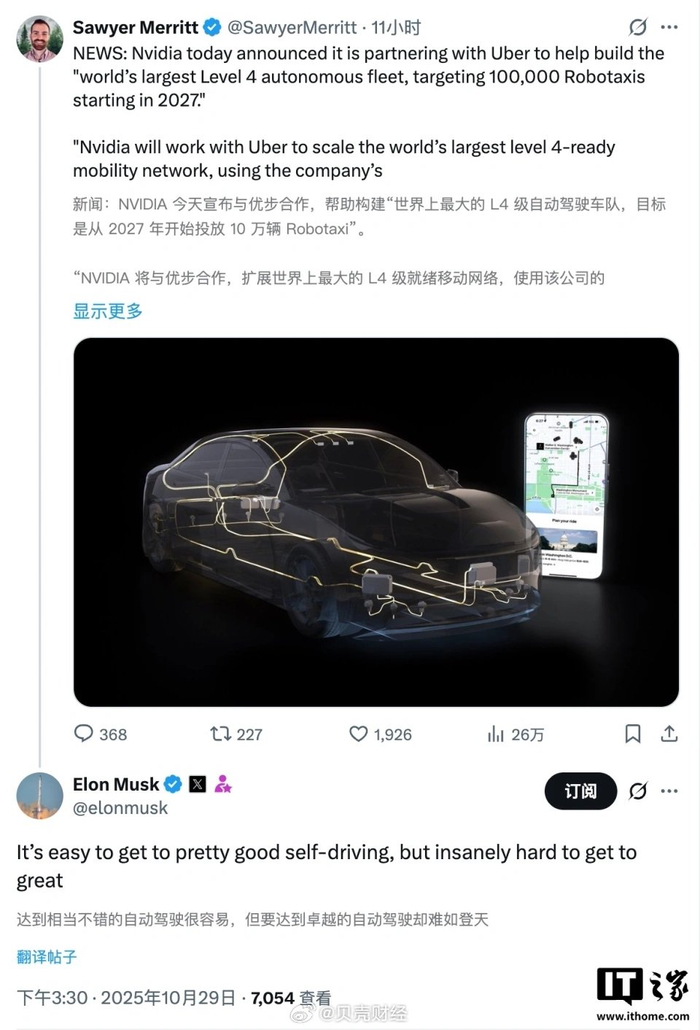
Core Insights - Elon Musk stated that achieving "pretty good" self-driving technology is easy, but reaching "great" levels is extremely difficult [1][6] - Nvidia announced a partnership with Uber to develop the world's largest Level 4 (L4) autonomous fleet, targeting 100,000 Robotaxis to be deployed starting in 2027 [3][4] Group 1: Partnership Details - Nvidia and Uber will collaborate to create a large-scale L4 autonomous mobility network, leveraging Uber's next-generation Robotaxi and delivery fleet alongside Nvidia's Drive AGX Hyperion 10 platform and software [1][2] - The partnership aims to develop a data factory based on the NVIDIA Cosmos platform to support data processing and analysis for autonomous vehicle development [1] Group 2: Technology Overview - The Nvidia Drive AGX Hyperion 10 is a reference design computing platform and sensor architecture that enables any vehicle to achieve L4 autonomous driving capabilities [2] - This platform provides automakers with a unified system to build compliant hardware and sensor systems that can run any compatible autonomous driving software, ensuring safety and scalability [2]


在汽车圈,人人都想平替库里南,多少中产会买单?
Xin Lang Cai Jing· 2025-10-29 07:58
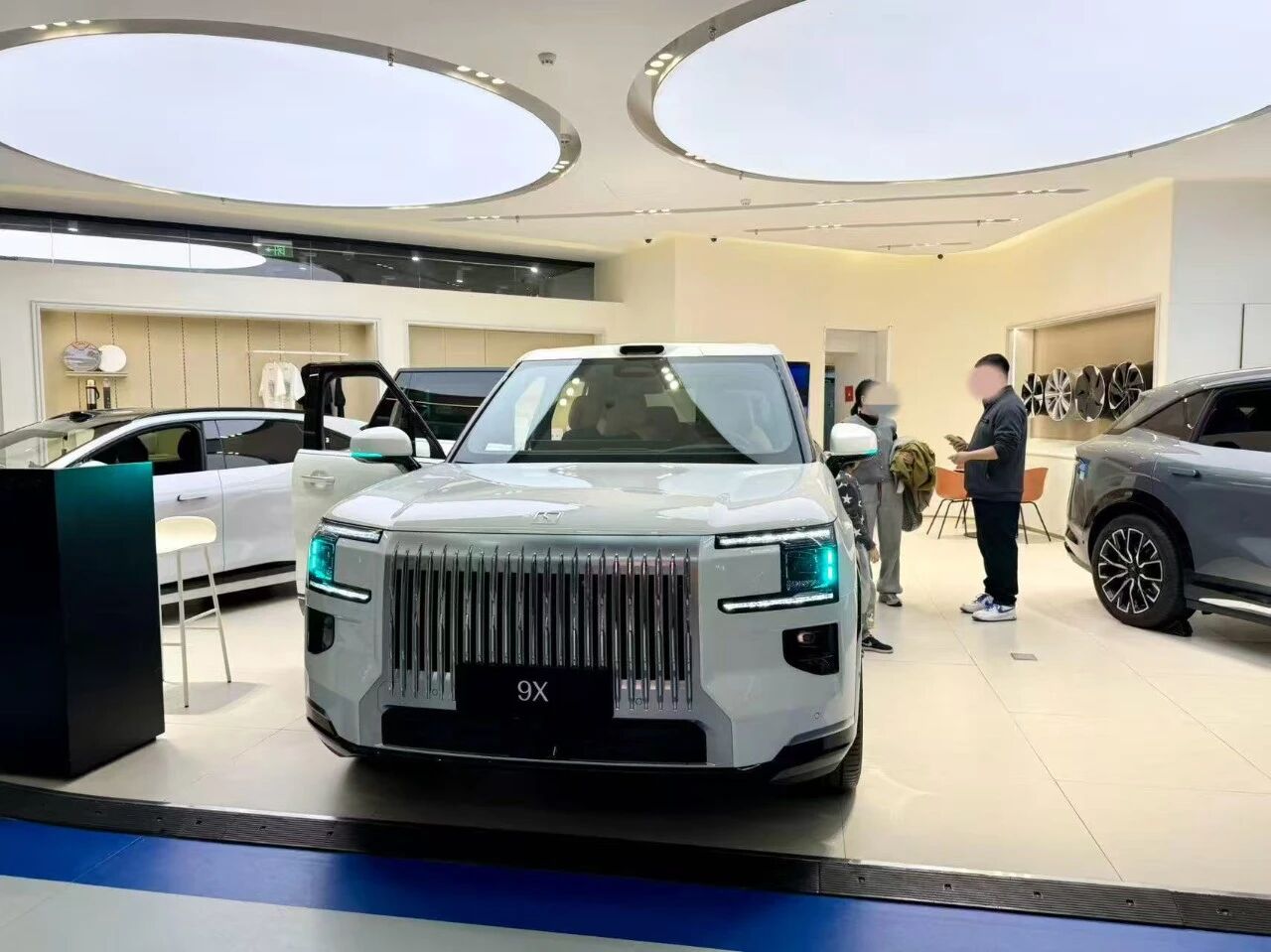
Core Viewpoint - The rise of domestic large SUVs, particularly the Zeekr 9X, is reshaping consumer preferences, as buyers seek more affordable alternatives to luxury models like the Rolls-Royce Cullinan, leading to increased sales and interest in the segment [1][3][5]. Market Trends - The domestic large SUV market is becoming increasingly competitive, with multiple brands launching models over 5.2 meters in length, indicating a shift from niche to mainstream [3][5]. - In the first seven months of 2025, China's SUV market saw retail sales of 6.294 million units, a year-on-year increase of 13.1%, with mid-to-large SUVs growing by 8.6% [5]. Consumer Behavior - There is a noticeable trend of consumers shifting from high-end imported vehicles to domestic full-size SUVs, driven by the appeal of larger space and practical features at lower prices [5][9]. - Many consumers, previously inclined towards luxury brands, are now considering domestic options due to their competitive pricing and features [7][9]. Product Features - The Zeekr 9X is priced between 465,900 and 599,900 yuan, offering advanced technologies typically found in luxury vehicles, such as a closed dual-chamber air suspension system [6][9]. - Other models like the Leap D19 and Haval H5 are pushing the boundaries of affordability, with prices as low as 150,000 yuan while offering substantial features [6][9]. Marketing Strategies - Domestic brands are positioning their vehicles as "alternatives" to luxury models, leveraging design similarities to attract attention and enhance brand image [10][19]. - The strategy of mimicking successful luxury designs while incorporating unique brand elements is seen as a way to reduce market acceptance risks [10][11]. Challenges Ahead - Despite the growing interest, the market for these "alternatives" remains limited, and brands are primarily focused on capturing high-end users to elevate their market presence [9][19]. - The perception of luxury and social status associated with traditional high-end brands poses a challenge for domestic manufacturers to overcome [18][19].




雷军的“偶像”,彻底撑不住了!
Sou Hu Cai Jing· 2025-10-29 07:35
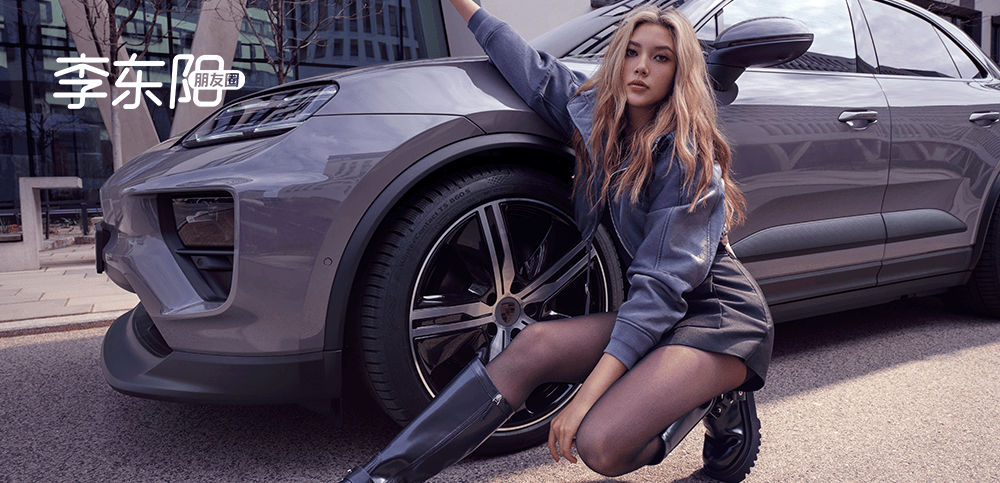
Core Viewpoint - Porsche, once considered a luxury "money printing machine," is now facing a significant decline in sales and profits, with a 99% drop in operating profit in the first three quarters of the year compared to the previous year [2][5][7] Financial Performance - In the first three quarters of this year, Porsche's revenue decreased by 6% to €26.864 billion, while operating profit fell to €4 million from €4.035 billion in the same period last year [2][5] - The operating profit margin plummeted to 0.2%, down from 14.1% year-on-year [2][7] Sales Decline - Porsche's delivery volume peaked at 95,700 units in 2021 but is projected to drop to 56,900 units in 2024, representing a 28% year-on-year decline [5][10] - In China, Porsche's sales fell by 26% to 32,000 units, highlighting a significant shift in consumer preferences towards electric vehicles [10][11] Market Challenges - The luxury car market is experiencing a downturn, with competitors like BMW, Mercedes-Benz, and Audi also reporting declines in sales in China [10][11] - Porsche's struggles are attributed to several factors, including product strategy adjustments, challenging market conditions in China, one-time expenses related to battery activities, organizational changes, and increased import tariffs in the U.S. [7][11] Brand Perception and Strategy - Porsche's brand image is under threat as it resorts to discounting strategies, which contradicts its luxury positioning [13][15] - The company is facing a crisis of confidence among existing customers, as the brand's high-end status is compromised by significant price reductions [15][18] Electric Vehicle Transition - Porsche has been proactive in its electric vehicle strategy, launching the Taycan and aiming for 50% of its sales to come from electric and hybrid models by 2025, and over 80% by 2030 [18][19] - However, delays from its partner Volkswagen in developing electric vehicle architecture have hindered Porsche's ability to capitalize on the rapid growth of the electric vehicle market [18][19] Future Plans - Porsche is implementing a "Rui Jing Plan" to upgrade its dealership network and promote digital retail and services, aiming to regain market share in China by 2026 [24]
库克尴尬了:印度的镰刀,挥向苹果,要向苹果收300亿的税?
Sou Hu Cai Jing· 2025-10-29 07:18
最近这几年,大家都说印度是外资坟场,因为印度对大量的来印度的外资,挥舞起了收割的镰刀,通过各种办法,对这些外资进行罚款。 比如小米、OPPO、VIVO等中国企业,还包括英特尔、谷歌、微软、亚马逊等美国企业,以及奔驰、大众等,还包括起亚、沃达丰,绝大部分到印度去发 展跨国性大企业,都被收割过。 但让人想不通的是,这么恶劣的情况之下,苹果居然押注印度了。 这几年,苹果跑到印度去建厂,将大量的iPhone制造,从中国搬到印度,为此苹果不惜砸了上百亿美元,还鼓动富士康,在印度也投了上百亿美元。 本以为靠着印度政府的补贴,以及当地的低成本,苹果可以分散风险,降低成本。 但让人没有想到的,印度政府还蛮讲究公平的,既然罚了小米、OPPO、VIVO,以及奔驰、谷歌、英特尔、起亚等外资,那苹果也不能错过。 近日,有媒体报道称,印度税务部门突然翻出了一条1961年颁布的旧税法,要求苹果按照"全球营业额"来交税,据称算出来苹果要将41亿美元,近300亿人 民币的税给印度。 印度收税的依据是什么呢?是印度在1961的颁布的法律,当时印度为了限制外资在印度的逃避进口税,出台了一个政策。 称如果外国公司在印度有生产设备,那么印度就可以对 ...
凯迪拉克新CT6上市:28.99万起欲搅动豪华车市场
Guo Ji Jin Rong Bao· 2025-10-28 15:06
Core Insights - The new Cadillac CT6 is launched with a starting price of 289,900 yuan, aiming to reshape the luxury mid-large sedan market [1] Group 1: Product Features - The CT6 focuses on "million-level configuration democratization," featuring the fourth-generation MRC electromagnetic suspension, which scans road conditions 1,000 times per second and adjusts damping instantly [1] - It is equipped with a fully imported longitudinal 10-speed transmission and an mLSD limited-slip differential, enhancing its performance [1] Group 2: Market Context - The luxury mid-large car market is undergoing a restructuring phase, with BBA (BMW, Benz, Audi) still dominating but facing challenges [1] - In 2024, BMW 5 Series sales are projected to decline by nearly 50,000 units year-on-year, while Mercedes E-Class and Audi A6L rely on terminal discounts to maintain sales, with entry prices exceeding 360,000 yuan [1] - Domestic electric models like BYD Han and Xiaomi SU7 are rapidly rising, putting significant pressure on traditional fuel luxury cars [1] Group 3: Strategic Positioning - Cadillac aims to break through the market with a strategy of "technological downscaling + price resetting," offering a starting price nearly 80,000 yuan lower than BBA competitors [1] - The company also provides unique benefits such as "free vehicle replacement for damages over 30%," creating a differentiated advantage [1] - This strategy targets not only BBA fuel vehicle users but also seeks to capture market share amidst the rising tide of electric vehicles by offering high-end configurations in fuel cars [1]
荷兰经济部长称 “一切为欧洲”,冻结安世资产反致车企停滞,大众工厂全面停摆
Sou Hu Cai Jing· 2025-10-28 13:48
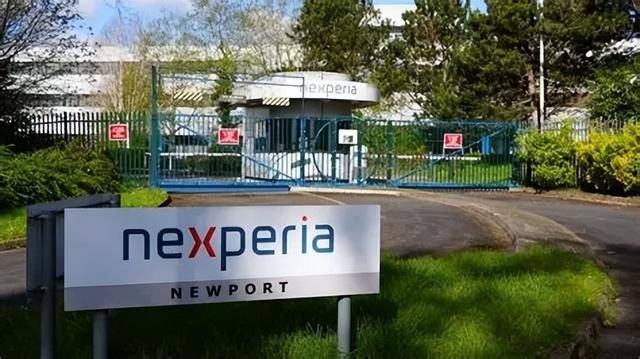
Group 1 - The Dutch government's intervention to freeze the global assets of Nexperia, a semiconductor company, was intended to protect European economic interests but has led to significant disruptions in the automotive industry [5][9][40] - Nexperia, controlled by Chinese company Wingtech Technology, is a major player in automotive-grade chips, holding a 40% market share in the transistor sector and 70% of its packaging and testing capacity located in Dongguan, China [7][32][38] - The rapid response from the Dutch courts to suspend the Chinese CEO and appoint a foreign non-executive director highlights the urgency and efficiency of the intervention, which has been criticized as a power grab disguised as compliance [15][28][47] Group 2 - Following the Dutch actions, China implemented export controls on Nexperia's Chinese operations, leading to a significant supply chain disruption for European automakers like Volkswagen, BMW, and Mercedes-Benz [21][36][38] - The automotive industry in Europe is facing a crisis, with production halts and inventory shortages, as the European Automobile Manufacturers Association warns of potential losses exceeding €10 billion if the situation persists [38][40] - The situation has escalated into a broader geopolitical conflict, with China demanding that all orders from Nexperia be settled in RMB, marking a strategic shift in the financial landscape and signaling a new phase in the economic power dynamics [23][26][49] Group 3 - The Nexperia incident reflects a fundamental shift in economic power, where control over production capacity and market access has become more critical than ownership of physical assets [42][45] - The response from China, particularly the move towards RMB settlements, indicates a proactive approach to shaping economic rules and countering Western dominance in financial systems [47][51] - The unfolding crisis serves as a cautionary tale for countries attempting to sever economic ties through political means, emphasizing the importance of cooperation over confrontation in the global economy [49][55]


安世中国恢复对欧供货,只要客户满足三项条件,荷兰总部直接傻眼
Sou Hu Cai Jing· 2025-10-28 13:28
Core Viewpoint - The situation surrounding ASML and its Chinese subsidiary highlights the complexities of geopolitical tensions and the shifting dynamics in the semiconductor industry, particularly the growing independence of Chinese firms in the global supply chain [1][3][18] Group 1: Events Leading to the Situation - On September 30, the Dutch government invoked a wartime emergency law to take control of ASML, citing national security concerns, which was perceived as a politically motivated action [3][5] - The Dutch government's actions were influenced by recent U.S. regulations aimed at preventing Chinese infiltration, leading to a miscalculation regarding ASML's operational dependencies in China [3][5][11] Group 2: ASML China's Response - ASML China announced the resumption of chip supplies to Europe under three new conditions: re-signing supply agreements, using RMB for transactions, and prioritizing domestic orders [1][7][8] - The requirement for RMB settlements signifies a move to diminish the dominance of the U.S. dollar in semiconductor trade, reflecting China's broader strategy to expand its currency's global usage [10][18] Group 3: Impact on European Automotive Industry - European automakers, heavily reliant on ASML's chips, faced potential production halts, prompting them to pressure the Dutch government for negotiations with China [5][11] - The automotive sector's dependence on ASML's power semiconductors, which hold nearly 20% of the global market share, underscores the critical nature of this supply chain [5][11] Group 4: Long-term Implications - The Dutch government's actions have backfired, leading to a realization that the European semiconductor supply chain is significantly dependent on China, affecting various industries including automotive and communications [11][13] - ASML China is expected to see a doubling of its annual output value in the next two years, positioning it among the top five power semiconductor suppliers globally [13][18]
保时捷坠入至暗时刻
Hua Er Jie Jian Wen· 2025-10-28 10:36
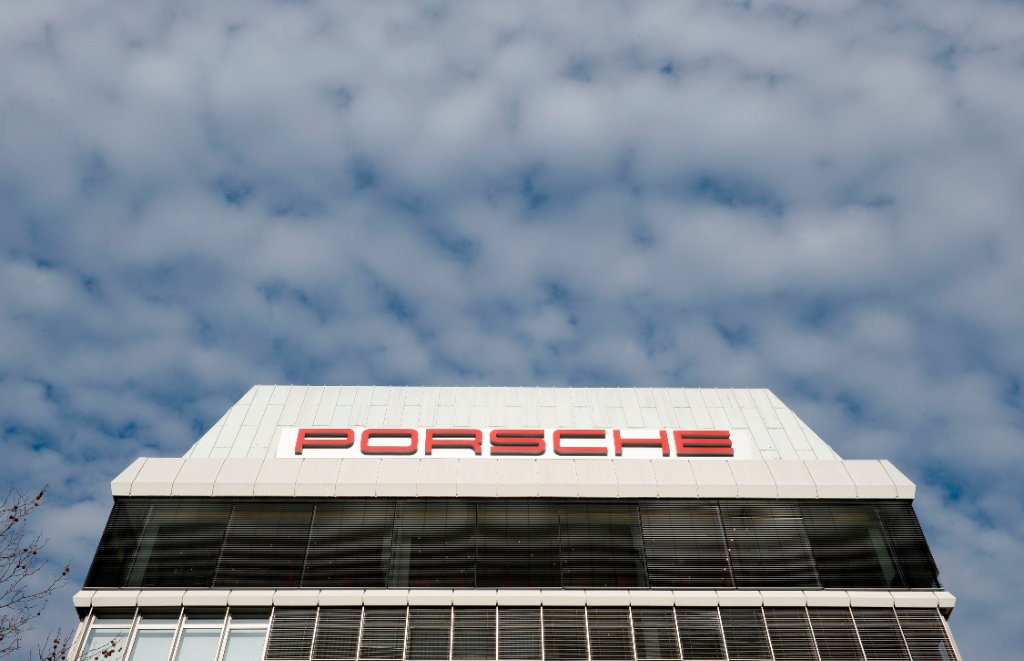
Core Insights - Porsche is facing unprecedented challenges, with a significant decline in profits and sales, particularly in the Chinese market [2][3][4] Financial Performance - In the first three quarters, Porsche's operating profit was only €40 million, a staggering 99% drop from €4.035 billion in the same period last year [2] - The third quarter alone saw a loss of €966 million [2] Market Challenges - The company is under pressure from €3.1 billion in strategic restructuring costs, a sharper-than-expected decline in the Chinese market, and high tariffs in North America [3] - Sales in China have plummeted from 96,000 units four years ago to 56,900 units last year, with a 26% year-on-year decline in the first three quarters of this year [4] Strategic Adjustments - Porsche has announced a restructuring of its battery subsidiary, Cellforce, and plans to introduce more fuel and hybrid models [3][10] - The company is shifting focus back to internal combustion engines while cautiously continuing its electric vehicle strategy [9][10] Competitive Landscape - The luxury car market in China has become increasingly competitive, with domestic brands like NIO and Zeekr entering the high-end segment, impacting Porsche's market share [6][8] - Porsche's entry-level Macan is facing competition from new entrants in the 500,000 yuan price range, which are offering advanced technology and electric capabilities [6] Future Plans - Porsche plans to reduce its dealer network to around 100 by 2026 and invest in first-tier cities to improve operational efficiency [11] - A new CEO, Michael Leiters, has been appointed to lead the company through this challenging period, focusing on addressing deep-rooted issues from its previous success [12]
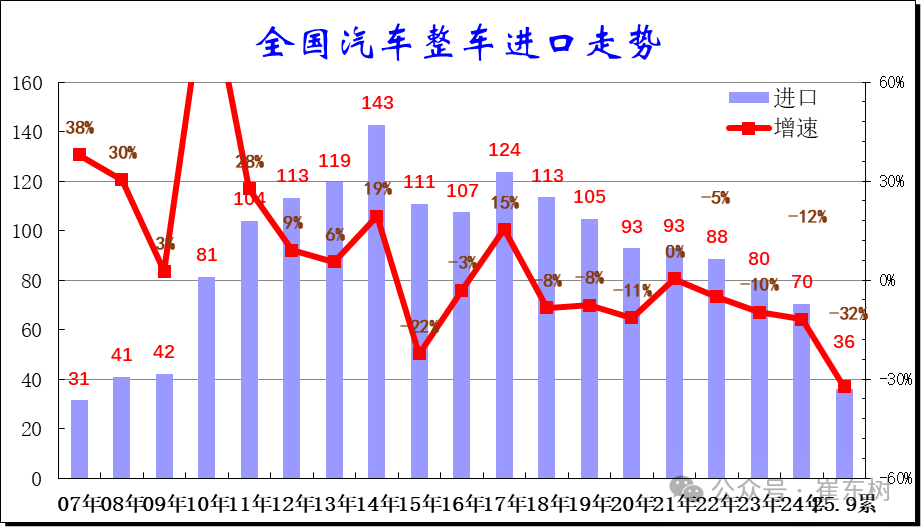
崔东树:2025年1-9月进口汽车36万辆 同比下降32%
智通财经网· 2025-10-28 09:33
Core Insights - The import of automobiles in China is experiencing a significant decline, with a projected 360,000 units imported from January to September 2025, representing a 32% year-on-year decrease. This trend is attributed to the rise of domestic new energy vehicles and a shift towards high-end models, leading to sustained pressure on imported vehicles [1][6][20]. Group 1: Overall Trends in Automobile Imports - The peak of automobile imports occurred in 2014 with 1.43 million units, followed by a continuous decline. The import volume is expected to drop to 700,000 units in 2024, down 12% year-on-year, and further to 360,000 units in the first nine months of 2025, down 32% year-on-year [6][20]. - In September 2025, 41,000 imported vehicles were recorded, marking a 26% decline year-on-year and a 10% decrease from August [1][6]. Group 2: Country-Specific Import Data - The top ten countries for automobile imports in September 2025 included Japan (18,265 units), Germany (10,549 units), and Slovakia (3,832 units). Notably, imports from the U.S. have plummeted, with only 41,736 units imported from January to September 2025, a staggering 52% decrease year-on-year [1][2][20]. - The U.S. vehicle imports saw a dramatic drop in September 2025, with only 1,462 units imported, reflecting an 85% year-on-year decline [2][20]. Group 3: Market Dynamics and Consumer Preferences - The demand for traditional fuel vehicles continues to shrink, with domestic manufacturers benefiting from a low base effect in sales. The market is shifting towards electric vehicles, which has led to a notable decrease in the demand for imported fuel vehicles [2][6][15]. - The luxury car segment showed some improvement in September 2025, with brands like Rolls-Royce and Ferrari performing well, particularly in the Shanghai region [3]. Group 4: Import Structure and Vehicle Types - In the first nine months of 2025, passenger cars accounted for 98% of total imports, with a significant focus on gasoline vehicles, which dominate the market despite the rise of new energy vehicles [12][13]. - The import of electric vehicles has seen a drastic decline, with pure electric vehicle imports dropping by 81% year-on-year in the first nine months of 2025 [14][15]. Group 5: Future Outlook - The ongoing decline in imported vehicles is expected to continue, with challenges in maintaining a reasonable scale of imports and ensuring the security of international supply chains amid complex international relations [2][20].