牧原股份

Search documents
2025中国企业ESG“金责奖”优秀奖评选结果揭晓


Xin Lang Cai Jing· 2026-01-15 03:45
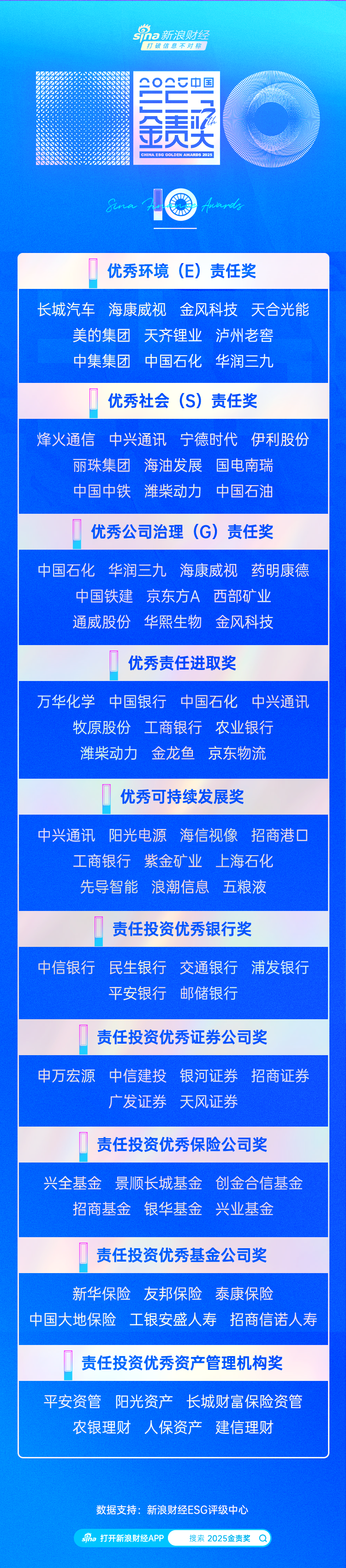
Core Viewpoint - The 2025 China Enterprise ESG "Golden Responsibility Award" aims to recognize companies and institutions that have made significant contributions to ESG initiatives in China, reflecting a shift from voluntary practices to compliance requirements in ESG performance [1][12]. Group 1: ESG Development and Awards Overview - By 2025, China's ESG development has transitioned from "setting standards" to "strengthening regulations," with a comprehensive disclosure standard system being established [1][12]. - The award selection attracted over 5,000 companies, with results based on ESG performance, online voting, and professional evaluations [2][12]. Group 2: Award Categories and Winners - The award categories include Excellent Environmental Responsibility Award, Excellent Social Responsibility Award, Excellent Corporate Governance Responsibility Award, Excellent Responsibility Initiative Award, Excellent Sustainable Development Award, and various responsibility investment awards [1][12]. - Notable winners of the Excellent Environmental Responsibility Award include Great Wall Motors, Hikvision, and China Petroleum [7][24]. - The Excellent Social Responsibility Award was awarded to companies such as YF Communication, ZTE, and Ningde Times [7][24]. - Winners of the Excellent Corporate Governance Responsibility Award include China Petroleum, Hikvision, and WuXi AppTec [7][24]. - The Excellent Responsibility Initiative Award was given to companies like ZTE, Sunlight Power, and Industrial and Commercial Bank of China [7][24]. - The Excellent Sustainable Development Award included companies such as WanHua Chemical, China Bank, and China Petroleum [7][24]. Group 3: Responsibility Investment Awards - The Responsibility Investment Excellent Bank Award was given to institutions like CITIC Bank and Minsheng Bank [5][21]. - The Responsibility Investment Excellent Securities Company Award included firms such as Shenwan Hongyuan and CITIC Securities [5][22]. - The Responsibility Investment Excellent Insurance Company Award recognized companies like New China Life and AIA [5][26]. - The Responsibility Investment Excellent Fund Company Award included firms such as Xinhua Fund and Harvest Fund [5][27]. - The Responsibility Investment Excellent Asset Management Institution Award recognized institutions like Ping An Asset Management and Sunshine Asset Management [5][28]. Group 4: Call to Action and Future Directions - The award committee encourages more Chinese enterprises to integrate ESG principles into their operations and strategic planning, emphasizing the importance of balancing commercial and social values [10][29].

ETF盘中咨询|猪企龙头强强对话,全市场唯一农牧渔ETF(159275)开盘走高!机构:行业基本面和估值有望修复
Sou Hu Cai Jing· 2026-01-15 02:15
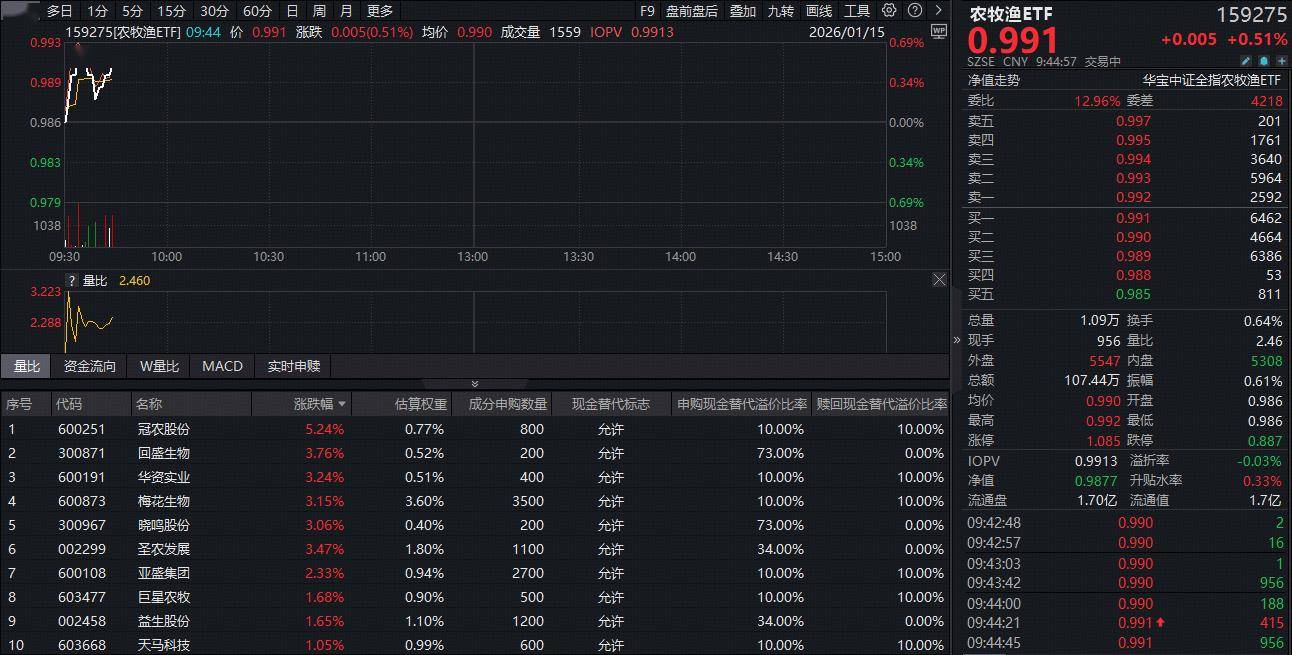
Core Viewpoint - The agricultural, animal husbandry, and fishery sector is experiencing a positive trend, with the highest "pig content" ETF (159275) showing a 0.51% increase in price as of the latest report, indicating a recovery in the market [1][3]. Group 1: Market Performance - The agricultural, animal husbandry, and fishery ETF (159275) opened with a continuous upward trend, rising by 0.51% [1]. - Key stocks in the sector, such as Guan Nong Biological, have seen significant gains, with some stocks increasing by over 5% [1][3]. - The ETF's underlying index, the CSI Agricultural, Animal Husbandry, and Fishery Index, has a price-to-book ratio of 2.53, which is at a low point compared to the past five years [3]. Group 2: Industry Insights - The feed industry is showing signs of recovery, with upstream raw material prices at a cyclical low and structural recovery in downstream breeding [3]. - The pig farming industry has entered a loss phase again, but market and policy factors are accelerating capacity reduction, leading to a decrease in the number of breeding sows [3]. - The pet food industry is highlighted for its growth potential, shifting competition from marketing to research and supply chain [3]. Group 3: Future Outlook - Analysts are optimistic about the pig farming sector, expecting a turning point in pig prices by Q2 2026 due to policy and market forces driving capacity reduction [3]. - The agricultural, animal husbandry, and fishery ETF (159275) is positioned as a strategic investment opportunity, covering major players in the pig farming industry and related sectors [4][6].


猪企龙头强强对话,全市场唯一农牧渔ETF(159275)开盘走高!机构:行业基本面和估值有望修复
Xin Lang Cai Jing· 2026-01-15 01:59
Core Viewpoint - The agricultural, animal husbandry, and fishery sector is experiencing a positive trend, with the highest "pig content" ETF (159275) showing a price increase of 0.51% as of January 15, 2026, indicating a recovery in the market [1][8]. Group 1: Market Performance - The agricultural, animal husbandry, and fishery ETF (159275) opened with a continuous upward trend, reflecting a market recovery [1][8]. - Key stocks in the sector, such as Crown Agricultural and Huazi Industrial, saw significant gains, with Crown Agricultural rising over 5% and several others increasing by more than 3% [1][8]. Group 2: Industry Insights - The feed industry is showing signs of recovery, with upstream raw material prices at a cyclical low and structural improvements in downstream breeding [3][10]. - The pig farming industry has entered a loss phase again, driven by market and policy factors that are accelerating capacity reduction, leading to a decrease in the number of breeding sows [3][10]. - The current valuation of the agricultural, animal husbandry, and fishery sector is relatively low, with the ETF's underlying index price-to-book ratio at 2.53, indicating a favorable long-term investment opportunity [3][10]. Group 3: Future Outlook - The pig farming sector is expected to benefit from recent policies and market dynamics that promote capacity reduction, with a potential price turning point anticipated in Q2 2026 [4][11]. - The agricultural, animal husbandry, and fishery ETF (159275) is highlighted as a key investment vehicle, tracking major stocks in the pig farming industry and related sectors [4][11].
从跨界深耕到无界生长 “瓜蒜之乡”中牟如何成为千亿级企业创新优选地
He Nan Ri Bao· 2026-01-14 23:25
Core Viewpoint - The article highlights the transformation of industries in Zhongmu, where major companies like Wanbang Group and Muyuan Group are diversifying their operations into new sectors, such as traditional Chinese medicine and smart agriculture, leveraging the region's advantages for growth [1][2][3]. Group 1: Wanbang Group's Transformation - Wanbang Group, originally focused on agricultural product distribution, is entering the traditional Chinese medicine sector with the establishment of the Thick Jiang Traditional Chinese Medicine Valley project, which aims to create a leading one-stop trading and logistics hub for TCM by 2027 [2]. - The project will cover over 300 acres and include a TCM museum, emphasizing the integration of food and medicine, with over 60% of products having both culinary and medicinal properties [2][3]. Group 2: Muyuan Group's Innovation - Muyuan Group is investing 5.5 billion yuan in the Central Plains Modern Food Industry Park, transitioning from traditional pig farming to a fully automated and intelligent farming model, which includes feed processing, pig breeding, and meat processing [3]. - The park spans 2,800 acres and is designed to produce 1 million tons of feed annually, with a capacity to raise 2 million pigs, showcasing a significant shift towards technology in agriculture [3]. Group 3: Broader Industry Trends - The article notes that the transformation in Zhongmu is not limited to individual companies but reflects a broader trend of industry integration, with various sectors such as commerce, tourism, and agriculture merging to create new business models [4][5]. - The region's development strategy emphasizes the importance of cultural and tourism integration, aiming to enhance the local economy and attract visitors, thereby reshaping the industrial landscape [5][6].
产能充裕叠加需求不足 上半年生猪市场或延续磨底
Zheng Quan Shi Bao· 2026-01-14 17:36
Core Viewpoint - The pig farming industry is entering its traditional peak season with the Lunar New Year approaching, but the market is still facing oversupply, leading to weak pig prices [2][5]. Industry Overview - The overall trend in the domestic pig market has been weak since 2025, with many companies reporting a decline in sales prices and revenues, some by as much as 30% [2][3]. - Analysts indicate that despite ongoing "anti-involution" policies in the livestock sector, the fundamental imbalance of oversupply and insufficient demand remains unchanged [2][8]. Company Performance - In 2025, Wens Foodstuffs Group sold 40.47 million pigs, generating revenue of 61.48 billion yuan, with an average selling price of 13.71 yuan/kg, reflecting a year-on-year decline of 0.45% in revenue and 17.95% in price [3]. - Muyuan Foods sold 6.98 million pigs in December 2025, with an average price of 11.41 yuan/kg, down 25.38% year-on-year, and a revenue drop of 36.06% [4]. - Tian Kang Bio reported a 5.34% increase in sales volume to 3.19 million pigs, but revenue fell by 10.69% to 4.55 billion yuan [4]. Price Trends - The average price of lean pigs in 2025 was 13.74 yuan/kg, a decrease of 17.97% year-on-year, with prices remaining low and companies facing losses [5][6]. - As of January 9, 2026, the national average price for pigs was 12.51 yuan/kg, showing a slight recovery due to seasonal demand, but losses persist in the industry [5][7]. Supply and Demand Dynamics - The supply of pigs remains high, with a reported 36.92 million pigs in large-scale farms as of December 2025, a slight decrease from the previous month but an increase year-on-year [8]. - Analysts predict that while there may be short-term price support due to reduced supply, the overall market remains oversupplied, limiting significant price increases [8][9]. Cost Factors - The prices of corn and soybean meal, key raw materials for pig farming, significantly influence the industry's profitability. High prices for these inputs could exacerbate losses, while a decrease could improve profit margins [9]. - Current prices for feed ingredients are stable, with limited impact on costs, but fluctuations in market supply and demand will continue to drive profitability [9].
华源晨会精粹20260114-20260114
Hua Yuan Zheng Quan· 2026-01-14 12:16
Group 1: Transportation Industry - The geopolitical situation may usher in an "oil transportation era," driven by U.S. sanctions on Venezuela and Iran, which have significantly reduced oil exports from these countries [2][7][10] - In the short term, Venezuela's oil exports are expected to be limited due to transportation blockades, translating to a demand equivalent to 19 VLCCs (Very Large Crude Carriers) [8] - If U.S. sanctions are lifted, Venezuela's oil exports could reach a historical peak of 2.4 million barrels per day, requiring 141 VLCCs [8] - For Iran, if domestic unrest escalates, oil trade demand may shift to compliant suppliers, equating to a need for 38 VLCCs [9] - The shadow fleet has allowed Russia to maintain oil exports despite sanctions, with potential increases in demand for VLCCs depending on geopolitical developments [10] Group 2: Agriculture and Livestock Industry - The pig farming sector is experiencing a slight recovery, with prices stabilizing around 12.7 yuan/kg, although production capacity is still under pressure [12][13] - The industry is seeing a shift towards protecting farmers' rights and encouraging innovation, which may lead to a more favorable pricing environment for pigs [13] - The chicken industry faces ongoing challenges with high production and weak consumption, but leading companies may gain market share [14] - The feed sector is witnessing price increases, particularly for special water fish, indicating potential growth opportunities for companies like Haida Group [15][16] Group 3: Real Estate Industry - The real estate sector has seen a 5.1% increase, with new housing transactions in 42 key cities totaling 137 million square meters, a 46.7% decrease from the previous period [23][24] - The government is expanding public rental housing and relaxing housing fund policies to stimulate demand [25] - The market sentiment is improving, with potential for a new wave of value reassessment among Hong Kong developers [27]

1月14日生物经济(970038)指数涨0.43%,成份股英科医疗(300677)领涨
Sou Hu Cai Jing· 2026-01-14 10:23
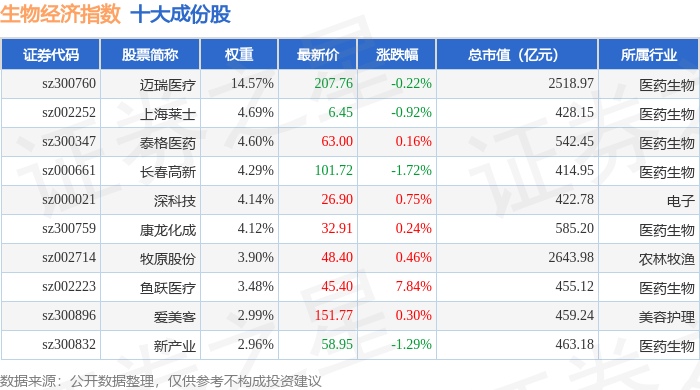
Group 1 - The Biotech Index (970038) closed at 2322.86 points, up 0.43%, with a total transaction volume of 50.71 billion yuan and a turnover rate of 3.77% [1] - Among the index constituents, 23 stocks rose, with Yingke Medical leading at an 8.37% increase, while 27 stocks fell, with Dabo Medical leading the decline at 3.28% [1] - The top ten constituents of the Biotech Index include major companies such as Mindray Medical, which has a weight of 14.57% and a market capitalization of 251.90 billion yuan, and Yuyue Medical, which has a weight of 3.48% and a market capitalization of 45.51 billion yuan [1] Group 2 - The net outflow of main funds from the Biotech Index constituents totaled 643 million yuan, while retail investors saw a net inflow of 771 million yuan [1] - Detailed fund flow data indicates that Yuyue Medical had a net inflow of 35.6 million yuan from main funds, while it experienced a net outflow of 66.06 million yuan from retail investors [2] - Mindray Medical saw a net inflow of 13.7 million yuan from main funds, with retail investors experiencing a net outflow of 36.97 million yuan [2]



养殖业板块1月14日涨0.09%,*ST天山领涨,主力资金净流出2.23亿元
Zheng Xing Xing Ye Ri Bao· 2026-01-14 08:44
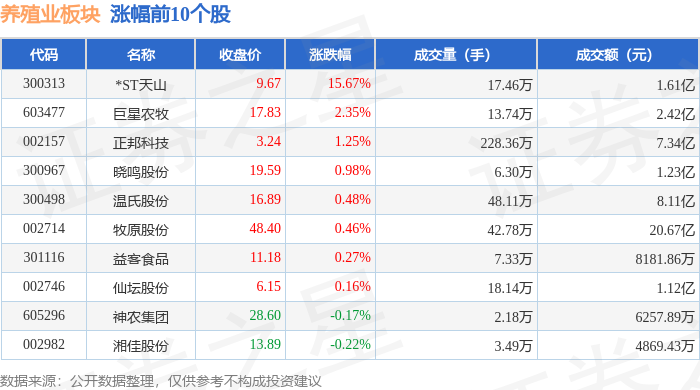
Core Viewpoint - The aquaculture sector experienced a slight increase of 0.09% on January 14, with *ST Tianshan leading the gains, while the overall market showed mixed results with the Shanghai Composite Index down by 0.31% and the Shenzhen Component Index up by 0.56% [1]. Group 1: Stock Performance - *ST Tianshan closed at 9.67, up by 15.67%, with a trading volume of 174,600 shares and a transaction value of 161 million yuan [1]. - Other notable performers included Juxing Agriculture (up 2.35% to 17.83), Zhengbang Technology (up 1.25% to 3.24), and Xiaoming Co. (up 0.98% to 19.59) [1]. - Major stocks like Wens Foodstuff and Muyuan Foods saw minor increases of 0.48% and 0.46%, respectively, with closing prices of 16.89 and 48.40 [1]. Group 2: Capital Flow - The aquaculture sector saw a net outflow of 223 million yuan from institutional investors, while retail investors contributed a net inflow of 77.57 million yuan [2]. - Notable stocks with significant capital flow included Zhengbang Technology, which experienced a net outflow of 37.67 million yuan from institutional investors [3]. - Muyuan Foods had a net inflow of 37.65 million yuan from institutional investors, indicating a positive sentiment towards this stock [3].


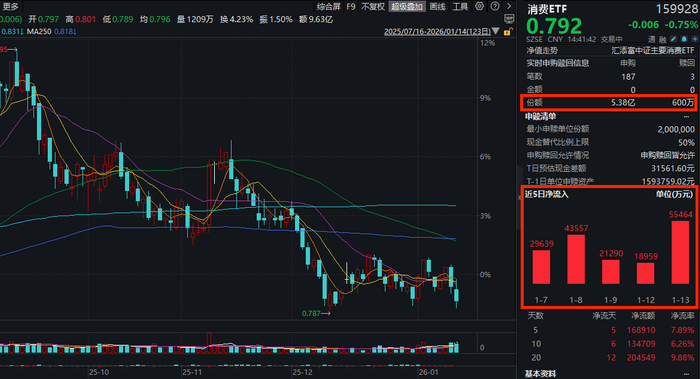
消费再迎政策催化!上海发布28条新政促消费!消费ETF(159928)回调近1%,近5日大举净流入超16亿元!
Xin Lang Cai Jing· 2026-01-14 07:05
Group 1: Market Performance - The Shanghai Composite Index experienced fluctuations, reaching a new high before a continuous decline, with the consumer sector undergoing a pullback, and the Consumer ETF (159928) dropping by 0.75% [1][3] - The trading volume for the Consumer ETF exceeded 1 billion yuan, with significant capital inflow, accumulating over 5.3 million shares during the day and over 1.6 billion yuan in the previous five days [1][3] Group 2: Policy Initiatives - Eight departments jointly introduced 14 specific measures to promote high-quality development in elderly care services and the silver economy, with the elderly population expected to reach 310 million by the end of 2024 and over 400 million by 2035, leading to a silver economy scale exceeding 30 trillion yuan [3] - Shanghai has implemented 28 measures to enhance service quality and stimulate consumption, including optimizing auto loan processes and supporting quality content creation in micro-dramas and the gaming industry [3][6] Group 3: Economic Indicators - The service sector and consumption in Shanghai have shown positive growth trends, with service value-added increasing by 5.9% and retail sales of consumer goods growing by 5% in the first eleven months of 2025, both surpassing national averages [6] - The Consumer Price Index (CPI) in December recorded its highest year-on-year increase since March 2023, with food prices improving, indicating a release of consumer potential [7][8] Group 4: Investment Opportunities - The valuation of the Consumer ETF (159928) is attractive, with a TTM price-to-earnings ratio of 19.29, placing it in the 2.76% percentile of the past decade, indicating it is cheaper than 97% of historical periods [3] - The top ten holdings in the Consumer ETF account for over 68.55% of its weight, with significant shares in leading liquor brands and major agricultural companies, suggesting a robust investment opportunity in the consumer sector [11]
2025猪市在成本与效率中重塑,微利时代寻求新平衡
Qi Huo Ri Bao· 2026-01-14 06:41
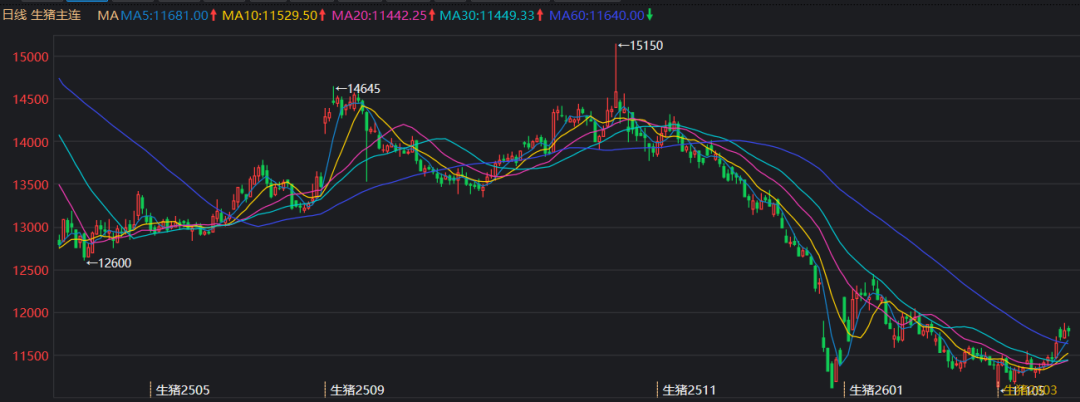
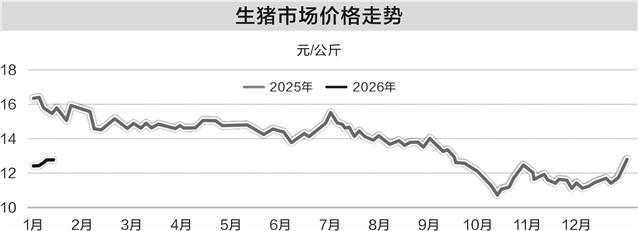
Core Viewpoint - The domestic pig market in 2025 is experiencing significant adjustments due to abundant supply and weak demand, leading to a decline in average prices and creating challenges for producers [1][2]. Group 1: Market Trends - The average price of pigs in 2025 is approximately 13.80 yuan/kg, significantly lower than in 2024, with prices fluctuating from around 16 yuan/kg at the beginning of the year to below 11 yuan/kg by late October [1][2]. - The supply of pigs is robust, driven by a high number of breeding sows and increased production efficiency, resulting in actual pork supply exceeding market expectations [2][5]. - Demand for pork is weakening, with traditional consumption peaks failing to stimulate demand, leading to a situation where price increases do not correspond with demand growth [2][6]. Group 2: Cost Management and Industry Dynamics - In response to declining prices, pig farming companies are undergoing an "efficiency revolution," focusing on cost reduction to survive, with leading companies like Muyuan Foods reducing their breeding costs from approximately 13 yuan/kg to 11.3 yuan/kg [5][6]. - The cost reduction is attributed to improved production efficiency and utilization rates, with leading firms achieving a PSY (pigs weaned per sow per year) of over 28, indicating fewer sows are needed for the same amount of pork production [5][6]. - The competition in the pig farming sector is intensifying, with a shift towards "cost reduction and efficiency enhancement," leading to increased pressure on smaller farms and a trend towards larger, more efficient operations [5][6]. Group 3: Future Outlook - For 2026, there is cautious optimism, with expectations of continued supply pressure in the first half but potential improvements in the second half as production capacity decreases and seasonal demand increases [6][7]. - The average price for pigs in 2026 is projected to be between 12 and 13 yuan/kg, with a potential for prices to rise later in the year [7]. - Policy interventions are expected to play a crucial role in stabilizing prices, with ongoing regulatory measures aimed at restoring prices to reasonable levels [7][8]. Group 4: Risk Management Strategies - The industry is evolving towards a new paradigm characterized by "policy guidance, market adjustment, and efficiency supremacy," necessitating an upgrade in survival strategies for pig farmers [8]. - Recommendations for pig farmers include maintaining biosecurity, enhancing efficiency, managing production capacity, and utilizing futures and derivatives for risk management [8][9]. - The trading volume of pig futures in 2025 reached 17.993 million contracts, indicating increased market liquidity and the growing importance of risk management tools among producers [9].