今世缘

Search documents
白酒板块8月5日涨0.9%,*ST岩石领涨,主力资金净流入6亿元
Zheng Xing Xing Ye Ri Bao· 2025-08-05 08:37
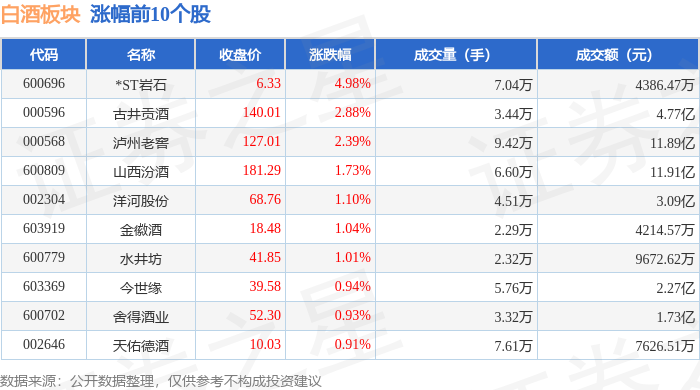
从资金流向上来看,当日白酒板块主力资金净流入6.0亿元,游资资金净流出3.58亿元,散户资金净流出 2.42亿元。白酒板块个股资金流向见下表: 证券之星消息,8月5日白酒板块较上一交易日上涨0.9%,*ST岩石领涨。当日上证指数报收于3617.6,上 涨0.96%。深证成指报收于11106.96,上涨0.59%。白酒板块个股涨跌见下表: | 代码 | 名称 | 收盘价 | 涨跌幅 | 成交量(手) | 成交额(元) | | | --- | --- | --- | --- | --- | --- | --- | | 600696 | *ST岩石 | 6.33 | 4.98% | 7.04万 | | 4386.47万 | | 000596 | 古井贡酒 | 140.01 | 2.88% | 3.44万 | | 4.77亿 | | 000568 | 泸州老窖 | 127.01 | 2.39% | 9.42万 | | 11.89 乙 | | 600809 | 山西汾酒 | 181.29 | 1.73% | 6.60万 | | 11.91亿 | | 002304 | 洋河股份 | 68.76 | 1.10% | 4.5 ...





今日1063只个股突破五日均线
Zheng Quan Shi Bao Wang· 2025-08-05 06:27
Market Overview - The Shanghai Composite Index closed at 3608.33 points, above the five-day moving average, with a gain of 0.70% [1] - The total trading volume of A-shares reached 1,290.701 billion yuan [1] Stocks Performance - A total of 1,063 A-shares have surpassed the five-day moving average, with notable stocks showing significant deviation rates [1] - Stocks with the highest deviation rates include: - Nanjing Julong (10.11%) - Changxin Bochuang (8.01%) - Dazhu CNC (7.93%) [1] - Stocks with smaller deviation rates that just crossed the five-day moving average include: - Allwinner Technology - Jinshiyuan - Yinlun Shares [1] Top Performing Stocks - The top stocks that broke through the five-day moving average and their respective performance metrics are: - Nanjing Julong: 11.60% increase, 23.45% turnover rate, latest price 36.76 yuan [1] - Changxin Bochuang: 13.44% increase, 14.23% turnover rate, latest price 95.40 yuan [1] - Dazhu CNC: 11.05% increase, 20.73% turnover rate, latest price 81.20 yuan [1]



小劲酒单品冲百亿,白酒的未来是“不做白酒”?
阿尔法工场研究院· 2025-08-05 00:06
Core Viewpoint - The rise of the small Jinjiao brand reflects a shift in the white liquor industry towards younger consumers, emphasizing the need for brands to adapt without losing their core values [2][39] Group 1: Sales Performance and Market Dynamics - The claim of "100 billion sales" for small Jinjiao is based on a linear extrapolation from a sales increase of 42.45% in the first half of 2024, with actual sales of 31.1 billion yuan in the same period [10][11] - The sales of small Jinjiao have been influenced by social media trends, leading to increased attention and temporary spikes in sales, but sustainability remains uncertain [9][12] - The company has not surpassed its historical sales peak of 80 billion yuan since 2017, indicating fluctuations in growth rather than a consistent upward trajectory [11] Group 2: Consumer Trends and Product Innovation - The creative mixing of small Jinjiao with childhood beverages like AD calcium milk reflects a new consumption logic that resonates with younger consumers seeking both enjoyment and health [15][20] - The company has adjusted its product offerings, including lowering the alcohol content from 35% to 28% and introducing sugar-free versions to align with health trends [21][22] - The marketing strategy has shifted to target younger demographics, including women and high-net-worth individuals, moving away from traditional male-centric marketing [25][26] Group 3: Marketing and Channel Strategies - The establishment of a dedicated content marketing team has allowed the company to effectively engage with younger audiences through social media platforms [26] - The sales model has transitioned from a focus on inventory pressure to creating value for end-users, enhancing the authenticity of sales data [27][28] - The brand's differentiation from traditional high-end liquor is a key factor in attracting younger consumers, as it emphasizes social enjoyment over formal occasions [23][24] Group 4: Industry Challenges and Future Outlook - The competition in the health-oriented liquor segment is intensifying, with established brands launching similar products, posing a threat to small Jinjiao's market share [36][38] - The inherent conflict between new consumption trends and the traditional aging process of liquor presents a challenge for brands to innovate while maintaining quality [34][35] - The ability of small Jinjiao to maintain its current popularity will depend on continuous innovation and the preservation of its brand identity amidst changing consumer preferences [32][39]

食品饮料行业周报:白酒持续磨底,关注资金切换节奏-20250804
Huaxin Securities· 2025-08-04 14:31
Investment Rating - The report maintains a "Recommended" investment rating for the food and beverage industry [7] Core Insights - The liquor sector is showing signs of bottoming out, with increased catalysts for investment and improved cost-effectiveness in allocations. Factors include ongoing policy adjustments, low fund allocations in Q2 2025, and rising dividend yields from liquor companies [5][6] - The overall beverage market is experiencing a shift towards new consumption patterns, particularly in instant retail and tea beverage sectors, driven by efficiency and scale [6][7] - The report highlights a focus on key companies within the liquor sector, including Guizhou Moutai, Wuliangye, and Luzhou Laojiao, as well as flexible stocks like JiuGui Jiu and SheDe JiuYe [5][7] Summary by Sections Industry News - The liquor manufacturing industry's profit decreased by 2.1% year-on-year in the first half of the year [16] - The production of Renhuai liquor is expected to exceed 310,000 tons in 2024 [16] - Regulatory measures in Guiyang have been introduced to liquor companies [16] Company News - Guizhou Moutai has undergone personnel adjustments in its supervisory board [16] - SheDe JiuYe's board member resigned from his position [16] Key Company Feedback - The report emphasizes the importance of maintaining a diversified portfolio in the liquor sector, with a focus on companies that are actively engaging in market strategies and product differentiation [5][6] Industry Performance - The food and beverage sector has shown varied performance over the past month, with a slight increase of 0.2% [2] - The liquor sector is currently undergoing a destocking cycle, facing multiple pressures from pricing, demand, and policy [5] Key Data Trends - In 2024, the liquor industry is projected to generate revenue of 796.4 billion yuan, reflecting a year-on-year increase of 5.3% [35] - The cumulative production of liquor in 2024 is expected to be 4.145 million tons, down 7.72% year-on-year [35]


食品饮料行业周报:育儿补贴落地,长期有望撬动整体消费-20250804
Guohai Securities· 2025-08-04 13:33
Investment Rating - The report maintains a "Recommended" rating for the food and beverage industry [1][4]. Core Insights - The implementation of the national childcare subsidy is expected to stimulate overall consumption in the long term, particularly benefiting the infant food sector [8]. - Recent policy signals from the Political Bureau meeting indicate a commitment to proactive fiscal and monetary policies aimed at boosting domestic demand and consumption [5]. - The food and beverage sector has underperformed compared to the broader market, with a decline of 1.45% over the past two weeks, while the Shanghai Composite Index rose by 0.72% [3][17]. Summary by Sections Industry Performance - Over the past year, the food and beverage sector has shown a 5.7% increase, but it has lagged behind the Shanghai Composite Index in the short term [3][17]. - The health products segment experienced the smallest decline of 0.01%, while processed foods and meat products fell by 0.16% and 0.30%, respectively [17]. Key Companies and Recommendations - Recommended stocks in the liquor segment include Kweichow Moutai, Wuliangye, Luzhou Laojiao, Shanxi Fenjiu, and others [28]. - In the consumer goods segment, recommended stocks include BaiRun Co., WeiLong, Salted Fish, Nongfu Spring, and others [28]. Market Trends - The report highlights a significant drop in the number of banquet reservations for graduation ceremonies, indicating a shift in consumer behavior due to recent restrictions [5]. - New product launches by companies like Qiaqia are accelerating, with a focus on innovative and differentiated products to capture market share [9]. Financial Performance - Dongpeng Beverage reported a revenue of 10.737 billion yuan for H1 2025, a year-on-year increase of 36.4%, with a net profit of 2.375 billion yuan, up 37.2% [10]. - The report notes that the beverage market is facing pressure from price wars, particularly in the bottled water segment, impacting profitability [11]. Valuation Metrics - As of August 1, 2025, the dynamic price-to-earnings ratio for the food and beverage sector stands at 20.23x, indicating a relatively low valuation compared to historical averages [23].


食品饮料:酒类周报:酒企布局即时零售,加大新渠道拓展-20250804
Ping An Securities· 2025-08-04 06:56
Investment Rating - Industry investment rating is "Outperform the Market" (expected to outperform the market index by more than 5% in the next 6 months) [18] Core Viewpoints - The report highlights that liquor companies are expanding into instant retail and increasing new channel development. The launch of "Moutai Sauce Fragrance·Shared by Thousands of Families" on Meituan Flash Purchase is a significant step, with Moutai's authorized stores entering this channel in bulk, which is expected to enhance downstream sales and support healthy industry development [8][14] - The report identifies three main investment lines: high-end liquor with relatively strong demand, mid-range liquor with ongoing national expansion, and real estate liquor products positioned in expanding price ranges [8] Summary by Sections Price Data Tracking - As of August 1, 2025, the wholesale price of Moutai (2022) is 2020 CNY per box, down 30 CNY from the previous week, while the price of the 2022 loose bottle remains stable at 1940 CNY per bottle [9] - The price of Wuliangye (Baijiu) is 900 CNY per bottle, unchanged from the previous week [9] Production Data Tracking - In June 2025, China's liquor production was 330,000 kiloliters, down 6.5% year-on-year; beer production was 4.12 million kiloliters, down 0.2%; soft drink production was 18.43 million kiloliters, up 3.2%; and wine production was 9000 kiloliters, down 18.2% [12] Company Announcements and Events Summary - In the first half of 2025, the liquor, beverage, and refined tea manufacturing industry saw a revenue of 814.69 billion CNY, a year-on-year increase of 1.9%, but profits fell by 2.1% [14] - Qingdao Beer expects its transaction volume on Meituan Flash Purchase to exceed 1.5 billion CNY for the year, with sales up nearly 60% year-on-year in the first half of 2025 [14]
消费仍是经济修复主动能,食品饮料ETF(515170)一周低调“吸金”2.32亿元
Sou Hu Cai Jing· 2025-08-04 05:27
Group 1 - The market showed a mixed performance on August 4, with military and chip sectors leading gains, while pharmaceutical stocks generally retreated [1] - The banking sector exhibited independent movement stimulated by new treasury regulations, with individual stocks experiencing varied performance [1] - The traditional consumer sector remained stable, with the Food and Beverage ETF (515170) closing flat and attracting 232 million yuan over the past five trading days [1] Group 2 - GF Securities predicts that the liquor industry may see a "valuation-earnings" double bottom by 2025, indicating that it has entered a mid-cycle buying point [1] - The dividend yield of the liquor sector is high compared to the ten-year treasury yield, suggesting improved cost-effectiveness for investors [1] - Despite ongoing downward adjustments in profit forecasts, valuations are at historical lows, and stock prices may stabilize before earnings do [1] Group 3 - The Food and Beverage ETF (515170) tracks the CSI segmented food and beverage industry theme index, focusing on high-barrier and resilient sectors such as liquor, beverages, and seasoning products [1] - The top ten constituent stocks include major brands like Moutai and Wuliangye, providing investors with a convenient way to access core assets in the "food and beverage" sector [1] - Compared to the high minimum investment thresholds of individual constituent stocks, the Food and Beverage ETF serves as an accessible investment tool for smaller capital [1]
国泰海通晨报-20250804
Haitong Securities· 2025-08-04 03:32
Macro Insights - The July non-farm payroll data in the US fell short of expectations, with significant downward revisions for May and June, raising concerns about the quality of the data [2][3][24] - The divergence between non-farm payrolls and the unemployment rate is attributed to the impact of immigration policies, which have affected job creation but not significantly increased unemployment [3][24] - The Federal Reserve faces a dilemma between managing inflation and employment, with the July non-farm data likely insufficient to alter Powell's hawkish stance [3][24] Strategy Insights - The Chinese economy is undergoing a transformation, with a "transformation bull market" established, and the stock market is expected to reach new highs despite current adjustments [4][6] - Key drivers of the "transformation bull market" include economic transformation, systemic decline in risk-free returns, and accelerated capital market reforms [6][7] - The interest in fixed income products is decreasing as long-term bond yields drop below 2%, making equities more attractive [7] Consumption Trends - The Hong Kong stock market's new consumption sector has shown strong performance, driven by changing consumer preferences towards experiential and social consumption [10][11] - The current phase of the new consumption sector is characterized by a digestion of previous gains, but long-term macroeconomic support remains strong [11][13] - The shift in consumer behavior from mass consumption to personalized and rational consumption is expected to continue, with investment opportunities in trendy and personal care products [11][13] Investment Themes - Emerging technologies are seen as a primary investment theme, while cyclical financial sectors are viewed as potential dark horses [8] - Recommendations include stable and monopolistic sectors such as financials, as well as emerging growth sectors like internet, media, and innovative pharmaceuticals [8] - The competitive landscape for certain cyclical products is improving, with opportunities in non-ferrous metals, chemicals, and construction materials [8]
白酒三巨头,江苏一哥消失了
36氪· 2025-08-03 13:41
Core Viewpoint - Yanghe, once a leading player in the Chinese liquor industry, is facing significant challenges, including declining revenue and profit, necessitating a strategic shift under new leadership to survive in a competitive market [4][6][50]. Group 1: Leadership Changes - Yanghe's former chairman, Zhang Liandong, resigned unexpectedly in July 2024, just a week after promoting a new product [4][6]. - Gu Yu, a 47-year-old local government official with no prior experience in liquor sales, was appointed as the new chairman [6][7][8]. Group 2: Financial Performance - In 2024, Yanghe's revenue fell by 12.83% to 28.876 billion yuan, and net profit dropped by 33.37% to 6.673 billion yuan [12][18]. - The company's market position deteriorated from third to fifth in the industry, with significant competition from Shanxi Fenjiu and Luzhou Laojiao [12][13]. Group 3: Market Challenges - Yanghe is grappling with high inventory levels, unclear brand positioning, and a breakdown of trust within its distribution channels [9][10]. - The average inventory turnover days surged to 898 days in 2024, indicating severe inventory management issues [9]. Group 4: Brand and Product Strategy - Yanghe's high-end product, "Dream Blue," has seen declining sales, with significant price drops observed in the market [21][26]. - The company has shifted focus to lower-priced products, launching a 59 yuan light bottle wine in collaboration with JD.com, which quickly gained popularity [27][30]. Group 5: Distribution and Channel Issues - Yanghe's distribution network is characterized by a high turnover rate of over 15%, indicating instability and a lack of strong relationships with distributors [38][40]. - The company has lost market share in its home province of Jiangsu, with revenue declining by 11.43% in 2024 [43][45]. Group 6: Strategic Missteps - Yanghe's failure to adapt to market changes and consumer preferences has led to a decline in its competitive edge [49]. - The company's past strategic decisions, such as underutilizing the acquired brand "Shuangou," have hindered its growth potential [49].


食品饮料周观点:育儿补贴政策落地,推新积极挖掘增量-20250803
GOLDEN SUN SECURITIES· 2025-08-03 10:36
Investment Rating - The report maintains an "Increase" rating for the food and beverage industry, indicating a positive outlook for the sector [5]. Core Insights - The implementation of the childcare subsidy policy is expected to stimulate growth in the food and beverage sector, particularly benefiting the infant formula and dairy product markets [4]. - The report highlights three main investment themes in the liquor segment: strong leading brands, sustained regional advantages, and recovery-driven elastic stocks [1][2]. - In the beer and beverage segment, Budweiser faces sales pressure but is seeing price recovery, while the sugary tea category is gaining market share during peak seasons [3]. Summary by Sections Liquor Industry - Leading brands such as Moutai, Wuliangye, and Luzhou Laojiao dominate the global rankings, with Moutai valued at $58.4 billion, maintaining its position as the most valuable liquor brand globally [2]. - The liquor sector is transitioning from scale growth to high-quality development, with a focus on brand strength and market positioning [2]. Beer and Beverage Sector - Budweiser's Q2 2025 results show a revenue decline of 3.9% and a profit drop of 31.1%, with a notable 6.2% decrease in sales volume [3]. - The sugary tea segment is experiencing a resurgence, with brands like Kang Shifu and Uni-President maintaining leading positions, and sales of Yuanqi Forest's iced tea growing by 53.9% year-on-year [3]. Food Sector - The national childcare subsidy program, effective from January 1, 2025, is projected to enhance birth rates and subsequently increase demand for dairy products [4]. - New product launches by companies like Qiaqia and Ximai are aimed at expanding market presence and tapping into health-oriented consumer trends [4][7].