同花顺

Search documents
A股总市值今年多了20万亿元
Shen Zhen Shang Bao· 2025-11-12 23:27
Group 1 - The A-share market has experienced significant growth in 2023, with the Shanghai Composite Index surpassing 4000 points and a cumulative increase of nearly 20% year-to-date, leading to a total market capitalization exceeding 108 trillion yuan, an increase of over 2 trillion yuan from the end of last year [1][2] - The total market capitalization of A-shares reached 108.27 trillion yuan as of November 11, 2023, marking a 26.37% increase from approximately 85.68 trillion yuan at the end of last year, the highest growth rate for the same period in nearly a decade [1][2] - The electronics, AI industry chain, and semiconductor sectors contributed over 80% of the market capitalization increase, highlighting the strong driving force of the "technology bull" market [1] Group 2 - Historical growth of A-share market capitalization can be divided into four phases: the initial phase (1990-2005), explosive phase (2006-2007), turbulent phase (2008-2018), and reform dividend phase (2019-present), with the current phase characterized by the implementation of the registration system and a surge in technology IPOs [2] - The electronics sector has become the largest industry by market capitalization in A-shares, surpassing the banking sector with a market value of 12.97 trillion yuan, an increase of 4.76 trillion yuan or 58% from the end of last year [2] - The current market capitalization of A-shares has surpassed levels not seen during previous peaks in 2007 and 2015, with the Shanghai Composite Index maintaining a position above 4000 points [2] Group 3 - The continuous rise in A-share market capitalization is driven by multiple favorable factors, including policy support, improving economic fundamentals, and favorable funding conditions [3] - The implementation of comprehensive reforms in the capital market, including the registration system and measures to attract long-term capital, has significantly enhanced the appeal of quality assets in the A-share market [3] - Economic growth is projected to remain strong, with GDP growth expected at 5% in 2024 and 5.2% in the first three quarters of 2025, providing robust support for the market [3]
37家A股公司抢先完成三季度分红
Zheng Quan Ri Bao· 2025-11-12 16:39
Group 1 - As of November 12, 37 companies have implemented their third-quarter dividend plans, distributing over 6.3 billion yuan in cash dividends to investors [1] - The emphasis on cash dividends by listed companies in 2025 is driven by regulatory guidance and improved corporate profitability, transforming dividends from an optional action to a feasible plan [1][2] - Recent policies encouraging cash dividends have led to more companies announcing dividend plans, providing investors with clear return expectations [1] Group 2 - SanDa Membrane Environment Technology Co., Ltd. announced a special dividend plan of 2.1 yuan per 10 shares, reflecting stable operating performance and a healthy balance sheet [2] - Companies emphasize that their dividend proposals consider development stages and future funding needs, ensuring no significant impact on cash flow or long-term operations [2] - Cash dividends signal enhanced profitability stability for companies and mark a transition from expansion to shareholder return periods, aligning with long-term capital needs [2] Group 3 - The improvement of the dividend mechanism requires collaboration among companies, regulators, and the market, moving from policy-driven to intrinsic awareness [3] - When companies achieve a balance of cash flow generation, continuous sharing, and transparent governance, dividends will become a dual win for corporate growth and market prosperity [3]

2025Q3非银板块基金持仓点评:券商板块获增配,保险持仓环比回落
HUAXI Securities· 2025-11-12 14:43
Investment Rating - The insurance industry is rated as "Recommended" [1] Core Insights - As of the end of Q3 2025, the allocation of non-bank financial sector in active funds is 1.20%, which is underweight by 8.48 percentage points compared to the total market capitalization of the CSI 300 [1] - The securities sector allocation has slightly increased to 0.41%, but remains significantly underweight by 4.28 percentage points compared to the CSI 300 [2] - The insurance sector's allocation has decreased from 0.75% at the end of Q2 to 0.61% at the end of Q3, underweight by 4.19 percentage points compared to the CSI 300 [3] - The multi-financial sector shows a marginal improvement with an allocation of 0.18%, up by 0.04 percentage points [4] - The report suggests that the current low allocation to the non-bank sector presents a value opportunity, especially with the expected market activity and reforms [5] Summary by Sections Non-Bank Financial Sector - The allocation in active funds is 1.20%, down by 0.06 percentage points from the previous quarter, and underweight by 8.48 percentage points compared to the CSI 300 [1] Securities Sector - The allocation is 0.41%, an increase of 0.04 percentage points, but still underweight by 4.28 percentage points compared to the CSI 300 [2] - Notable increases in holdings for leading firms such as Huatai Securities and Citic Securities, with significant percentage increases in both share quantity and market value [2] Insurance Sector - The allocation decreased to 0.61%, down from 0.75%, underweight by 4.19 percentage points compared to the CSI 300 [3] - Key stocks include China Ping An and China Life, with varying changes in shareholding and market value [3] Multi-Financial Sector - The allocation is 0.18%, showing a slight increase of 0.04 percentage points [4] - Significant increases in holdings for companies like Hong Kong Exchanges and Clearing and Bohai Leasing [4] Investment Recommendations - The report emphasizes the potential for value in the non-bank financial sector due to its current underweight status and the anticipated market developments [5]
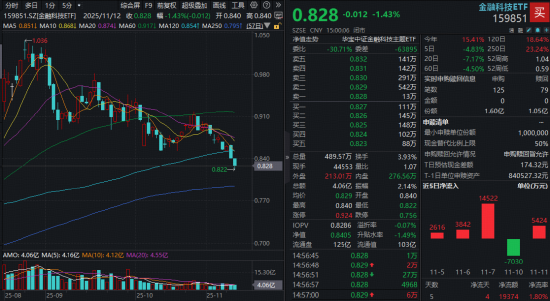
金融科技板块创本轮调整新低,自高点回撤超17%,跌到位了吗?
Xin Lang Ji Jin· 2025-11-12 11:41
Core Viewpoint - The financial technology sector is experiencing a downturn, with the China Securities Financial Technology Theme Index dropping over 1% on November 12, marking a new low in the current adjustment phase [1][3]. Group 1: Market Performance - Internet brokerage stocks are leading the decline, with Dazhihui hitting a limit down and closing down over 8%, while Tonghuashun fell by 4% and Guiding Chen dropped over 2% [1]. - In contrast, financial IT stocks showed resilience, with Hengyin Technology closing up over 7%, and several other stocks like Gaoweida and Guao Technology also seeing gains [1]. - The popular ETF, the 100 billion financial technology ETF (159851), fell below its six-month moving average, with a daily trading volume exceeding 400 million and a net subscription of 55 million shares on the same day [1][4]. Group 2: Technical Analysis - The financial technology index has retreated over 17% since its historical high on August 25, indicating it may be at the bottom of the current adjustment phase [3]. - The next key support level is anticipated to be the annual line, as the sector continues to explore lower levels after losing the six-month line [3]. Group 3: Investment Insights - The investment value of the financial technology sector is influenced by two main factors: internet brokerages and financial IT [3]. - The non-bank financial sector is expected to benefit from the ongoing "slow bull" market, with potential for continued profit and valuation increases during the capital market upcycle [3]. - Internet brokerages are seen as having unique Alpha growth potential due to successful transformations and support from policy, improved funding conditions, and industry dynamics [3][4]. Group 4: Financial IT Sector - The financial IT sector is experiencing high demand driven by the development of digital currencies and increased market activity, particularly in cross-border payments and internet finance [4]. - Financial technology companies are positioned to benefit from heightened market activity and advancements in AI within the financial sector, presenting new growth opportunities [4]. Group 5: ETF and Fund Recommendations - It is recommended to focus on the financial technology ETF (159851) and its associated funds, which cover a wide range of themes including internet brokerages, financial IT, cross-border payments, and AI applications [4]. - As of October 31, the financial technology ETF (159851) has a scale exceeding 10 billion, with an average daily trading volume of 500 million, leading in scale and liquidity among similar ETFs [4].

AI下一站,软件应用是星辰大海
Sou Hu Cai Jing· 2025-11-12 10:40
Core Insights - The rise of domestic software is not just an industrial upgrade but a demonstration of China's technological strength and AI capabilities, marking a deterministic trend in the industry [2][15] - AI is reshaping the world, with software applications becoming the next "main battlefield" [2] - The demand for AI software is surging in both consumer (C-end) and business (B-end) sectors, driven by digital transformation and policy support [3][7] Industry Trends - The domestic AI application user base has surpassed 700 million by Q3 2025, indicating rapid penetration in the consumer market [2] - The "15th Five-Year Plan" encourages the implementation of AI across various sectors, aiming for 100% domestic replacement in state-owned enterprises by 2027 [6] - The software industry in China is projected to reach a scale of 15 trillion yuan by 2025, with AI expected to significantly contribute to this growth [10] Company Performance - Oracle's performance exceeded expectations with a 359% year-on-year increase in remaining performance obligations, reaching $455 billion [2] - Palantir reported Q3 2025 revenue of $1.181 billion, a 63% increase year-on-year, with a net profit of $477 million, up 220% [2] - Keda Xunfei, a leader in AI applications, reported Q3 2025 revenue of 6.078 billion yuan, a 10.02% increase year-on-year, with a net profit of 172 million yuan, up 202.4% [14] - Kingsoft Office, another key player, achieved Q3 2025 revenue of 1.521 billion yuan, a 25.33% increase year-on-year, with a net profit of 431 million yuan, up 35.42% [14] - Deepin's revenue reached 2.116 billion yuan in Q3 2025, a 9.86% increase year-on-year, with a net profit of 147 million yuan, up 1097.4% [15] Market Outlook - The AI software sector is expected to drive significant growth in the global software market, with estimates suggesting a 20% increase by 2030 due to AI agents alone [10] - The domestic software market is anticipated to create a trillion-level business increment driven by AI [10] - The current market conditions indicate a strong potential for recovery in the software sector, with the CSI Software Index showing a year-to-date increase of 13.34% [13]

计算机行业资金流出榜:指南针等19股净流出资金超亿元
Zheng Quan Shi Bao Wang· 2025-11-12 09:24
Market Overview - The Shanghai Composite Index fell by 0.07% on November 12, with 11 sectors experiencing gains, led by household appliances and comprehensive sectors, which rose by 1.22% and 1.05% respectively [1] - The sectors with the largest declines were power equipment and machinery, which fell by 2.10% and 1.23% respectively [1] Capital Flow Analysis - The main capital outflow from the two markets totaled 58.897 billion yuan, with 5 sectors seeing net inflows [1] - The pharmaceutical and biological sector had the highest net inflow, amounting to 2.402 billion yuan, with a daily increase of 0.61% [1] - The banking sector also saw a net inflow of 1.810 billion yuan, with a daily increase of 0.50% [1] - A total of 26 sectors experienced net capital outflows, with the power equipment sector leading with an outflow of 17.743 billion yuan, followed by the computer sector with an outflow of 6.711 billion yuan [1] Computer Industry Performance - The computer industry declined by 1.04%, with a total net outflow of 6.711 billion yuan [2] - Out of 335 stocks in the computer sector, 82 stocks rose, including 1 stock that hit the daily limit, while 247 stocks fell [2] - The top three stocks with the highest net inflow in the computer sector were Zhong An Ke (2.26 billion yuan), Aerospace Zhizhuang (2.09 billion yuan), and Gao Weida (1.06 billion yuan) [2] - The stocks with the largest net outflows included Zhinanzhen (6.591 billion yuan), Tonghuashun (5.907 billion yuan), and Zhongke Shuguang (4.32 billion yuan) [2][3] Capital Inflow and Outflow Rankings - The top stocks in terms of capital inflow included Zhong An Ke (10.00% increase), Aerospace Zhizhuang (16.57% increase), and Gao Weida (6.49% increase) [2] - The stocks with the largest capital outflows included Zhinanzhen (-2.63% decrease), Tonghuashun (-4.11% decrease), and Zhongke Shuguang (-1.39% decrease) [3]


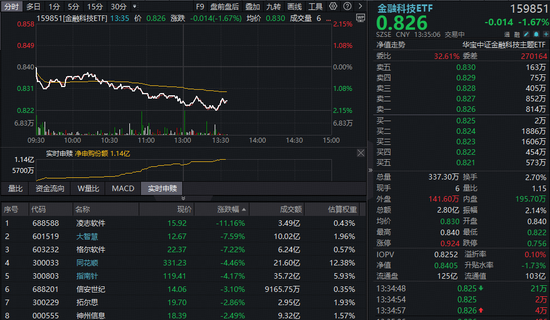
利空突袭,大智慧盘中跌停!失守半年线后,金融科技ETF续跌超2%,板块超跌布局时刻到了?
Xin Lang Ji Jin· 2025-11-12 05:47
Group 1 - The core viewpoint of the news highlights a significant drop in internet brokerage stocks, with the China Securities Financial Technology Theme Index falling below its six-month line, indicating a bearish trend in the sector [1] - Major individual stocks like Dazhihui experienced a sudden drop, with the company being sued by a major shareholder, which has led to increased market volatility [1] - Other stocks such as Tonghuashun and Guidingzheng also saw declines exceeding 5%, reflecting a broader downturn in the financial technology sector [1] Group 2 - Citic Securities points out that the current internet brokerage sector is supported by policy backing, improved funding conditions, and internal transformation dynamics, enhancing its investment appeal [3] - The ongoing "slow bull" market in A-shares is expected to continue benefiting non-bank financials, with recommendations to focus on high elasticity companies and quality industry leaders [3] - The Financial Technology ETF (159851) has surpassed 10 billion yuan in scale, with a daily average trading volume of 500 million yuan over the past month, indicating strong liquidity and market interest [3]

同花顺股价跌5.1%,长城基金旗下1只基金重仓,持有6.83万股浮亏损失120.75万元
Xin Lang Cai Jing· 2025-11-12 05:35
Group 1 - The core point of the news is that Tonghuashun's stock price has dropped by 5.1%, currently trading at 329.01 CNY per share, with a total market capitalization of 176.88 billion CNY [1] - Tonghuashun, established in August 2001 and listed in December 2009, provides software products, system maintenance services, financial data services, and investment analysis tools for individual investors [1] - The company's revenue composition includes 48.33% from value-added telecommunications services, 36.01% from advertising and internet promotion services, 9.43% from fund sales and other businesses, and 6.22% from software sales and maintenance [1] Group 2 - According to data, Changcheng Fund has one fund heavily invested in Tonghuashun, with the Changcheng Growth Enterprise Index Enhanced Fund A holding 68,300 shares, accounting for 1.76% of the fund's net value [2] - The estimated floating loss for this fund today is approximately 1.2075 million CNY [2] - The Changcheng Growth Enterprise Index Enhanced Fund A was established on June 1, 2017, with a current scale of 762 million CNY and has achieved a year-to-date return of 50.25% [2]

LPG产业风险管理日报-20251112
Nan Hua Qi Huo· 2025-11-12 05:11
Report Industry Investment Rating No relevant content provided. Core Viewpoints - The core contradictions affecting the LPG price trend include cost - end crude oil facing supply - surplus pressure and geopolitical disturbances, with prices oscillating between $63 - 65 this week and a slightly lower price center; the CP November contract price showing supply - side pressure; the US propane inventory at a historical high and demand being seasonally weak; and the domestic fundamental situation with a slight contraction in supply and relatively strong chemical demand [2][5]. - There are both negative and positive factors. Negative factors are the continuous losses in the domestic PDH sector and the shrinking Asian cracking profit which may reduce the demand for PG as a cracking substitute. Positive factors are the potential avoidance of a US government shutdown and the supply - decrease and demand - increase in the fundamentals this week, along with a rebound in civil gas prices [5]. Summaries by Catalog LPG Price Forecast - The monthly price range forecast for LPG is 4000 - 4500, with a current 20 - day rolling volatility of 15.77% and a 3 - year historical percentage of 9.53% [1]. LPG Hedging Strategy Inventory Management - When inventory is high and there are concerns about price drops, for a long - position in the spot market, it is recommended to short the PG2512 futures at 25% hedging ratio with an entry range of 4400 - 4500 to lock in profits and cover production costs, and sell the PG2512C4400 call option at 25% hedging ratio with an entry range of 60 - 70 to collect premiums and lock in the selling price if the spot price rises [1]. Procurement Management - When the procurement of regular inventory is low and procurement is based on orders, for a short - position in the spot market, it is recommended to buy the PG2512 futures at 25% hedging ratio around 4000 to lock in procurement costs, and sell the PG2512P4000 put option at 25% hedging ratio with an entry range of 50 - 70 to collect premiums and lock in the spot purchase price if the PG price drops [1]. Industry Data Summary - The data shows the prices, spreads, month - spreads, ratios, and profits of various LPG - related products on different dates from November 4 to November 11, 2025, including Brent, WTI, MOPJ, FEI, CP, etc., along with their daily and weekly changes [6].
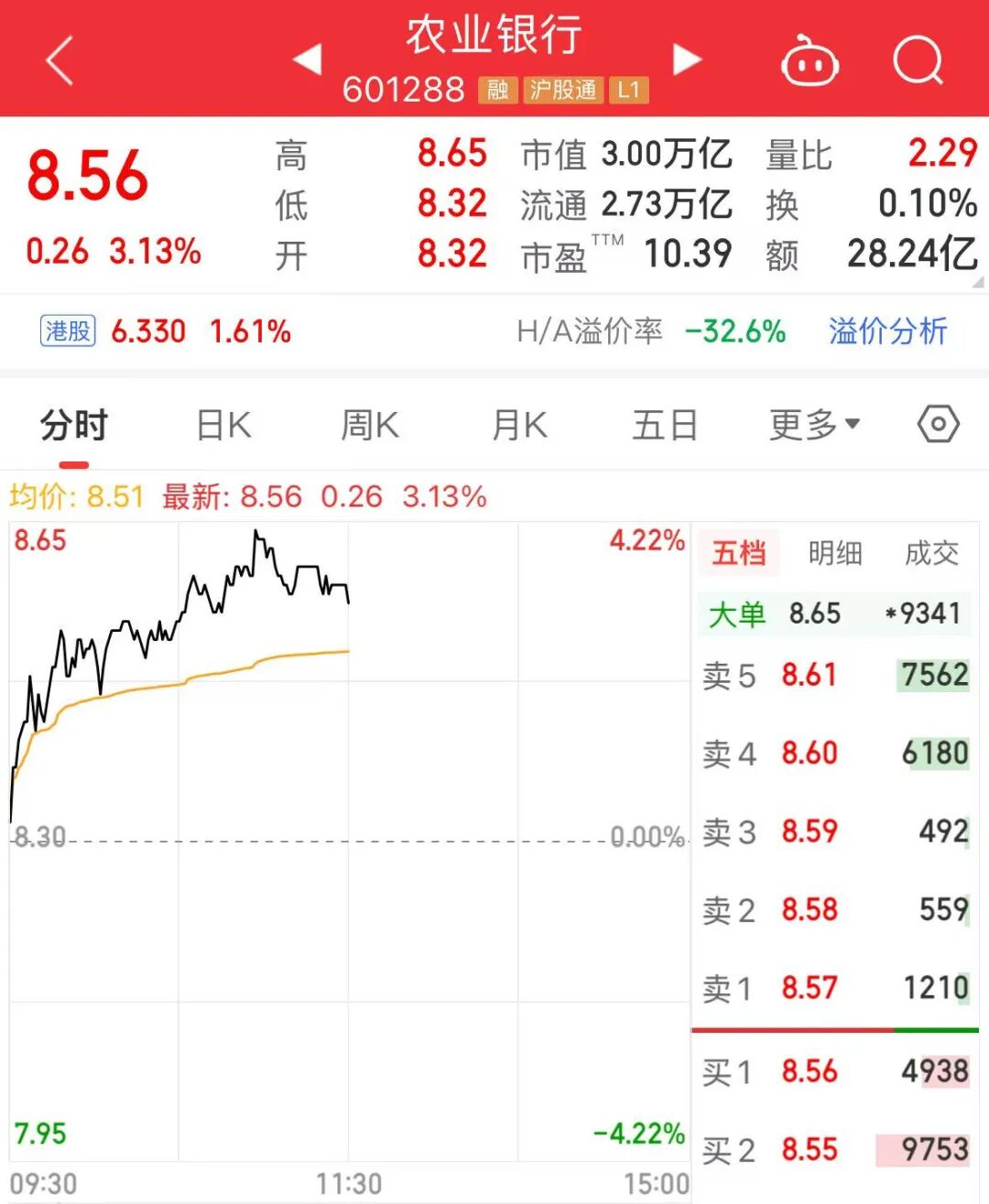
A股“一哥”,3万亿元!
Zhong Guo Zheng Quan Bao· 2025-11-12 04:16
Group 1: Agricultural Bank Performance - Agricultural Bank experienced a 14-day consecutive rise in stock price from September 25 to October 22, breaking the long-standing price-to-book (PB) ratio below 1, now exceeding 1 [1][6] - The stock price increased by 3.13% today, reaching a market capitalization of 3 trillion yuan, making it the largest in A-shares [1][2] - The PB ratio of Agricultural Bank is currently at 1.09, while other major banks like Industrial and Commercial Bank of China (ICBC) and China Construction Bank have PB ratios of 0.773 and 0.737 respectively [6] Group 2: Key Highlights of Agricultural Bank - Agricultural Bank benefits from the potential release of county-level economic growth and has a larger credit growth space compared to peers due to its deep layout in these regions [6][7] - The bank has the highest proportion of personal demand deposits among comparable peers, leading to lower deposit costs and stronger interest margin resilience [6] - Agricultural Bank maintains the lowest non-performing loan ratio among its peers while having a strict recognition of non-performing loans [6][7] - The bank's high provisions strengthen its risk compensation and profit reinvestment capabilities, leading the industry [7] Group 3: Market Trends - The banking sector saw an overall rise today, with Agricultural Bank, Bank of China, and Chongqing Rural Commercial Bank among the top gainers [4][5] - The Shanghai Composite Index fell by 0.24%, while the Shenzhen Component Index and the ChiNext Index dropped by 1.07% and 1.58% respectively [3]