洋河股份

Search documents
绿发信评发布白酒上市公司ESG主动评级结果:五粮液领跑,山西汾酒被拉开差距
Sou Hu Cai Jing· 2025-12-08 05:55
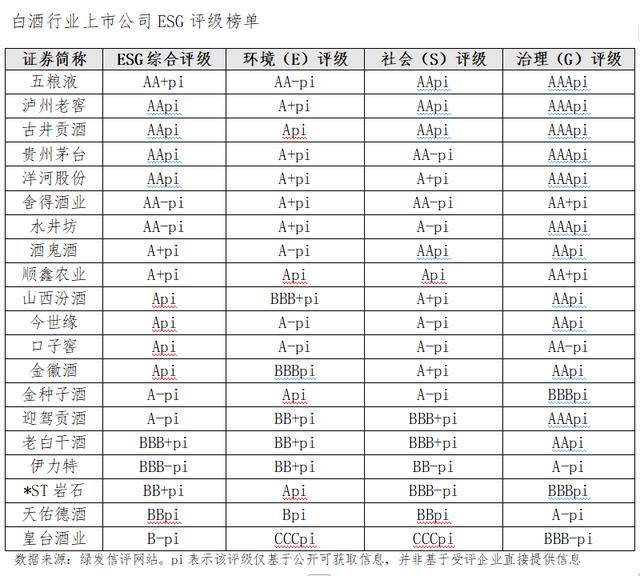
Core Viewpoint - The ESG ratings of leading Chinese liquor companies indicate a significant gap between top-tier firms and their mid-tier counterparts, highlighting the need for improved sustainability practices across the industry [1][6]. Environmental (E) Summary - The average ESG score for the top five liquor companies is 77.78, significantly higher than the industry average of 68.84, with Wuliangye receiving the highest rating of AA+pi [1]. - Environmental ratings for the top five companies range from AA-pi to BBB+pi, with Wuliangye leading in environmental disclosures and performance [1][2]. - Companies like Moutai and Luzhou Laojiao have established unique water resource management practices, while Shanxi Fenjiu lags behind in environmental performance metrics [2]. Social (S) Summary - The social ratings for the top five liquor companies are generally strong, ranging from AApi to A+pi, with notable performances in charity, product quality, and supply chain management [3]. - Wuliangye has implemented a comprehensive quality traceability system across its supply chain, while Luzhou Laojiao excels in employee development and training [3]. Governance (G) Summary - Four of the five leading companies received AAApi governance ratings, indicating robust ESG management frameworks and strong financial performance [4]. - Shanxi Fenjiu's governance rating is lower, necessitating improvements in its ESG management system and ethical standards [4]. - The overall performance of other liquor companies varies significantly, with some achieving ratings comparable to top firms, while others face challenges in governance and financial stability [4][5]. Industry Insights - The liquor industry is witnessing a widening gap in ESG performance between leading and mid-tier companies, necessitating a shift towards better sustainability practices [6]. - Key areas for improvement include enhancing environmental disclosures, setting clear sustainability goals, and strengthening governance frameworks to mitigate risks [6].






跌破1499元,茅台都卖不动了
首席商业评论· 2025-12-08 05:01
Core Viewpoint - The article discusses the significant decline of the Moutai brand and the broader challenges facing the Chinese liquor industry, highlighting a structural transformation driven by changing consumer preferences and economic pressures [5][14]. Group 1: Moutai's Price Decline - Moutai's price has plummeted from over 2000 yuan to below 1700 yuan, with a record low of 1640 yuan per bottle reported in November [5][6]. - The decline in Moutai's price has triggered a ripple effect across the industry, leading to negative growth for major brands like Wuliangye and Luzhou Laojiao, with 18 A-share liquor companies reporting collective performance declines [5][8]. Group 2: Dealer Challenges - Dealers are facing severe financial pressure, with many halting purchases due to price volatility and losses on inventory [6][8]. - The bundling purchase requirement for Moutai forces dealers to buy less popular products, exacerbating their financial strain as these products often sell at a loss [6][7]. Group 3: Inventory and Cash Flow Issues - The liquor industry is experiencing a significant increase in inventory, with stock levels rising by 63% since 2021, leading to a cash flow crisis for many dealers [10][12]. - The average inventory turnover period has extended to 1424 days, indicating a severe slowdown in sales and a growing backlog of unsold products [12]. Group 4: Changing Consumer Preferences - The younger generation is moving away from traditional liquor consumption, favoring low-alcohol beverages and cocktails, which is reshaping market dynamics [14][15]. - The shift in consumer behavior is compounded by a decline in demand for high-end liquor during traditional festive seasons, with a reported 20% to 30% drop in overall demand [10][14]. Group 5: Industry Response and Future Outlook - Liquor companies are attempting to innovate by introducing lower-alcohol products and diversifying into cocktails to attract younger consumers [15][16]. - However, the effectiveness of these strategies remains uncertain, as the industry grapples with overcapacity and a potential long-term downturn [15][17].
酒价内参12月8日价格发布 市场回调习酒君品逆势领涨
Xin Lang Cai Jing· 2025-12-08 01:34
Core Viewpoint - The Chinese liquor market, particularly for the top ten baijiu products, has experienced a price correction, with a total retail price of 9,160 yuan for a bundled sale of these products, reflecting a decrease of 14 yuan from the previous day, indicating a resumption of downward trends after a period of high-level consolidation [1]. Price Movements - The market has shown structural differentiation, with five products increasing in price and five decreasing. Notably, Xijiu Junpin saw a price increase of 6 yuan per bottle, while Wuliangye Pu Wubai and Shuijing Jianshan Chun both rose by 5 yuan per bottle [1][3]. - Among the declining products, Qinghua Lang experienced a significant drop of 13 yuan per bottle, leading the decline, suggesting potential profit-taking pressure. Additionally, Yanghe Dream Blue M6+ fell by 9 yuan per bottle, while both Jingpin Moutai and Feitian Moutai decreased by 8 yuan and 4 yuan per bottle, respectively [1][4]. Detailed Price Summary - The following table summarizes the current prices and changes for notable baijiu products: - Feitian Moutai 53°/500ml: 1,811 yuan, down 4 yuan [3] - Jingpin Moutai 53°/500ml: 2,312 yuan, down 8 yuan [3] - Wuliangye Pu Wubai 52°/500ml: 855 yuan, up 5 yuan [3] - Qinghua Fen 20 53°/500ml: 383 yuan, up 2 yuan [3] - Guojiao 1573: 879 yuan, down 1 yuan [3] - Yanghe Dream Blue M6+ 52°/550ml: 565 yuan, down 9 yuan [4] - Gujing Gong 20 52°/500ml: 514 yuan, up 3 yuan [4] - Xijiu Junpin 53°/500ml: 666 yuan, up 6 yuan [4] - Qinghua Lang 53°/500ml: 766 yuan, down 13 yuan [4] - Shuijing Jianshan Chun 52°/500ml: 409 yuan, up 5 yuan [4]

白酒渠道跟踪
2025-12-08 00:41
Summary of the Conference Call on the Baijiu Industry Industry Overview - The Baijiu market in 2025 is facing challenges such as declining sales and inventory buildup, with high-end brands like Moutai and Wuliangye experiencing price adjustments and increased inventory pressure [2][18] - The overall sales in the Henan region decreased by approximately 20% compared to 2024, with some manufacturers issuing reduction directives due to unfulfilled sales tasks [7][18] Key Points and Arguments Sales Performance - Moutai's sales have been stable, with all goods delivered by November 2025 and a 10% increase in December. However, online platforms have reported prices as low as 1,300 RMB, below cost [4][18] - Wuliangye expects a 10% sales growth in 2026, driven by new leadership and compensation for reduced output in 2025, but faces challenges with margins and potential negative profits [2][6][20] - Fenjiu has shown relative stability in Shandong, with a planned 10% growth for 2026, although it has faced historical low prices and reliance on rebates for profits [2][10] - The Jiangsu market has seen a 25%-30% decline in high-end Baijiu demand, with increased inventory levels and reduced enthusiasm from distributors [2][18] Inventory and Pricing - Moutai's current inventory is approximately 40 days, while Wuliangye's is about 10 days, with some stores facing up to two months of inventory due to wholesale restrictions [4][18] - Fenjiu's pricing has dropped to historical lows, with some products priced at around 350 RMB, impacting distributor profits [4][10] - The overall inventory levels in the Shandong region are high, with significant pressure on brands like Water Well and Shede, which have seen declines of 10% and 15% respectively [11][12] Future Outlook - Wuliangye's growth expectations for 2026 are contingent on pricing and subsidy negotiations, with no specific plans communicated yet [8][20] - Fenjiu has adjusted its product structure, increasing high-end offerings while facing challenges in profit generation due to low prices [10][20] - The overall sentiment in the Baijiu market indicates a cautious outlook, with expectations for improvement in 2026 if economic conditions stabilize and inventory is effectively managed [23][24] Additional Important Insights - Consumer behavior has shifted towards immediate consumption rather than stockpiling, leading to stable but non-explosive sales growth [3][18] - The competitive landscape shows that while high-end brands are under pressure, some mid-tier brands like Yanghe and Jinshiyuan are also struggling with high inventory and low prices [22][23] - The overall market dynamics suggest that brands need to adapt to changing consumer preferences and economic conditions to navigate the current challenges effectively [24][46]

再论白酒周期
2025-12-08 00:41
Summary of the Baijiu Industry Conference Call Industry Overview - The Baijiu industry is transitioning from passive inventory accumulation to active destocking, with expectations for stabilization in volume and price by the first half of 2026 [2][5] - Supply-side contraction is already evident, with most companies setting conservative targets for 2025 [2][6] - The demand for Baijiu is highly correlated with the macroeconomic environment, indicating that market stabilization in 2026 will require economic support [2][6] Key Insights and Arguments - The Baijiu industry is currently in a destocking cycle, with stock prices nearing their bottom [2][5] - Historical patterns show that during destocking phases, stock prices typically remain low until a clear upward price trend is observed [3][4] - The last complete inventory cycle from 2009 to 2012 saw a significant price increase followed by a downturn due to policy restrictions on consumption, leading to a phase of passive inventory accumulation [4] - The current market conditions are reminiscent of the 2013-2014 period, where many companies failed to meet their annual targets, except for leading brands like Moutai and Shui Jing Fang [6] Supply and Demand Dynamics - From 2024 to 2025, many Baijiu companies are expected to gradually reduce supply, with a notable trend of increasing concentration among leading firms [6][7] - The industry is facing a 20% loss rate, which may expand to 30% in the coming years, indicating a challenging environment for many companies [6] - The marginal impact of alcohol bans is decreasing, suggesting that supply contraction and demand recovery could lead to stabilization in the first half of 2026 [6][7] Valuation and Market Position - The current valuation of the Baijiu industry is at a historical low, with most companies below the 25th percentile of historical valuations [8] - Fund holdings in Baijiu have reverted to levels seen before 2017, indicating a cautious market sentiment [8] - Leading companies like Moutai and Wuliangye offer strong dividend yields, providing some support for their stock prices [8] Recommendations and Investment Opportunities - The Baijiu industry maintains a recommendation rating, with a focus on companies that show strong certainty and a faster destocking cycle [9] - Recommended stocks include: - **Moutai**: Strong brand influence and competitive advantages [9] - **Shanxi Fenjiu**: Stability in pricing and a robust product matrix [9] - **Yanghe**: Potential for performance recovery and stock price elasticity due to recent adjustments [10] Conclusion - The Baijiu industry is poised for potential recovery, with a focus on leading companies that can navigate the current challenges effectively. The outlook for 2026 appears cautiously optimistic, contingent on macroeconomic conditions and internal industry dynamics.
广发策略:牛市产业主线,如何跨年、如何躁动?
Xin Lang Cai Jing· 2025-12-07 13:30
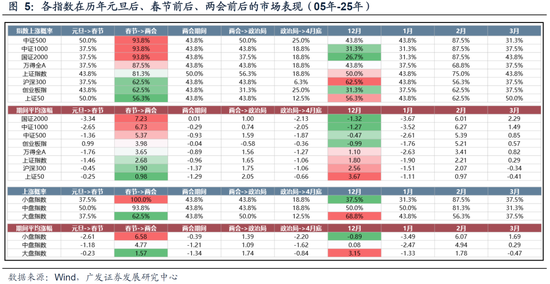
炒股就看金麒麟分析师研报,权威,专业,及时,全面,助您挖掘潜力主题机会! 来源:晨明的策略深度思考 在上周周报中,我们讨论了《2026年春季躁动前瞻》,总结了基于历史规律的春季躁动几个关键结论: 春季躁动的强弱由何决定?什么情况下,春季躁动会提前?春季躁动对当年行情,有指示意义吗?春季 躁动期间,业绩增长不重要了吗?业绩雷落地后,是否会演绎"利空出尽"? 本周我们进一步讨论:如果一轮产业主线已经确立(例如今年的AI产业链),那么相关行业在历史上 的跨年阶段、春季躁动时期,有何表现? 一、我们再总结一下,岁末年初,指数及风格表现的历史规律: 11月:对机构最不利的一个月已经过去,11月份市场涨跌和基本面关联度最弱,主题活跃、轮动加快。 12月:过去20年,指数在12月涨跌各半,不过基本面定价的有效性较11月增强;风格方面,大盘优于小 盘,红利占优,金融板块涨幅居前,港股红利也迎来一年中日历效应最强的时段。 1月:指数在1月的上涨概率仅43%,小盘股上涨概率仅31%,主要受年报预告压制风险偏好影响。 春节前后、2月:一年当中风险偏好最高的区间,小盘股胜率超过90%,成长风格、电子/计算机/非银等 行业的平均涨幅最 ...
“江苏味道”火热出圈,洋河股份助力寻味江苏从泰州启程
Zheng Quan Ri Bao Zhi Sheng· 2025-12-07 12:48
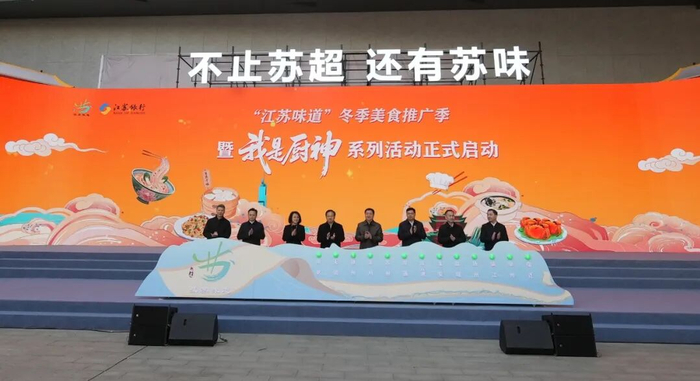
从"脚尖"到"舌尖","苏式德比"再次开打——12月6日,"江苏味道"冬季美食推广季暨"我是厨神"系列活 动在泰州靖江市长江文化中心正式启动。作为本次活动白酒行业特约合作伙伴,洋河股份以美酒为媒, 深度融入江苏美食文化的展示与传播,与全省消费者共同开启一场美食文化盛宴。 伴随着开场舞《茉莉芬芳》的演绎,江苏十三城的风味故事一一呈现。启动仪式现场,"苏超"球队的队 员们化身"美食推荐官",纷纷为家乡美食打call。江苏省作家协会副主席祁智、"苏超"爆款热梗代言人 叨叨傅也前来助阵,从"苏超"赛场的激情梗王,变身为"苏味"的探索者。 随着两辆"寻味巴士"缓缓驶出,一场串联江苏十三城的风味探索之旅拉开序幕。"寻味巴士"将从泰州出 发,一南一北,化身移动的美食地标,串联十三城的烟火脉络;同时联动各地重大赛事、餐饮促消费等 活动,征集寻味线路、体验官,探访寻味,发布环省"寻味之旅"短视频。 活动最终将汇聚十三城"厨神队"的65道精品菜肴,精选一席代表江苏千年文脉与十三城风味的"厨神·新 春团圆宴",于2026年新年前后隆重呈现。活动期间,洋河美酒都将作为"江苏味道"不可或缺的一部 分,全程跟随"寻味巴士",深入市井街巷 ...
跌破1499元,茅台都卖不动了
虎嗅APP· 2025-12-07 09:03
Core Viewpoint - The "Moutai myth" is collapsing, with the price of Feitian Moutai experiencing a significant decline, leading to widespread losses among investors and industry players [5][6][10]. Price Decline and Market Impact - Feitian Moutai's price fell from over 2000 yuan to 1640 yuan per bottle, marking a historic low [5][6]. - The price drop has triggered a chain reaction in the industry, with major brands like Wuliangye and Luzhou Laojiao also reporting negative growth for the first time in a decade [5][6][10]. - The overall white liquor industry is facing a downturn, with 18 A-share listed companies reporting collective performance declines [5][10]. Dealer and Distributor Challenges - Distributors are facing severe financial pressure, with many halting purchases due to unsold inventory and price declines [6][8]. - The profit margins for distributors have been squeezed, as they are forced to bundle high-priced products with Moutai to secure inventory [6][7]. - A significant number of distributors are reporting losses, with some predicting losses exceeding 30 million yuan this year [7][10]. Inventory and Cash Flow Issues - The white liquor industry is experiencing a "money shortage," with inventory levels rising significantly [9][12]. - As of Q3 2025, the inventory turnover days have increased to an average of 1424 days, indicating a severe liquidity crisis [12][13]. - Over 58% of distributors reported increased inventory, and more than 40% are facing cash flow pressures [8][12]. Changing Consumer Preferences - The decline in demand is attributed to a generational shift in consumer preferences, with younger consumers showing less interest in traditional high-end liquor [15][16]. - Younger consumers prefer low-alcohol beverages and are increasingly opting for alternatives like fruit wines and non-alcoholic drinks [15][16]. - The traditional "drinking culture" is being challenged, leading to a significant shift in market dynamics [15][16]. Industry Response and Future Outlook - In response to the downturn, companies are innovating products to appeal to younger consumers, including lower-alcohol and flavored options [16][17]. - However, the effectiveness of these strategies remains uncertain, as the entrenched perceptions of traditional liquor may hinder acceptance [17]. - The industry is expected to remain in a turbulent phase for the next 2-3 years, with ongoing challenges in attracting younger consumers and managing inventory [17][18].
周观点:年底关注渠道反馈,餐供龙头率先复苏-20251207
GOLDEN SUN SECURITIES· 2025-12-07 08:24
Investment Rating - The report maintains an "Increase" rating for the food and beverage industry, indicating a positive outlook for selected stocks and sectors within the industry [4]. Core Insights - The white liquor sector is showing signs of recovery, with Shanxi Fenjiu focusing on national expansion, youth engagement, and internationalization strategies for 2026. The company is optimizing inventory and enhancing market capacity, which is expected to support growth [2]. - In the beverage sector, companies like Nongfu Spring are planning to strengthen their water and tea product lines while introducing new products. The beer segment is diversifying with new flavors to cater to changing consumer preferences [3]. - The report highlights the potential for growth in consumer staples, with companies like Three Squirrels expanding into a full-category strategy and Mengniu Dairy leading in deep processing innovations [7]. Summary by Sections White Liquor - Shanxi Fenjiu's 2026 marketing strategy focuses on nationalization, youth engagement, and precise consumer service. The company is targeting key markets and optimizing inventory to enhance growth potential [2]. - The white liquor industry is characterized by bottoming out in sales, clearing financial reports, and low expectations, suggesting a favorable environment for quality asset allocation [2]. Beer and Beverage - The beer sector is witnessing the launch of new products like Jin Xing Beer’s winter flavor, reflecting a shift in consumption patterns towards home and outdoor settings [3]. - Nongfu Spring's strategy for 2026 includes strengthening its core water products and expanding its tea offerings, indicating a focus on product diversification and market penetration [3]. Consumer Staples - Three Squirrels is advancing its full-category strategy with the opening of flagship stores, emphasizing community engagement and a wide range of products [7]. - Mengniu Dairy is enhancing its product line with deep processing innovations, which are expected to drive demand and improve the utilization of raw milk [7]. - The frozen food sector is recovering, with companies like Anjuke benefiting from new product launches and channel optimizations, indicating a positive market response [7].


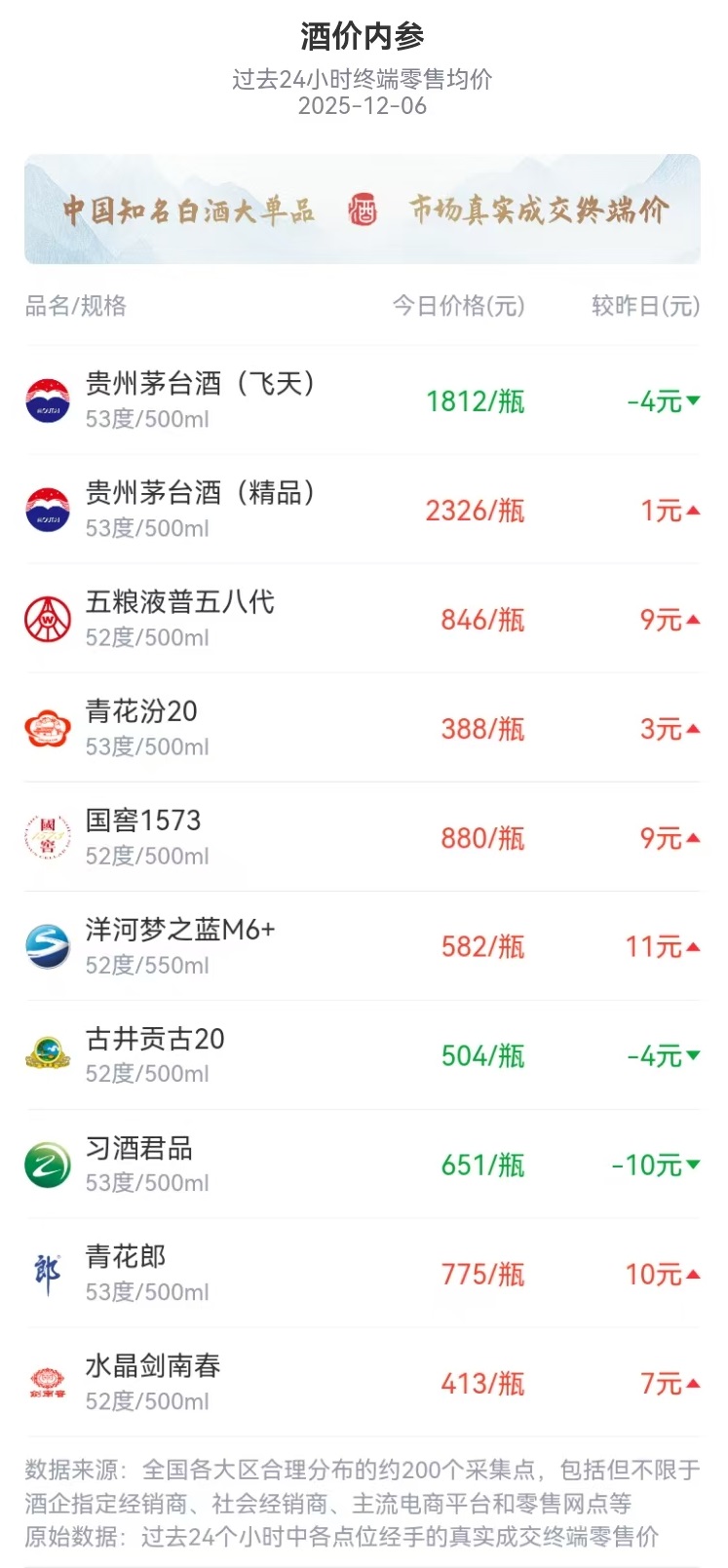
酒价内参12月6日价格发布 市场强劲反弹多款名酒价格回升
Xin Lang Cai Jing· 2025-12-06 01:18
Core Viewpoint - The white liquor market has shown a strong rebound in retail prices for the top ten products, ending a period of continuous decline, with the total price for a packaged set of these products reaching 9177 yuan, an increase of 32 yuan from the previous day, indicating a return to an upward trend in the market [1]. Price Trends - The overall market is experiencing a broad increase, with most products stabilizing and recovering in price [1]. - Yanghe Dream Blue M6+ leads the market with an increase of 11 yuan per bottle [1]. - Qinghua Lang continues its strong performance with a price increase of 10 yuan per bottle, reaching a recent high [1]. - The prices of Wuliangye Pu 58th generation and Guojiao 1573 have rebounded by 9 yuan per bottle each [1]. - Other notable price increases include Shuijing Jian Nan Chun up by 7 yuan and Qinghua Fen 20 up by 3 yuan [1]. - The only products showing a decline are Xijiu Junpin, which fell by 10 yuan per bottle, and Gujing Gong Gu 20 and Feitian Moutai, which decreased by 4 yuan per bottle [1][3][4]. Data Sources - The price data is sourced from approximately 200 collection points across various regions, including designated distributors, social distributors, mainstream e-commerce platforms, and retail outlets, ensuring an objective and traceable representation of the market [1][4].