
美的集团

Search documents
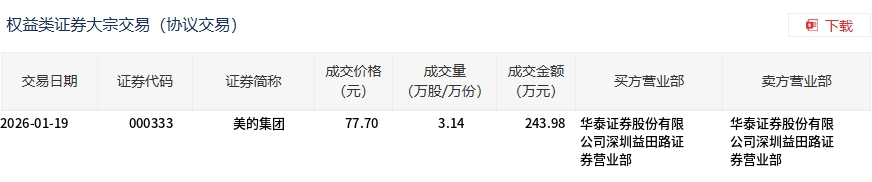
美的集团今日大宗交易溢价成交3.14万股,成交额243.98万元
Xin Lang Cai Jing· 2026-01-19 08:49
Group 1 - On January 19, Midea Group executed a block trade of 31,400 shares, with a transaction value of 2.4398 million yuan, accounting for 0.09% of the total transaction volume for the day [1] - The transaction price was 77.70 yuan, which represents a premium of 0.1% compared to the market closing price of 77.62 yuan [1]

智通AH统计|1月19日
智通财经网· 2026-01-19 08:17
Group 1 - The article highlights the top three and bottom three AH premium rates for various companies, with Northeast Electric (00042) leading at 815.25% and Ningde Times (03750) at -11.36% [1] - The top three companies with the highest deviation values are Junda Co., Ltd. (02865) at 129.73%, Goldwind Technology (02208) at 38.82%, and Sanhua Intelligent Control (02050) at 18.64% [1] - The bottom three companies with the lowest deviation values include Northeast Electric (00042) at -42.57%, Chenming Paper (01812) at -21.05%, and Nanhua Futures (02691) at -20.64% [1] Group 2 - The top ten AH stocks by premium rate include Zhejiang Shibao (01057) at 384.97% and Junda Co., Ltd. (02865) at 355.07% [2] - The bottom ten AH stocks by premium rate include China Merchants Bank (03968) at -0.84% and Hengrui Medicine (01276) at -4.80% [2] - The deviation values for the bottom ten AH stocks show significant negative values for Northeast Electric (00042) and Chenming Paper (01812), indicating a potential mispricing in the market [2]



研报掘金丨华创证券:维持美的集团“强推”评级,年内两推回购,股东回报突出
Ge Long Hui A P P· 2026-01-19 07:26
Group 1 - The core viewpoint of the report highlights Midea Group's commitment to shareholder returns through multiple share buybacks in 2025 and 2026, indicating a strong focus on enhancing shareholder value [1] - In 2026, Midea Group repurchased approximately 2 million yuan worth of 2.613 million A-shares at an average price of 76.5 yuan per share, representing about 0.038% of the total shares [1] - The total amount for Midea's two share buybacks in 2025 ranged from 6.5 billion to 13 billion yuan, with 70% of the 5-10 billion yuan allocated for cancellation and reduction of registered capital, and 1.5-3 billion yuan for employee stock ownership plans [1] Group 2 - Midea Group's operational performance remains stable, and short-term disruptions do not alter its long-term value, suggesting potential for further market capitalization expansion driven by cash flow [1] - The company is expected to leverage global resources for diversified growth opportunities, maintaining a target price of 93.4 yuan based on a DCF valuation method, corresponding to a 15x PE for 2026 [1] - The report maintains a "strong buy" rating for Midea Group, reflecting confidence in its financial health and growth prospects [1]
机构普遍看好A股长牛、慢牛行情,A500ETF南方(159352)涨0.62%
Sou Hu Cai Jing· 2026-01-19 06:25
Group 1 - The A-share market has shown a strong start in 2026, with the Shanghai Composite Index, Shenzhen Component Index, and ChiNext Index recording cumulative increases of over 3%, 5%, and 4% respectively as of last week [1] - The A500 ETF from Southern has risen by 0.62%, with notable component stocks such as Zhongce Rubber increasing by 5.44% and Xinyi Technology by 1.03% [1] - Institutional investors express optimism for the entire market in 2026, focusing on new productive forces and global competitive advantages, indicating a long-term bullish trend for A-shares [1] Group 2 - Investor sentiment has been highly active since the beginning of 2026, with the margin balance for margin trading continuing to rise, reflecting a policy signal aimed at guiding rational investment and maintaining market stability [2] - The central bank has implemented a series of measures, including lowering interest rates on various structural monetary policy tools, to support economic structural transformation and enhance market confidence [2] - The China Securities Regulatory Commission (CSRC) emphasized a "stability first" approach during its 2026 work meeting, outlining five key tasks to solidify the foundation for a long-term bullish market, indicating that short-term fluctuations do not alter the long-term positive outlook [2]
记者手记:在阿拉木图,看见具体而生动的“出海”
2 1 Shi Ji Jing Ji Bao Dao· 2026-01-19 04:17
Group 1 - Almaty, known as the "Apple City," remains an economic and cultural center of Kazakhstan despite the capital moving to Astana, showcasing a blend of old Soviet-style buildings and modern architecture [1] - The digital economy is rapidly developing in Kazakhstan, with 95% of the population using smartphones, leading to a mobile-first internet ecosystem that bypassed traditional PC usage [1][2] - Chinese brands have significantly penetrated the Almaty market, with high visibility of logos from companies like Geely, BYD, and Huawei, indicating a strong acceptance and recognition of these brands among local consumers [2] Group 2 - Kazakhstan is viewed as a strategic market for internet companies, particularly Yandex, which sees it as a key area for growth outside of Russia, with a developing consumer base and established habits [2][4] - The market is characterized by rapid change and growth, similar to China's market a decade ago, presenting numerous opportunities for brands looking to expand [4] - The local ride-hailing platform Yandex Go predominantly features Chinese cars, reflecting the increasing presence of Chinese automotive brands in the region [2]
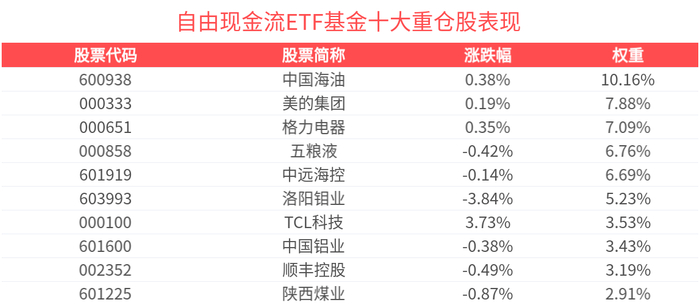
聚焦顺周期,布局高价值,自由现金流ETF(159233)交投活跃
Xin Lang Cai Jing· 2026-01-19 03:32
Core Viewpoint - The market is witnessing a strong performance in the free cash flow index, with significant gains in related sectors, particularly in cyclical industries, driven by recent positive developments in the automotive and transportation sectors [1][2]. Group 1: Free Cash Flow Index Performance - The CSI Free Cash Flow Index (932365) increased by 1.08%, with notable gains from stocks such as Xinhua Department Store (+9.99%), Zhongmin Energy (+9.93%), and Pinggao Electric (+9.76%) [1]. - The Free Cash Flow ETF (159233) rose by 1.28%, closing at 1.26 yuan, and is designed to track the CSI Free Cash Flow Index, focusing on cyclical industries [1]. Group 2: Automotive Sector Developments - A new electric vehicle quota agreement between China and Canada is expected to accelerate the entry of Chinese electric vehicles into the North American market, with a reduction in tariffs from 100% to 6.1% for a quota of 49,000 vehicles annually [1]. - The China Automobile Association projects that vehicle exports will reach 7.4 million units by 2026, reflecting a year-on-year growth of 4.3% [1]. Group 3: Transportation Sector Insights - The 2026 Spring Festival travel season is set to begin on February 2, with an expected 539 million passengers, marking a 5.0% increase year-on-year, which will boost demand in the transportation sector [2]. - The Spring Festival is anticipated to enhance profitability across various transportation segments, including railways, civil aviation, and logistics, leading to improved cash flow stability for transportation companies [2].
家电行业2026W03周报:地产利好政策频出,Meta计划提高智能眼镜产能
GUOTAI HAITONG SECURITIES· 2026-01-19 02:55
Investment Rating - The industry investment rating is "Overweight" [4][11]. Core Insights - The report highlights favorable real estate policies and Meta's plan to increase smart glasses production to 20 million units by the end of 2026, indicating a strong market demand [2][3]. - Several home appliance companies have released their performance forecasts for 2025, showing a mix of growth and decline in net profits [2][3]. Summary by Sections Investment Recommendations - The report suggests that national subsidies are expected to transition smoothly, with leading black and white appliance companies demonstrating stable operations and high dividends, making them cost-effective investments. Recommended companies include: - Midea Group (2025 PE: 13.2X) - Haier Smart Home (2025 PE: 11.4X) - TCL Electronics (2025 PE: 10.8X) - Hisense Visual (2025 PE: 12.0X) [4][5]. - The core driver for smart home appliances is overseas expansion, with recommendations for leading robot vacuum companies: - Roborock (2025 PE: 20.8X) - Ecovacs (2025 PE: 22.7X) [4][5]. - Companies with stable performance and upward potential include: - Ninebot (2025 PE: 19.1X) - Anfu Technology (2025 PE: 53.2X) - Hailong Cold Chain (2025 PE: 15.2X) - Beiding Co. (2025 PE: 31.2X) [4][5]. - Appliance companies are diversifying into new areas, with recommendations for: - Rongtai Health (2025 PE: 21.1X) - Wanlong Magnetic Plastic (2025 PE: 21.9X) [4][5]. Performance Forecasts - Stone Technology expects a net profit of no less than 1.34 billion, a 31% decline year-on-year for 2025. - Beiding Co. anticipates a revenue of 950 million, a 26% increase year-on-year, with a net profit of 111 million, up 59.1% year-on-year. - Dechang Co. forecasts a net profit between 160 to 200 million, a decline of 51% to 61% year-on-year, with a non-recurring net profit forecasted between 145 to 185 million, down 53% to 63% year-on-year [2][4].





西部证券晨会纪要-20260119
Western Securities· 2026-01-19 02:39
Group 1: Commercial Aerospace - The commercial aerospace sector is transitioning from "single satellite testing" to "constellation networking," with significant growth expected as China develops reusable rocket technology and increases satellite launches [5][6][7] - The "Zhuque-3" rocket has a launch capacity of 21.3 tons, surpassing the Falcon 9's initial recovery capacity, indicating a strong foundation for future satellite launches [6] - The market potential for domestic satellite launches is substantial, with an estimated annual demand for approximately 4,000 satellites, suggesting a significant growth trajectory for the industry [6][7] Group 2: Automotive Industry - Spring Power (603129.SH) is projected to achieve net profits of 1.907 billion, 2.371 billion, and 2.805 billion yuan from 2025 to 2027, with a target market capitalization of 49.8 billion yuan based on a 21x PE ratio for 2026 [2][13] - The company is positioned as a leader in all-terrain vehicles and large-displacement motorcycles, with competitive advantages in performance and cost-effectiveness compared to international competitors [13][14] - The electric two-wheeler segment is expected to contribute significantly to revenue growth, with sales reaching 250,500 units and revenue of 872 million yuan in the first half of 2025, reflecting a year-on-year increase of 652.06% [15] Group 3: Financial Sector - The introduction of the "Derivatives Trading Supervision Management Measures" aims to regulate the derivatives market, enhancing the legal framework and promoting the development of the derivatives business [32][33][34] - The measures emphasize the importance of derivatives in managing risks and supporting the real economy, indicating a growing focus on regulatory oversight in the financial sector [32][34] - Major securities firms are expected to benefit from the regulatory changes, particularly those with strengths in derivatives trading, as the market becomes more structured and opportunities for growth arise [34] Group 4: Macro Financial Data - In December, new loans totaled 910 billion yuan, with a year-on-year decrease compared to the previous year, while corporate loans showed signs of recovery [18][19] - The social financing growth rate slowed, primarily due to government financing constraints, indicating a need for policy adjustments to stimulate economic activity [19][20] - The central bank's recent rate cuts and liquidity measures suggest a continued effort to support economic growth and maintain stable financing conditions [20][40]
如何看待白酒VS白电的配置机会
2026-01-19 02:29
Summary of Key Points from Conference Call Industry Overview - The conference call primarily discusses the **Chinese liquor industry** and the **white goods (appliances) industry**. The liquor industry is expected to undergo an adjustment period until 2025, with a potential balance in the second and third quarters of 2026. The white goods industry has shown resilience due to strong domestic demand and contributions from overseas markets [1][9]. Key Insights on the Liquor Industry - The liquor industry is projected to experience significant pressure in the first half of the year, with a rebound expected in the second half due to lower baselines and inventory reduction efforts [1][2]. - The price of **Moutai** is relatively stable, with the income-to-price ratio for urban residents nearing historical extremes, indicating limited downward price potential [3]. - **Wuliangye** is reducing prices on non-standard products to clear inventory, which could shorten the inventory cycle if quotas are reduced [1][3]. - The demand for liquor is closely tied to the economic cycle, with monetary policy indicators like M1 and M2 being crucial for understanding demand trends [1][5]. - Recommendations include low-position allocations in high-end liquors (Moutai, Wuliangye), regional brands (Gujinggong, Yanghe), and mid-range Fenjiu, which are seen as having good investment value [1][6]. Inventory and Seasonal Trends - The liquor industry is currently experiencing low inventory levels, with a significant drop in prices leading to potential sales exceeding expectations during the upcoming Spring Festival [4][8]. - Historical data suggests that if sales during the Spring Festival exceed expectations, it could alleviate pressure in the latter part of the year [4]. Economic Indicators and Demand Stability - Key indicators such as CPI show signs of stabilizing, suggesting that the liquor industry may be nearing a bottom [7]. - The relationship between liquor demand and economic cycles is significant, with macroeconomic changes and monetary policy having a substantial impact on demand [5]. Insights on the White Goods Industry - The white goods industry has performed well in recent years, supported by strong domestic demand and growth in overseas markets [9][15]. - Challenges include the impact of subsidy policies on demand, rising raw material costs, and competition from brands like Xiaomi [10][12]. - Despite these challenges, the overall impact on the fundamentals is expected to be limited, with leading companies capable of managing cost increases through price adjustments and efficiency improvements [12][13]. Valuation and Investment Opportunities - The current public fund holdings in the white goods sector are at historical lows, suggesting potential for recovery and rebound in valuations [17]. - The white goods sector is viewed as a dividend play, with expected stable growth and increasing dividend rates, making it an attractive investment option [18]. Comparative Analysis - The white goods industry is seen as having advantages over the liquor industry, particularly in terms of overseas market performance and resilience against domestic economic fluctuations [15][19]. - The liquor industry is currently facing a challenging environment, while the white goods sector is positioned for stable growth, making it a more favorable investment choice at this time [19].
AI赋能下的消费品投资机遇
2026-01-19 02:29
Summary of Key Points from Conference Call Records Industry and Company Overview - The conference call discusses investment opportunities in the consumer goods sector, particularly focusing on AI applications, AR technology, smart glasses, and AI education [1][2] - Companies mentioned include Yiyuan Yichuang, Quark, Tianli International Holdings, Huatu Shanding, Fenbi, Kevin Education, Focus Technology, Xiaogoods City, and Qingmu Technology [1][2][3][4] Core Insights and Arguments AI and AR Applications - The development of AR technology is expected to significantly impact traffic distribution and marketing channels, with companies like Yiyuan Yichuang already making strides in this area [2] - Smart glasses are becoming more affordable, priced around 1,000 yuan, and are anticipated to replace traditional glasses, with domestic companies like Quark showing strong performance [2] - AI education is addressing challenges in personalized learning and scalability, with companies like Tianli International Holdings and Huatu Shanding rapidly expanding their offerings [2] E-commerce Transformation - AI tools are transforming the e-commerce landscape through functionalities like image and video generation and cross-border translation, with companies like Focus Technology excelling in B2B platforms [3] Food and Beverage Sector - The food and beverage industry is showing signs of recovery, with companies like Anji Food, Baoli Food, and Qianhe Flavor Industry seeing stock price increases. A rising CPI is expected to further strengthen this trend [4] - The liquor sector is projected to accelerate its recovery starting Q3 2025, with companies like Moutai benefiting from price elasticity [4] Market Competition Changes - The public servant exam training and gold jewelry sectors are experiencing improved competitive dynamics, with online and offline integration reshaping the public exam training ecosystem [5] - The tourism industry is also expected to see increased demand, supported by favorable policies and anti-monopoly investigations benefiting upstream resources [5] Additional Important Insights Investment Recommendations - Investors are advised to focus on undervalued companies, particularly those significantly below their fair value, such as Action Education and Jiangsu Guotai [6] - The cultural tourism and retail sectors are anticipated to undergo significant transformations, presenting investment opportunities [6] Cotton Industry Trends - The cotton industry is witnessing a stabilization in prices, with Brazil expected to reduce production in 2025-2026, alleviating inventory pressures. Companies like Bailong Dongfang, with significant overseas capacity, are recommended for investment [7] Agricultural Sector Developments - AI technology is being applied in pig farming to reduce costs, with a slight increase in pork prices noted [8][9] Light Industry and Home Appliances - The light industry is seeing advancements in AI applications, particularly in smart glasses and toys, with companies like Mingyue Lens and Konnate expected to perform well [10][11] - The home appliance sector is closely tied to AI, with companies like Midea making significant progress in robotics, although competition is intense [14][15] Small Appliance Sector Strategies - Small appliance companies are encouraged to innovate their marketing strategies to adapt to the current market environment, with firms like Xiaoxiong and Xinbao actively expanding their operations [16]