
西部矿业

Search documents
600103,4连板!600376,8天7板
Zheng Quan Shi Bao· 2025-09-12 03:03
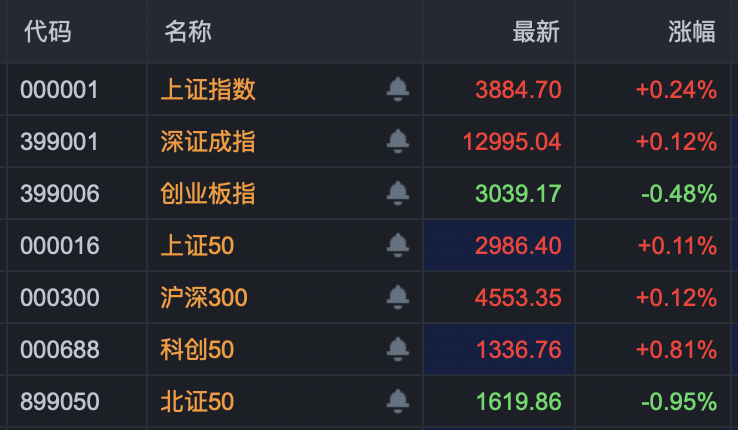
Market Overview - On September 12, A-shares opened mixed with the Shanghai Composite Index at 3884.70, up 0.24%, Shenzhen Component Index at 12995.04, up 0.12%, and ChiNext Index at 3039.17, down 0.48% [2] - The sectors showing gains included cultivated diamonds, shipping, and computing power leasing, while CPO, optical communication, and 6G sectors faced declines [1] Company Highlights - Evergrande Property experienced significant volatility, initially rising over 40% before settling at a 21.74% increase after news of potential share sales by its controlling shareholder [2][3] - The real estate sector saw a rally, with stocks like Rongsheng Development, Huaxia Happiness, and New Dazheng hitting the daily limit [3] - The storage chip sector also showed strength, with companies like Demingli hitting the daily limit and others like Purun and Dongxin following suit [5] - Kioxia announced a collaboration with NVIDIA to develop SSDs with speeds nearly 100 times faster than traditional SSDs, boosting the computing power sector [7] - Qingshan Paper experienced a four-day consecutive limit-up, with other companies in the computing power sector also seeing gains [7] - The non-ferrous metals sector saw early gains, with Northern Copper and Electric Alloy hitting the daily limit, and other companies like Yunnan Copper and Jiangxi Copper also rising [9] - The robotics sector strengthened, with Worldde rising over 15% and Shoukai Co. achieving eight limit-ups in seven days [12] - Shoukai Co. disclosed its indirect stake in Yushu Technology through its subsidiary, with a low holding percentage of approximately 0.3% [14]


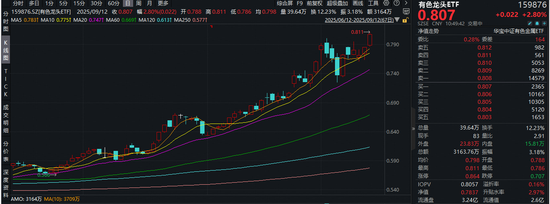
有色金属领涨两市!多重利好驱动,北方铜业等4股涨停,有色龙头ETF(159876)拉升3%刷新阶段高点!
Xin Lang Ji Jin· 2025-09-12 03:02
Group 1 - The non-ferrous metal sector is leading the market, with the non-ferrous metal ETF (159876) rising over 3.1% during trading, reaching a peak and achieving a transaction volume exceeding 310 million yuan [1] - Key stocks such as Yunnan Copper, Northern Copper, and others have hit the daily limit, while Jiangxi Copper and Yun Aluminum have increased by over 7% [1] Group 2 - In the first half of 2025, China's economy is expected to recover beyond expectations, with GDP growth reaching 5.3%, benefiting the non-ferrous metal industry [3] - The non-ferrous metal sector has experienced a strong bullish trend this year, driven by multiple favorable factors, including expectations of interest rate cuts by the Federal Reserve [3][4] - The "anti-involution" policy and large-scale infrastructure projects are creating significant demand for non-ferrous metals [3][4] Group 3 - The supply-demand dynamics are improving, with stricter regulations on rare earth mining and smelting, leading to a perception of increasing scarcity [4] - Rapid development in green industries such as new energy and electric vehicles is driving strong demand for metals like copper, aluminum, lithium, and rare earths [4] - Predictions indicate that the demand for key metals in new energy will increase sixfold by 2040 compared to 2020, with electric vehicle metal demand expected to grow at least 30 times [4] Group 4 - The current economic policies are expected to stimulate a new round of supply-side reforms, similar to the impact seen in 2015, which could lead to a recovery in the non-ferrous metal sector [4][6] - The non-ferrous metal sector is positioned to benefit from both monetary easing due to Federal Reserve rate cuts and domestic policies aimed at optimizing production factors [6] Group 5 - The non-ferrous metal sector is characterized by strategic metals like rare earths benefiting from global competition, while lithium and cobalt are influenced by the "anti-involution" logic [7] - The supply-demand balance for industrial metals like copper and aluminum is tight due to limited supply growth and emerging industry demand [7] - The non-ferrous metal ETF and its linked funds provide a diversified investment option, reducing risks associated with investing in single metal industries [7]

西部矿业涨2.01%,成交额3.21亿元,主力资金净流入1097.96万元
Xin Lang Cai Jing· 2025-09-09 03:17
Group 1 - The core viewpoint of the news highlights the recent performance and financial metrics of Western Mining, indicating a positive trend in stock price and financial growth [1][2]. - As of September 9, Western Mining's stock price increased by 2.01%, reaching 19.30 CNY per share, with a total market capitalization of 45.992 billion CNY [1]. - The company has seen a year-to-date stock price increase of 28.07%, with notable gains over various trading periods: 1.26% over the last 5 days, 8.55% over the last 20 days, and 22.70% over the last 60 days [1]. Group 2 - For the first half of 2025, Western Mining reported a revenue of 31.619 billion CNY, reflecting a year-on-year growth of 26.59%, and a net profit attributable to shareholders of 1.869 billion CNY, up 15.35% year-on-year [2]. - The company has distributed a total of 10.723 billion CNY in dividends since its A-share listing, with 6.911 billion CNY distributed in the last three years [3]. - As of June 30, 2025, the top ten circulating shareholders include Hong Kong Central Clearing Limited, which holds 117 million shares, a decrease of 12.1887 million shares from the previous period [3].

趋势研判!2025年中国锌精矿行业产业链、供需现状、竞争格局及行业发展趋势分析:下游需求拉动价格维持高位震荡,进口依赖度下降[图]
Chan Ye Xin Xi Wang· 2025-09-08 01:12
Core Viewpoint - Zinc concentrate resources are crucial for societal development, providing a buffer during resource supply disruptions, with China being the largest producer and consumer of zinc concentrate globally [1][2]. Zinc Concentrate Industry Definition and Characteristics - Zinc concentrate is produced from lead-zinc ore or zinc-containing ore through processes like crushing, ball milling, and froth flotation, achieving a high zinc content of 40-55% [2]. Current Development Status of the Zinc Concentrate Industry - In 2023, China's zinc concentrate production was 2.965 million tons, with a projected production of approximately 2.936 million tons in 2024 and 788,300 tons from January to May 2025 [1][2]. Zinc Concentrate Price Trends - Domestic zinc prices are expected to rise in a stepwise manner in 2024, with an average price of 23,398 yuan/ton, an increase of 1,765 yuan/ton or 8.16% compared to 2023 [4]. Zinc Concentrate Industry Import Trade - Due to high demand from infrastructure and galvanizing industries, China is projected to import 4.0964 million tons of zinc concentrate in 2024, with a significant increase in imports in the first half of 2025 [6]. Zinc Concentrate Industry Competitive Landscape - Major companies in China's zinc concentrate sector include Chihong Zn & Ge, Zhongjin Lingnan, Western Mining, and others, with abundant zinc resources distributed across the country [7][9]. Development Trends in the Zinc Concentrate Industry - China aims to increase its self-sufficiency rate of zinc to 65% by 2025, with new zinc resources discovered in regions like Yunnan and Guizhou, providing a resource guarantee for domestic production [10].

金属、新材料行业周报:降息预期进一步抬升,重视黄金板块表现-20250907
Shenwan Hongyuan Securities· 2025-09-07 12:44
Investment Rating - The report maintains a positive outlook on the metals and new materials industry, particularly highlighting the performance of the gold sector [3][4]. Core Insights - The report indicates that the gold sector is expected to benefit from rising interest rate cut expectations, with a long-term trend of central bank gold purchases anticipated due to low current gold reserves in China [4][23]. - The industrial metals segment shows a mixed performance, with copper prices expected to remain strong due to supply constraints and increasing demand from sectors like home appliances and power grid investments [4][36]. - The aluminum market is projected to experience a long-term upward trend in prices, supported by tightening supply-demand dynamics and potential policy support [4][49]. Weekly Market Review - The Shanghai Composite Index fell by 1.18%, while the non-ferrous metals index rose by 2.12%, outperforming the Shanghai Composite by 2.93 percentage points [5][11]. - Precious metals saw a significant increase, with gold prices rising by 3.52% and silver by 1.87% [4][17]. - Year-to-date performance shows precious metals up by 60.89%, aluminum by 23.36%, and copper by 60.11% [11][12]. Price Changes and Key Company Valuations - The report details price changes for various metals, with copper at $9,898 per ton, aluminum at $2,601 per ton, and gold at $3,640 per ounce [17][20]. - Key companies in the sector include Zijin Mining, Shandong Gold, and Huayou Cobalt, with respective valuations and earnings projections provided [20][21]. Supply and Demand Analysis - Copper supply is tightening, with domestic social inventory increasing to 141,000 tons, while demand remains robust with operating rates for copper products showing slight increases [36][49]. - The aluminum sector is experiencing a rise in downstream processing rates, with a current operating rate of 61.70% [49][51]. - Steel production is affected by short-term production limits in Hebei, leading to a decrease in output and an increase in steel prices [4][73].





工业金属板块9月5日涨4.12%,新威凌领涨,主力资金净流入13.6亿元
Zheng Xing Xing Ye Ri Bao· 2025-09-05 08:56
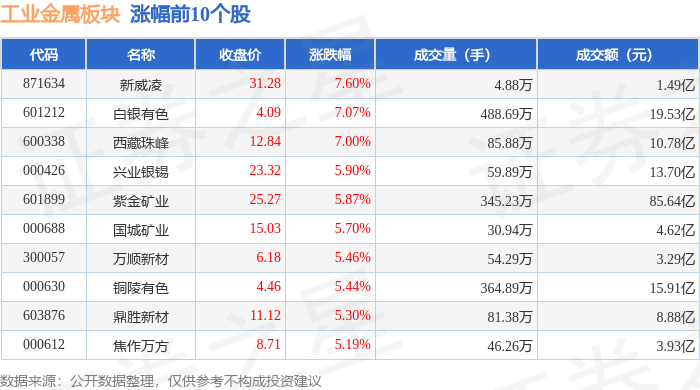
Market Overview - On September 5, the industrial metals sector rose by 4.12% compared to the previous trading day, with Xinweiling leading the gains [1] - The Shanghai Composite Index closed at 3812.51, up 1.24%, while the Shenzhen Component Index closed at 12590.56, up 3.89% [1] Individual Stock Performance - Xinweiling (871634) closed at 31.28, with a gain of 7.60% and a trading volume of 48,800 shares, amounting to a transaction value of 149 million [1] - Baiyin Youse (601212) closed at 4.09, up 7.07%, with a trading volume of 4.8869 million shares and a transaction value of 1.953 billion [1] - Xizang Zhufeng (600338) closed at 12.84, gaining 7.00%, with a trading volume of 858,800 shares and a transaction value of 1.078 billion [1] - Other notable performers include Xingye Yinxin (000426) with a 5.90% increase, Guocheng Mining (000688) up 5.70%, and Dingsheng New Materials (603876) up 5.30% [1] Capital Flow Analysis - The industrial metals sector saw a net inflow of 1.36 billion in main funds, while retail funds experienced a net outflow of 298 million [1] - Major stocks like Zijin Mining (668109) had a net inflow of 756 million from main funds but a net outflow of 357 million from retail funds [2] - Jiangxi Copper (600362) reported a net inflow of 176 million from main funds, with retail funds seeing a net outflow of 131 million [2]


反内卷”之风未止,铜冶炼之路不竭 | 投研报告
Zhong Guo Neng Yuan Wang· 2025-09-05 07:09
Core Viewpoint - The report highlights the emergence of "anti-involution" in industries such as photovoltaic and new energy vehicles, which are characterized by low operating rates and low profits, amidst a backdrop of economic slowdown and significant losses in the copper smelting industry [2][3]. Group 1: Economic Context - Economic growth is slowing, with the political bureau meeting on July 30, 2024, emphasizing the need for industry self-discipline to prevent "involution-style" competition [2]. - The macroeconomic environment is marked by a decline in GDP growth and a prolonged negative Producer Price Index (PPI) [2]. Group 2: Industry Challenges - The copper smelting industry is facing significant losses, necessitating the implementation of "anti-involution" measures [2][3]. - Factors contributing to the challenges in the copper smelting sector include weak raw material conditions, high costs, and a mismatch between mining and smelting capacities due to continuous expansion of smelting capacity [2][3]. Group 3: Strategic Recommendations - The focus for the copper smelting industry should be on optimizing capacity by eliminating outdated production, reducing costs through advanced smelting technologies, and encouraging the establishment of high-level smelting plants [3]. - There is an expectation for the copper industry to return to profitability as capacity alignment improves, with stronger profitability anticipated for companies with cost advantages in smelting [3]. Group 4: Investment Opportunities - Companies with smelting cost advantages and those involved in mining and smelting integration are recommended for attention, including Zijin Mining, Western Mining, Jiangxi Copper, China Nonferrous Mining, Yunnan Copper, and Northern Copper [4].
天风证券:铜冶炼行业亟需落地“反内卷” 利润长期有望回归正值
智通财经网· 2025-09-05 03:40
Group 1 - The core viewpoint is that the non-ferrous metal industry is experiencing a clear peak and decline trend, particularly in the copper smelting sector, which is facing significant losses and requires the implementation of "anti-involution" measures [1][2] - The "anti-involution" movement is driven by the need for industry self-discipline to prevent vicious competition, especially in the context of slowing economic growth and negative PPI [2] - The copper smelting industry is under pressure due to a mismatch between mining and smelting capacities, exacerbated by high costs and weak raw material conditions in China [2][3] Group 2 - The focus of "anti-involution" in the copper smelting industry is on optimizing production capacity, which includes phasing out outdated capacities and enhancing efficiency through advanced smelting technologies [3] - There is an expectation that the copper industry profits will return to positive values as production capacity is optimized, with stronger profitability anticipated for companies with cost advantages in smelting [3] - The report suggests monitoring companies with smelting cost advantages and those involved in mining and smelting partnerships, including Zijin Mining, Western Mining, Jiangxi Copper, China Nonferrous Mining, Yunnan Copper, and Northern Copper [3]

金属与材料“反内卷”之风未止,铜冶炼之路不竭
Tianfeng Securities· 2025-09-05 01:28
Core Insights - The report emphasizes the ongoing trend of "anti-involution" in the copper smelting industry, driven by economic slowdown and the need for industry self-discipline to prevent vicious competition [3][4][6] - The copper smelting sector is facing significant losses, necessitating a focus on capacity optimization to improve profitability [3][22] - The report suggests that the copper industry is expected to return to profitability in the long term, with an emphasis on optimizing capacity and improving operational efficiency [3][22] Industry Overview - The "anti-involution" movement was first highlighted in a Politburo meeting on July 30, 2024, aiming to strengthen industry self-discipline and prevent harmful competition [3][5] - The copper smelting industry is currently experiencing substantial losses, with the need for a shift towards capacity optimization and the elimination of outdated production methods [3][22] - The report identifies the mismatch between copper mining and smelting capacities as a critical issue, with domestic smelting capacity expanding while raw material supply remains heavily reliant on imports [45][49] Economic Context - The report draws parallels between the current "anti-involution" movement and previous supply-side reforms, both occurring in a context of economic growth slowdown [7][9] - It highlights that both periods experienced declining GDP growth rates and prolonged periods of negative Producer Price Index (PPI) [9][10] - The current economic environment is characterized by weaker demand on the consumer side, exacerbating challenges for industries like copper smelting [10][14] Capacity Optimization Strategies - The report outlines key strategies for optimizing copper smelting capacity, including the elimination of outdated production capacity and the adoption of advanced smelting technologies [3][52] - It emphasizes the importance of constructing high-standard smelting facilities and effectively utilizing recycled resources [3][52] - The report suggests that companies with cost advantages in smelting are likely to have stronger profitability as the industry undergoes restructuring [3][22] Investment Opportunities - The report recommends focusing on companies with smelting cost advantages and those involved in mining and smelting integration, such as Zijin Mining, Western Mining, Jiangxi Copper, and others [3][22] - It indicates that the copper smelting industry may see a turnaround in profitability as capacity mismatches are addressed and operational efficiencies are improved [3][22] Challenges and Risks - The report notes that the copper smelting industry is currently facing significant challenges, including high production costs and a reliance on imported raw materials [3][45] - It highlights the need for the industry to adapt to changing market conditions and regulatory environments to mitigate risks associated with overcapacity and competition [3][22]
搭上新能源顺风车 “有色牛”能走多远
Zhong Guo Zheng Quan Bao· 2025-09-04 09:41
Core Viewpoint - The recent mid-to-long term development plan for the new energy vehicle (NEV) industry has made it a hot topic in the capital market, leading to significant price increases in related metal assets such as lithium, nickel, cobalt, and platinum [1][2]. Group 1: New Energy Vehicle Market Performance - The NEV index rose by 4.83% as of November 5, ranking 10th among 184 concept index sectors, with a cumulative increase of 41.35% since the second half of the year [2]. - Key stocks in the NEV sector, including Xiaokang Co., Yinchuan Co., and BYD, experienced significant price increases, with some reaching the daily limit [2]. - The State Council's development plan emphasizes the importance of securing key resources like lithium, nickel, cobalt, and platinum, which has garnered widespread market attention [2]. Group 2: Demand for Nonferrous Metals - The NEV sector is expected to significantly increase the demand for nonferrous metals, with projections indicating that by 2025, NEVs will account for approximately 20% of total new car sales in China [3][4]. - The demand for metals such as copper, aluminum, lithium, nickel, and cobalt is anticipated to grow due to the transition from traditional vehicles to electric vehicles [4][5]. - Analysts predict that the demand for lithium and cobalt will see substantial growth, with cobalt expected to have the largest demand increase, followed by lithium and nickel [6]. Group 3: Investment Opportunities - Investors are encouraged to explore various channels for investing in new energy metals, including stocks of companies involved in the production of new energy metal materials and futures markets for copper, aluminum, and nickel [6]. - It is advised to pay attention to changes in demand forecasts and technological advancements that could lead to valuation gains [6]. - Investment strategies should consider the dynamics of market demand and the potential for excess returns by identifying key opportunities in the sector [6].
