万代

Search documents
玩模乐器品牌TOP15,“IP+技术”撬动积木潮玩|世研消费指数品牌榜Vol.53
3 6 Ke· 2025-07-18 09:52
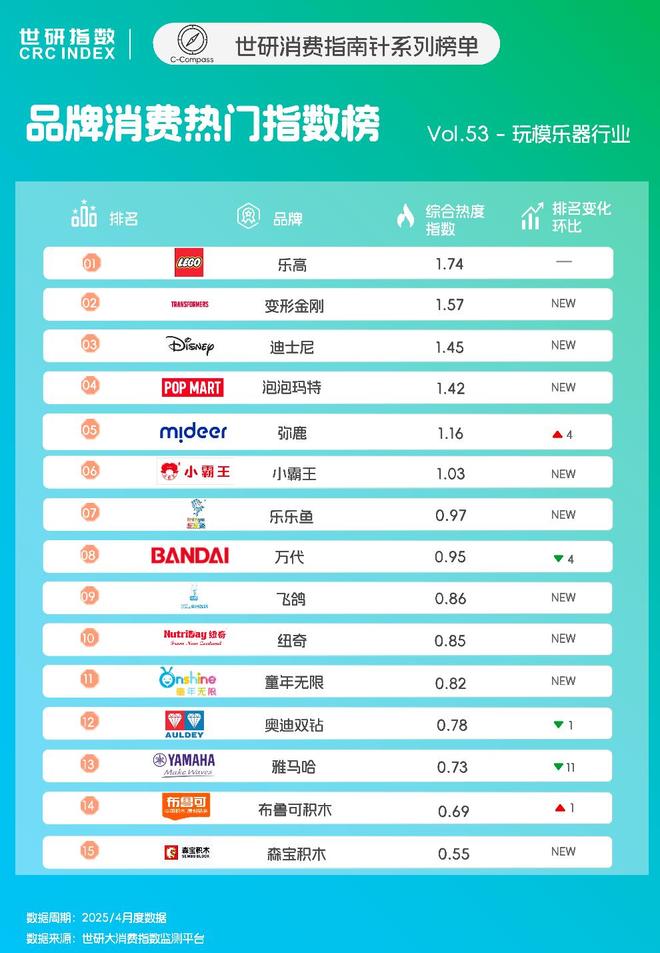
Group 1: Market Rankings - The top brands in the building block category include LEGO, Transformers, Disney, and Pop Mart, with LEGO leading at 1.74 billion [1] - New entrants in the market include brands like Transformers, Disney, and Pop Mart, indicating a dynamic competitive landscape [1] Group 2: Industry Trends - The building block industry is witnessing a dual-track approach of technological scenario innovation and localized IP development, with leading brands creating differentiated systems to build competitive moats [2] - LEGO enhances its ecological barrier through "compatibility systems + cross-media narratives," while brands like Blokus focus on low-age technological innovations [2] - The competition is characterized by international brand localization and domestic brand cultural confidence, with strategies targeting different market segments [2] Group 3: Early Education and Technology - The core competitiveness of early education brands lies in technology-driven scenarios and precise demand segmentation, with products like AI bilingual enlightenment drawing attention [3] - Brands are innovating in both indoor and outdoor educational scenarios, with offerings that cater to specific educational needs and enhance user experience [3] - The industry is shifting towards a "hardware + content + data" model, reconstructing the value chain of early education [3]

IP盛宴,次元破壁,从BW2025现场调研看潮玩谷子发展趋势
2025-07-16 15:25
Summary of Key Points from the Conference Call Industry Overview - The IP derivative market in China is projected to reach a scale of 174.2 billion yuan in 2024, with a compound annual growth rate (CAGR) of 15% from 2020 to 2024, indicating rapid market expansion and growth opportunities for related companies [1][2][10]. Core Trends and Insights - **Diverse IP Development**: The Bilibili World 2025 exhibition highlighted a clear trend towards IP diversification, with the rise of national style and domestic animation. Companies like Morning Light and Qixin have launched various products related to national style IPs, indicating the growing influence of domestic culture in the derivative market [1][2][4]. - **Product Type Interpenetration**: Companies are expanding their product lines beyond traditional categories. For instance, card game companies like KAYOU and JICARD are venturing into plush toys and figurines, while Keep is integrating sports medals with IPs, showcasing the effectiveness of cross-industry collaboration to enhance product value and market competitiveness [1][2][5][10]. - **Emotional Value of Products**: There is an increasing emphasis on the emotional value of products, with interactive and socially engaging products gaining popularity. For example, Bandai's promotion of card products at the exhibition exemplifies this trend, highlighting the importance of user experience and engagement [1][3][9]. Impact of Bilibili World 2025 - The exhibition had a positive impact on the industry, with a 35% month-on-month increase in overall cultural tourism bookings in Shanghai during the event, and a staggering 475% increase in hotel bookings in the vicinity. This indicates that such exhibitions not only attract visitors but also stimulate related industries [4]. Future Development Directions - **IP Matrix Construction**: Companies will continue to build IP matrices by leveraging popular and differentiated IPs to avoid competitive saturation and enhance their competitiveness. Popular IPs like Conan and Hatsune Miku, as well as unique character designs from virtual novels, are expected to be key resources for companies [5][10]. - **Product Diversification**: There is a focus on developing a wider range of peripheral products based on licensed IPs, enabling cross-selling of different product types under the same IP to meet diverse consumer needs [5][10]. - **Cross-Industry Collaboration**: The trend of cross-industry collaborations is on the rise, as seen with Keep's integration of sports medals with anime culture, enriching brand connotations and expanding market space [5][10]. - **Enhancing Emotional Value**: Products that emphasize emotional value and social attributes are expected to be more popular, with interactive gaming elements enhancing user experience and loyalty, which will continue to drive industry growth [5][10]. Recommendations for Companies - Key companies recommended for investment include Morning Light, Blukoo, and Qixin Group, which possess strong product development, operational capabilities, and channel layouts. Broadcasting and Chuangyuan are also mentioned as relevant targets. Continuous monitoring of actual sales performance is advised to ensure the accuracy of research conclusions [10][11].
扭蛋机,日本最抽象的“全民盲盒”
3 6 Ke· 2025-07-15 01:28
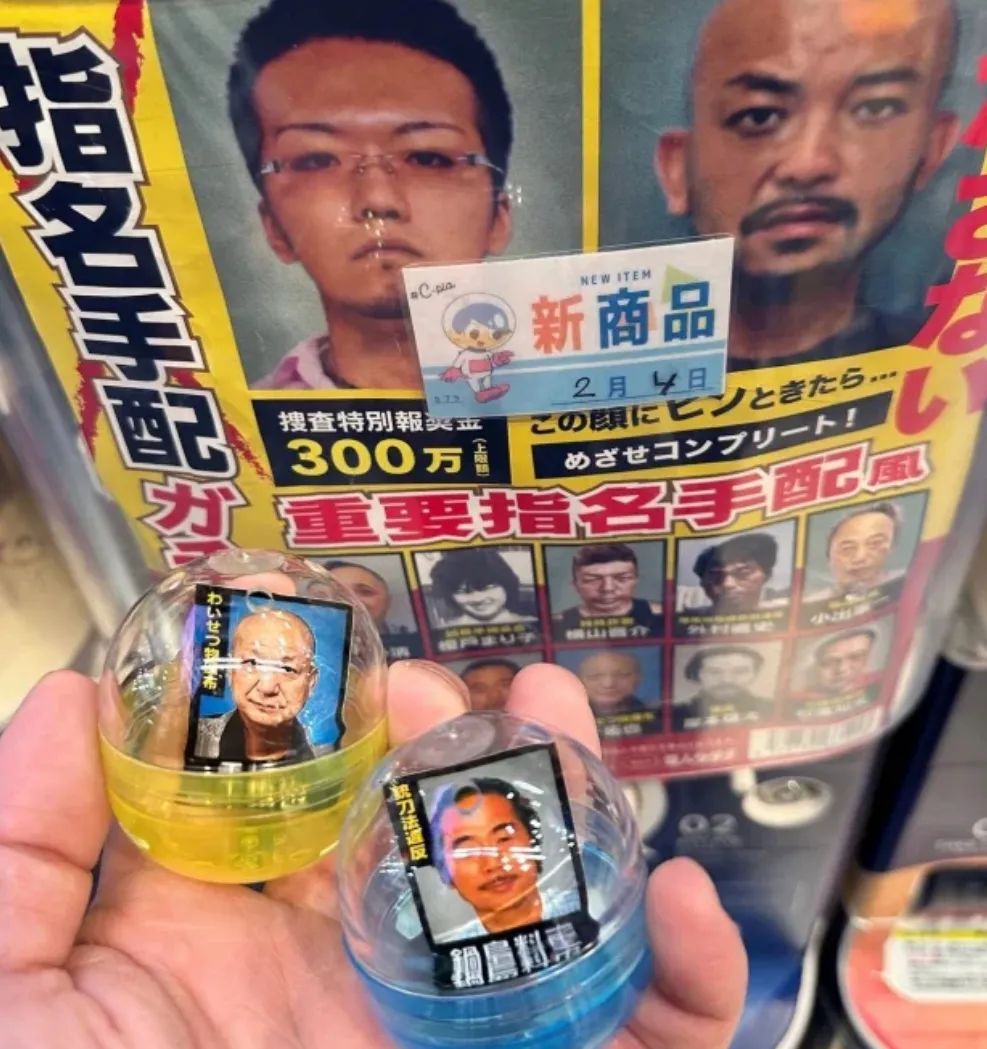
Group 1 - The article discusses the unique and humorous nature of Japanese gacha machines, particularly the "wanted criminal gacha" that dispenses figurines of fictional criminals, which has gained popularity online [1][3][5] - The developer of the gacha machine, Hiroki Terai, revealed that the criminals depicted are fictional and based on acquaintances, leading to a lighthearted reception from consumers [5][7] - The gacha machine has expanded in Japan, selling over 30,000 capsules and generating approximately 9 million yen in revenue, showcasing the commercial success of this novelty [9][49] Group 2 - Japan's gacha market is extensive, with over 500 billion yen (approximately 3.2 billion USD) in market size, having doubled since 2010, indicating a strong growth trend [49][63] - The gacha machines are prevalent across various locations, with an estimated 500,000 machines in Japan, selling nearly 300 million capsules annually [47][49] - Despite the popularity of gacha machines, the market size is significantly smaller than that of the Chinese blind box company Pop Mart, which is projected to exceed 13 billion yuan in sales in 2024 [63][72] Group 3 - The article highlights the creativity and diversity of gacha products, ranging from food items to absurd concepts, reflecting a culture of innovation in Japan [11][25][27] - Gacha machines have evolved from simple toy dispensers to complex marketing tools for popular IPs, with major companies like Bandai dominating the market [45][68] - The competitive landscape for smaller gacha manufacturers has become challenging, with many struggling to achieve significant sales volumes, indicating a saturated market [70][72]
国泰海通|轻工:IP盛宴,次元破壁,从BW2025现场调研
国泰海通证券研究· 2025-07-14 14:29
Core Viewpoint - The BW2025 exhibition highlights the trend of IP diversification, with a significant presence of domestic cultural IPs, indicating a growing market for IP-derived products as consumer disposable income increases [1][2]. Group 1: Exhibition Insights - The BW2025 exhibition, organized by Bilibili, serves as a platform for content creators and derivative product vendors, showcasing a variety of brands including Qizhi Haowan, Deli, and Aofei Entertainment [2]. - Companies are increasingly building IP matrices to leverage popular IPs for natural traffic while avoiding intense competition in saturated markets [2]. - Popular IPs such as Conan, Fuliang, and others have multiple toy companies vying for their licensing, indicating a competitive landscape [2]. Group 2: Product Development Trends - There is a rapid expansion of product types among toy companies based on IP, with leaders like Kayi and Jikasa diversifying into plush toys, stationery, and more [3]. - The integration of IP into various product lines is expected to create effective synergy and enhance the overall value of the IP [3]. - The importance of operational and channel capabilities of leading toy companies is emphasized as they navigate the increasingly interconnected product landscape [3]. Group 3: Consumer Engagement - Emotional value and interactive gaming experiences are becoming prominent, with card companies setting up live battle areas to meet social needs [3]. - Events such as Coser interactions and product exchanges at the exhibition enhance the engagement and popularity of IP products [3].

布鲁可20250710
2025-07-11 01:05
Summary of the Conference Call for Bluko Company Overview - Bluko is a rapidly growing leader in the building block character toy industry, established in 2014. [2][4] - The company is planning to launch female-oriented and adult-oriented toys in 2025 and is expanding its overseas presence. [2][4] Financial Performance - Revenue increased from 300 million RMB in 2021 to an expected 4 billion RMB in 2025, with a projected net profit of 1 billion RMB. [2][29] - The net profit for 2024 is estimated at 580 million RMB, with a net profit margin of 26% and a gross profit margin of 53%. [2][7] - The company has shown strong financial indicators, ranking just below Moutai and Dongpeng in the consumer goods sector. [7] Market Position - Bluko's main products are building block character toys, with Ultraman IP accounting for nearly half of its sales. [2][8] - The global toy market is valued at over 700 billion RMB, growing at approximately 5%, while the Chinese toy market is around 100 billion RMB with an expected growth rate of 10%. [10] - The building block toy segment in China is projected to grow at 20%, with character toys also expected to see similar growth. [10][11] Competitive Landscape - The global building block character toy market is dominated by LEGO and Bandai, which together hold a 75% market share. [12] - Bluko has a market share of about 6% globally and 30% in China, significantly outperforming LEGO and Bandai in the Chinese market. [12][13] Strategic Initiatives - The company employs a "rural encirclement of cities" strategy, focusing on low-priced products to penetrate lower-tier cities. [14][13] - Bluko has implemented a three-pronged strategy: targeting all demographics (including female and adult products), offering a full price range, and pursuing globalization. [21][25] Product Development and Sales - Bluko has a rapid product development cycle of 6-7 months, faster than the industry average of one year. [22] - The company has established a robust sales network with 150,000 offline outlets covering 80% of China, aiming to reach 300,000 by 2025. [22][18] Future Outlook - The company anticipates strong growth in 2025, with revenue projected at 4 billion RMB and profit at 1 billion RMB. [29] - Bluko is focusing on expanding its IP portfolio and enhancing consumer interaction through a BFC mechanism, which has resulted in over 12 million global members and a 20% repurchase rate. [20][21] Additional Insights - The company is actively exploring overseas markets, particularly in Southeast Asia and Latin America, with plans to enhance brand awareness through participation in toy exhibitions. [24][26] - The competitive landscape is characterized by a mix of high-end and low-end strategies, with Bluko focusing on affordability and accessibility. [14][17] This summary encapsulates the key points from the conference call regarding Bluko's business strategy, financial performance, market position, and future growth prospects.
布鲁可(0325.HK):IP积木潮 创意趣无限-深度报告
Ge Long Hui· 2025-06-30 02:20
Company Overview - The company is a leading player in the rapidly growing building block toy sector, established in 2014 and launched its proprietary IP "Buluco" in 2017, achieving a revenue of 2.24 billion yuan and a net profit of 585 million yuan by 2024 [1] - The founder, Zhu Weisong, has significant ownership with 54.95% of shares prior to the IPO, and the core team has substantial equity through an employee incentive program [1] Industry Analysis - The global toy market was valued at 773.1 billion yuan in 2023, with a projected CAGR of 5.1% from 2023 to 2028; the building block and character toy segments are expected to grow at CAGRs of 15%, 9.3%, and 20.5% respectively [1] - In China, the toy market reached 104.9 billion yuan in 2023, with a CAGR of 9.5% from 2023 to 2028; the building block and character toy segments are projected to grow at CAGRs of 22%, 17.7%, and 41.3% respectively, indicating a strong growth advantage for building block character toys [1] - The global market for building block character toys is dominated by Bandai and LEGO, holding market shares of 39.5% and 35.9% respectively, while Buluco leads the Chinese market with a 30.3% share [1] Competitive Advantages - The company exemplifies IP commercialization with advantages in design and R&D, including a robust patent portfolio and a short product launch cycle [2] - Multi-channel sales strategies effectively penetrate lower-tier markets [2] - Internet marketing fosters a fan ecosystem through member interaction [2] - The company has a substantial reserve of licensed IPs and high market recognition for its proprietary IP [2] Growth Strategy - The company has adopted a "Three All" strategy focusing on "All demographics, All price ranges, Globalization" to enhance market share [2] - Plans include establishing a female-oriented studio to cater to female consumers and innovating complex building toys to attract adult customers [2] - The pricing structure will be adjusted to ensure affordability across various price points [2] - There is significant growth potential in overseas markets, with future international expansion anticipated [2] Profit Forecast and Investment Outlook - The company is expected to focus its strategy on building block character toys, supported by the "Three All" strategy, ensuring future growth [2] - Revenue growth rates are projected at 88.38%, 51.02%, and 32.40% for 2025, 2026, and 2027 respectively [3] - Profit estimates for 2025, 2026, and 2027 are 1.076 billion yuan, 1.751 billion yuan, and 2.480 billion yuan respectively, with corresponding PE ratios of 28x, 17x, and 12x [3]
潮玩系列4:全球IP生命周期复盘启示录
2025-06-30 01:02
Summary of Key Points from the Conference Call Industry Overview - The report focuses on the global IP (Intellectual Property) lifecycle and its implications for the collectible toy market, particularly in China and Southeast Asia, which are expected to lead global growth with compound annual growth rates (CAGR) of 17.2% and 20% respectively from 2024 to 2029 [1][5][6]. Market Size and Growth - The global IP derivative market is projected to reach 14 trillion yuan (approximately 2.1 trillion USD) by 2024, with the IP toy market specifically estimated at 525.1 billion yuan (approximately 79.5 billion USD) [1][5]. - China's IP toy market is expected to grow at a CAGR of 17.2%, reaching 167.5 billion yuan (approximately 25.5 billion USD) by 2029 [1][6]. Key Segments in the Market - Major segments in the Chinese market include building and assembly toys (26.8 billion yuan), static dolls (17 billion yuan), and plush toys (14.3 billion yuan) [6]. - There is significant potential for per capita spending on IP toys in China, which is currently 5-7 times lower than in Japan and the United States [6]. Competitive Landscape - Chinese companies are rapidly emerging in the IP toy market, with six out of the top ten companies being Chinese, including Pop Mart and Blokus [7]. - The industry typically employs a revenue-sharing model with a gross merchandise volume (GMV) share of 5%-8%, while licensing fees account for 10%-15% of listed companies' revenues [7]. Global IP Licensing Market - The global IP licensing market is highly concentrated, with the top five licensors holding approximately 40% market share and the top ten around 50% [8]. - Disney remains the leading player due to its extensive IP portfolio and consistent content output, followed by Warner Bros and Sea World [8]. IP Success Factors - The success of an IP is often attributed to its operational strategies, which can extend its lifecycle and enhance monetization opportunities [2]. - High-value IPs like Pokémon, Hello Kitty, Winnie the Pooh, and Mickey Mouse have generated over 50 billion USD in cumulative revenue, typically requiring over 30 years of history and a diversified commercial system [9]. Disney's IP Strategy - Disney has built a vast IP matrix through both organic growth and acquisitions, owning between 1,000 to 2,000 core IPs [10][17]. - The company has successfully maintained its IP relevance through continuous content updates and strategic partnerships [10][17]. Case Studies of IPs - **Hello Kitty**: Launched in 1974, it has a multi-layered monetization system and has successfully expanded its audience demographics over the years [24][25]. - **Mickey Mouse**: As a cultural icon since the 1930s, it has leveraged merchandise licensing and media adaptations to maintain its influence [26]. - **Pokémon**: Initially launched in 1996, it has seen rapid growth through innovative gaming and media strategies, achieving a GMV of nearly 120 billion USD in recent years [30][31]. Future Outlook - The report suggests that the Chinese IP toy market has a promising future, driven by increasing consumer spending and the emergence of local players [6][32]. - Companies like Pop Mart are expected to continue their growth trajectory, supported by a strong IP and product matrix [32][33].

轻工行业2025年中期投资策略:把握新型烟草潮玩布局节奏,重视传统轻工结构性机会
SINOLINK SECURITIES· 2025-06-26 11:11
Group 1 - The report emphasizes the importance of grasping the layout rhythm of new consumption sectors while paying attention to structural opportunities in traditional light industry, as the valuation of traditional light industry is at historical lows [2][8] - The new consumption sector is expected to lead the market in H1 2025, with a focus on new tobacco and trendy toys, while traditional light industry should be gradually increased in H2 2025 [2][12] - The report suggests that the new tobacco market is set for expansion due to the increasing global penetration rate and the easing impact of illegal products on the market [2][29] Group 2 - The paper highlights the structural opportunities in the paper and packaging sector, recommending a focus on companies with stable positions and high dividends, as well as those benefiting from industry consolidation [2][6] - The two-wheeler sector is expected to see improved market conditions due to new national standards and policies promoting trade-in programs, making it a favorable investment area [2][6] - The domestic home goods sector is projected to benefit from trade-in policies and resilient demand in the second-hand housing market, with a focus on companies with strong retail capabilities [2][6] Group 3 - The report indicates that the export sector is facing mixed risks and opportunities, with a recommendation to focus on companies with unique advantages or those showing marginal improvements [2][6] - The analysis of the new consumption sector identifies key areas such as light consumer goods, AI glasses, and pet food, with a focus on companies that can innovate and differentiate their products [2][12] - The report provides a detailed comparison of various segments within the new consumption sector, highlighting their market penetration rates and competitive dynamics [14][20]
日本,永远活在20年前的老人经济
Hu Xiu· 2025-06-20 16:05
Group 1 - Japan is gradually shifting its national policy from manufacturing to a combination of manufacturing and tourism, with a notable increase in tourism from China [1] - Chinese tourists are the main force in visiting Japan, often returning multiple times and exploring deeper into local experiences [2][5] - Residents from Jiangsu, Zhejiang, and Shanghai are particularly familiar with traveling to Japan, finding it more convenient compared to other regions in China [3][4] Group 2 - Japan is experiencing rapid aging, with a significant presence of elderly drivers in the taxi industry, raising concerns about safety [6][11] - The elderly workforce is prevalent across various service sectors, including hospitality and security, reflecting Japan's acceptance of a "super-aged society" [12][14] - Over 30% of Japanese companies have abolished retirement age policies, indicating a trend towards retaining older employees in the labor market [18] Group 3 - The aging population in Japan is leading to an increase in solitary elderly individuals, raising concerns about social isolation and "lonely deaths" [19] - The elderly consumer market is evolving, with older individuals maintaining purchasing power and preferences for traditional products and services [25][26] - Japan's unique "Galapagosization" phenomenon reflects a cultural and economic isolation that may hinder technological advancement while fostering niche markets for elderly products [46][47] Group 4 - The Japanese government is focusing on enhancing the quality of life for the elderly through community planning and age-friendly initiatives [53][54] - There is a clear strategy to improve the health and longevity of older adults, gradually eliminate retirement, and promote consumption among the elderly [54][55] - The development of elderly-friendly products and services is becoming a significant market segment, with a variety of specialized items catering to the needs of older consumers [30][42]

中金 | 潮玩系列#4:全球IP生命周期复盘启示录
中金点睛· 2025-06-20 00:10
Core Viewpoint - The article discusses the growth and lifecycle of IPs (Intellectual Properties) in the global market, particularly focusing on the success of domestic潮玩 (trendy toys) leaders like Labubu, and analyzes the operational strategies of world-class IPs such as Hello Kitty, Pokémon, and Mickey Mouse to identify potential investment opportunities and risks in the IP industry [1][4]. Global IP Market Overview - The global IP toy market is projected to reach 525.1 billion yuan in 2024, with a CAGR of 8% from 2024 to 2029, while the Chinese IP toy market is expected to grow to 75.6 billion yuan in 2024, with a CAGR of 17.2% during the same period [2][13]. - The concentration of the global IP licensing market has increased, with the top five companies holding a market share of 41% and the top ten at 54% as of 2024, indicating a trend towards market consolidation [2][21]. IP Lifecycle Model - The IP lifecycle is divided into four stages: birth, breakthrough, sedimentation, and stabilization, with each stage requiring different operational strategies to ensure longevity and profitability [3][30]. - Successful IPs often exhibit a high degree of adaptability and resource allocation, which are crucial for navigating through different lifecycle stages [3][30]. Case Studies of World-Class IPs - Hello Kitty, Mickey Mouse, and Pokémon have each experienced distinct lifecycle phases, with their peak GMV values reaching approximately 3.8 billion, 10 billion, and 12 billion USD respectively, showcasing their commercial viability and cultural significance [4][52]. - The commercial success of these IPs is influenced by factors such as brand inclusivity, geographic reach, and diverse monetization strategies, which can provide valuable insights for the domestic潮玩 industry [4][52]. Operational Strategies - Hello Kitty's operational strategy has evolved through various phases, including initial expansion, global breakout, adjustment periods, and digital transformation, highlighting the importance of adaptability in maintaining relevance [53][56]. - Mickey Mouse has maintained a stable brand presence through consistent content updates and a strong licensing model, benefiting from its deep-rooted cultural significance in the U.S. [57][59]. - Pokémon has leveraged continuous content innovation and a broad commercial ecosystem, including games, merchandise, and media, to sustain its popularity and revenue growth [60][62]. Conclusion - The analysis of these IPs illustrates that a well-structured operational strategy, combined with an understanding of market dynamics and consumer preferences, is essential for the longevity and profitability of IPs in the competitive landscape [3][4][30].