
可口可乐

Search documents
大项目引领大发展
Qi Lu Wan Bao· 2025-08-21 21:12
Core Viewpoint - The article highlights the rapid development and transformation of the Bucun area in Jinan, focusing on the integration of various industries, particularly food and beverage, tourism, and smart manufacturing, to drive high-quality economic growth [2][3][4][6][7]. Group 1: Industrial Development - Bucun is leveraging its strengths in the food and beverage sector, with major companies like Coca-Cola and Silver Eel leading the way, aiming for a production value of over 4.1 billion yuan in 2024, which will account for 53.4% of the total industrial output [3]. - The area is also enhancing its tourism resources, with attractions like the Jinan Wildlife Park and Jinan Botanical Garden revitalizing the local tourism industry, supported by the ongoing construction of the Jinan Bucun International Comprehensive Leisure Resort [3][4]. Group 2: Project Implementation - The successful implementation of quality projects is seen as vital for Bucun's development, with significant investments such as 500 million yuan for the Zhengtai Electric smart equipment project and 1.1 billion yuan for Silver Eel's upgraded production line [4][6]. - The area has adopted innovative mechanisms to streamline project execution, achieving rapid progress in land acquisition and project completion, exemplified by the swift development of the Qian Xuesen High School project [6]. Group 3: Service Optimization - Bucun is committed to providing tailored services to enterprises, ensuring smooth project progress through a "one-on-one" tracking system and proactive problem-solving strategies [6]. - The establishment of a government-business platform has facilitated efficient communication and collaboration among stakeholders, enhancing the overall business environment [6]. Group 4: Innovation and Transformation - Bucun is focusing on innovation as a key driver for high-quality development, with initiatives to create integrated platforms for emerging industries, particularly in biomedicine and digital economy [7]. - Traditional industries are also undergoing transformation through technological upgrades, with 25 ongoing projects aimed at enhancing digitalization and smart manufacturing capabilities [7].


软饮料行业深度:后来居上,中国软饮料巨头的平台化之路
Soochow Securities· 2025-08-21 15:34
Investment Rating - The report maintains an "Add" rating for the soft drink industry [1] Core Insights - The Chinese soft drink industry has evolved through three main stages: the dominance of carbonated drinks, diversified growth, and structural growth driven by the rise of the middle class and differentiated consumer demands [11][23] - Leading companies in the soft drink sector are innovating and creating billion-yuan products, establishing competitive advantages through product iteration and market penetration strategies [30][33] - The future of the industry is expected to focus on health and functionality, with high growth potential in categories such as bottled water, sugar-free tea, energy drinks, and emerging segments like electrolyte water and coconut water [36][41] Summary by Sections Historical Overview - The soft drink industry in China has transitioned from a carbonated drink-dominated phase (before the mid-1990s) to a diversified growth phase (1995-2014), and currently to a structural growth phase (2015-present) [11][23] - The market saw significant growth in various segments, with carbonated drinks holding over 50% market share until the mid-1990s, followed by a surge in demand for juices, tea drinks, bottled water, and plant-based beverages [11][18] Current Landscape - The competition in the soft drink industry is intense, with traditional leaders maintaining advantages while new entrants are breaking through in emerging segments [30] - Key segments such as bottled water, tea drinks, and energy drinks are expected to sustain good growth rates, with the top three companies in each segment holding significant market shares [32][33] Future Outlook - The report identifies health and functionality as the main trends driving the industry forward, with specific growth opportunities in bottled water, sugar-free tea, energy drinks, and new categories like electrolyte water and coconut water [36][41] - The bottled water segment is projected to see an increase in packaging rates from 14.4% in 2023 to 18.9% by 2028, indicating a long-term growth trajectory [41][60] - The sugar-free tea segment is expected to grow significantly, with current penetration rates still low compared to markets like Japan [66][70] Investment Recommendations - The report recommends investing in companies like Dongpeng Beverage and Nongfu Spring, while also keeping an eye on China Resources Beverage and IFBH, as they are well-positioned in high-growth segments [1][36]

兴业证券:椰子水赛道分层竞争加剧 场景多元+质价比驱动市场扩容
Zhi Tong Cai Jing· 2025-08-18 07:25
Group 1 - The core viewpoint is that leading companies in the coconut water market have significant supply chain advantages and stable channels, with multi-category collaboration driving growth [1][2] - IFBH (06603) is identified as a leading player in the domestic coconut water market, leveraging a light asset model for cost advantages and enhancing brand influence through celebrity endorsements and cross-industry collaborations [1][2] - The health-driven demand for coconut water is supported by its low sugar content and natural electrolytes, establishing a stable consumption structure across various scenarios such as office (45%), sports (32%), and home (18%) [1][3] Group 2 - The global coconut water market is experiencing rapid expansion, with the market size projected to grow from $2.52 billion in 2019 to $4.99 billion by 2024, reflecting a CAGR of 14.7% [2] - The Greater China market is leading this growth, with a projected increase from $0.1 billion to $1.09 billion, achieving a remarkable compound growth rate of 60.8% [2] - The competitive landscape is evolving, with a shift from a highly concentrated market to a more diversified one, where leading brands like Vita Coco maintain their positions while new entrants like IFBH rapidly gain market share [2] Group 3 - The Chinese coconut water market is transitioning from a high-end niche to mass consumption, with the mainstream price range dropping to 6-8 RMB per 500ml, and distribution expanding to convenience stores and lower-tier cities [3] - The per capita consumption of coconut water in China is currently low at 0.1 liters, indicating significant growth potential compared to markets like the US and Hong Kong [3] - The industry is expected to reach a scale of 18 billion RMB by 2029, driven by expanding consumption habits and increased availability across various channels [3]

预见2025:《2025年中国果汁行业全景图谱》(附市场规模、竞争格局和发展趋势等)
Qian Zhan Wang· 2025-08-12 04:20
Industry Overview - The juice industry in China is defined as the production of juice products made from fresh or refrigerated fruits, with a minimum juice content of 10% [1] - The industry is categorized under beverage manufacturing, specifically soft drink manufacturing [1] Industry Chain Analysis - The juice industry chain consists of upstream (raw materials and equipment suppliers), midstream (juice processing companies), and downstream (distribution and sales channels) [2][5] - Upstream includes fruit planting bases and packaging material suppliers, while midstream focuses on juice processing and product manufacturing [2][5] Industry Development History - The juice industry in China has evolved over 30 years, shifting from an export-oriented model to a domestic demand-driven and technology-led market [8] - Key milestones include the establishment of Huiyuan in 1992, the rise of low-concentration juice in 2001, and the emergence of NFC juice post-2008 [8][11] Policy Background - Multiple policies have been introduced to regulate and support the juice industry, focusing on food safety, resource conservation, and market standardization [12] - Policies aim to enhance the competitiveness of the juice industry and promote healthy product development [12] Current Market Status - The juice market in China is steadily growing, with sales increasing from 120 billion to 156 billion yuan from 2019 to 2024 [13] - High-end juice products, particularly those produced using NFC and HPP technologies, are driving market growth, with their sales share rising from 12% in 2019 to 23% in 2024 [13] Competitive Landscape - The juice market features a tiered competitive structure, with leading companies like Coca-Cola, Master Kong, and Nongfu Spring dominating the market [17][21] - Emerging brands are also gaining traction, particularly in the high-end segment, with significant growth rates [15][21] Regional Competition - The juice industry exhibits regional competition, with Shandong leading in the number of listed companies, followed by Hebei, Zhejiang, and Guangdong [19] - Each region has its unique focus, such as concentrated juice production or high-end juice products [19] Future Trends and Predictions - The demand for high-end, health-oriented juice products is expected to continue driving innovation and market upgrades [23] - The market is diversifying, with younger consumers and new consumption scenarios emerging, leading to new growth opportunities [23]


老牌果汁自爆内讧!大股东“空头支票”激化矛盾,汇源已起诉
Nan Fang Du Shi Bao· 2025-08-11 05:10
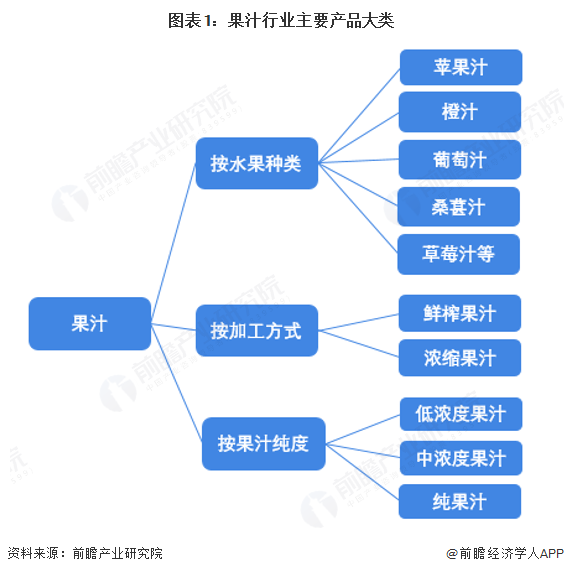
Core Viewpoint - Beijing Huiyuan Juice has publicly accused its major shareholder, Zhuji Wenshenghui, of failing to fulfill its financial commitments, which has led to a governance crisis and trust issues within the company [1][2]. Group 1: Company Governance Issues - Zhuji Wenshenghui has only contributed 22.8% of the registered capital, with an overdue investment of 850 million yuan that has not been paid despite 11 reminders [1][7]. - The major shareholder controls the board of directors and management nominations, despite not meeting its investment obligations, raising concerns about governance and control [8][9]. - Huiyuan Juice has initiated legal action against Zhuji Wenshenghui and Shanghai Wensheng Asset Management, which has been accepted by the court [9][10]. Group 2: Financial and Operational Challenges - The company is facing a significant debt restructuring plan, with over 10 billion yuan in debt, which is at risk of stagnation due to the lack of incoming funds from the major shareholder [1][10]. - Huiyuan Juice's capital reserve has uncertainties, as many creditors have not yet received shares, leading to potential changes in capital reserves [7]. - The company has ongoing legal and financial issues, including nearly 2.6 billion yuan in total execution amounts and multiple frozen equity cases [10][11]. Group 3: Industry Context - The juice market is highly competitive, with major players like Nongfu Spring and Coca-Cola continuing to expand, putting pressure on Huiyuan Juice's market share [15]. - The company has struggled to innovate and adapt to changing consumer trends towards healthier and sugar-free products, which require substantial investment [15]. - The public dispute with the major shareholder has further eroded market confidence, complicating Huiyuan Juice's recovery and growth prospects [12][13].
外卖大战下,肯德基客单价提升丨消费参考
2 1 Shi Ji Jing Ji Bao Dao· 2025-08-07 01:04
Group 1: Company Performance - KFC and Pizza Hut's operator, Yum China, reported a 4% year-on-year revenue increase to $2.787 billion in Q2, with net profit rising 1.4% to $215 million [1] - KFC's revenue grew by 4.1% to $2.096 billion, while operating profit increased by 10.6% to $292 million in Q2 [1] - Pizza Hut's revenue rose by 2.6% to $554 million, with operating profit up 15% to $46 million [1] Group 2: Sales Channels and Trends - Delivery sales accounted for approximately 45% of Yum China's restaurant revenue in Q2, a 7% increase year-on-year, with KFC's delivery sales being the largest source of revenue [1] - Pizza Hut's delivery sales represented 43% of its revenue, up 5% year-on-year, while dine-in remained its largest revenue source at 48% [1] - Same-store sales for KFC increased by 1% year-on-year, with transaction volume achieving positive growth for ten consecutive quarters [2] Group 3: Cost and Profitability - The increase in delivery sales has led to a rise in labor costs, with labor costs increasing by 0.9% year-on-year, while food and rent costs decreased by 0.5% and 1.1% respectively [2] - Yum China's CFO emphasized the importance of maintaining a disciplined growth approach in delivery services while controlling profitability [3][4] Group 4: Market Reaction - On August 6, Yum China's stock closed at HKD 348.6 per share, down 5.99% [5] - The Shanghai Consumer 80 Index closed at 4914.72 points, with a slight decline of 0.02% [6]
能量饮料行业专题报告:复盘Monster:历年费用加码,次年利润均实现高增
ZHONGTAI SECURITIES· 2025-08-06 11:30
Investment Rating - The industry investment rating is "Overweight" [3][32]. Core Insights - The report emphasizes the growth logic of the energy drink industry from both macro and micro perspectives, highlighting the importance of channel strategies and operational expenses in driving market share and profitability [5][6]. - The analysis of Monster's historical performance indicates that significant increases in operational expenses often correlate with substantial profit growth in subsequent years, driven by channel transformations [5][9]. - The report suggests that Eastroc Beverage's investment in freezer displays is expected to enhance market share and sales efficiency in the long term, despite short-term cost increases [6][28]. Summary by Sections Review of Monster - Monster experienced four instances of over 50% year-on-year growth in operational expenses since 2000, with subsequent profit growth typically exceeding revenue growth [5][9]. - In 2006, Monster's market share in the U.S. energy drink market reached 23.4%, with a significant increase in sales driven by strategic partnerships and product offerings [10][17]. - By 2008, Monster surpassed Red Bull in market share, achieving a 29.2% share in convenience stores and gas stations, leading to a 93.21% increase in net profit the following year [15][20]. Eastroc Beverage - In the first half of 2025, Eastroc Beverage's sales expenses increased by 37.27% to 1.682 billion yuan, primarily due to a 61.20% rise in channel promotion expenses from freezer investments [28][29]. - The report anticipates that the freezer investments will enhance product visibility and sales efficiency, potentially increasing market share by 20-30% [31][32]. - The long-term outlook for Eastroc is positive, with expectations of improved profitability and market share through strategic channel enhancements [6][28].
净利润暴跌近60%,巴菲特遭遇“滑铁卢”?仍囤积超2.4万亿元现金
Mei Ri Jing Ji Xin Wen· 2025-08-02 23:26
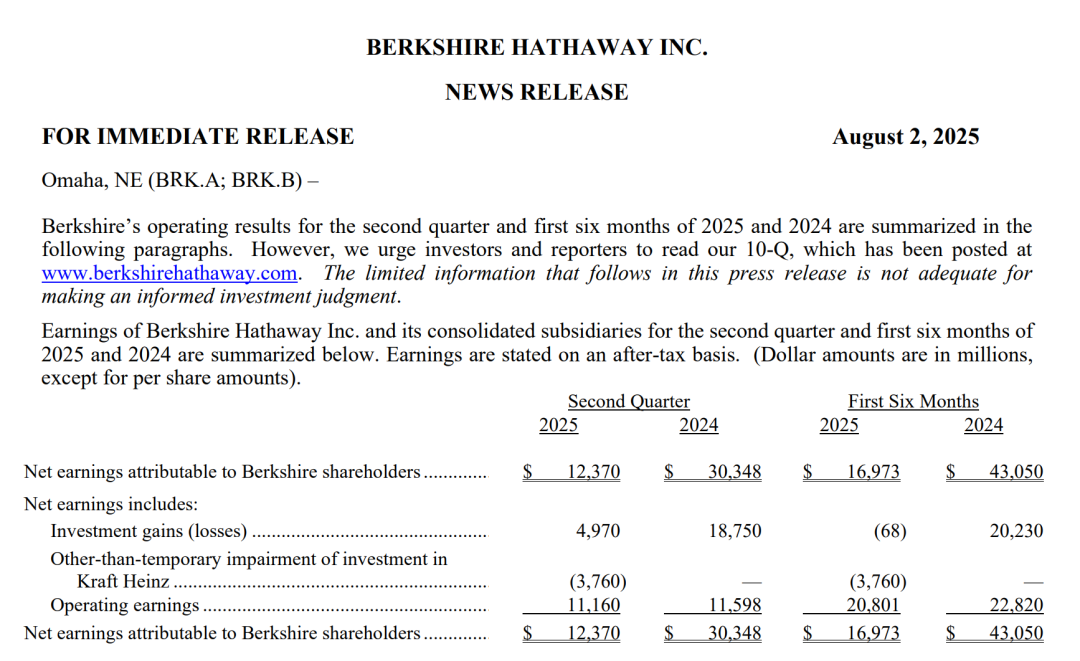
Core Points - Berkshire Hathaway reported a significant decline in net earnings, with a 59% drop in net income attributable to shareholders for Q2 2025, amounting to $12.37 billion compared to $30.35 billion in the same period last year [6][8] - The company has not repurchased any shares in the first half of 2025, marking the 11th consecutive quarter of net stock sales [4][11] - Berkshire's cash reserves decreased slightly from $347 billion to $344.1 billion, the first decline in three years, indicating challenges in finding suitable investment opportunities [9][10] Financial Performance - Total revenues for Q2 2025 were $92.515 billion, a slight decrease from $93.653 billion in Q2 2024 [8] - Operating earnings fell by 4% year-over-year to $11.16 billion, primarily due to a decline in insurance underwriting [9] - Investment gains for the second quarter were reported at $6.364 billion, down from $23.857 billion in the previous year [8] Investment and Holdings - Berkshire's top five holdings as of Q2 2025 include American Express, Apple, Bank of America, Coca-Cola, and Chevron [4] - The company recorded a $3.76 billion impairment on its investment in Kraft Heinz, reflecting ongoing struggles with this investment [4][12] - Berkshire sold approximately $1.23 billion worth of VeriSign shares, reducing its stake from 14.2% to 9.6% [15][16] Management and Future Outlook - Warren Buffett announced plans to retire at the end of 2025, with Greg Abel recommended as his successor [18] - Concerns about the potential impact of international trade policies and tariffs on Berkshire's operations were highlighted, indicating significant uncertainty ahead [10][19] - The stock price of Berkshire has declined over 12% since the announcement of Buffett's retirement, raising concerns about the "Buffett premium" diminishing [19]
伯克希尔哈撒韦前五大持仓为美国运通、苹果、美国银行、可口可乐和雪佛龙
Xin Lang Cai Jing· 2025-08-02 12:40
Group 1 - The core holdings of Berkshire Hathaway A as of the end of Q2 include American Express, Apple, US Bank, Coca-Cola, and Chevron [1] - As of June 30, 2025, the fair value of the top five holdings is expected to account for 67% of the company's total portfolio [1]
金十图示:2025年08月01日(周五)美股热门股票行情一览(美股收盘)
news flash· 2025-08-01 20:07
Market Capitalization Summary - Oracle has a market capitalization of 722.79 billion, while Mastercard and Visa have market capitalizations of 857.12 billion and 947.73 billion respectively [2] - ExxonMobil, SoftBank, and Johnson & Johnson have market capitalizations of 492.32 billion, 472.42 billion, and 402.94 billion respectively [2] - Bank of America, Procter & Gamble, and Home Depot have market capitalizations of 371.58 billion, 352.80 billion, and 338.05 billion respectively [2] Stock Performance - Oracle's stock decreased by 7.20 (-2.43%), while Mastercard's increased by 0.47 (+0.48%) and Visa's increased by 22.58 (+3.05%) [2] - ExxonMobil's stock decreased by 9.35 (-3.68%), SoftBank's decreased by 6.33 (-1.83%), and Johnson & Johnson's decreased by 6.60 (-1.17%) [2] - Bank of America's stock increased by 5.96 (+1.62%), Procter & Gamble's decreased by 1.63 (-3.45%), and Home Depot's increased by 0.17 (+0.11%) [2] Additional Company Insights - Disney's market capitalization is 709.49 billion, with a stock decrease of 14.10 (-1.95%) [3] - American Express and Caterpillar have market capitalizations of 302.79 billion and 237.65 billion respectively, with stock changes of +2.72 (+0.91%) and -11.91 (-4.77%) [3] - Verizon Communications and Royal Bank of Canada have market capitalizations of 180.80 billion and 169.05 billion respectively, with stock changes of +0.17 (+0.13%) and +0.12 (+0.28%) [3] Sector Performance - The technology sector shows mixed performance with Intel at 863.77 billion, down by 0.50 (-2.53%), and Dell Technologies at 844.76 billion, down by 0.39 (-1.20%) [4] - The energy sector includes companies like Rio Tinto with a market cap of 687.52 billion, down by 0.13 (-0.22%) [4] - The financial sector includes Barclays at 676.80 billion, down by 0.53 (-2.68%) [4] Recent Trends - Delta Airlines has a market capitalization of 394.70 billion, with a stock decrease of 2.08 (-3.90%) [5] - Vodafone (US) has a market cap of 266.08 billion, down by 2.16 (-2.74%) [5] - Companies like Pinterest and Nokia show slight decreases in their market capitalizations, indicating a trend of volatility in the market [5]
