长安

Search documents
2025合肥国际新能源汽车大会开幕 千余款车型集中亮相
Zheng Quan Shi Bao Wang· 2025-09-29 13:25
Group 1 - The 2025 Hefei International New Energy Vehicle Conference officially opened on September 29, featuring a theme of "Hui Moves Globally, Moving Forward" and running from September 29 to October 5 [1] - The conference includes a main new energy vehicle conference, an exhibition, and multiple automotive-themed activities, with a total exhibition area exceeding 200,000 square meters, showcasing over 100 automotive brands and more than 1,000 vehicle models [1][2] - Hefei has established a comprehensive automotive industry structure, with six major vehicle manufacturers and nearly 600 related enterprises, highlighting the city's focus on electric, intelligent, and connected vehicle development [1] Group 2 - Hefei has transitioned from the electrification phase of new energy vehicles to the intelligent phase, emphasizing innovation as a key to gaining competitive advantage [2] - In 2024, Hefei's new energy vehicle production reached 1.376 million units, marking an over 80% year-on-year increase, making it the leading city in China for production volume [2] - The conference will host various events aimed at promoting deep cooperation between major automotive enterprises and component manufacturers, as well as attracting external projects for investment [2]
哪吒汽车重整投资人招募结果公布;宝马燃料电池车试点项目今年将布局海南
Mei Ri Jing Ji Xin Wen· 2025-09-28 00:21
Group 1 - The core viewpoint is that by 2030, the penetration rate of new energy vehicles (NEVs) in China is expected to reach 70%, while the fuel vehicle market will still retain a portion of users, maintaining a certain market share [1] - The domestic market structure for NEVs will form a "433" pattern with hybrid, pure electric, and fuel vehicles [1] - The statement provides a long-term expectation for the NEV industry chain, reinforcing market focus on the electrification transformation of automakers [1] Group 2 - A suggestion was made for a smooth transition of the 5% purchase tax on NEVs starting next year, with a gradual implementation plan to control industry capacity and costs [2] - If adopted, this proposal would provide a valuable buffer period for the NEV industry, stabilizing operational expectations for mainstream automakers [2] - The suggestion highlights the industry's common concern for stable policy transitions, which could alleviate market worries about demand fluctuations [2] Group 3 - Only one potential investor met the requirements for the restructuring of Nezha Auto, reflecting a cautious market evaluation of current new force car companies [3] - The single interested party situation raises concerns about the feasibility of the restructuring plan and resource integration capabilities [3] - This event prompts investors to reassess the NEV industry, particularly the financial and competitive pressures faced by second-tier brands [3] Group 4 - BMW plans to launch its first hydrogen fuel cell vehicles by 2028, with a series of pilot projects set to be implemented in Hainan this year [4] - This move underscores BMW's strategic layout in hydrogen fuel cell technology, injecting certainty into its diversified technology path [4] - The pilot projects in Hainan may increase attention on local hydrogen infrastructure-related companies, reflecting intensified competition in energy technology routes within the automotive industry [4]

联合动力(301656) - 首次公开发行股票并在创业板上市之上市公告书提示性公告
2025-09-23 12:48
苏州汇川联合动力系统股份有限公司 首次公开发行股票并在创业板上市之 上市公告书提示性公告 保荐人(主承销商):国泰海通证券股份有限公司 一、上市概况 4、首次公开发行股票数量:28,857.4910万股,占发行后公司总股本的比例 为12.00%,本次公开发行全部为新股,无老股转让。 1 1、股票简称:联合动力 2、股票代码:301656 3、首次公开发行后总股本:240,479.0910万股 二、风险提示 本公司股票将在深圳证券交易所创业板市场上市,该市场具有较高的投资风 险。创业板公司具有业绩不稳定、经营风险高、退市风险大等特点,投资者面临 较大的市场风险。投资者应充分了解创业板市场的投资风险及本公司所披露的风 险因素,审慎做出投资决定。 本公司及董事会全体成员保证信息披露的内容真实、准确、完整,没有虚假 记载、误导性陈述或重大遗漏。 经深圳证券交易所审核同意,苏州汇川联合动力系统股份有限公司(以下简 称"发行人"或"本公司")发行的人民币普通股股票将于2025年9月25日在深 圳证券交易所创业板上市,上市公告书全文和首次公开发行股票并在创业板上市 的招股说明书全文披露于中国证券监督管理委员会指定的信息披露 ...
从2万元狂降至千元!激光雷达巨头赴港上市潮涌,竞逐“智驾+机器人”双赛道
Zheng Quan Shi Bao Wang· 2025-09-17 03:21
Core Insights - The Hong Kong stock market is experiencing a surge in listings from leading companies in the LiDAR industry, indicating a high level of industry activity and maturity [1][2] - The growth in the LiDAR sector is driven by advancements in autonomous driving technology and the increasing adoption of LiDAR in various applications, including robotics [3][4] Industry Growth and Financial Performance - Major LiDAR companies in China, including Hesai Technology, RoboSense, and TuSimple, are seeing rapid revenue growth, with compound annual growth rates exceeding 30% for Hesai and over 70% for RoboSense [2] - Revenue projections for these companies show significant increases from 2022 to 2024, with Hesai's revenue expected to rise from 1.203 billion yuan to 2.077 billion yuan [2] - The sales volume of LiDAR units is also expected to grow substantially, with RoboSense projecting sales of 259,600 units in 2023, a year-on-year increase of 355% [2] Market Penetration and Technology Adoption - The penetration rate of LiDAR in new energy passenger vehicles is projected to reach 17% by 2025, marking a significant shift from niche to mainstream adoption [3] - Major automotive manufacturers are integrating LiDAR into their smart driving systems, indicating a trend towards democratization of advanced driving technologies [4] Cost Reduction and Technological Advancements - The average price of ADAS LiDAR has dramatically decreased from 20,000 yuan to around 2,500 yuan from 2020 to 2024, facilitating broader market access [5][6] - The industry is witnessing a shift towards chip integration and solid-state LiDAR technologies, which enhance performance while reducing costs and size [6][7] Emerging Opportunities in Robotics - The robotics sector is emerging as a "second growth curve" for LiDAR applications, with significant year-on-year growth in unit deliveries [8][10] - Companies are exploring new applications in the robotics field, such as lawn mowing robots, with high profit margins compared to automotive applications [10][11] - The collaboration between LiDAR manufacturers and robotics companies is expected to drive innovation and market expansion in this area [12]

行业自律是产业治理重要抓手
Zheng Quan Shi Bao· 2025-09-16 00:10
Group 1 - The core viewpoint emphasizes the importance of precise governance and execution in the automotive industry for maintaining stability and vitality in the supply chain [1] - The China Automobile Industry Association released a proposal focusing on the "60-day payment term commitment," addressing pain points in its implementation and establishing comprehensive guidelines for key processes such as order confirmation, delivery acceptance, payment settlement, and contract duration [1] - Seventeen major automakers, including Dongfeng, SAIC, Chery, and BYD, have committed to actively implement the payment term standards outlined in the proposal [1] Group 2 - The proposal not only sets a "hard benchmark" for automakers to adhere to payment term commitments but also signals a strong message for enhanced industry self-discipline [2] - The initiative reflects a significant transformation in industry governance concepts, demonstrating that self-regulation can be practical and effective [2] - Recent calls from industry associations in sectors like photovoltaics, cement, steel, and semiconductors to resist low-price competition indicate a positive trend towards industry self-discipline [2]
汽车稳增长方案带来利好,汽车产业链股、港股整车股走强
Xin Jing Bao· 2025-09-15 14:46
Core Viewpoint - The Ministry of Industry and Information Technology (MIIT) has emphasized the importance of stabilizing growth in the automotive industry and regulating competition, leading to a significant rise in automotive stocks on September 15, 2023 [1][2]. Group 1: Policy Initiatives - The "Automotive Industry Stabilization Growth Work Plan (2025-2026)" was officially released on September 13, outlining 15 initiatives and 3 guarantee measures across four dimensions: expanding domestic consumption, improving supply quality, optimizing the development environment, and deepening open cooperation [2]. - The plan aims for approximately 32.3 million vehicle sales in 2025, a year-on-year increase of about 3%, with new energy vehicle sales targeted at around 15.5 million, reflecting a 20% growth [2]. Group 2: Industry Response - Following the MIIT's initiatives, the China Association of Automobile Manufacturers (CAAM) issued a payment standard for automotive suppliers, advocating for a 60-day payment term to stabilize the supply chain and reduce systemic risks [3]. - Major automotive companies, including FAW, Dongfeng, Changan, SAIC, and BYD, have committed to actively implementing the payment standards proposed by CAAM [2]. Group 3: Market Reaction - On September 15, automotive stocks surged, with notable increases in companies such as Jianghuai Automobile (up 6.68%) and BYD (up 2.63%), reflecting positive market sentiment towards the government's initiatives [1]. - Hong Kong-listed automotive stocks also experienced gains, with Li Auto rising by 4.56% and NIO by 3.53%, indicating a broader market response to the regulatory changes [1].




追踪十家主流上市车企账期状况:广汽、比亚迪最短
Jing Ji Guan Cha Wang· 2025-09-15 05:36
此外,上半年行业竞争加剧无疑对企业现金流带来压力。从数据可以看到,十家国内主流车企中有六家 的付款周期较去年同期有所上涨,仅有小鹏、上汽、长安、比亚迪的账期是减少。 随着国内主流上市车企半年报悉数披露,除了营收、净利润等经营指标外,向供应商付款周期到底是变 长还是变短,无疑是行业关注的核心指标。 据数据显示,包括上汽、比亚迪(002594)、吉利汽车、长城在内十家国内主流车企今年上半年向上游 供应商的平均付款周期为183天,较2024年上半年增加约7天。这其中,广汽、比亚迪、吉利汽车、上汽 集团(600104)的账期最短,分别为137天、142天、156天和157天,优于行业平均水平。 行业专家认为,随着头部车企将陆续兑现中小供应商"60天账期"承诺,不仅能极大减少供应商资金压 力,也能促使其将资金更高效地投入到技术研发,推动产业链上下游实现高质量发展。 ...
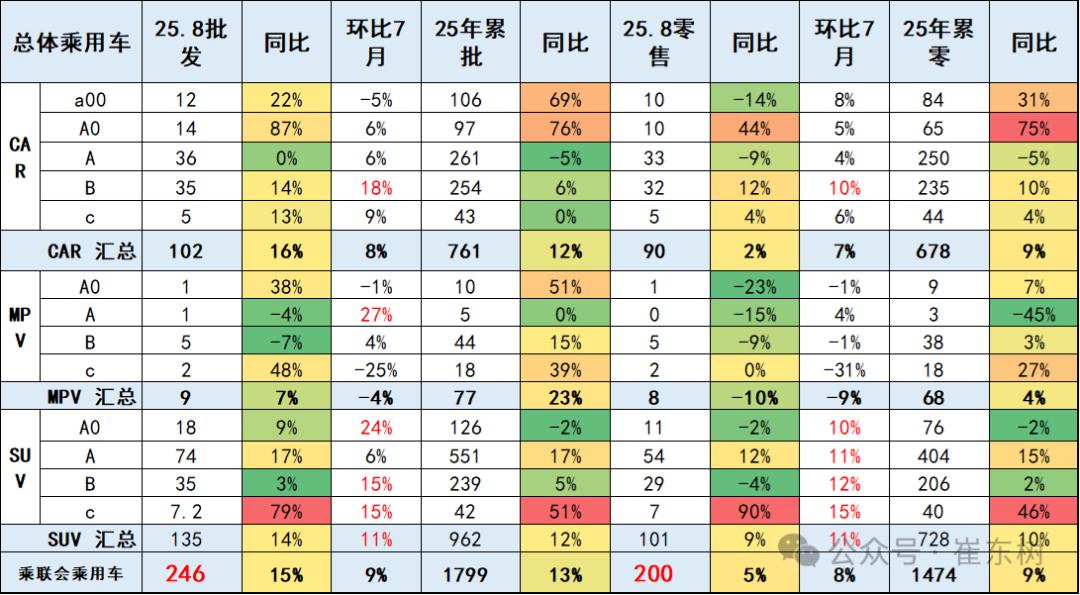
崔东树:8月乘用车零售增5% 轿车零售与SUV零售均较低
智通财经网· 2025-09-14 06:16
Core Insights - The retail growth of passenger cars in August 2025 is projected to be 5%, significantly lower than the 15% growth in wholesale [1] - The retail decline in August is attributed to high interest rates, limited rebates, and the suspension of subsidies [1] - C-class SUVs emerged as the main retail force in August, with strong performance in the high-end SUV segment [1] Passenger Car Market Overview - The overall wholesale volume for passenger cars in August 2025 reached 246,000 units, reflecting a 15% year-on-year increase [2] - The cumulative wholesale volume for the first eight months of 2025 is 1.799 million units, showing a 13% increase compared to the previous year [2] - Retail sales in August 2025 totaled 200,000 units, a 5% increase year-on-year, with a cumulative retail volume of 1.474 million units, up 9% [2] A00 Segment Performance - A00-class cars had a wholesale volume of 117,300 units in August 2025, with a year-on-year increase of 22% but a month-on-month decrease of 5% [5] - Retail sales for A00-class cars decreased by 14% year-on-year but increased by 8% month-on-month [5] - The cumulative wholesale volume for A00-class cars from January to August 2025 is 1.0575 million units, with a 69% year-on-year increase [5] A0 Segment Performance - A0-class cars achieved a wholesale volume of 140,000 units in August 2025, marking an 87% year-on-year increase and a 6% month-on-month increase [8] - Retail sales for A0-class cars increased by 44% year-on-year and by 5% month-on-month [8] - The cumulative wholesale volume for A0-class cars from January to August 2025 is 972,500 units, reflecting a 76% year-on-year increase [8] A-Class Segment Performance - A-class cars had a wholesale volume of 358,700 units in August 2025, with no year-on-year growth but a 6% month-on-month increase [13] - Retail sales for A-class cars decreased by 9% year-on-year but increased by 4% month-on-month [13] - The cumulative wholesale volume for A-class cars from January to August 2025 is 2.6134 million units, showing a 5% year-on-year decline [13] B-Class Segment Performance - B-class cars had a wholesale volume of 345,900 units in August 2025, reflecting a 14% year-on-year increase and an 18% month-on-month increase [19] - Retail sales for B-class cars increased by 12% year-on-year and by 10% month-on-month [19] - The cumulative wholesale volume for B-class cars from January to August 2025 is 2.5364 million units, with a 6% year-on-year increase [19] MPV Market Trends - B-class MPVs had a wholesale volume of 52,700 units in August 2025, a 7% year-on-year decline but a 4% month-on-month increase [23] - Retail sales for B-class MPVs decreased by 9% year-on-year and by 1% month-on-month [23] - C-class MPVs saw a wholesale volume of 21,200 units in August 2025, with a 48% year-on-year increase but a 25% month-on-month decline [23]



瞄准高端产品 加强技术突破 政策助力汽车芯片产业高质量发展
Zhong Guo Zheng Quan Bao· 2025-09-11 20:38
Core Insights - The automotive industry is rapidly evolving towards electrification and intelligence, with AI technology driving the transformation of vehicles into "super intelligent entities" since 2025 [1] - The automotive MCU chip market is experiencing significant growth, with industry participants promoting healthy development through open-source collaboration and ecosystem building [1] Industry Development - The Ministry of Industry and Information Technology (MIIT) emphasizes the need for improved support policies for high-end automotive chips and the importance of core technology breakthroughs to drive high-quality industry development [2] - Automotive chips are categorized into ten types, covering various application scenarios, and have stricter requirements for environmental adaptability, reliability, and safety compared to consumer and industrial chips [2] - The global MCU market is projected to grow from $30.9 billion in 2023 to $33.8 billion in 2024, reaching $37 billion by 2025, driven by demand from the automotive and industrial AIoT sectors [2] Company Performance - Semiconductor companies like Zhaoyi Innovation and Zhongwei Semiconductor reported significant revenue and profit growth, with automotive chip business being a key driver [3] - Zhaoyi Innovation's revenue for the first half of 2025 was 4.15 billion yuan, a 15% increase year-on-year, while its net profit rose by 11.3% to 575 million yuan [3] - Zhongwei Semiconductor's automotive chip revenue reached 17.35 million yuan, up 89.4% year-on-year, with several products entering the supply chains of major automotive manufacturers [3] - Guoxin Technology also reported strong performance in automotive chip revenue, achieving 49.15 million yuan, a 63.81% increase [3] Market Potential - China, as a major automotive and new energy vehicle market, has significant demand potential for automotive-grade chips, with expectations of a 10% annual growth rate from 2025 to 2030 [4] Ecosystem Collaboration - Industry experts advocate for multi-party cooperation to promote collaborative innovation in the automotive chip industry [5] - The automotive industry is leveraging intelligent transformation to create competitive advantages, with an initial ecosystem forming around autonomous compilers and debugging tools [5] - The development of a unified platform and open-source collaboration models is seen as essential for overcoming current challenges in the automotive chip sector [6]

易车研究院:小城车市消费升级加速,新能源与个性化车型成新增长极
Zhong Guo Chan Ye Jing Ji Xin Xi Wang· 2025-09-11 09:49
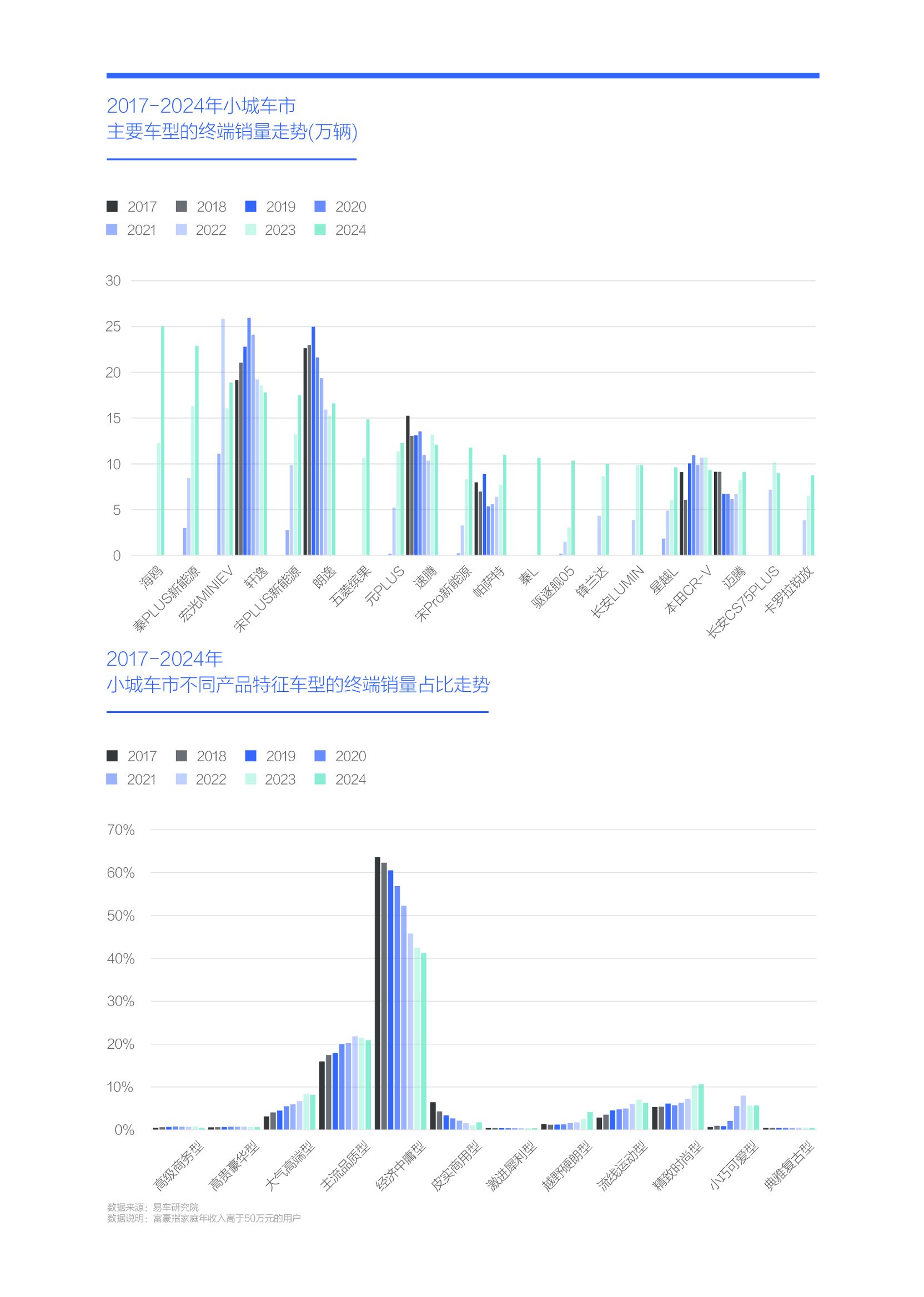
Group 1 - The core viewpoint of the articles highlights the significant transformation in the small city car market, driven by the increasing dominance of the middle-aged demographic, leading to a decline in traditional models like the Lavida, Sylphy, and Haval H6, while brands like BYD emerge as major beneficiaries [1][8][19] - From 2017 to 2024, the market share of traditional economy models dropped from 63.52% to 41.22%, while the market share of mainstream quality and high-end models increased from 15.96% to 20.92% and from 3.13% to 8.20%, respectively [1][8] - In 2024, BYD's market share in the small city car market surged to 16.43%, surpassing Volkswagen's 10.82%, with BYD occupying 7 out of the top 20 models [8][19] Group 2 - The small city car market is experiencing a shift towards upgraded, energy-efficient, and practical vehicles, with 14 out of the top 20 models in 2024 being launched after 2020, including popular electric and hybrid models [2][8] - The competition in the small city car market is intensifying, with brands like Geely aiming to challenge BYD's leadership by launching new models that emphasize cost-effectiveness and meet the evolving consumer demands [7][8] - The rise of the small city car market is attributed to government subsidies and the return of younger and older demographics to small cities, which has led to a diversification of consumer needs and preferences [17][19]