药明生物

Search documents
中国创新药资产加速走向国际,港股创新药精选ETF(520690)盘中交投活跃,最新规模、份额创成立以来新高
Xin Lang Cai Jing· 2025-10-23 05:53
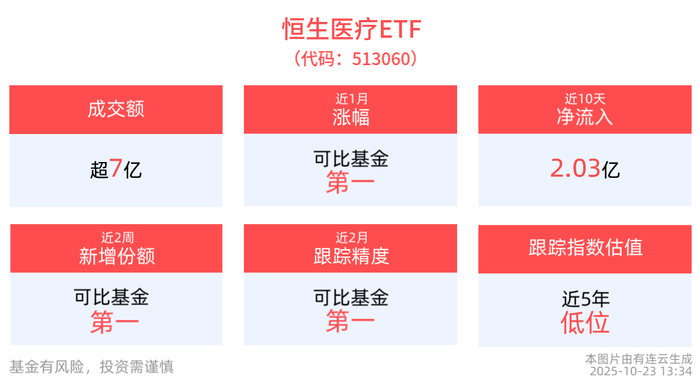
Market Performance - The Hang Seng Healthcare Index decreased by 2.71% as of October 23, 2025, with mixed performance among constituent stocks [2] - The Hang Seng Medical ETF (513060) fell by 2.41%, with a latest price of 0.65 CNY, but has seen a 3.42% increase over the past three months [2] - The Hong Kong Stock Connect Innovative Drug Selection Index dropped by 3.70%, with the Hong Kong Innovative Drug Selection ETF (520690) down by 3.26% [4][5] - The CSI Pharmaceutical 50 Index declined by 0.95%, while the Pharmaceutical 50 ETF (159838) decreased by 0.96% [6] Liquidity and Trading Activity - The Hang Seng Medical ETF had a turnover of 11.25% and a trading volume of 763 million CNY, indicating active market participation [2] - The Hong Kong Innovative Drug Selection ETF recorded a turnover of 21.44% with a trading volume of approximately 98.5 million CNY [5] - The Pharmaceutical 50 ETF had a turnover of 1.67% and a trading volume of 2.71 million CNY [6] Key Events and Trends - The flu season has started early, leading to a rise in flu-related stocks, with companies like Hendi Pharmaceutical and Duori Pharmaceutical seeing significant gains [7] - The ongoing ESMO (European Society for Medical Oncology) conference has heightened interest in Chinese pharmaceutical companies, showcasing clinical data from firms like Heng Rui Pharmaceutical and Ke Long Bo Tai [7] - The collaboration between Sinopharm and Takeda is expected to enhance foreign investment confidence in Chinese innovative drug assets [7] Industry Insights - The Chinese innovative drug sector is accelerating its international presence, with 135 licensing-out transactions recorded from January to October 17, 2025, totaling over 102.9 billion USD [7] - The ESMO conference highlighted 23 LBA studies led by Chinese scholars, demonstrating the global competitiveness of China's innovative drug pipeline [7] - The aging population is increasing the demand for chronic disease treatments, while the optimization of the medical insurance payment system and AI technology applications are injecting new vitality into the industry [8] ETF Overview - The Hang Seng Medical ETF has a current scale of 6.865 billion CNY, ranking in the top third among comparable funds [8] - The Hong Kong Innovative Drug Selection ETF reached a new high with a scale of 468 million CNY [10] - The Pharmaceutical 50 ETF tracks the top 50 pharmaceutical companies in China, with the top ten stocks accounting for 59.46% of the index [11]

港股创新药概念股走低,相关ETF跌约3%
Mei Ri Jing Ji Xin Wen· 2025-10-23 02:35
Group 1 - The core viewpoint indicates that Hong Kong's innovative pharmaceutical stocks have declined, with notable drops in companies such as Kelun-Botai Biopharmaceuticals falling over 6%, and others like 3SBio and Zai Lab dropping over 5% [1] - Multiple Hong Kong innovative pharmaceutical-related ETFs have also experienced a decline of approximately 3% [2] - Analysts suggest that after a decade of transformation, China's innovative pharmaceutical industry is entering a phase of realization, with a steady increase in the number of domestic innovative drugs approved for market and significant overseas transactions [3]

湘财证券晨会纪要-20251023
Xiangcai Securities· 2025-10-23 02:08
Automotive Industry - The core point of the report highlights the impressive performance of the Chinese automotive industry in the first three quarters of 2025, with strong growth in new energy vehicles (NEVs) [3][4] - In the first three quarters of 2025, production and sales of NEVs exceeded 11.24 million units, representing a year-on-year growth of 35.2% and 34.9% respectively, with a penetration rate of 46.1% [4] - In September 2025, NEV production and sales reached 1.617 million and 1.604 million units, showing a month-on-month increase of 16.3% and 15%, and a year-on-year increase of 23.7% and 24.6% [4] - The export volume of automobiles in the first three quarters of 2025 increased by 14.8% year-on-year, with a total export of 4.95 million vehicles [4] - The report suggests focusing on leading companies in the NEV supply chain and those with overseas market presence, as the increasing penetration rate of NEVs will drive the collaborative development of the entire industry chain [4][5] Investment Recommendations - The report indicates that the automotive sector is experiencing a resonance phase between new product cycles and technological advancements, particularly in smart driving and smart cockpit technologies, which are expected to drive continuous sales growth [5] - Continuous policy support for automotive consumption and the rising penetration rate of NEVs provide a broad market space for vehicle manufacturers [5] - In the components sector, the rapid increase in the penetration of smart components such as smart cockpits and electric drive systems is expected to benefit related companies [5] - The report maintains an "overweight" rating for the automotive industry, recommending attention to quality companies in the sector, such as Shuanghuan Transmission and Beite Technology [5] New Materials - The report notes a slight increase of 0.05% in the rare earth magnetic materials industry, outperforming the benchmark by 2.27 percentage points [7] - The prices of rare earth concentrates have accelerated their decline, with specific price drops reported for various rare earth minerals [9] - The report highlights the need to monitor the demand side closely, as the market's just-in-time transactions are primarily driven by basic needs, with expectations for demand to improve in the coming months [10] Medical Services - The report indicates a decline of 2.48% in the pharmaceutical and biological sector, with the medical services sub-sector experiencing a significant drop of 5.21% [11][12] - The current PE ratio for the medical services sector is 34.96, with a recent decrease of 1.96 from the previous week [13][14] - The report emphasizes the potential of ADC (Antibody-Drug Conjugates) and CDMO (Contract Development and Manufacturing Organization) in the innovative drug sector, projecting significant growth in the ADC outsourcing market [15][16] - The report maintains a "buy" rating for the medical services industry, recommending attention to high-growth companies and those with improving expectations, such as WuXi AppTec and Aier Eye Hospital [17] ETF Market Overview - As of October 17, 2025, there are 1,328 ETFs in the Shanghai and Shenzhen markets, with a total asset management scale of 55,264.48 billion [19] - The report notes that the average weekly change in shares for stock ETFs was an increase of 27.63 million shares, with significant increases in bank and brokerage ETFs [20] - The report recommends focusing on the automotive, coal, and agriculture sectors within the PB-ROE framework for ETF rotation strategies, highlighting the potential for these sectors to outperform [24]
2026年中国医药外包(CXO)行业政策、运行现状、细分市场、竞争格局及未来发展趋势研判:创新药融资与BD交易双升,CXO行业景气度持续向上[图]
Chan Ye Xin Xi Wang· 2025-10-23 01:26
Core Insights - The CXO (Contract X Organization) model allows pharmaceutical companies to outsource drug development, production, or sales to specialized institutions, enhancing efficiency and reducing costs while sharing the benefits of pharmaceutical innovation [1][2][4] - The global CXO market is projected to reach $196.6 billion by 2025, with a CAGR of 14.0% from 2021 to 2025, while the Chinese market is expected to grow to 247.7 billion yuan, with a remarkable CAGR of 26.56% from 2020 to 2025 [1][7][9] - Recent policies in China, such as the MAH (Marketing Authorization Holder) system, are optimizing resource allocation and encouraging innovation, providing a robust support system for the CXO industry [5][10] CXO Industry Overview - CXO encompasses various outsourcing services including CRO (Contract Research Organization), CMO (Contract Manufacturing Organization), CDMO (Contract Development and Manufacturing Organization), and CSO (Contract Sales Organization) [2][4] - The CXO industry is characterized by a full-process collaboration model that integrates services from early research to commercial production, significantly improving client R&D efficiency [4][10] Policy Analysis - Recent Chinese policies have created a favorable environment for the CXO industry, promoting innovation and optimizing the pharmaceutical supply chain [5][10] - The implementation of the MAH system has separated drug marketing and production licenses, enhancing specialization and reducing redundant investments [5][10] Global Market Trends - The global CXO market is experiencing rapid expansion, driven by increased R&D investments from innovative pharmaceutical companies [6][9] - By 2025, the global CRO market is expected to reach approximately $98 billion, while the CDMO market is projected to reach $99 billion, indicating strong growth potential [6][9] Chinese Market Dynamics - China's CXO market is rapidly expanding, with a projected market size increase from 76.3 billion yuan in 2020 to 247.7 billion yuan by 2025, reflecting a strong domestic market vitality [7][9] - In the first eight months of 2025, domestic innovative drug financing reached $7.75 billion, a year-on-year increase of 89%, highlighting the growing investment interest in the sector [9][10] Competitive Landscape - The Chinese CXO industry features a clear competitive hierarchy, with leading companies like WuXi AppTec and Kanglong Chemical expanding their market share through comprehensive service capabilities [10] - The first-tier companies are establishing a global delivery system, while second-tier companies are focusing on niche areas to build competitive advantages [10] Future Development Trends - The CXO industry is expected to evolve around three main directions: technological advancement, global operations, and ecosystem integration [10][12] - Leading companies will focus on high-tech areas such as ADC and gene therapy, while also enhancing their global operational resilience [12][13] - The integration of AI in drug development will drive new service models and reshape the competitive landscape, with larger firms consolidating their positions while smaller firms must specialize to survive [14]





港股科技ETF(159751)盘中净申购超400万份,往后看对比红利板块科技线仍会是主线
Xin Lang Cai Jing· 2025-10-22 06:45
Group 1 - The technology sector is experiencing a pullback, but it is expected to remain a main focus until the end of the year due to its strong correlation with indices and risk appetite, particularly in AI [1] - There is a potential return of active funds that had previously exited the market, as well as institutional demands for net asset value and rankings before the assessment period at the end of November and December [1] - Market capitalization style may slightly favor small and mid-cap stocks, as many absolute return institutions are expected to operate conservatively in the next two months, limiting the market's ability to exceed a trading volume of 3 trillion [1] Group 2 - The domestic AI supply chain, AI applications, and Hong Kong internet stocks are viewed positively, especially during the performance gap in November and December, where focus will shift to economic policy expectations for December and next year's industry outlook [2] - The domestic AI supply chain is expected to have more visibility and potential for earnings upgrades compared to overseas chains, attracting institutions that previously missed out on overseas computing power [2] - In the Hong Kong tech sector, low valuations and the need for institutions to lock in profits will drive interest, especially as the market anticipates upward index movements and faces selling pressure from broad-based ETFs [2] Group 3 - As of October 22, 2025, the CSI Hong Kong Stock Connect Technology Index shows mixed performance among its constituent stocks, with notable gains from China National Pharmaceutical (4.27%) and Semiconductor Manufacturing International Corporation (0.88%) [3] - The CSI Hong Kong Stock Connect Technology Index consists of 50 large-cap, high R&D investment, and high revenue growth technology companies, reflecting the overall performance of tech leaders within the Hong Kong Stock Connect [3] - The top ten weighted stocks in the CSI Hong Kong Stock Connect Technology Index account for 66.5% of the index, including major players like Alibaba, Tencent, and Xiaomi [3]



中泰国际每日晨讯-20251021
ZHONGTAI INTERNATIONAL SECURITIES· 2025-10-21 05:10
Market Performance - The Hang Seng Index rose by 2.4% to 25,859 points, while the Hang Seng China Enterprises Index increased by 2.5% to 9,233 points[1] - Total turnover in Hong Kong stocks was HKD 239.2 billion, lower than HKD 314.6 billion on the previous Friday, indicating market caution despite the rise[1] - Key sectors such as Energy, Consumer Discretionary, Information Technology, and Conglomerates saw increases of 2.8%, 3.3%, 3.2%, and 2.0% respectively, while Materials fell by 0.7%[1] Economic Indicators - China's Q3 GDP grew by 4.8%, surpassing the market expectation of 4.7%[3] - Industrial output in September rose by 6.5%, exceeding the forecast of 5.0%[3] - Retail sales increased by 3.0% year-on-year, aligning with expectations[3] Real Estate Trends - New home sales in 30 major cities reached 1.98 million square meters, down 25.4% year-on-year but improved from a previous decline of 41.4%[3] - New housing starts fell by 15.0% to 55.98 million square meters, a smaller decline compared to 19.8% in August[3] - The price index for new residential properties in 70 major cities dropped by 2.7% year-on-year, with first, second, and third-tier cities experiencing declines of 0.7%, 2.1%, and 3.4% respectively[3] Sector Highlights - Li Auto (9863 HK) saw a 6.2% increase in stock price after its founder and shareholders increased their holdings[4] - UBTECH (9880 HK) surged by 9.8% following a procurement order worth HKD 126 million for its latest humanoid robot[4] - The Hang Seng Healthcare Index rose by 1.3%, with major pharmaceutical companies showing stable performance despite market concerns[4]
港股创新药ETF(159567)跌0.46%,成交额9.07亿元
Xin Lang Cai Jing· 2025-10-20 10:03
Core Insights - The Hong Kong Innovative Drug ETF (159567) closed down 0.46% on October 20, with a trading volume of 907 million yuan [1] - The fund was established on January 3, 2024, with an annual management fee of 0.50% and a custody fee of 0.10% [1] - As of October 17, 2024, the fund's shares totaled 8.134 billion, with a total size of 6.968 billion yuan, reflecting a significant increase in both shares and size compared to the previous year [1] Fund Performance - The fund has seen a remarkable increase of 1957.27% in shares and 1744.35% in size since December 31, 2023 [1] - The fund's cumulative trading amount over the last 20 trading days reached 27.487 billion yuan, with an average daily trading amount of 1.374 billion yuan [1] - Year-to-date, the cumulative trading amount is 224.063 billion yuan, averaging 1.173 billion yuan per day over 191 trading days [1] Fund Management - The current fund manager is Ma Jun, who has managed the fund since its inception, achieving a return of 71.34% during the management period [2] - The fund's top holdings include companies such as Innovent Biologics, WuXi Biologics, BeiGene, and others, with significant percentages of the portfolio allocated to these stocks [2]


港股通数据统计周报:2025.10.13-2025.10.19-20251020
Zhe Shang Guo Ji Jin Rong Kong Gu· 2025-10-20 08:07
Group 1: Top Net Buy Companies - The top net buy company is Pop Mart (9992.HK) with a net buy amount of 30.56 billion CNY and a change in holdings of 11,095,857 shares[8] - Xiaomi Group (1810.HK) follows with a net buy amount of 29.88 billion CNY and a change in holdings of 65,019,122 shares[8] - China Mobile (0941.HK) ranks third with a net buy amount of 23.84 billion CNY and a change in holdings of 27,952,291 shares[8] Group 2: Top Net Sell Companies - The top net sell company is SMIC (0981.HK) with a net sell amount of -63.04 billion CNY and a change in holdings of -91,228,489 shares[9] - Alibaba (9988.HK) follows with a net sell amount of -40.16 billion CNY and a change in holdings of -26,011,949 shares[9] - Tencent Holdings (0700.HK) ranks third with a net sell amount of -27.79 billion CNY and a change in holdings of -4,569,909 shares[9] Group 3: Industry Distribution - The report highlights significant net buying in the consumer discretionary sector, particularly in companies like Pop Mart and Meituan[11] - The technology sector shows notable net selling, with companies like SMIC and Tencent experiencing substantial outflows[11] - Financial services also see mixed activity, with both buying and selling observed in major banks like ICBC and CMB[11]
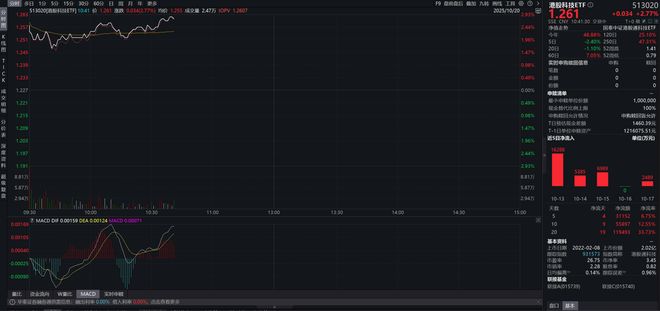
特朗普:“关税冲突不可持续”,港股科技ETF(513020)盘中涨超2.7%
Mei Ri Jing Ji Xin Wen· 2025-10-20 03:14
Core Viewpoint - Recent signals of tariff easing from the Trump administration have positively impacted the Hong Kong stock market, particularly the technology sector, which has seen significant inflows and price increases [1][3]. Group 1: Tariff Easing Signals - On October 17, Trump acknowledged that the 100% tariffs on China are "unsustainable" [1][3]. - Trump has been quietly relaxing several tariff policies, exempting dozens of products from tariffs and indicating a willingness to exclude more items during trade negotiations [3]. - The leaders of China and the U.S. agreed to hold new consultations soon, suggesting potential tariff reductions [3]. Group 2: Performance of Hong Kong Technology Sector - The Hong Kong Technology ETF (513020) has risen over 2.7% in a single day and has gained nearly 50% year-to-date, attracting nearly 1.2 billion yuan in inflows over the past 20 days [1][3]. - The technology sector is characterized by growth-oriented attributes, with a focus on future cash flow discounting, making it sensitive to interest rate environments [3]. - The core drivers of the technology sector have shifted from internet innovation to AI and hard technology innovation, supported by industrial policies and valuation recovery [3]. Group 3: Index Performance - The Hong Kong Technology ETF tracks the CSI Hong Kong Stock Connect Technology Index, which includes popular sectors such as internet, innovative pharmaceuticals, and new energy [4]. - The Hong Kong Stock Connect Technology Index has outperformed both the Hang Seng Technology Index and the Hong Kong Stock Connect Internet Index, with a cumulative increase of 76.06% since 2018 [6][7]. Group 4: Future Outlook - The ongoing Federal Reserve rate cut cycle is expected to enhance the attractiveness of Hong Kong technology stocks, as lower interest rates typically boost valuations in growth sectors [8]. - As the U.S. dollar's appeal diminishes due to rate cuts, international investors may reassess investment values, potentially leading to increased capital inflows into the Hong Kong market [8]. - The combination of renminbi appreciation and sustained expectations of U.S. rate cuts supports a favorable outlook for Hong Kong technology stocks, particularly those focused on AI [8].
医药生物行业:坚定看好创新主线,积极把握Q3业绩
ZHONGTAI SECURITIES· 2025-10-19 12:30
Investment Rating - The report maintains a "Buy" rating for key companies in the pharmaceutical and biotechnology sector, including WuXi AppTec, WuXi Biologics, and Changchun High-tech [5][28]. Core Insights - The report expresses a strong outlook on the innovation theme and emphasizes the importance of capturing Q3 performance. The pharmaceutical sector has shown a decline, with the Shanghai Composite Index down 2.73% and the pharmaceutical sector down 3.65% [12][16]. - The report highlights the active participation of Chinese biopharmaceutical companies in global business development (BD) transactions, which have reached 38% of the global total since 2025. This trend is expected to boost investment sentiment in the sector [12][16]. - The report suggests focusing on companies with improving performance metrics, particularly in the CRO/CDMO and upstream segments, as well as in medical devices and traditional Chinese medicine [12][16]. Summary by Sections Industry Overview - The pharmaceutical industry comprises 515 listed companies with a total market capitalization of approximately 731.59 billion yuan and a circulating market value of about 666.30 billion yuan [2]. Market Dynamics - The pharmaceutical sector has experienced a year-to-date return of 18.85%, outperforming the Shanghai Composite Index by 4.13 percentage points. However, recent weeks have seen a decline in various sub-sectors, with traditional Chinese medicine being the only one to show an increase [16][18]. Valuation Metrics - The current valuation of the pharmaceutical sector is approximately 26.2 times PE based on 2025 earnings forecasts, which is a premium of 17.3% compared to the overall A-share market (excluding financials). The TTM valuation stands at 30.1 times PE, below the historical average of 34.9 times PE [18][20]. Key Company Performance - The report lists several companies with strong performance metrics, including WuXi AppTec, WuXi Biologics, and Changchun High-tech, all rated as "Buy." The average decline for recommended stocks in the month was 10.08%, with a weekly decline of 7.43% [28][29]. Business Development Activity - The report notes that several pharmaceutical companies have engaged in overseas licensing agreements, indicating a growing recognition of Chinese companies' capabilities in the global market [12][16]. Regulatory Updates - Recent regulatory announcements from the National Medical Insurance Administration and the National Medical Products Administration are aimed at improving drug pricing transparency and enhancing the approval process for innovative drugs [12][29]. Price Trends - The report tracks the price movements of various vitamins, noting slight decreases in some and stability in others, which may impact the cost structure for companies in the sector [31][32].