五粮液

Search documents
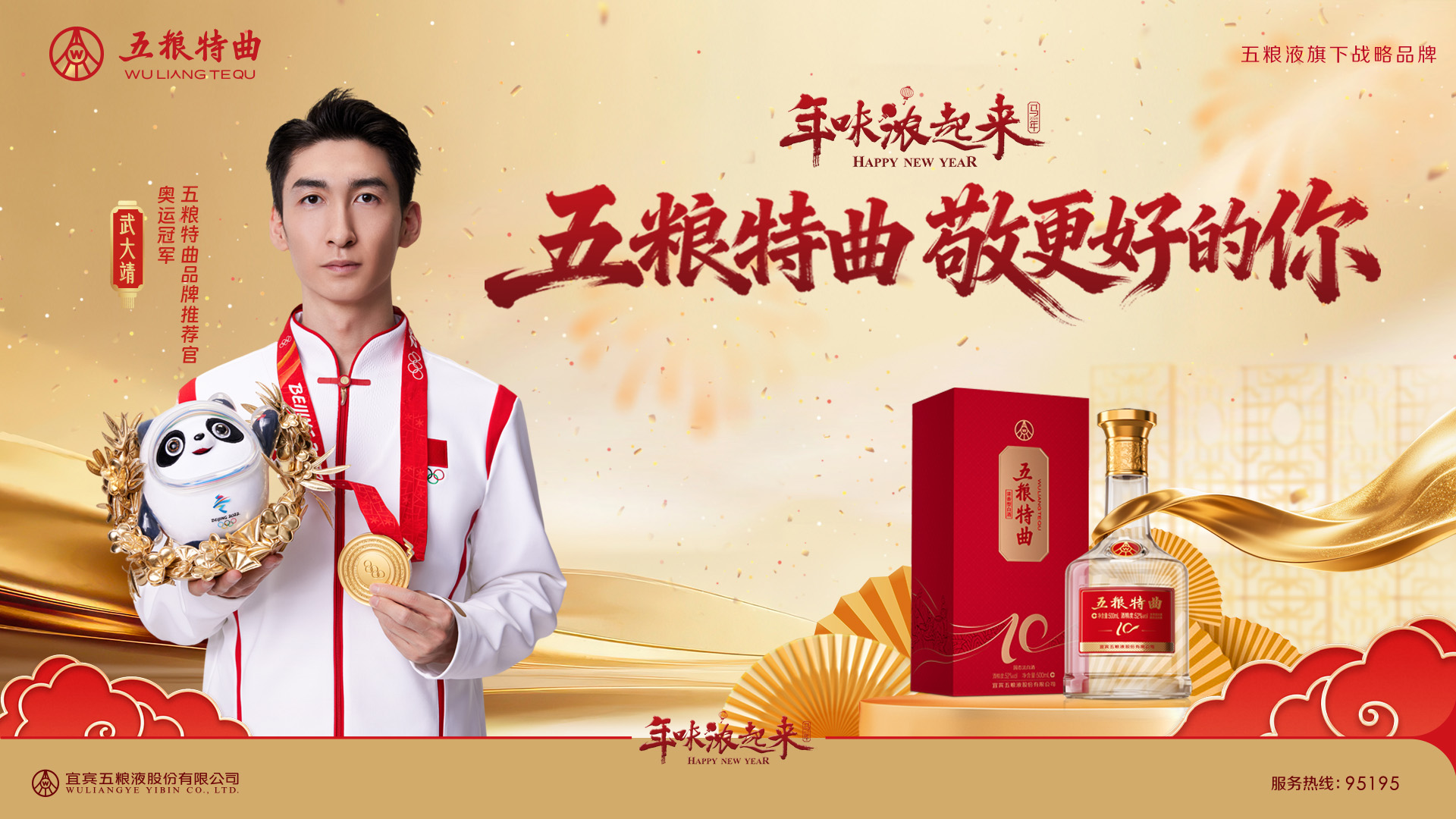
官宣!武大靖担任五粮特曲品牌推荐官,与冠军共举杯,让年味浓起来!
Sou Hu Wang· 2026-01-20 04:58
Core Viewpoint - Wuliangye's strategic brand Wuliang Tequ has appointed Olympic champion Wu Dajing as its brand ambassador, marking a significant move in sports marketing and aligning the brand's core values with the spirit of "faster, higher, stronger" [2][3] Group 1: Brand and Marketing Strategy - The collaboration with Wu Dajing represents a deep resonance between the brand's pursuit of excellence and the champion's spirit [2][10] - Wuliang Tequ aims to enhance its brand expression of "better Tequ" by leveraging Wu Dajing's champion mentality, promoting a message of dedication and continuous improvement [10] Group 2: Product Quality and Recognition - Wuliang Tequ has been recognized for its quality, winning the "2013 China Baijiu Body Design Award" and the "Blind Tasting Champion" at the 2018 China International Wine Expo, showcasing its status as a "dual champion" in the industry [5][7] - The brand emphasizes traditional brewing techniques while striving for self-improvement and excellence in every drop of liquor, paralleling Wu Dajing's relentless pursuit of speed and strength [7]

宜宾银行一年内三度调整行长,郭华正式接任
Zhong Guo Jing Ying Bao· 2026-01-20 03:38
记者了解到,蒋琳曾任五粮液集团党委委员。该行2025年年中报显示,五粮液集团是该行第一大股东。 不过,2025年10月30日,该行公告表示,蒋琳已向董事会送达辞呈,提出因个人原因,辞去该行执行董 事、行长职务。 【这家上市银行,一年内行长三次调整!】宜宾银行(02596.HK)近日发布公告称,已收到国家金融 监督管理总局四川监管局批复,正式核准郭华先生行长任职资格,郭华自2026年1月13日起履行行长职 责。 《中国经营报》记者注意到,一年内,该行行长已多次调整。 2025年4月8日,该行公告,行长杨兴旺因个人身体原因,已向董事会送达辞呈,辞去该行执行董事、行 长、董事会风险管理委员会主席、战略与资产负债管理委员会委员及关联交易控制委员会委员职务。 2025年6月4日,宜宾银行宣布,董事会审议通过委任蒋琳为该行行长。蒋琳自2024年4月起任该行党委 委员、副书记。蒋琳担任行长的任职资格尚需报国家金融监督管理机构核准。董事会同意在国家金融监 督管理机构核准蒋琳的行长任职资格前,由蒋琳代为履行行长职责,代为履职期限自董事会审议通过之 日起不超过6个月。 记者就宜宾银行频繁调整行长及其他情况与该行确认,该行相关人士 ...

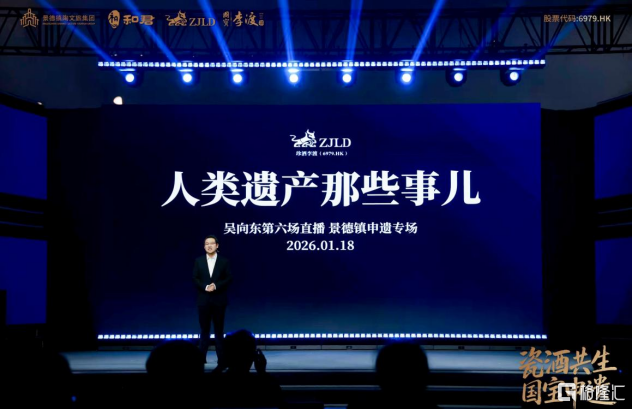
每个人都能成为人类遗产的传承者!吴向东直播呼吁珍视和传承人类遗产
Ge Long Hui· 2026-01-20 02:13
Core Viewpoint - The second summit of the Baijiu Heritage Application Co-Creation Alliance highlighted the importance of applying for world heritage status for Chinese Baijiu, with a focus on cultural preservation and the unique aspects of Baijiu production [1][5]. Group 1: Event Overview - The summit took place on January 18 in Jingdezhen, Jiangxi, attracting 6.59 million viewers online, with a peak concurrent viewership of 213,500 [1]. - Wu Xiangdong, Chairman of Zhenjiu Lidu Group, delivered a live broadcast titled "Human Heritage Matters," discussing the significance of world heritage and its protection [3]. Group 2: Heritage Application Insights - Wu emphasized that the "Jingdezhen Handcrafted Porcelain Heritage" is set to be nominated as a world heritage site in January 2025, which could serve as a reference for Baijiu's heritage application [5]. - Despite the rich history and unique brewing techniques of Chinese Baijiu, it has yet to be recognized as a world heritage, with existing listings primarily featuring wine and beer [5]. - The application process for Baijiu heritage status has been ongoing since 2006, involving major brands like Moutai, Lidu, Wuliangye, and Fenjiu [5]. Group 3: Challenges and Recommendations - Current world heritage evaluations focus on endangered projects, which may disadvantage the large and thriving Chinese Baijiu industry in terms of urgency [5]. - Wu suggested exploring alternative application pathways, such as leveraging the French Burgundy region's "terroir" concept and highlighting the unique microbial diversity involved in Baijiu fermentation [5]. - The complexity of the microbial system in Baijiu production, with over 300 types of bacteria, distinguishes it from other distilled spirits [5]. Group 4: Cultural Engagement and Industry Impact - During a dialogue segment, participants discussed enhancing the experiential and relatable aspects of cultural heritage to engage younger audiences [7]. - Wu stated that the heritage application process is more about uniting industry efforts and articulating cultural value than merely achieving success [7]. - The live broadcast sparked significant attention and discussion within the industry, reinforcing Zhenjiu Lidu's leadership role and commitment to heritage preservation [9].
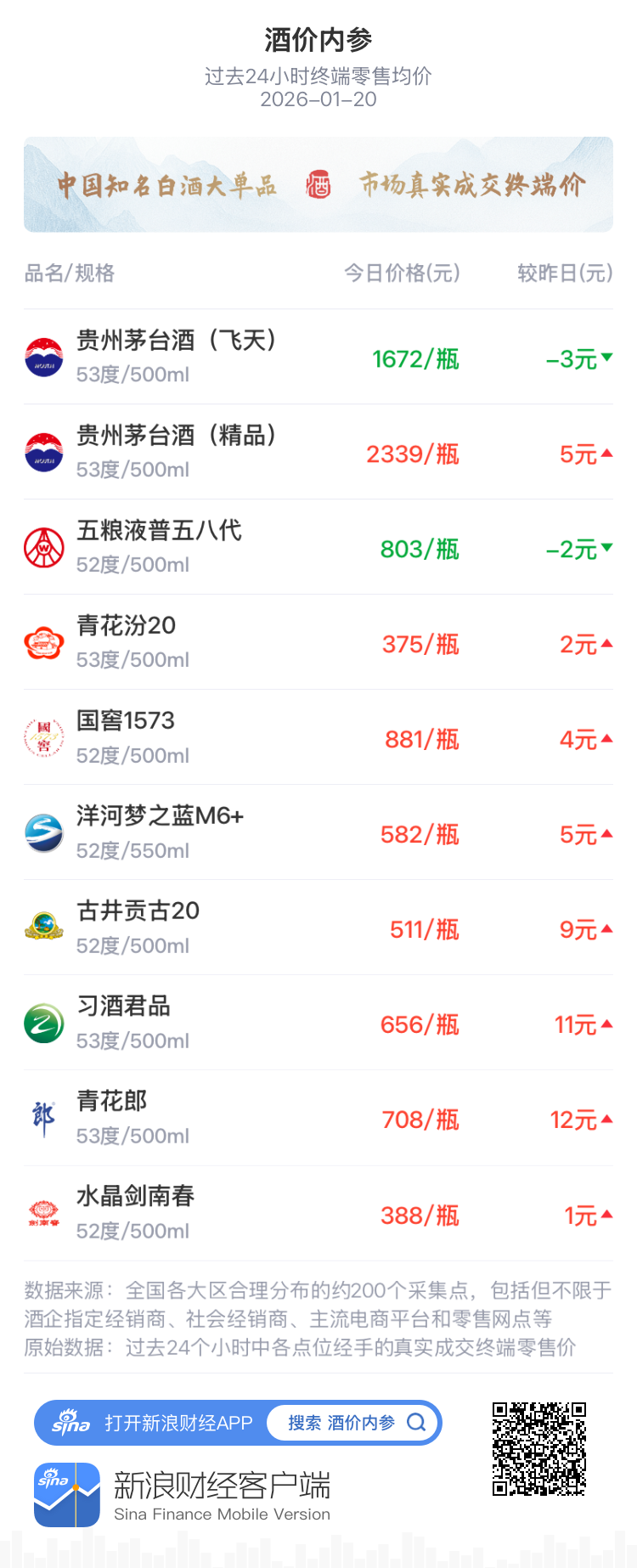
酒价内参1月20日价格发布 飞天茅台下跌3元
Xin Lang Cai Jing· 2026-01-20 02:05
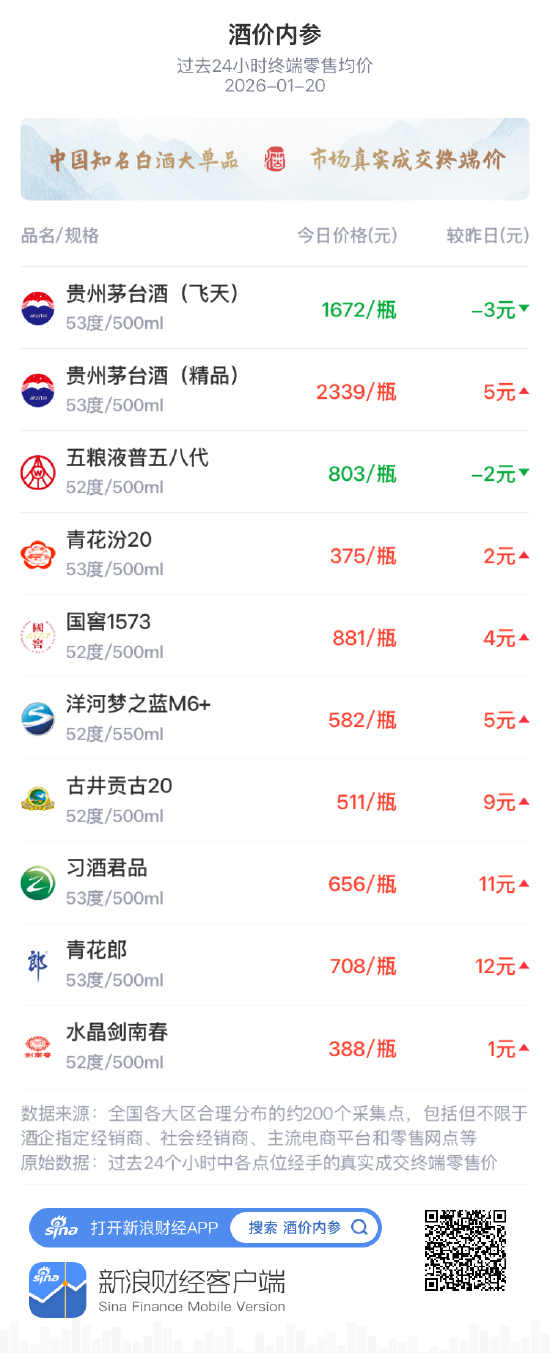
Core Viewpoint - The Chinese liquor market is experiencing a price rebound, with the average retail price of the top ten liquor products rising, indicating a structural fluctuation in the market despite low trading volumes [1][2]. Price Trends - On January 20, the total retail price for a package of the top ten liquor products reached 8915 yuan, an increase of 44 yuan from the previous day [1]. - Eight out of the ten products saw price increases, with Qinghua Lang leading with a rise of 12 yuan, followed by Xijiu Junpin with an 11 yuan increase, and Gujing Gonggu 20 with a 9 yuan increase [1][6]. - The two products that experienced price declines were Feitian Moutai and Wuliangye Pu Wubai Dai, which fell by 3 yuan and 2 yuan, respectively [1][6]. Market Data Collection - The price data is sourced from approximately 200 collection points across various regions, including designated distributors, social distributors, e-commerce platforms, and retail outlets, ensuring a comprehensive and objective representation of the market [2]. Industry Insights - CICC's report indicates that Kweichow Moutai is advancing its market-oriented transformation to strengthen its pricing power and adapt to industry changes, which may enhance its market influence and solidify its leading position [3]. - The report predicts that leading liquor companies will accelerate the elimination of weaker brands and outdated capacities, thereby increasing industry concentration and facilitating market clearing [3]. - CICC maintains its profit forecast for 2025 but has reduced the 2026 profit forecast by 2.8% to 904.7 billion yuan, while introducing a new forecast for 2027 at 915.9 billion yuan [3].

如何看2025年12月消费数据
2026-01-20 01:50
Summary of Key Points from Conference Call Records Industry Overview - **Consumer Sector Performance**: In December 2025, the overall retail sales growth was 0.9% year-on-year, with a full-year growth of 3.7%. Online retail grew by 5.2% for the year, while offline retail showed slower growth [2][3]. Key Insights and Arguments - **Retail Categories**: - Supermarket retail sales increased by 4.3% year-on-year, while department stores only saw a 0.1% increase [3]. - Essential goods performed well, with grain and oil food growth at 3.9%. In the discretionary category, cosmetics grew by 8.8%, and gold and jewelry increased by 5.9% due to a rise in gold prices [3][4]. - Communication equipment maintained a growth rate of over 20%, while home appliances declined by 19% due to tightening subsidies [3][4]. - **Automotive Sector**: - The total retail sales for automobiles reached 548.2 billion, down 5% year-on-year. Passenger car sales fell by 8.8%, but new energy vehicle wholesale sales grew by 3.3% [11]. - **Textile and Apparel**: - The textile and apparel sector saw a 0.6% year-on-year retail growth in December, but a decline in month-on-month performance due to weather and the delayed Spring Festival [13][14]. - **Alcohol Industry**: - The retail sales of the liquor industry decreased by 2.9% year-on-year in December, with a price index decline of 0.19%. The industry is currently in a phase of active inventory reduction [16][17]. - **Consumer Expectations**: - Due to the late Spring Festival and expectations of rising gold prices, consumer demand is anticipated to recover in January and February 2026 [5]. Additional Important Insights - **Investment Recommendations**: - In the beauty and personal care sector, companies like Shiseido and domestic brands such as Maogeping are recommended. For the gold and jewelry sector, brands with strong store expansion logic are highlighted [6][10]. - In the automotive sector, companies like JAC Motors and Geely are recommended, focusing on high-end and luxury markets [12]. - For the textile and apparel sector, brands like Li Ning and Fuanna are suggested, with a focus on companies that can support their market value through dividends [15]. - **Household Appliances**: - The household appliance sector is experiencing a downturn, with significant declines in sales across various categories. However, leading companies like Midea and Haier are expected to maintain slight growth due to low inventory levels [21][22][24]. - **Light Industry**: - The light industry saw a decline in furniture sales by 2.2% year-on-year, with exports down by 9.8%. However, some companies are expected to see revenue and profit recovery in 2026 [26][27]. Conclusion The consumer sector is facing mixed performance across various categories, with essential goods showing resilience while discretionary spending is under pressure. Investment opportunities exist in specific brands and sectors that are positioned to benefit from changing consumer behaviors and market dynamics.
酒价内参1月20日价格发布 十大单品价格低位回升
Xin Lang Cai Jing· 2026-01-20 01:20
Core Insights - The Chinese white liquor market has seen a general price rebound for the top ten products as of January 20, marking a five-day high after a period of low prices. The total retail price for a bundled package of these products is 8,915 yuan, an increase of 44 yuan from the previous day [1]. Price Movements - The market experienced a broad increase today, with eight products rising in price and two declining, reversing the trend from the previous day. However, trading volumes remain low [1]. - Leading the price increases, Qinghua Lang rose by 12 yuan, followed by Xijiu Junpin with an 11 yuan increase, and Gujing Gonggu with a 9 yuan increase. Other notable increases include Yanghe Dream Blue M6+ and Premium Moutai, both up by 5 yuan, and Guojiao 1573, which increased by 4 yuan. Qinghua Fen 20 and Shuijing Jian'nan Chun saw minor increases of 2 yuan and 1 yuan, respectively [1][4]. Price Table Summary - The following table summarizes the current prices and changes for major products: - Moutai (Feitian): 1,672 yuan, down 3 yuan [3] - Moutai (Premium): 2,339 yuan, up 5 yuan [3] - Wuliangye (Pu Wubai): 803 yuan, down 2 yuan [3] - Qinghua Fen 20: 375 yuan, unchanged [3] - Guojiao 1573: 881 yuan, up 4 yuan [3] - Yanghe Dream Blue M6+: 582 yuan, up 5 yuan [4] - Gujing Gonggu: 511 yuan, up 9 yuan [4] - Xijiu Junpin: 656 yuan, up 11 yuan [4] - Qinghua Lang: 708 yuan, up 12 yuan [4] - Shuijing Jian'nan Chun: 388 yuan, up 1 yuan [4]





打造蓉酒品牌,成都如何破局?
Xin Lang Cai Jing· 2026-01-19 18:12
Core Viewpoint - The article discusses the efforts of Chengdu to enhance its liquor industry by promoting the "Rongjiu" brand through policy measures aimed at upgrading brand strength, industry ecology, and consumer scenarios in response to the evolving market dynamics [3][4]. Group 1: Brand Development - Chengdu is actively seeking to build the "Rongjiu" brand and support the development of regional brands, as outlined in the recent policy drafts [4][6]. - The revenue rankings of leading liquor companies indicate that while Guizhou Moutai leads with 170.61 billion yuan, Chengdu's Shui Jing Fang has a revenue of only 5.217 billion yuan, highlighting significant growth potential [3][4]. Group 2: Industry Structure and Challenges - Chengdu's liquor industry is facing challenges such as insufficient brand concentration, weak transformation among small and medium enterprises, and a lack of innovation in research and development [6]. - The policy draft proposes the establishment of a liquor fund led by Chengdu Industrial Group and aims to include liquor companies in the "Huirong Loan" whitelist to alleviate financing difficulties [6]. Group 3: Consumer Engagement and Market Trends - The article emphasizes the shift in consumer behavior from traditional purchasing to experiential engagement, with venues like 1919 Liquor Life Hall transforming into social spaces [7]. - Chengdu's policy encourages innovation in liquor consumption scenarios, moving beyond traditional sales to enhance consumer experiences through various integrations such as food and beverage pairings [7].
桂林旅游2025年预计扭亏为盈:清障减负 多点发力激活内生增长动能
Zheng Quan Shi Bao Wang· 2026-01-19 14:56
Core Viewpoint - Guilin Tourism (000978.SZ) is expected to achieve a net profit of 11 million yuan in 2025, marking a successful turnaround from losses, with a basic earnings per share of 0.0235 yuan, indicating positive operational development and strategic transformation efforts [1] Group 1: Financial Performance - The company anticipates a significant reduction in net losses for non-recurring profits in 2025, alongside a net profit of 11 million yuan [1] - The company recovered 54.34 million yuan in overdue payments and reversed 19.99 million yuan in bad debt provisions, improving cash flow [1] - The transfer of 100% equity and debt of Guilin Zijiang Danxia Tourism Co., Ltd. contributed approximately 29 million yuan to the net profit for the period [1] Group 2: Strategic Initiatives - Guilin Tourism is implementing a strategy centered on "one core, one optimization, two wings, and three expansions," focusing on optimizing asset structure and resolving historical issues [1] - The company is actively revitalizing its existing assets through tailored strategies, such as transforming the Tianzhitai Building into a multi-functional shopping center [1] Group 3: Growth and Marketing - The company expects to receive approximately 6.25 million tourists in 2025, a year-on-year increase of 9.97%, reflecting strong market recognition of Guilin's tourism resources [2] - Guilin Tourism is enhancing its product offerings through cultural and tourism integration, collaborating with top brands to develop high-end customized services [2] - Innovative marketing strategies, including partnerships with popular mobile games and social media influencers, are being employed to enhance brand visibility and market penetration [2] Group 4: Technological Advancements - The company is leveraging AI technology for product innovation, service upgrades, and operational efficiency, including the launch of an AI assistant and smart monitoring systems [3] - The implementation of 5G-WiFi coverage in scenic areas and the introduction of AI-driven interactive projects are part of the company's digital transformation efforts [3] Group 5: Operational Efficiency - Guilin Tourism has streamlined its management structure and linked employee performance to compensation, effectively reducing operational costs by 9.12 million yuan year-on-year [3] - The company is focusing on enhancing employee motivation and creativity through performance-based incentives [3] Group 6: Future Outlook - The operational achievements in 2025 reflect the company's ongoing reform efforts and practical progress in addressing historical issues, showcasing the potential for core business development [4] - The optimization of asset structure and the implementation of innovative measures are expected to provide substantial growth momentum for the company [4]

白酒行业“冬去春来”系列研究2:沉舟侧畔千帆过,露酒先发一缕春
Sou Hu Cai Jing· 2026-01-19 13:13
Group 1 - The core viewpoint of the report is that the liquor industry, particularly the emerging category of "露酒" (liquor with medicinal properties), is experiencing growth despite the overall decline in the traditional white liquor market since 2016, driven by changing consumer preferences and innovative marketing strategies [1][2][10]. - The white liquor industry has faced a downturn since 2016, with total production decreasing from 12.66 million tons to an estimated 3.594 million tons by 2024, alongside high channel inventory and a decline in interest from younger consumers [1][26]. - "露酒" has historically been associated with health and medicinal properties, limiting its appeal to younger demographics who seek trendy and visually appealing products, creating a structural bottleneck for growth [1][2][10]. Group 2 - The strategy of "去药化" (de-medicalization) is crucial for "露酒" to break through its growth bottleneck, focusing on reducing its medicinal attributes and enhancing its appeal as a social beverage [9][40]. - The report highlights the successful transformation of "露酒" from a functional health drink to a social beverage, exemplified by products like "梅见酒," which have innovated in flavor and presentation to attract younger consumers [9][41]. - The market for "露酒" is projected to exceed 200 billion yuan by 2030, indicating significant growth potential as it becomes a core segment of the liquor industry [9][42]. Group 3 - The "露酒" industry has shown a remarkable profit growth of nearly 200% from 2020 to 2024, outperforming the overall liquor industry, driven by health-conscious trends and product innovation [10][44]. - The product range of "露酒" has diversified to include lower alcohol content and smaller packaging sizes, catering to a wider audience and adapting to modern consumption habits [11][46]. - Innovative marketing strategies, particularly through social media platforms, have helped "露酒" reach younger consumers and reshape its image away from traditional health-focused branding [14][49]. Group 4 - The future of the "露酒" industry looks promising, with expectations of a flourishing market driven by its refreshing taste, innovative marketing, and the entry of major liquor companies like Moutai and Wuliangye, which will enhance product diversity and market presence [15][54]. - The report suggests focusing on investment opportunities within the "露酒" sector, particularly brands that have established a strong market presence and those that are innovating in flavor and marketing to capture the growing consumer base [16][56].

打造蓉酒品牌 成都如何发力?
Sou Hu Cai Jing· 2026-01-19 12:43
Core Viewpoint - The adjustment in pricing strategies by leading liquor companies, such as Guizhou Moutai, reflects the transformation anxiety and desire for breakthroughs in the Chinese liquor industry, which is currently undergoing a deep adjustment phase due to intense competition and market saturation [1] Group 1: Industry Trends - The liquor industry in China is transitioning from "scale competition" to "value competition," making brand strength a key factor for regional differentiation and success [3] - The revenue rankings of major liquor companies indicate that Guizhou Moutai leads with 170.61 billion yuan, followed by Wuliangye at nearly 90 billion yuan and Luzhou Laojiao at approximately 34 billion yuan, while Chengdu's Shui Jing Fang has a revenue of only 5.217 billion yuan, highlighting significant room for growth [3] - Chengdu is actively seeking to enhance its liquor brand through policy measures aimed at supporting the development of the "Rong Jiu" brand and promoting flagship products [5] Group 2: Policy Initiatives - The "Measures for Promoting High-Quality Development of the Liquor Industry in Chengdu" draft emphasizes the need for brand protection and support for liquor companies in intellectual property rights and market order maintenance [5] - Chengdu's government plans to explore the establishment of a liquor fund and include liquor companies in the "Huirong Loan" whitelist to alleviate financing difficulties, providing a sustainable financial support system for high-quality industry development [9] Group 3: Market Dynamics - The shift in consumer behavior from business banquets to social and self-consumption is prompting a focus on innovative consumption scenarios, with policies encouraging the integration of liquor with tourism and experiential consumption [12] - Chengdu's liquor industry is developing a unique liquor tourism route that combines historical culture, brewing techniques, and tourism experiences, aiming to attract both domestic and international visitors [13]