
万华化学

Search documents
化工板块强势回归!石化、化肥股领涨,化工ETF(516020)上探1.63%!
Xin Lang Cai Jing· 2025-12-30 03:20
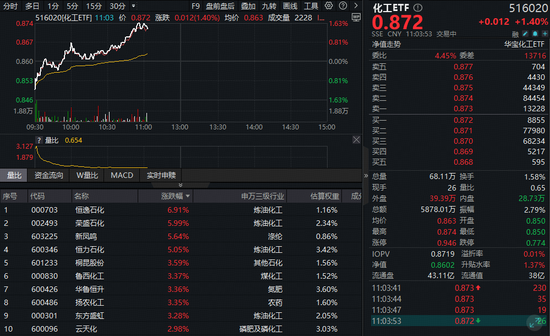
Group 1 - The chemical sector has regained momentum, with the chemical ETF (516020) experiencing a maximum intraday increase of 1.63% and closing up 1.4% [1][8] - Key stocks in the sector include Hengyi Petrochemical, which surged over 6%, and other companies like Rongsheng Petrochemical and New Fengming, which rose over 5% [1][8] - The recent high-quality development conference for the fertilizer industry highlighted the transition towards quality and efficiency in the sector, alongside new quota policies for refrigerants that are expected to optimize supply-demand dynamics [10][10] Group 2 - According to Huaxin Securities, the chemical industry remains weak overall, with mixed performance across sub-sectors due to past capacity expansions and weak demand, although some sectors like lubricants have exceeded expectations [3][10] - The chemical ETF (516020) has a price-to-book ratio of 2.57, indicating a relatively reasonable valuation position within the last decade [3][10] - According to Everbright Securities, the basic chemical industry is expected to see significant growth by 2025, driven by strong demand in new materials and emerging applications such as AI and OLED [4][11] Group 3 - The chemical ETF (516020) tracks the CSI sub-sector chemical industry theme index, covering various segments, with nearly 50% of its holdings in large-cap stocks like Wanhua Chemical and Salt Lake Potash [4][11] - Investors can also access the chemical sector through linked funds of the chemical ETF, providing a diversified investment approach [5][11]


万华化学涨2.09%,成交额10.35亿元,主力资金净流出1537.71万元
Xin Lang Zheng Quan· 2025-12-30 03:19
Core Viewpoint - Wanhua Chemical's stock has shown a positive trend with a year-to-date increase of 10.08%, and significant gains over various trading periods, despite a recent net outflow of funds [1][2]. Group 1: Stock Performance - As of December 30, Wanhua Chemical's stock price increased by 2.09% to 77.74 CNY per share, with a trading volume of 10.35 billion CNY and a market capitalization of 243.36 billion CNY [1]. - The stock has risen by 3.93% over the last five trading days, 16.03% over the last 20 days, and 17.90% over the last 60 days [1]. Group 2: Financial Performance - For the period from January to September 2025, Wanhua Chemical reported a revenue of 144.23 billion CNY, a year-on-year decrease of 2.29%, and a net profit attributable to shareholders of 9.16 billion CNY, down 17.45% year-on-year [2]. Group 3: Shareholder Information - As of September 30, 2025, the number of shareholders for Wanhua Chemical was 243,600, a decrease of 9.49% from the previous period, while the average number of tradable shares per person increased by 10.16% to 12,850 shares [2]. - The company has distributed a total of 50.24 billion CNY in dividends since its A-share listing, with 14.05 billion CNY distributed in the last three years [3]. Group 4: Institutional Holdings - Among the top ten circulating shareholders, Hong Kong Central Clearing Limited holds 104 million shares, a decrease of 31.92 million shares from the previous period [3]. - China Securities Finance Corporation remains unchanged with 73.35 million shares, while several ETFs have reduced their holdings, indicating a shift in institutional investment [3].

万华化学股价涨1.02%,永赢基金旗下1只基金重仓,持有1.67万股浮盈赚取1.3万元
Xin Lang Cai Jing· 2025-12-30 03:07
Group 1 - Wanhua Chemical's stock increased by 1.02%, reaching 76.93 yuan per share, with a trading volume of 8.02 billion yuan and a turnover rate of 0.34%, resulting in a total market capitalization of 240.83 billion yuan [1] - The company, established on December 16, 1998, and listed on January 5, 2001, is located in Yantai, Shandong Province, and specializes in the development, production, and operation of various isocyanate products and their derivatives, as well as polyurethane systems and additives [1] - The revenue composition of Wanhua Chemical includes: polyurethane series 40.58%, petrochemical series 38.43%, fine chemicals and new materials series 17.19%, and others 12.46% [1] Group 2 - Yongying Fund has one fund heavily invested in Wanhua Chemical, specifically the Yongying Hexiang Mixed Fund A (014598), which reduced its holdings by 9,100 shares, now holding 16,700 shares, accounting for 1.32% of the fund's net value, ranking as the eighth largest holding [2] - The Yongying Hexiang Mixed Fund A was established on December 22, 2021, with a latest scale of 65.7644 million yuan, achieving a year-to-date return of 11.39%, ranking 5,581 out of 8,087 in its category [2] - The fund manager, Zeng Wanyun, has been in position for 4 years and 235 days, with total assets under management of 1.207 billion yuan, achieving a best return of 27.04% and a worst return of 0.29% during the tenure [3]
化工ETF(159870)红盘向上,PX盈利情况率先好转,PTA反内卷可期,聚酯产业链景气度持续上行
Xin Lang Cai Jing· 2025-12-30 02:40
Group 1: Polyester Industry Chain Price Trends - The prices of polyester industry chain products have increased as of December 25, with PX at 7318, PTA at 5040, polyester filament at 6450, polyester bottle chips at 5990, and BOPET at 7475 yuan/ton, reflecting increases of +7.88%, +8.39%, +2.79%, +5.27%, and +1.15% respectively compared to the previous week [1] Group 2: Production Capacity Insights - PX production is currently at 89% capacity, with no new capacity expected before Q4 2024. PTA has a 74% operating rate with significant pressure from 2025, and no new capacity is anticipated for 2026. Polyester filament is stable with a 90% operating rate and an annual expansion of 3-4% [1] Group 3: Demand and Consumption Forecast - From January to November this year, the apparent demand for polyester filament has only increased by 3.5%. Following a proactive inventory accumulation cycle in 2024, a destocking cycle is expected to begin in early 2025. By 2026, a return to an inventory accumulation cycle is anticipated, with consumption growth expected to return to the 5-10% range [1] Group 4: Profitability Analysis - Recent profitability trends show PX recovering from zero to 700 yuan/ton, PTA moving from cash flow losses to break-even, and polyester entering a state of slight losses. By 2026, PX profits are expected to expand further, while PTA is likely to maintain break-even, and polyester is projected to recover to a profit range of 100-200 yuan [1] Group 5: Lithium Battery Materials Sector - The lithium battery materials sector has seen a decline due to rumors of a 15% production cut by CATL in Q1 and speculation about 6F prices dropping below 110,000 yuan. However, ongoing negotiations indicate that pricing discussions are progressing as planned, and CATL's suppliers have stated that a 15% reduction is not feasible without losing market share [2] Group 6: Chemical ETF Performance - As of December 30, 2025, the CSI Sub-Industry Chemical Theme Index (000813) rose by 0.37%, with notable increases in constituent stocks such as Hengyi Petrochemical (000703) up by 5.21% and Hengli Petrochemical (600346) up by 2.95% [2]
光伏硅片价格回升,出光兴产、三井化学整合千叶乙烯业务 | 投研报告
Zhong Guo Neng Yuan Wang· 2025-12-30 02:02
Industry Overview - The chemical sector's overall performance ranked 7th this week (2025/12/22-2025/12/26) with a fluctuation of 4.23%, outperforming the Shanghai Composite Index by 2.35 percentage points and the ChiNext Index by 0.34 percentage points [1] - The chemical industry is expected to continue its differentiated trend in 2025, with a focus on synthetic biology, pesticides, chromatography media, sweeteners, vitamins, light hydrocarbon chemicals, COC polymers, and MDI [1] Synthetic Biology - The arrival of a pivotal moment in synthetic biology is anticipated, driven by the adjustment of energy structures, which may disrupt fossil-based materials and favor low-energy products [1] - Traditional chemical companies are expected to compete based on energy consumption and carbon tax costs, with successful firms leveraging green energy alternatives and integrated advantages to reduce costs [1] - The demand for bio-based materials is projected to surge, leading to potential profitability and valuation increases for leading companies in the synthetic biology sector, such as Kasei Bio and Huaheng Bio [1] Refrigerants - The implementation of quota policies is expected to usher in a high-growth cycle for third-generation refrigerants, with supply entering a "quota + continuous reduction" phase starting in 2024 [2] - The demand for refrigerants is anticipated to grow steadily due to the development of heat pumps, cold chain markets, and the expansion of the air conditioning market in Southeast Asia [2] - Companies with a high quota share, such as Juhua Co., Sanmei Co., Haohua Technology, and Yonghe Co., are expected to benefit significantly from this trend [2] Electronic Specialty Gases - Electronic specialty gases are critical to the electronics industry and represent a core component of domestic industrial chain localization [2] - The domestic market faces a contradiction between rapid upgrades in wafer manufacturing and insufficient high-end electronic specialty gas capacity, presenting significant domestic substitution opportunities [2] - Key players like Jinhong Gas, Huate Gas, and China Shipbuilding Gas are positioned to capitalize on the growing demand driven by integrated circuits, panels, and photovoltaics [2] Light Hydrocarbon Chemicals - The trend towards light raw materials in the global olefin industry is becoming increasingly significant, with a shift from heavy naphtha to lighter low-carbon alkanes like ethane and propane [3] - Light hydrocarbon chemicals are characterized by low carbon emissions, low energy consumption, and low water usage, aligning with global carbon neutrality goals [3] - Companies in the light hydrocarbon sector, such as Satellite Chemical, are expected to see a revaluation of their value as this trend continues [3] COC Polymers - The industrialization process of COC/COP (cyclic olefin copolymer) is accelerating in China, driven by domestic companies achieving breakthroughs and the shift of downstream industries to domestic sources [4] - COC/COP materials are increasingly used in various applications, including mobile camera lenses and medical packaging, with a focus on high-end applications [4] - Companies like Acolyte are recommended for their potential in the COC polymer production segment [4] Potash Fertilizers - Potash fertilizer prices are expected to rebound as the industry enters a destocking cycle, with supply constraints due to Canpotex withdrawing new quotes and Nutrien announcing production cuts [5] - The demand for potash fertilizers is likely to increase as farmers respond to rising grain prices, leading to a potential reversal in potash prices [5] - Leading companies in the potash sector, such as Yara International, Salt Lake Potash, and Zangge Mining, are recommended for investment [5] MDI Market - The MDI market is characterized by oligopoly, with demand steadily improving due to the expansion of polyurethane applications [6] - The global MDI production capacity is concentrated among five major chemical giants, which control approximately 90.85% of the market [6] - Companies like Wanhua Chemical are expected to benefit from the favorable supply dynamics and demand recovery in the MDI sector [6] Chemical Price Tracking - The top five price increases this week included NYMEX natural gas (9.59%), PTA (8.95%), and butadiene (6.83%) [6] - The top five price decreases included pure MDI (-4.23%) and acrylic fiber (-3.45%) [6] - A total of 170 chemical companies reported production capacity impacts this week, with 6 new repairs and 10 restarts [6]


全球大公司要闻 | 中芯国际拟406亿元收购中芯北方49%股权
Wind万得· 2025-12-29 22:50
2. 软银集团:宣布以每股16美元现金收购DigitalBridge全部流通股,较其12月26日收盘价溢价约15%。 此次收购旨在加码布局支撑AI浪潮的数字基础设施,交易预计2026年下半年完成,需监管批准。 3. 英特尔:向英伟达出售2.148亿股普通股,交易总价50亿美元,每股23.28美元。此次交易进一步深化 了半导体行业的资源整合,对两家公司的战略布局具有重要意义。 4. 胜通能源:公司股票自12月12日至29日期间价格涨幅达213.97%,严重背离公司基本面,将于12月30 日起停牌核查。公司近期经营正常,主营业务未发生重大变化,不涉及机器人相关业务,静态市盈 率-773.81,市净率8.63,显著高于行业平均水平。 // 热点头条 // 1. 中芯国际:拟向国家集成电路基金等5名股东发行股份,购买中芯北方49%股权,交易价格406亿元。 交易完成后,中芯北方将成为公司全资子公司,主要提供12英寸集成电路晶圆代工及配套服务。国家集 成电路基金将获配3.57亿股A股,交易后合计持股比例达8.66%。 5. 赣锋锂业:收到宜春市公安局的移送起诉告知书,因涉嫌内幕交易罪单位犯罪,案件已移送检察机关 审查起 ...

多家企业检修减产挺价 新一轮扩产项目又启动 磷酸铁锂行业“左右为难”
Shang Hai Zheng Quan Bao· 2025-12-29 19:06
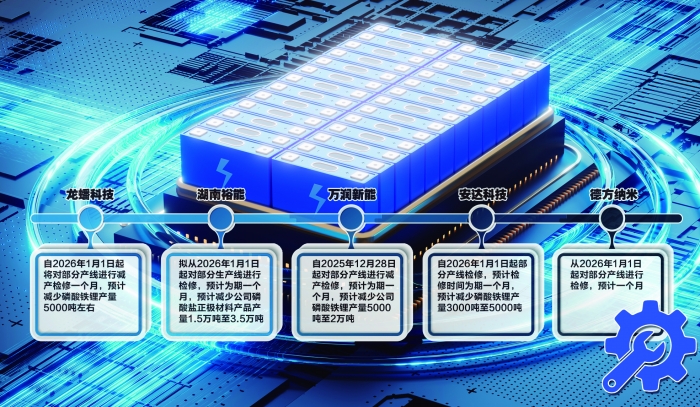
Core Viewpoint - The lithium iron phosphate (LFP) industry is facing significant operational pressure due to rising raw material costs and challenges in passing price increases to downstream battery manufacturers, leading to collective production cuts among major companies in the sector [2][4]. Group 1: Production Cuts - Five major LFP companies, including Wanrun New Energy and Hunan Youneng, announced production cuts scheduled for January 2026, with reductions ranging from 35% to 50% [2][3]. - Long-term contracts ("long orders") provide some market security for LFP companies, but challenges remain in transmitting raw material price increases [2][4]. - The collective production cuts are seen as a necessary measure to support pricing amid unfavorable market conditions [4][5]. Group 2: Market Dynamics - The average market price for LFP in November was 14,704.8 yuan per ton, while production costs ranged from 16,798.2 yuan to 17,216.3 yuan per ton, indicating a widening gap between costs and prices [5]. - Despite high demand and increased operational rates, most LFP companies are still operating at a loss, with only a few exceptions like Hunan Youneng and Fulian Precision [5][6]. - The industry is characterized as being in a "sandwich" position, squeezed by rising raw material costs and resistance from downstream customers to accept price hikes [2][5]. Group 3: Expansion Trends - A new wave of capacity expansion is emerging in the LFP sector, with companies like Ningde Times and Wanhua Chemical investing heavily in new production projects [7][8]. - Ningde Times' subsidiary, Bangpu Recycling, launched a new LFP project with an annual capacity of 450,000 tons, while Wanhua Chemical plans to build a 650,000-ton LFP project in Shandong [7][8]. - The influx of new entrants and expansion by existing players raises concerns about potential oversupply in the market, especially as the industry has not fully recovered from previous losses [7][8].




如何挖掘新材料进口替代机会?100大新材料国产化详解(附100+行研报告)
材料汇· 2025-12-29 16:01
Semiconductor Wafer Manufacturing Materials - The global photoresist market is projected to reach approximately $15 billion by 2030, with the domestic market expected to grow to 30 billion RMB [4] - The current domestic photoresist localization rate is around 10%, with high-end products heavily reliant on imports [4] - Major foreign companies in the photoresist market include Tokyo Ohka Kogyo, Dow Chemical, and Sumitomo Chemical, which dominate the market shares [5] Silicon Wafers - The global semiconductor silicon wafer market is estimated to exceed $20 billion by 2030, with the domestic market projected to reach about 50 billion RMB [10] - The current localization rate for silicon wafers is approximately 15%, with significant progress in small-sized wafers [11] - Key domestic players include Shanghai Silicon Industry and Zhonghuan Semiconductor, with substantial monthly production capacities [12] Electronic Specialty Gases - The global electronic specialty gas market is expected to reach $12 billion by 2030, with the domestic market projected to grow to 35 billion RMB [14] - The localization rate for electronic specialty gases is around 20%, with some conventional gases showing progress in domestic production [13] - Major foreign companies include Air Products, Linde, and Air Liquide, which hold over 70% of the global market share [13] Target Materials - The global target materials market is projected to exceed $20 billion by 2030, with the domestic market expected to reach 40 billion RMB [15] - The current localization rate for target materials is about 30%, with high-end products still dependent on imports [16] - Leading foreign companies include JX Nippon Mining & Metals and Honeywell, which dominate the market [16] Chemical Mechanical Polishing (CMP) Materials - The global CMP materials market is expected to grow to $4 billion by 2030, with the domestic market projected to reach 7 billion RMB [21] - The current localization rate for CMP materials is around 15%, with domestic companies making strides in the mid-to-low-end market [22] - Major foreign suppliers include Cabot and Hitachi, which hold significant market shares [23] Wet Electronic Chemicals - The global wet electronic chemicals market is projected to reach $9 billion by 2030, with the domestic market expected to grow to 20 billion RMB [24] - The localization rate for wet electronic chemicals is approximately 35%, with better progress in mid-to-low-end products [24] - Key foreign players include BASF and Merck, which dominate the market [24] Photomasks - The global photomask market is expected to exceed $7 billion by 2030, with the domestic market projected to grow to over 12 billion RMB [28] - The current localization rate for photomasks is around 20%, with high-end products still heavily reliant on imports [27] - Major foreign companies include Toppan and Photronics, which hold a significant market share [27] Gallium Nitride (GaN) Materials - The global GaN materials market is projected to reach $5 billion by 2030, with the domestic market expected to grow to 8 billion RMB [30] - The current localization rate for GaN materials is about 30%, with progress in power device applications [30] - Leading foreign companies include Cree and Sumitomo Electric, which dominate the market [30] Silicon Carbide (SiC) Materials - The global SiC materials market is expected to reach $3.5 billion by 2030, with the domestic market projected to grow to 6 billion RMB [31] - The current localization rate for SiC materials is around 25%, with high-end products still dependent on imports [31] - Key foreign players include Cree and II-VI, which hold significant market shares [31] Semiconductor ALD/CVD Precursors - The global ALD/CVD precursors market is projected to exceed $3 billion by 2030, with the domestic market expected to reach 6 billion RMB [32] - The current localization rate for ALD/CVD precursors is about 10%, with high-end products dominated by foreign companies [32] - Major foreign companies include SK Materials and Merck, which hold a significant market share [32]
供给优化-气势升腾-基础化工2026年度投资策略
2025-12-29 15:50
Summary of Key Points from the Conference Call on the Chemical Industry Investment Strategy for 2026 Industry Overview - The chemical industry is undergoing significant changes on the supply side, with European capacity being reduced due to cost pressures and domestic fixed asset investment growth slowing down, which may lead to improved profits in certain sub-industries [1][2] - The China Chemical Price Index (CCPI) and the gross profit margin of the Yangtze Chemical Sector are at historically low levels, indicating a cyclical fluctuation in the industry, with a potential upward cycle on the horizon [1][4] Core Insights and Arguments - The investment strategy for the chemical industry in 2026 can be summarized as "supply optimization, rising momentum," following three years of downturn from 2023 to 2025 [2] - The International Monetary Fund (IMF) predicts a global GDP growth rate of approximately 3.09% for 2026, with China's growth at 4.2%, suggesting resilient external demand [5] - Emerging fields such as new energy, energy storage, and AI infrastructure are positively impacting the demand for chemical products, with significant growth in new energy vehicle production and global energy storage installations [6] Performance of Domestic and Overseas Companies - Domestic chemical leaders experienced a year-on-year decline in performance in the first half of 2025, but overseas companies faced a faster decline, with Europe shutting down 11 million tons of capacity across 21 major production bases [7] - China's market share in the chemical sector increased from less than 10% in 2020 to 43% in 2023 due to the closure of European capacities [7] Policy Impacts - The domestic anti-involution policy is positively influencing the governance of disorderly competition and promoting the exit of outdated capacities, which is expected to enhance industry profitability [8] - Energy consumption dual control and environmental policies are likely to become key drivers for supply optimization, aiming to reduce excess capacity through stricter project approvals and enhanced regulation [9] Sub-Industry Focus - Notable sub-industries include the silicon-based industry chain, polyester industry chain, spandex, soda ash, chlor-alkali, high-demand refrigerants, chromium salts, and phosphate rock industry chain, as well as new materials related to tires and new energy [3][10] - The organic silicon industry is expected to recover from a low point due to limited new supply and collaborative production cuts among companies [11] - The polyester industry chain is nearing the end of its expansion cycle, with downstream demand remaining strong, and leading companies are negotiating to improve profitability [12] Challenges and Opportunities - The soda ash market faces challenges due to its significant exposure to the real estate sector, but long-term demand from photovoltaic glass is expected to rise [15] - The chlor-alkali industry shows stable demand for caustic soda, while PVC demand is fluctuating, with no new PVC capacity expected in 2026 [16] Noteworthy Companies and Investment Opportunities - High-quality companies in the chemical sector include Wanhua (MDI leader), Hualu (coal chemical leader), Longbai (titanium concentrate and titanium dioxide leader), and Huafeng (spandex) [19] - New material companies such as Guocera Songjing (related to solid-state batteries) and Dongcai Shengquan (high-frequency resin) are also highlighted for their growth potential [20][21]


党建赋能聚合力 埋头实干促发展 不断开创北海经济开发区高质量发展新局面
Xin Lang Cai Jing· 2025-12-29 15:11
Group 1 - The core viewpoint of the article emphasizes the high-quality development achieved by the Beihai Economic Development Zone through a systematic approach to governance and party leadership, resulting in significant economic indicators leading the city [1][13] Group 2 - Political construction is prioritized, with 29 learning sessions on Xi Jinping's thought and multiple meetings to strengthen ideological foundations and party discipline [2] - Organizational development is enhanced by establishing community and industry-specific party organizations, achieving comprehensive coverage of the organizational system [3] - Efforts to reduce bureaucratic burdens have led to a decrease in the number of documents and meetings, allowing party members to focus on implementation [3] Group 3 - A new investment attraction mechanism integrates party leadership into the entire investment process, resulting in numerous signed projects, including several exceeding 1 billion yuan [4] - Project construction is accelerated with a new operational framework, achieving significant progress on key projects ahead of schedule [4] Group 4 - The industrial economy is supported through a service matrix that promotes high-end aluminum and green chemical industries, with several companies recognized for innovation [5] - Initiatives to optimize the business environment include regular communication with entrepreneurs and targeted support for enterprise development [6] Group 5 - The workforce is being revitalized through training programs and a merit-based promotion system, enhancing strategic thinking and practical skills among staff [7] - Safety measures have been strengthened, resulting in a significant decrease in criminal and administrative cases, contributing to a stable political environment [7] Group 6 - The integration of party leadership with industrial chains is fostering upgrades in high-end aluminum and green chemical sectors, enhancing competitiveness and resilience [8] - The marine economy is being developed with significant production increases in shrimp farming and the initiation of eco-friendly salt projects [9] Group 7 - The tourism sector is thriving, with a substantial increase in visitor numbers and related industry revenues, positioning Beihai as a popular travel destination [10] Group 8 - Community governance initiatives are enhancing local living conditions and providing essential services, contributing to overall societal well-being [12]